Scottish Scenes from Our Holiday

Whilst we were on holiday this summer in and around Glencoe we visited Castle Stalker again. We first saw it nearly two years ago at the end of an afternoon as the light was fading. So this time we went in the morning and looked at it from both sides. We were staying at Kentallen near Glencoe – Castle Stalker is on the same road, the A828 between Kentallen and Oban and there is a view point behind the View Cafe. Just a short distance along the road there is another viewpoint via an old lane. This takes you down to the shore of Loch Linnhe:

Castle Stalker 1and here it is in close-up:

Castle Stalker 2When I say we ‘visited’ Castle Stalker it’s not strictly accurate as although it is open to visitors that’s only for five days a year  – and not during the time we were there.

From Castle Stalker we drove on to Oban, which as it was the holiday season was packed. But we walked up the hillside above Oban to McCaig’s Tower overlooking the town and it was much quieter there. It’s not actually a tower but a Roman style Colosseum built over a five year period from 1895 until his death in 1902 by John Stuart McCaig. It was unfinished at the time of his death. He intended it to have a roof and a central tower.

McCaig's Tower from below P1000051

Inside the tower is a garden with spectacular views over the town, the harbour and out to  the islands of KerreraLismore and Mull.

McCaig's Tower P1000034


Oban from McCaig's Tower P1000042

I have more photos to show another day of Glen Etive, a beautiful glen in the Central Highlands.

 Saturday Snapshot is a weekly event hosted by West Metro Mommy Reads.

Put On By Cunning by Ruth Rendell

Put On By Cunning, aka in America as Death Notes is another book off my to-be-read shelves, an enjoyable read. It was first published in 1981.

The epigraph indicates just what is to follow:

So shall you hear
Of deaths put on by cunning and forc’d cause;
Fall’n on th’inventors’ heads all this can I
Truly deliver.

Hamlet

It is a tale of great complexity, a tale of murder and conspiracy to murder. A wealthy old man, Sir Manuel Camargue, one of greatest flautists of his time is found dead. Ankle deep in snow he had lost his footing in the dark and slipped into an icy lake and became trapped. His heiress, his daughter Natalie, had only recently been reunited with him after an absence of nineteen years. Although it seems a straight forward death, Camargue’s much younger fiancée puts doubts in Chief Inspector Wexford’s mind when she tells him that Camargue had said that the woman who presented herself as Natalie was an imposter.

As is Wexford’s way he becomes obsessed with finding the truth and wonders if Camargue’s death was actually murder, despite the Chief Constable’s insistence that he forgets about it as the evidence all points to his death being an accident. Indeed, the verdict of the inquest is ‘Misadventure’. Wexford, however, is persistent in his doubts and convinced Natalie is an imposter, he is determined to investigate, which leads him to both California and France.

There is much I enjoyed in this, the eleventh Wexford book. It begins well, Ruth Rendell sets an excellent scene, and I could easily visualise the locations and characters, with beautiful descriptive passages. Inevitably, as both Wexford and Inspector Burden, begin to unravel the mystery more and more characters are implicated, until it really does seem a complex case becoming even more complicated, with too many coincidences and characters.

I thought that Wexford was keeping far too much to himself – leaving both Burden and me too much in the dark. The ending came as somewhat of an anti-climax as Wexford explained what had really happened and revealed all the false leads. Still, it kept me guessing to the end and I wondered (as I often do) just what clues I had missed along the way.

And now I’m wondering if I could attempt a ‘Ruth Rendell/Barbara Vine Reading Challenge’, along the lines of the ‘Agatha  Christie Reading Challenge’, ie to read all her books. I’ve read several already.

Library Loot

I’ve picked up several books from the library recently (both from the mobile library van and from my local branch library) and here is a selection that I’m looking forward to reading.

Lib bks Aug 14 From top to bottom they are:

  • Under the Wide and Starry Sky by Nancy Horan. I’ve had this book on my wishlist since I read about it on Barbara’s blog, Views from the Countryside, so I was really pleased to see this on the library shelves. It’s a novel about Robert Louis Stevenson (who liked to be called Louis) and his American wife Fanny. Barbara thought it was wonderful and recommended it highly.
  • The Tell-Tale Heart by Jill Dawson. I chose this book because I think I’ve seen it mentioned on a few book blogs – and it has the same title as the Edgar Allen Poe story. It’s a novel about a heart transplant and I thought it would be interesting to compare it to Hazel McHaffie’s book, Over My Dead Body, also a novel about organ transplants, which I read last October.
  • We Are All Completely Beside Ourselves by Karen Joy Fowler (a new-to-me author) – this book and the one below are both on the Longlist for the Man Booker Prize this year. Rosemary had a sister and a brother, but now she’s an only child. They’ve vanished from her life and she doesn’t know why.
  • The Blazing World by Siri Hustvedt – when I saw this was on the Longlist I immediately wanted to read it because I’ve read other books by her and loved them. This one is about an artist whose work had been ignored and is described as an ‘intricately conceived diabolical puzzle’.
  • Entry Island by Peter May. I’ve borrowed this book because I loved May’s Lewis Trilogy and I want to try some of his other books. This is a standalone crime novel about the murder of a wealthy man on an island in the Gulf of St Lawrence. Detective Sime Mackenzie is sent from Montreal to investigate the murder but what had initially seemed an open-and-shut case takes on a disturbing dimension when he meets the prime suspect, the victim’s wife, and is convinced that he knows her – even though they have never met.

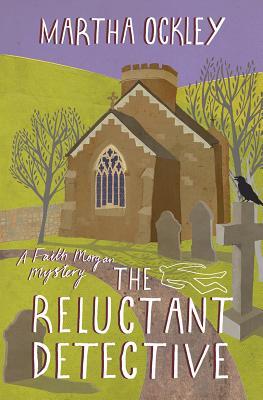
The Reluctant Detective by Martha Ockley

17742272I had little idea what to expect from Martha Ockley’s first Faith Morgan mysteryThe Reluctant Detective as I hadn’t come across the author before and all I had to go on was the description on LibraryThing’s Early Reviewers page last month:

‘Former cop Faith Morgan may have quit the world of crime, but crime has not let her go. Now a priest in the Church of England, she is assigned to the improbably named village of Little Worthy, and within an hour of her arrival she witnesses the sudden, shocking death of a fellow priest. To her distress, the detective assigned to the case is Ben, her former partner and former boyfriend.

As she meets her parishioners she learns some surprising details about her apparently well-loved predecessor, and starts to suspect a motive for his death. The cop may have donned a clerical collar, but the questions keep coming. How will she reconcile her present calling with her past instincts? Is she in danger herself? What should she do about Ben?’

I thought a detective who  was a priest and who used to be a policewoman sounded interesting. So, I am very pleased that The Reluctant Detective turned out to be a good read. Faith Morgan is a well-rounded character; she’s very likeable, observant, compassionate and the sort of person that people feel comfortable talking to – a bit like a young Miss Marple. Indeed, the book has an Agatha Christie feel to it – set in an apparently idyllic country village, with interesting and somewhat quirky characters and although there is one rather gruesome death, it’s not a gory thriller. In short it’s the type of murder mystery that I like, with plenty of complications that kept me guessing about the identity of the murderer for most of the book.

The church and village location are convincing. The parish church of St John is an old building dating from Saxon times, with a tower and church bells, set in the English countryside:

Faith avoided the main approach and followed a gravel path around the back of the church. A creamy cloud of ivory clematis cascaded over a grey stone wall. Beyond a solitary pony raised its chestnut head to gaze mournfully at her from a field of weeds. Some way off squatted a group of ramshackle farm buildings. (page 9)

Faith’s ex – Detective Inspector Ben Shorter, reluctantly allows Faith to contribute to the search for the murderer and the chemistry between the two of them is clearly evident even though he can’t understand why she left the police force for the church. Indeed, Faith herself wonders if she has done the right thing, cutting herself off from her old life and her old self as she realises that she likes investigating, and analyzing people, their expressions and body language and working out what makes them tick. But these are assets for a priest as well as for a police officer. And as for death:

It struck Faith how death is always startling, facing us with the greatest mystery: how the particular and the individual can vanish from this world so completely in a moment. (page 17)

The back cover reveals that Martha Ockley lives in the North East of England and has close links with the church, having grown up as the daughter of a minister. She is a full-time writer of both fiction and non-fiction. I was curious about Martha Ockley and wondered why she had given ‘special thanks to Rebecca Jenkins’ on the title page, so I searched online and discovered that ‘Martha Ockley’ is actually a pseudonym of Rebecca Jenkins, the daughter of the Rev David Jenkins, formerly the Bishop of Durham.

Thanks to LibraryThing and Lion Fiction/Kregel Publications for providing a copy for review. Based on my reading of The Reluctant Detective I shall certainly seek out more books by Martha Ockley/Rebecca Jenkins. There are two more Faith Morgan books:

  • The Advent of Murder
  • A Saintly Killing (to be published in October 2014)

And writing as Rebecca Jenkins:

The R F Jarrett books (the Regency Detective)

  • The Duke’s Agent (1997)
  • Death of a Radical (2010)

also Non Fiction:

  • Free to Believe (David Jenkins and Rebecca Jenkins (1991)
  • Fanny Kemble: a reluctant celebrity (2005)
  • The First London Olympics 1908 (2008)

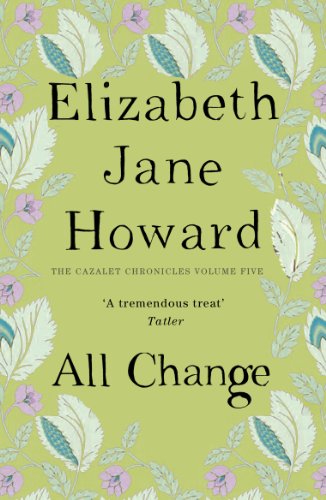
All Change by Elizabeth Jane Howard

I finished reading All Change, Elizabeth Jane Howard’s fifth book in her Cazalet Chronicles last night. I’d read the first four books years ago and loved them, so I was keen to read this last one. And it is the final volume of the Chronicles as Elizabeth Jane Howard died in January this year following the publication of All Change.

I’m not going to write very much about it because I read it straight through without marking any passages, or making any notes. I read for the pure pleasure of reading it, just as I had read the first four books, losing myself in the story of the Cazalet family. And it is a very large family by the time of this novel – 1956 – 1958. Some of the family are a bit blurry – the small children are a bit indistinguishable from each other, apart from Georgie, who loves animals and Laura who’s old before her time, both idiosyncratic little characters, and I did keep forgetting which children belonged to which parent and had to keep checking the family tree at the beginning of the book. But that is just a minor point.

It’s a lovely warm, old fashioned family saga, with both happy and sad events as the Cazalets move forward, and not successfully for all of them, in post-war England. It was a great treat! It’s made me want to re-read the early books and to read Slipstream, Elizabeth Jane Howard’s memoir.

I agree with Hilary Mantel’s quotation on the back cover:

Elizabeth Jane Howard is one of those novelists who shows, through her work, what the novel is for . . . She helps us to do the necessary thing – open our eyes and our hearts

The Cazalet Chronicles

1. The Light Years (1988)
2. Marking Time (1991)
3. Confusion (1993)
4. Casting Off (1995)
5. All Change (2013)

The Shadows in the Street by Susan Hill

The Shadows in the Streets is Susan Hill’s fifth Simon Serrailler crime novel. I’ve read the earlier books which I enjoyed, although I found the fourth book, The Vows of Silence rather a gloomy book not just because of the murders but also because of the unhappy state of Simon and his family. So, I decided to wait a while before moving on to the fifth book. And I am now way behind in reading the series, which will reach book 8 in October!

Susan Hill’s Serrailler novels, whilst being crime fiction, concern moral and social issues. They also follow the lives of the Serrailler family, the main characters being Simon and his sister, Dr Cat Deerbon, which is why I think it’s best to read them in order. I noticed that in this book there are references to events and characters in the earlier books and I had to look back to refresh my memory. Without knowing what happened before those incidents would not have made much sense. The books are character-driven, concentrating on the people involved in the crime rather than the police investigations, although that of course is also part of the story.

There are two major themes in this book. One concerns the murders of local prostitutes, found strangled and Susan Hill draws a sympathetic, but never a condescending or judgemental view of these women’s lives, resulting in a moving storyline of a young woman, Abi who is a single mother. Alongside this is the problem of mental illness, with Ruth Webber, who suffers from manic depression. She is the wife of the new Dean of the Cathedral and arrives full of plans to change things, which causes problems. When she too goes missing there are fears she may become one of the murder victims.

I think of these novels more as psychological studies than crime fiction – the characters and their lives predominate, whilst the police make slow progress in finding the murderer (much like real life, maybe). Anyway it’s the characters and their problems that interested me more in this book than the police procedures.

The Shadows in the Street is a complex book, but it is immensely readable and once the mystery really got under way it’s tense and full of suspense. I really enjoyed it.