WWW Wednesday: 24 October 2018

IMG_1384-0

WWW Wednesday is run by Taking on a World of Words.

The Three Ws are:

What are you currently reading?
What did you recently finish reading?
What do you think you’ll read next?

I’m currently reading: three books, one historical fiction in hardback, one crime fiction on my Kindle and one non-fiction that I’ve borrowed from the library.

Tombland by C J Sansom, the 7th book in his Shardlake series, set in 1549 two years after the death of Henry VIII.
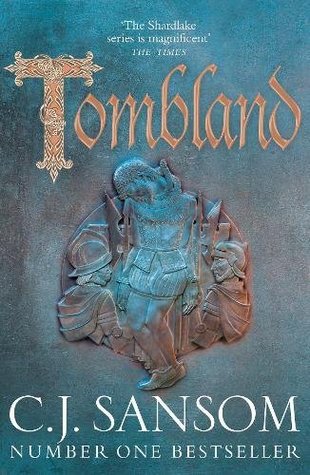
Tombland (Matthew Shardlake, #7)

I’m just settling into this book – Edward VI, is eleven years old and his uncle Edward Seymour, Lord Hertford, rules England as Protector. Matthew Shardlake, a lawyer in the employ of Lady Elizabeth, the old King’s younger daughter, is once more called on to investigate a murder, that of Elizabeth’s distant relative, Edith Boleyn. 1549 is the year of Kett’s Rebellion, which began when a group of rebels destroyed fences that wealthy landowners had erected to enclose their land.

I’m also reading The Darkest Place by Jo Spain, the Kindle edition was published on 20 September 2018. It’s the fourth Inspector Tom Holland mystery. I’ve read nearly 70% and am really enjoying it.

The Darkest Place (Inspector Tom Reynolds, #4)

Synopsis:

Christmas day, and DCI Tom Reynolds receives an alarming call. A mass grave has been discovered on Oileán na Caillte, the island which housed the controversial psychiatric institution St. Christina’s. The hospital has been closed for decades and onsite graves were tragically common. Reynolds thinks his adversarial boss is handing him a cold case to sideline him.

But then it transpires another body has been discovered amongst the dead – one of the doctors who went missing from the hospital in mysterious circumstances forty years ago. He appears to have been brutally murdered.

As events take a sudden turn, nothing can prepare Reynolds and his team for what they are about to discover once they arrive on the island . . .

And I’ve also started to read Jacob’s Room is Full of Books, by Susan Hill in which she writes about the books she has read, reread or returned to the shelf during one year.

Jacob's Room is Full of Books: A Year of Reading

It’s a mix of reflections on the books, on writing and of observations about a variety of topics, month by month.

I’ve recently finished:  
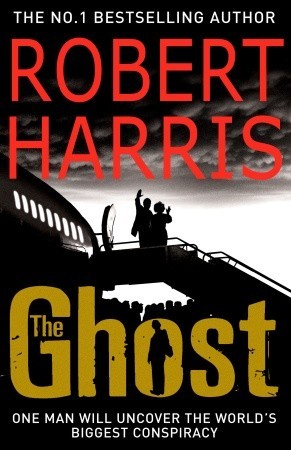
The Ghost

The Ghost by Robert Harris. I quoted the opening paragraph and synopsis in this post. It’s a political thriller with an anonymous narrator who is the ‘ghost’ or rather a ghostwriter employed to write the autobiography of Adam Peter Benet Lang, recently retired prime minister of Great Britain. I’m writing my review and will post it in the next few days.

My next book could be:

I am torn, as usual, wanting to read several books at once. I so want to start Daisy in Chains by Sharon Bolton – I wrote a bit about this book in this post.  It’s crime fiction about a convicted murderer, Hamish Wolfe who tries to convince, defence barrister Maggie Rose that he is innocent.

Daisy in Chains

But there are many more books also crying out to be read, so when the time comes to start another book, it could be something completely different.

Have you read any of these books?  Do any of them tempt you? 

A-Z of TBRs: E-Books: D, E and F

Earlier this year I looked through my TBRs – the ‘real’ books – and as it prompted me to read more of them, I’ve decided to take a fresh look at some of the TBRs on my Kindle. I have a bad habit of downloading books and then forgetting all about them – it’s as though they’ve gone into a black hole.

This is the second instalment of my A – Z of my e-book TBRs – with a little ‘taster’ from each. These are all fiction.

Daisy in Chains

D is for Daisy in Chains by Sharon Bolton (on my Kindle since November 2014.)  I can’t quite believe I haven’t read this book as Sharon Bolton is one of my favourite authors, but there it is – I can see I started it as I’m on page 22. It’s about a convicted murderer, Hamish Wolfe who tries to convince, defence barrister Maggie Rose that he is innocent.

The Times Online, Monday, 8 September 2014

CONTROVERSY IN COURT AS WOLFE TRIAL OPENS

Accused surgeon, Hamish Wolfe, refused to enter a plea on the first day of his trial at the Old Bailey today. In accordance with English law, he will now be tried as if he had pleaded not guilty.

Dressed in a dark grey suit, white shirt and blue tie, Wolfe appeared to be paying close attention to proceedings, but when asked to speak he remained silent, in spite of the judge, Mr Justice Peters, on three occasions, advising him that it was not in his interests to do so. (page 13)

There are letters, emails, and court transcripts as well as newspaper reports and the story is told from multiple viewpoints, told mainly as far as I can see from the little I’ve read, in the present tense, as in the following extract where Sandra, Hamish’s mother is talking to Maggie as she drives her home from the beach:

I came here today to talk to you,’ she says. I didn’t want to come to your house, I didn’t want to intrude, so I thought I’d wait for you at the beach. And then Daisy ran off just before you arrived. It all nearly went so horribly wrong.’

… ‘I drove over this morning,’ Sandra says before she’s even changed gear. ‘And yesterday morning too. I watched your car pull out of your drive. I guessed you were coming here. And that you come at high tide. (page 9)

Exposure

E is for Exposure by Helen Dunmore, on my Kindle since July 2017. It’s set in London in 1960 when the Cold War is at its height, and a spy may be a friend or neighbour, colleague or lover. At the end of a suburban garden, in the pouring rain, a woman buries a briefcase deep in the earth. She believes that she is protecting her family. What she will learn is that no one is immune from betrayal or the devastating consequences of exposure.

Another book written in the present tense, which again might be the reason I stopped reading this book at page 56:

It starts with a whistle of a train, shearing through the cold, thick dust of a November afternoon. Lily Callington hears it as she digs over her vegetable patch at the bottom of her garden in Muswell Hill. For a second she’s startled, because the whistle sounds so close, as if a rain is rushing towards her along the disused railway line at the bottom of the garden. She straightens and listens intently, frowning. the whistle goes through her, touching nerves so deep that Lily doesn’t even know where they are. The children! They aren’t here. She can’t see them, touch them, keep them safe.

Stop it you fool. They are not babies any more. Paul is ten, Sally almost nine. Even Bridget is five. They’re at school. What could be safer than a primary school in Muswell Hill?

(pages 4-5)

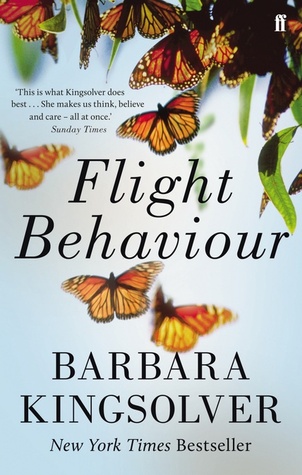
Flight Behaviour

F is for Flight Behaviour by Barbara Kingsolver, on my Kindle since February 2014. On the Appalachian Mountains above her home, a young mother discovers a beautiful and terrible marvel of nature: the monarch butterflies have not migrated south for the winter this year. Is this a miraculous message from God, or a spectacular sign of climate change? Entomology expert, Ovid Byron, certainly believes it is the latter. He ropes in Dellarobia to help him decode the mystery of the monarch butterflies.

Dellarobia is a restless farm wife who gave up her own plans when she accidentally became pregnant at seventeen. Now, after a decade of domestic disharmony on a failing farm, she has settled for permanent disappointment but seeks momentary escape through an obsessive flirtation with a younger man. As she hikes up a mountain road behind her house to a secret tryst, she encounters a shocking sight: a silent, forested valley filled with what looks like a lake of fire.

The flame now appeared to lift from the individual treetops in showers of orange sparks, exploding the way a pine log does in a camp fire when it’s poked. The sparks spiralled upwards in swirls like funnel clouds. Twisters of brightness against gray sky. In broad daylight with no comprehension she watched. From the tops of the funnels the sparks lifted high and sailed out undirected above the dark forest.

A forest fire, if that’s what it was, would roar. This consternation swept the mountain in perfect silence. The air remained cold and clear. No smoke, no crackling howl. she stopped breathing for a second and closed her eyes to listen, but heard nothing. Only a faint patter like rain on leaves. (page 19)

If you’ve read any of these please let me know what you think?

Timekeepers: How the World Became Obsessed with Time by Simon Garfield

Timekeepers: How the World Became Obsessed With Time

3*

Synopsis:

Time flies like an arrow, but fruit flies like a banana. The Beatles learn to be brilliant in an hour and a half. An Englishman arrives back from Calcutta but refuses to adjust his watch. Beethoven has his symphonic wishes ignored. A US Senator begins a speech that will last for 25 hours. The horrors of war are frozen at the click of a camera. A woman designs a ten-hour clock and reinvents the calendar. Roger Bannister lives out the same four minutes over a lifetime. And a prince attempts to stop time in its tracks.

Timekeepers is a book about our obsession with time and our desire to measure it, control it, sell it, film it, perform it, immortalise it and make it meaningful. It has two simple intentions: to tell some illuminating stories, and to ask whether we have all gone completely nuts.

My thoughts:

Timekeepers fulfils Simon Garfield’s intentions – to tell some illuminating stories, and to ask whether we have all gone completely nuts. It covers a wide variety of topics, all in one way or another about time – how it’s been recorded, the development of the calendar, the standardisation of time to aid with railway timetables, and aspects of time management, for example.

The chapters vary in length and some are more interesting than others. The one that interested me most was Movie Time, with an account of how the silent film, Safety Last! was made in 1923.

File:Safetylast-1.jpg
Harold Lloyd dangling from the clock in Safety Last! (1923)

Harold Lloyd climbs the outside of a department store, obstacles falling on him as he does so, until he reaches the giant clock at the top, grabs hold of it, and dangles above the street below. Garfield recalls that for the first audiences time just froze, some went into hysterics and others fainted. Garfield’s focus is on the concept of time that the movies portrayed and goes on to explain how films were originally produced and shown when the timing depended on the cranking skills of the cameraman during filming and the projectionist during showing.

I was also interested in the chapter on performances of Beethoven’s Ninth Symphony, a long and complex piece of music involving a large orchestra, solo singers and a chorus, where Garfield’s focus is on the tempo of the music and the differences made by different composers’ interpretations; and also in the chapter on Nic Ut’s photograph of children fleeing after a napalm bomb had been dropped on a village in Trảng Bàng, Vietnam. Garfield’s focus here is on the fraction of a second when the photograph was captured that brought the story home to its viewers.

Several other chapters also interested me but I wasn’t taken with those on the technicalities of time measurement, time management,or the production of clocks and watches, that Garfield describes in great detail. The book jumps about from topic to topic with, as far as I can make out, no chronological order. But it is full of facts, and going off the Further Reading and Acknowledgement section it is well researched. A book to dip into rather than read straight through.

  • Format: Kindle Edition
  • File Size: 4503 KB
  • Print Length: 369 pages
  • Publisher: Canongate Books; Main edition (29 Sept. 2016)
  • Source: Canongate Books via NetGalley
  • My Rating: 3 stars

Thanks to Canongate Books and NetGalley for my copy of this book for review.

WWW Wednesday: 17 October 2018

IMG_1384-0

WWW Wednesday is run by Taking on a World of Words.

The Three Ws are:

What are you currently reading?
What did you recently finish reading?
What do you think you’ll read next?

I’m currently reading:

The GhostTimekeepers: How the World Became Obsessed With Time

The Ghost by Robert Harris. I quoted the opening paragraph and synopsis in yesterday’s post. It’s a political thriller with an anonymous narrator who is the ‘ghost’ or rather a ghostwriter employed to write the autobiography of Adam Peter Benet Lang, recently retired prime minister of Great Britain. And he has a month to do it, or rather complete the manuscript started by his predecessor McAra, Lang’s assistant who was found dead, drowned, after falling overboard on the ferry to Martha’s Vineyard.

The film, The Ghost (in the UK)/ The Ghost Writer (in the US) is an adaptation of this book, with Ewan McGregor playing the part of the unnamed ghostwriter.

I’m also reading Timekeepers by Simon Garfield, a book of short essays on different aspects of time. It’s full of facts, but still easy reading written in an entertaining style. But so far I’m finding it ‘interesting’ rather than ‘fascinating’.

I’ve recently finished:  

Now We Shall Be Entirely Free

Now We Shall Be Entirely Free by andrew Miller. See this post for my review – historical fiction set in 1809 Captain John Lacroix, home from Britain’s disastrous campaign against Napoleon’s forces in Spain.

My next book could be:

Tombland (Matthew Shardlake, #7)

Although I have several books in mind to read next, it will most probably be Tombland by C J Sansom, which is to be published tomorrow. It’s the 7th book in his Shardlake series.

Synopsis:

Spring, 1549.

Two years after the death of Henry VIII, England is sliding into chaos…

The nominal king, Edward VI, is eleven years old. His uncle Edward Seymour, Lord Hertford, rules as Protector, presiding over a collapsing economy, a draining, prolonged war with Scotland and growing discontent amongst the populace as the old religion is systematically wiped out by radical Protestants.

Matthew Shardlake, meanwhile, is a lawyer in the employ of Lady Elizabeth, the old King’s younger daughter. The gruesome murder of Elizabeth’s distant relative Edith Boleyn soon takes him and his assistant Nicholas Overton to Norwich where he is reunited with Overton’s predecessor Jack Barak. As another murder drags the trio into ever-more dangerous waters, Shardlake finds his loyalties tested as Barak throws in his lot with the exploding peasant rebellion and Overton finds himself prisoner in Norwich castle.

Simultaneously, Shardlake discovers that the murder of Boleyn may have connections reaching into both the heart of the rebel camp and of the Norfolk gentry…

Have you read any of these books?  Do any of them tempt you? 
First Chapter First Paragraph: The Ghost by Robert Harris

Every Tuesday First Chapter, First Paragraph/Intros is hosted by Vicky of I’d Rather Be at the Beach sharing the first paragraph or two of a book she’s reading or plans to read soon.

I’m currently reading The Ghost by Robert Harris, about a ghostwriter, not a tale of the supernatural.

The Ghost


The moment I heard how McAra died I should have walked away. I can see that now. I should have said, ‘Rick, I’m sorry, this isn’t for me, I don’t like the sound of it,’ finished my drink and left. But he was such a good storyteller, Rick – I often thought he should have been the writer and I the literary agent – that once he’s started talking there was never any question I wouldn’t listen, and by the time he had finished, I was hooked.

Blurb:

Britain’s former prime minister is holed up in a remote, ocean-front house in America, struggling to finish his memoirs, when his long-term assistant drowns. A professional ghostwriter is sent out to rescue the project – a man more used to working with fading rock stars and minor celebrities than ex-world leaders. The ghost soon discovers that his distinguished new client has secrets in his past that are returning to haunt him – secrets with the power to kill.

What do you think? Would you keep reading?

Now We Shall Be Entirely Free by Andrew Miller

Now We Shall Be Entirely Free

4*

Hodder and Stoughton|23 August 2018|432 pages|Review copy

The opening chapters of Now Well Shall Be Entirely Free drew me in immediately as I read about Captain John Lacroix’s return to England from Spain in 1809, close to death after the battle of Corunna, during the Peninsular War. Miller’s descriptive writing, lyrical and poetic, vividly sets the scene as Lacroix is nursed back to health by Nell, his servant. But it is clear that he is on the edge of a breakdown, mentally and emotionally, saying little about the battle and indeed, unable to face the memories of the horrors he experienced. When another officer arrives ordering him to report back to duty, he decides instead to leave for the Highlands to recuperate.

This is followed by an account of the investigation of the atrocities carried out  in the village of Los Morales during the army’s retreat to Corunna.  The village was burned down, men were lynched and women raped. Two men, a vicious Englishman, Corporal Calley is ordered to track down and kill the officer responsible and a Spaniard, Lieutenant Medina, a liaison officer with the British army, is assigned to accompany him and report back that the execution has been carried out. It is soon obvious that the officer is Captain John Lacroix and so the hunt is on, as Calley and Medina follow his trail from Somerset to Bristol and Glasgow and then on to the Hebrides, leaving a trail of violence and death behind them.

The pace is brisk, until Lacroix reaches the isles, where he meets the Frend family, a brother and sisters, living as part of an isolated community. Jane is pregnant and Emily is slowly losing her sight. At this point in the novel the pace dropped partly because of the vagueness in describing the location of the island (somewhere in the Outer Hebrides beyond Mingulay) and Lacroix’s own mental and physical slowing down on the island – after being attacked and robbed in Glasgow, he began taking opium to relieve his pain. My attention began to wander until he and Emily returned to Glasgow for an operation to improve her eyesight. The pace picked up and I was fascinated by the medical details, with intriguing insights into new discoveries in medical treatment.

But then the ending came all too quickly and left me feeling uncertain about what actually happened – the ambiguity surrounding their ‘freedom’. Freedom is a theme throughout the novel – its definition and how it differs for men and women. The relentless brutality of war, of course is another theme, demonstrated through the inhumanity of Calley’s actions and its effects on Lacroix as he finally reveals what had happened in Spain.

I enjoyed the historical details, the medical techniques as well as the effects of industrialisation, and in particular the conditions in the cotton mills, where Calley laboured as a child. He had worked as a ‘piecer’ mending the cotton threads and cleaning the machines, in danger of losing a limb, deafened by the noise in the hot machine room where the air was thick with little bits of cotton filling up your nose and lungs.

But most of all I enjoyed the writing. Miller’s ability to write in such a lyrical style, to convey emotions and create such complex characters that are so believable that you can empathise, to a limited extent, even with a thug like Calley, make this book remarkable.

Thanks go to Hodder and Stoughton and NetGalley for my copy of this book for review.