I’m glad to see that Cathy of 746 Books and Rebecca of BookishBeck are once again co-hosting Novellas in November as a month-long challenge with four weekly prompts. Each week they will take it in turns to host a “buddy read” of a featured book they hope we will join in reading.
They suggest 150–200 pages as the upper limit for a novella, and post-1980 as a definition of “contemporary.”
1–7 November: Contemporary fiction (Cathy)
Open Water by Caleb Azumah Nelson – including a giveaway of a signed copy!
8–14 November: Short nonfiction (Rebecca)
The Story of My Life by Helen Keller (free to download here from Project Gutenberg. Note: only the first 85 pages constitute her memoir; the rest is letters and supplementary material.)
15–21 November: Literature in translation (Cathy)
Territory of Light by Yuko Tsushima
22–28 November: Short classics (Rebecca)
Ethan Frome by Edith Wharton (free to download here from Project Gutenberg)
~~~
I enjoyed taking part last year so I’m looking forward to this year’s event. I read Ethan Frome in 2014 and loved it, so I think I’ll re-read it. Many years ago (I can’t remember when) I read a biography of Helen Keller, or it may even have been her autobiography, so I’ll have a look at that too. I also have several novellas on my TBR shelves to choose from.
At the beginning of the summer I joined Cathy’s 20 Books of Summer Challenge which ended on September 1st, 2021.
I haven’t been reading as many books as usual this summer and I read 19 books in total. And just 13 of them were the books I’d originally chosen. I’ve reviewed 10 of them – linked to my blog posts:
It’s time again for Six Degrees of Separation, a monthly link-up hosted by Kate atBooks Are My Favourite and Best. Each month a book is chosen as a starting point and linked to six other books to form a chain. A book doesn’t need to be connected to all the other books on the list, only to the one next to it in the chain.
This month the chain begins with Second Place by Rachel Cusk, one of the books longlisted for the Booker Prize 2021. I’ve read a couple of books by Rachel Cusk, Arlington Park which I loved and The Bradshaw Variations, which I enjoyed but not as good, in my opinion, as Arlington Park. So I was interested to see what Second Place was like and have just finished reading it .
Blurb: ‘A woman invites a famed artist to visit the remote coastal region where she lives, in the belief that his vision will penetrate the mystery of her life and landscape. Over the course of one hot summer, his provocative presence provides the frame for a study of female fate and male privilege, of the geometries of human relationships, and of the struggle to live morally between our internal and external worlds. With its examination of the possibility that art can both save and destroy us, Second Place is deeply affirming of the human soul, while grappling with its darkest demons.’
My preliminary comments – this book was inspired by a real set of circumstances. In her Acknowledgement at the end of the book Cusk refers to Mabel Dodge Luhan’s 1932 memoir of the time D H Lawrence stayed with her in Taos, New Mexico. She acknowledges that her version of that event is intended as a tribute to her spirit. I’ll write more about Second Place in a later post.
I didn’t find it easy to come up with a chain from Second Place. I started twice, but each time the chain just fizzled out quite quickly. One began with Mabel Luhan’s memoir, Lorenzo in Taos, which is written loosely in the form of letters to and from D. H. Lawrence, Frieda Lawrence, and Robinson Jeffers, the celebrated poet who had been a guest of Mabel’s in Taos, with references to Dorothy Brett and Spud Johnson among others. The second began with A Town Called Solaceby Mary Lawson, which is also on the longlist for the Booker Prize 2021.
So, I decided to make it very simple!
First link – The Secret River by Kate Grenville – historical fiction following the life of William Thornhill from his childhood in the slums of London to Australia. He was a Thames waterman transported for stealing timber; his wife and child went with him and they made a new life for themselves. It’s about their struggle for survival as William is eventually pardoned and becomes a waterman on the Hawkesbury River and then a settler with his own land and servants.
Second Link – See What I Have Done by Sarah Schmidt – a novel based on true events. On the 4 August 1892 Andrew Borden and his second wife, Abby, were brutally murdered in their home at 92 Second Street in Fall River, Massachusetts and Andrew’s daughter, Lizzie, was charged with the murders. She was tried and was acquitted in June 1893 and speculation about the murders and whether Lizzie was guilty or not continues to the present day.
Third Link – The Serpent Pool by Martin Edwards – a Lake District murder mystery featuring DCI Hannah Scarlet, in charge of the Cumbria’s Cold Case Team, her partner Marc Amos, a rare book dealer and Daniel Kind, a historian and the son of Hannah’s former boss, Ben Kind. It begins with the death of George Saffell, one of Marc’s customers, stabbed and then burnt to death amidst his collection of rare and valuable books.
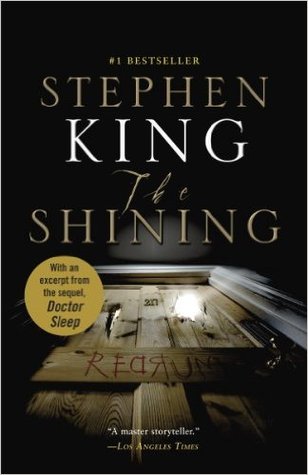
Fourth Link – The Shining by Stephen King – this tells the story of Jack Torrance and his family as they move into the Overlook Hotel in the Colorada Rockies. The Overlook is closed for the winter and Jack, a recovering alcoholic is the caretaker. Just what impels him towards murder is horrifyingly revealed as the winter weather closes in on the hotel and they are cut off from the rest of the world.
Fifth Link – Sleeping Murder by Agatha Christie is Miss Marple’s last case, published posthumously in 1976, although Agatha Christie had written it during the Second World War. Miss Marple investigates a murder that had happened 18 years ago.
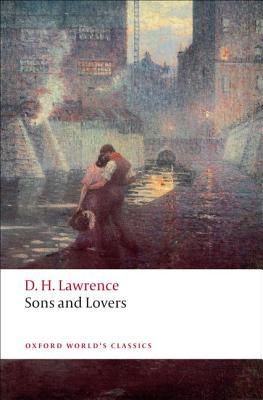
Sixth Link – Sons and Lovers by D H Lawrence – a powerful, emotional novel depicting the struggle, strife, and passion of relationships and their intensity, and possessiveness. Throughout the book Lawrence’s vivid descriptions and observation of the English countryside are so beautiful that I couldn’t stop marvelling at his writing.
My chain is made up of books all with titles beginning with the letter ‘S’. The final link, Sons and Lovers makes the chain into a circle as it is also linked to Second Place, which inspired Cusk’s fictionalised version of D H Lawrence’s relationship with Mabel Dodge Luhan – called ‘L’ and ‘M’ in her book.
Next month (October 2, 2021), the chain begins with a (frightening) short story, The Lottery by Shirley Jackson.
Every Friday Book Beginnings on Friday is hosted by Gillion at Rose City Readerwhere you can share the first sentence (or so) of the book you are reading. You can also share from a book you want to highlight just because it caught your fancy.
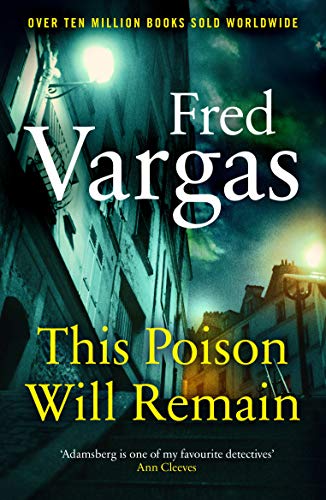
This week’s extracts are from This Poison Will Remain by Fred Vargas. This is the 9th in the Commissaire Adamsberg series. When three elderly men are poisoned by spider venom, everyone assumes that the deaths are tragic accidents. But at police headquarters in Paris, Inspector Adamsberg begins to suspect that the case is far more complex than first appears.
Jean-Baptiste Adamsberg, sitting on a rock at the quayside, watched the Grimsey fishermen return with their daily catch, as they moored their boats and hauled up their nests. Here, on this tiny island off the coast of Iceland, people called him simply ‘Berg’.
Also every Friday there is The Friday 56, hosted by Freda at Freda’s Voice. *Grab a book, any book. *Turn to Page 56 or 56% on your ereader . If you have to improvise, that is okay. *Find a snippet, short and sweet, but no spoilers!
These are the rules:
Grab a book, any book.
Turn to page 56, or 56% on your eReader. If you have to improvise, that is okay.
Find any sentence (or a few, just don’t spoil it) that grabs you.
Post it.
Add the URL to your post in the link on Freda’s most recent Friday 56 post.
Page 56:
And that very day, a local newspaper reported that a woman, Jeanne Beaujeu, who had just returned from three weeks’ holiday and heard about the deaths, had gone to hospital in Nimes, asking to have her own wound, now healing, to be examined. She stated that she had been bitten by a spider on 8 May, but since the bite had not spread beyond a slight irritation, she had merely taken the medicine prescribed by her doctor. She was forty-five.
Adamsberg stood up and went to gaze at the lime tree outside his window. So it wasn’t just old people.
I’ve read 5 of Fred Vargas’ books. They’re quirky and original and I like Adamsberg, an expert at untangling mysteries, a thinker, who doesn’t like to express his feelings, but mulls things over. I bought this book a couple of years ago and fully intended to read it at that time – but it got buried in my Kindle!
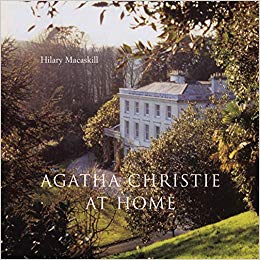
Today I’m looking back at my post on Agatha Christie at Home by Hilary Macaskill, which I first posted on 19 August 2013.
Here’s the first paragraph:
One of the things that struck me when I was reading Agatha Christie’s An Autobiography was her love of houses. It stemmed from her childhood dolls’ house. She enjoyed buying all the things to put in it – not just furniture, but all the household implements such as brushes and dustpans, and food, cutlery and glasses. She also liked playing at moving house, using a cardboard box as a furniture van.
August was a busy month for me and it didn’t leave much time for reading or writing reviews! But I did read 5 books, and as both Framley Parsonage (684 pages) and Dead Tomorrow (663 pages) are very long books, it took me over half of August to read just those two!
Framley Parsonage by Anthony Trollope 4* – see my review
The Queen’s Spy by Clare Marchant 4*
The Madness of Crowds by Douglas Murray 3*
Dead Tomorrow by Peter James 3*
Moon Over Soho by Ben Aaronovitch 4*
The only book I reviewed was Framley Parsonage. So, before I begin September’s books here are just a few brief thoughts on the other 4 books.
The Queen’s Spy by Clare Marchant – historical fiction with a dual timeline set in 1584 and 2021. I read this quickly drawn along by the plot and keen to know the links between the two main characters, Mathilde in the present day and Tom in the 16th century. I was more interested in Tom’s story. He is deaf and dumb, but he can lip read. He is an apothecary and also a spy, working for Sir Francis Walsingham, Elizabeth I’s spymaster, during the period leading up to the Babbington Plot. Mathilde has inherited a medieval mansion, Lutton Hall, and she is surprised to find that she has family there she had never heard of before. The two timelines interlink as Mathilde discovers the secrets hidden at Lutton Hall.
The Madness of Crowds: Gender, Race and Identityby Douglas Murray. Crowd behaviour fascinates me, so I hoped this book would cast some light on the subject – it certainly did. There are sections on sexuality, gender, technology and race, including a chapter on transgender, which I found the most enlightening. The synopsis describes how Murray “reveals the astonishing new culture wars playing out in our workplaces, universities, schools and homes in the names of social justice, identity politics and ‘intersectionality’.” Some of it I found shocking and infuriating.
Dead Tomorrow by Peter James – the 5th book in his Detective Superintendent Roy Grace series. Grace and his team investigate the deaths of three teenagers found by a dredger at the bottom of the English Channel, which leads them to a gang of human traffickers operating from Eastern Europe. Parallel with their investigation a desperate mother is fighting for her daughter’s life. One of the things I like about the Roy Grace series is the continuing story of Grace’s personal life. But what I find irritating is the way Peter James describes what all his characters are wearing and the details of all the little details of their surroundings. And this book in particular is far too long and drawn out.
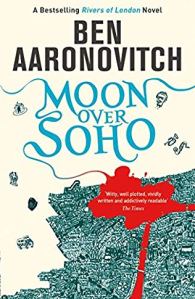
Moon Over Soho by Ben Aaronovitch, the second Rivers of London novel. I loved the first book, Rivers of London. These are fast-paced police procedurals of a very different kind – urban fantasy, set in the real world of London, a mix of reality and the supernatural. You could probably read them as standalones, but I really think it’s best to read them in order to get the full background to what is going on and what has already happened to the main characters.
DC Peter Grant is assigned to work with Detective Chief Inspector Thomas Nightingale (who is the last wizard in England) as part of a special and secret branch of the Met, dealing with all things magical and supernatural. Moon Over Soho begins with the murder of Cyrus Wilkinson, a part-time jazz saxophonist, who had apparently dropped dead of a heart attack just after finishing a gig in a Soho jazz club. Peter can hear music coming from his corpse. What follows is a complicated story full of twists and turns, humour, and some gruesome and unusual murders.







 BooksPlease