Book Beginning: A Sight for Sore Eyes by Ruth Rendell

The library van came round this week and I borrowed another Ruth Rendell book: A Sight for Sore Eyes, first published in 1998. I don’t really check what the book is about when it’s one by Ruth Rendell, as I usually enjoy her books. This one begins:

They were to hold hands and look at one another. Deeply, into each other’s eyes.

‘It’s not a sitting,’ she said, ‘it’s a standing. Why can’t I sit on his knee?’

He laughed. Everything she said amused him or delighted him, everything about her captivated him from her dark-red curly hair to her small white feet. The painter’s instructions were that he should look at her as if in love and she at him as if enthralled. This was easy, this was to act naturally.

This could be the opening to a love story, but this is a Ruth Rendell book and I’m expecting it to be something darker and more mysterious. Indeed, the information on the back cover warns that this is ‘Masterfully spooky. Don’t read this alone.’

For more Book Beginnings see Gilion’s blog Rose City Reader.

The Cupboard by Rose Tremain

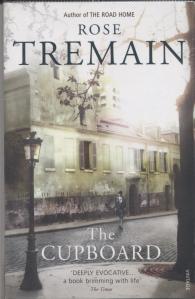
I’ve never read any of Rose Tremain’s books, but when I saw The Cupboard on the library van’s shelves the plainness of the title and the photo on the cover interested me, because they just didn’t seem to match.

The Cupboard 001

I took it off the shelf and read the back cover, where the newspaper critics’ quotations are glowing with praise for Rose Tremain: ‘one of the finest writers in English’ from the Daily Telegraph, ‘Rose Tremain’s fiction is my gold standard’, from The Independent on Sunday’, and ‘Miss Tremain has fashioned the totality of one life – and conveyed the evanescence of all human existence’ from the Sunday Telegraph. So I thought I should have a look inside the book, where I see that Rose Tremain has won many prizes for her books.

But it was the opening paragraph that really caught my attention and is the reason I borrowed the book:

At the age of eighty-seven, Erica March died in a cupboard. She wrapped her body in a chenille tablecloth, laid it out neatly under a few skirts and dresses that still hung on the clothes rail and put it to death very quietly, pill by pill.

Now that makes me want to read on to find out why she did that! Not the accolades or the awards, but the words.

For more Book Beginnings see Gilion’s blog Rose City Reader.

The Steel Bonnets: the opening chapter

A friend has just lent me The Steel Bonnets : the Story of the Anglo-Scottish Border Reivers by George MacDonald Fraser and having looked at the opening chapter I know I just have to read on, rather than waiting for January when Peggy Ann’s Read Scotland 2014 Challenge starts. It’s a long, detailed book so I shall probably still be reading it in January anyway.

The Steel Bonnets 001I live on the English side of the Border with Scotland and the history of the area just fascinates me. The Steel Bonnets covers the period from the building of Hadrian’s Wall to 1603, when James VI of Scotland became James I of England. Four hundred or so years ago it was all very different around here and as the history of the Border Reivers is very complicated I’m hoping this book will guide me through it.

The opening paragraph took me by surprise:

At one moment when President Richard Nixon was taking part in his inauguration ceremony, he appeared flanked by Lyndon Johnson and Billy Graham. To anyone familiar with Border history it was one of those historical coincidences which send a little shudder through the mind: in that moment, thousands of miles and centuries away in time away from the Debateable Land, the threads came together again; the descendants of three notable Anglo-Scottish Border tribes – families who lived and fought within a few miles of each other on the West Marches in Queen Elizabeth’s time – were standing side by side, and it took very little effort of the imagination to replace the custom-made suits with leather jacks or backs-and-breasts. Only a political commentator would be tactless enough to pursue the resemblance to Border reivers beyond the physical, but there the similarity is strong.

In the following paragraphs he goes on to describe their physical features, particularly those of Nixon and Johnson, as ‘excellent specimens of two distinct but common Border types.’ I hadn’t expected this at all.

For more Book Beginnings see Gilion’s blog Rose City Reader.

First Chapter: Shakespeare the Biography by Peter Ackroyd

First chapterEvery Tuesday Diane at Bibliophile by the Sea hosts First Chapter First Paragraph Tuesday Intros, where you can share the first paragraph or (a few) of a book you are reading or thinking about reading soon.

In my last post I mentioned Peter Ackroyd’s biography of William Shakespeare when deciding which book to read next. As soon as I began the first chapter I knew that this is the next non fiction book I’ll be reading.

The first paragraph is:

William Shakespeare is popularly supposed to have been born on 23 April 1564, or St George’s Day. The date may in fact have been 21 April or 22 April, but the coincidence of the national festival is at least appropriate.

But it is the second paragraph that caught my attention, after all Shakespeare’s birthday or supposed birthday was not a surprise to me. The second paragraph, however, gives me information I hadn’t known before:

When he emerged from the womb into the world of time, with the assistance of a midwife, an infant of the sixteenth century was washed and then ‘swaddled’ by being wrapped tightly in soft cloth. Then he was carried downstairs in order to be presented to the father. After this ritual greeting, he was taken back to the birth-chamber, still warm and dark where he was lain beside the mother. She was meant to ‘draw to her all the diseases from the child’, before her infant was put in a cradle. A small portion of butter and honey was usually placed in the baby’s mouth. It was the custom in Warwickshire to give the suckling child hare’s brains reduced to jelly. ( page 3)

Ackroyd is not of course saying that this is what happened when Shakespeare was born, merely that this was the ritual at the time and he refers to David Cressy’s book, Birth, Marriage, and Death: Ritual, Religion, and the Life Cycle in Tudor and Stuart England as the source of his information. But it is fascinating, nonetheless to think of the infant William wrapped in swaddling clothes and sucking hare’s brain jelly! Butter and honey sounds far more delectable. And how different from birth today.
Saturday Snapshots

Last Saturday I posted a photo of the little Japanese Maple still bearing its flame red leaves. We’ve had some high winds this week and this is what it looks like today – what a difference a week makes!

Japanese Maple 23 Nov 2013Just a few leaves are still clinging to its branches:

Japanese Maple 23 Nov 2013 P1090329

The rest are on the ground or have blown away.

Autumn Leaves P1090328

For more Saturday Snapshots see Melinda’s blog West Metro Mommy Reads.

Saturday Snapshots

Autumn in the garden:

Jap Maple Nov 2013 P1090302

The leaves are falling from some of the trees now, but our little Japanese Maple is still bearing its flame-coloured leaves.

Autumn trees Nov 2013 P1090305The Wych Elm leaves are a glorious golden colour.

Autumn leaves Nov 2013 P1090313And in our little wood the ground is now a carpet of rustling brown leaves.

D up ladder P1090314

Finally, here’s D up a ladder doing repairs to the roof – I had to watch because falling leaves are one thing …

For more Saturday Snapshots see Melinda’s blog West Metro Mommy Writes.