The Grapes of Wrath by John Steinbeck

‘… in the eyes of the hungry there is a growing wrath. In the souls of the people the grapes of wrath are filling and growing heavy, growing heavy for the vintage.’

The Grapes of Wrath

Shocking and controversial when it was first published in 1939, Steinbeck’s Pulitzer Prize-winning epic remains his undisputed masterpiece.

Set against the background of dust bowl Oklahoma and Californian migrant life, it tells of the Joad family, who, like thousands of others, are forced to travel West in search of the promised land. Their story is one of false hopes, thwarted desires and broken dreams, yet out of their suffering Steinbeck created a drama that is intensely human yet majestic in its scale and moral vision; an eloquent tribute to the endurance and dignity of the human spirit. (Amazon)

I loved The Grapes of Wrath. It’s a book that totally surprised me by how much I loved it and I’m sure that whatever I write about it will not do it justice – my post merely skims the surface of this brilliant book. My copy has an Introduction by Robert DeMott, who is an American author, scholar, and editor best known for his influential scholarship on John Steinbeck and in it he writes that The Grapes of Wrath is the greatest of Steinbeck’s seventeen novels.

Steinbeck’s aggressive mixture of native philosophy, common sense politics, blue-collar radicalism, working class characters, folk wisdom, and home-spun literary form – all set to a rhythmic style and nervy, raw dialect – qualified the novel as the ‘American book” he set out to write. (page 1)

Cannery Row was the first of Steinbeck’s novels that I read and I thought then that Steinbeck’s style is perfect for me. With both books I felt that I was there in the thick of everything he described. His writing conjures up such vivid pictures and together with his use of dialect I really felt I was there in America in the 1930s travelling with the Joad family on their epic journey from Oklahoma to California. What a long, hard journey with such high hopes of a better life and what a tragedy when they arrived to find their dreams were shattered, their illusions destroyed and their hopes denied.

I liked the structure of the book with chapters advancing the story of the Joad family’s journey interspersed with general chapters about the current situation in the country giving snapshots of living conditions. But it’s the landscape and the characters (so many of them) together that made such an impression on me. I liked all the details Steinbeck gives, for example how everything, no matter how small has meaning and memories attached, how to decide what to leave and what to take as the Joads packed up to leave their home. Their belongings and their land is their whole being:

How can we live without our lives? How will we know it’s us without our past? No. Leave it. Burn it. They sat and looked at it and burned it into their memories. How’ll it be not to know what land’s outside the door? How if you wake up in the night and know—and know the willow tree’s not there? Can you live without the willow tree? Well, no, you can’t. The willow tree is you. The pain on that mattress there—that dreadful pain—that’s you. (page 93)

Throughout the book, Steinbeck shows the inhumanity of man to man and also the dignity and compassion, the essential goodness and perseverance of individuals against such appalling conditions and inhumane treatment. Inevitably, I found myself comparing it to the situation today with the influx of migrants and refugees and the problems of illegal immigrants.

Steinbeck’s first wife, Carol chose the novel’s title from Howe’s ‘Battle Hymn of the Republic’ –  Mine eyes have seen the coming of the glory of the Lord, He is trampling on the vintage where the grapes of wrath are stored… , which in turn is taken from the Book of Revelation Ch14:19-20: ‘So the angel swung his sickle on the earth, gathered its grapes, and threw them into the great winepress of God’s wrath.'(NIV)

~~~

This book slots into the only reading challenge I’m doing this year – What’s in a Name 2018. It fits into the category of a book with a ‘fruit or vegetable‘ in the title. It is also one of my TBR books (a book I’ve owned prior to 1 January 2018) and also a book on my Classics Club list.

  • Format: Paperback
  • Print Length: 476 pages
  • Publisher: Penguin Modern Classics 2000 (first published 1939)
  • Source: A present
  • My Rating: 5*

My ABC of TBRs

For the past few months I’ve been taking a look at my TBR shelves, to encourage me to read them, or maybe even to recycle a few (click on the headings to see my original posts on my TBRs). These are all, with the exception of 2 e-books, physical books on my bookshelves.

As a result I’ve read just 4 of these books – could do better, I think – and found a few that I’ll probably recycle). But it has been an enjoyable exercise and I’m thinking of trawling through my e-books in a similar way.

A, B and C

TBRs abc_edited

I haven’t started any of these three, but they are all books I still want to read:

  • The Appeal by John Grisham – now I have another Grisham to read – Camino Island. It too, sounds good –  ‘Valued at $25 million (though some would say priceless) the five manuscripts of F Scott Fitzgerald’s only novels are amongst the most valuable in the world. After an initial flurry of arrests, both they and the ruthless gang of thieves who took them have vanished without trace.’
  • The Blood Doctor by Barbara Vine – small font
  • The Children’s Book by A S Byatt – a long book that’s quite heavy to hold

D, E and F

I’ve read one of these!

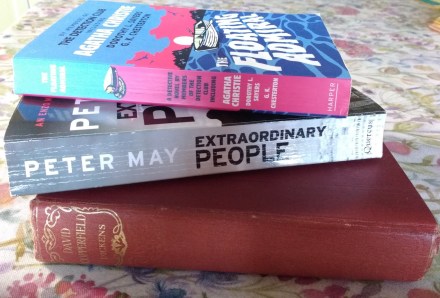
  • David Copperfield by Charles Dickens
  • Extraordinary People by Peter May –READ – I liked it, but not as good as his Lewis trilogy
  • The Floating Admiral by Members of the Detection Club

G, H and I

a-z tbrs ghi P1020304

The problem with these three is that they are all in a small font – hard on the eyes!

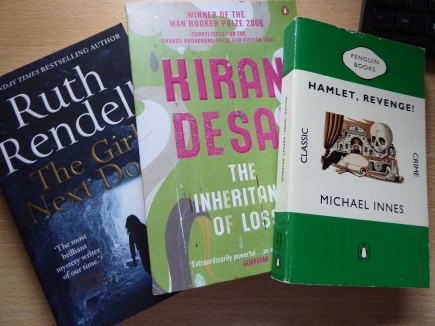
  • The Girl Next Door by Ruth Rendell
  • Hamlet, Revenge! by Michael Innes
  • The Inheritance of Loss by Kiran Desai

J, K and L

TRBs jkl

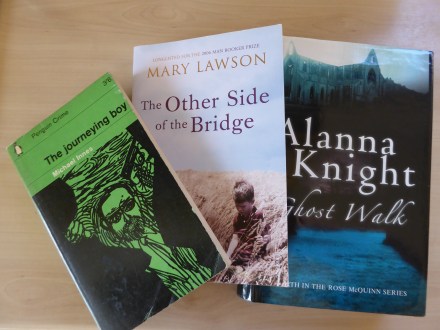
  • The Journeying Boy by Michael Innes –  will probably not read this, some of those who commented were in favour, but others were not.
  • Ghost Walk by Alanna Knight
  • The Other Side of the Bridge by Mary Lawson – READ and loved this one!

M, N and O

MNO bks P1020320

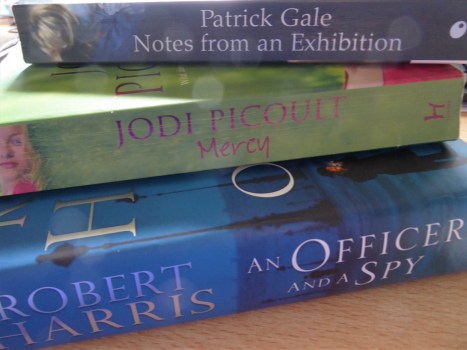
  • Mercy by Jodie Picoult – doubtful that I’ll read this.
  • Notes from an Exhibition by Patrick Gale – READ – Café Society sang the praises of this book, and I’m pleased to say she was right and I loved it.
  • An Officer and a Spy by Robert Harris – Helen commented that this is probably her favourite Robert Harris book so far, so I’m very keen to read this one soon.

P, Q and R

The Power HouseThe Queen's ManResistance

All these received favourable comments!

  • The Power House by John Buchan – a short book, should be a quick read.
  • The Queen’s Man by Sharon Penman (Kindle) – loved her Sunne in Splendour – why haven’t I read this one before now? As a result of comments I now have added Welsh Princes books, especially Here Be Dragons – love that title!
  • Resistance by Owen Sheers – apparently this is not an easy read, but some people recommended it.

S and T

IMG_20180308_091608245_HDR.jpg

  • The Stranger House by Reginald Hill – I’ll definitely read this one.
  • Slipstream: A Memoir by Elizabeth Jane Howard
  • The True Deceiver by Tove Jansson – Simon T  thinks this ‘is one of her best – much starker and darker than most of her others (dark in atmosphere – not gory or anything) but so brilliantly written.’
  • The Tenderness of Wolves by Stef Penney – READ – I was encouraged by the comments on this. I did enjoy it, particularly the descriptions of the landscape and climate that set it in geographic context, but it just took so long to read particularly with so many sub-plots to hold in my head! I think some of the sub-plots that don’t contribute much to the story could easily have been developed into books in their own right. And the ending seemed so abrupt. I’m not sure I want to read any more of Stef Penney’s books.

U, V and W

U V W books

  • The Unlikely Pilgrimage of Harold Fry by Rachel Joyce – I’m put off by the title – too gimicky, but I will at least begin this book – sometime.
  • The Various Flavours of Coffee by Anthony Capella – this one may get recycled.
  • The Water Horse by Julia Gregson – definitely a book to read.

X, Y and Z

IMG_20180517_155637127_HDR.jpgimg_20180610_124437297_hdrimg_20180610_124417342

I’m still hoping to read these, especially Margaret Atwood’s book after watching the BBC One programme Imagine where she talks to Alan Yentob in Toronto.

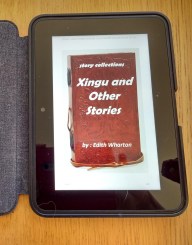
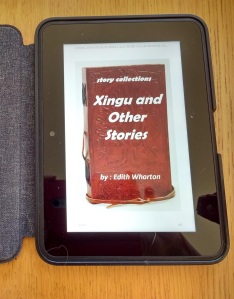
  • Xingu and other stories by Edith Wharton (Kindle)
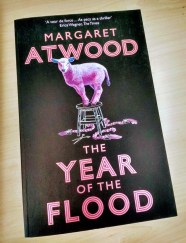
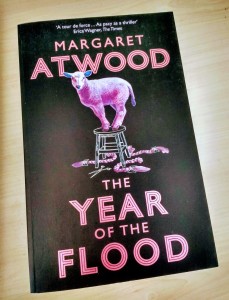
  • The Year of the Flood by Margaret Atwood
  • Zoo Time by Howard Jacobson

Come a Little Closer by Rachel Abbott

Once again I’ve fallen behind with writing reviews! This is the first post in a series of short reviews of the books that I’ve read this year and not reviewed.

Come A Little Closer (DCI Tom Douglas #7)

Come a Little Closer by Rachel Abbott. I had high hopes for this book as I’ve seen Rachel Abbott’s books praised on other book blogs and highly rated on Amazon and Goodreads, but I’d never read any of them. This is the seventh in the DCI Tom Douglas series, but I was encouraged by Rachel Abbott’s reassurance (on Goodreads author questions) that ‘each story is entirely standalone, but the character of Tom Douglas does run through the whole series. There are bits in each story about his life, but nothing that would require you to have read previous books. So please feel free to read them in any order you like. Many people do.’

Synopsis:

They will be coming soon. They come every night. 

Snow is falling softly as a young woman takes her last breath. 

Fifteen miles away, two women sit silently in a dark kitchen. They don’t speak, because there is nothing left to be said. 

Another woman boards a plane to escape the man who is trying to steal her life. But she will have to return, sooner or later. 

These strangers have one thing in common. They each made one bad choice – and now they have no choices left. Soon they won’t be strangers, they’ll be family…

When DCI Tom Douglas is called to the cold, lonely scene of a suspicious death, he is baffled. Who is she? Where did she come from? How did she get there? How many more must die? 

Who is controlling them, and how can they be stopped? 

My thoughts:

I have mixed thoughts about this book – I didn’t ‘like’ it (although I gave it 3 stars on Goodreads), but it held my interest and I read to the end. It reads OK as a standalone, although it probably would have helped to have known more about Tom Douglas, but the police investigation isn’t the main focus of the book.

The main focus is on Callie and the mess she gets herself into. Her relationship with her boyfriend, Ian is awful, he’s just sponging off her and treating her like a doormat. Although she tells him to leave, by the time she returns from a trip to Myanmar, he is still living in her flat. She then goes to stay with a couple she met on the cruise ship, without knowing that she is letting herself in for a nightmare scenario.

Here’s where the two women mentioned in the synopsis come into the story – a story that left me feeling sick. It’s not blood thirsty or gory – it’s just sick as the protagonists set about manipulating their victims. It’s full of action and barely credible coincidences. About halfway in I could see where this was going – and I didn’t like it. I was glad to finish it. It’s easy to read, but the characters seemed shallow and the only ones I liked were Tom his team and his brother, Nathan – now that sounds as though it’s a more interesting story.

What do you think? Should I read any of the other Tom Douglas books – or are they all like this one?

  • Format: Kindle Edition
  • File Size: 6326 KB
  • Print Length: 406 pages
  • Publisher: Black Dot Publishing Ltd (15 Feb. 2018)
  • Source: Kindle Users Lending Library
  • My rating: 3*

A – Z of TBRs: X, Y and Z

And so I come to the last letters in the alphabet,  X, Y and Z in my A – Z of TBRs, a series of posts in which I’ve been taking a look at some of my TBRs  to decide whether I really do want to read them all. Some of them were impulse buys, or books I bought as part of those 3 for 2 offers, but most of them are books I bought full of enthusiasm to read each one – and mainly because I wanted to finish books I was already reading, they have sat on the shelves ever since. And then other books claimed my attention.

X  – is for Xingu and other stories by Edith Wharton Xingu is the first story in this IMG_20180517_155637127_HDR.jpgcollection of seven short stories. It’s about a group of ladies who form a book group called The Lunch Club – but it’s more
‘And what do you think of “The Wings of Death”? Mrs Roby abruptly asked her.  It was the kind of question that might be termed out of order, and the ladies glanced at each other as though disclaiming any share in such a breach of discipline. They all knew there was nothing Mrs Plinth so much disliked as being asked her opinion of a book. Books were written to read; if one read them what more could be expected? To be questioned in detail regarding the contents of a volume seemed to her as great an outrage as being searched for smuggled laces at the Custom House. (location 77)

Why, I wonder, would anyone want to smuggle laces – and why would it be necessary?

img_20180610_124437297_hdr

Y – is for The Year of the Flood by Margaret Atwood. I’ve had this book for 8 years. According to Wikipedia this book focuses on a religious sect called the God’s Gardeners, a small community of survivors of the same biological catastrophe depicted in Atwood’s earlier novel Oryx and Crake, which I read soon after it was first published in 2003. The earlier novel contained several brief references to the group.

Figuring out the Gardener hierarchy took her some time. Adam One insisted that  all Gardeners were equal on the spiritual level, but the same did not hold true for the material one: the Adams and the Eves ranked higher, though their numbers indicated their areas of expertise rather than their importance. In many ways it was like a monastery, she thought. The inner chapter, then the lay brothers. And the lay sisters, of course. Except that chastity was not expected.

Since she was accepting Gardener hospitality, and under false pretences at that – she wasn’t really a convert – she felt she should pay by working very hard. (pages 55 -56)

img_20180610_124417342

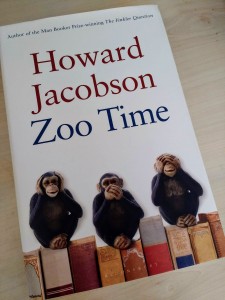
Z– is for Zoo Time by Howard Jacobson, a book I’ve had for eighteen months. It’s described on the book jacket as ‘By turns angry, elegiac and rude’,’ a novel about love – love of women, love of literature, love of laughter. It shows our funniest writer at his brilliant best.’

I haven’t read any of his books, although I have a copy of The Finckler Question, the 2010 Man Booker Prize winner still to read. Looking at Zoo Time today I’m wondering of I really do want to read it – I’m not very good with ‘funny’ books, often wondering what’s so funny about them. It’s about a writer, whose readership is going downhill, with lots of problems.

Things had not being going well in my neck of the woods: not for me, on account of being a writer whose characters readers didn’t identify with, not for my wife who didn’t identify with my characters or with me, not for Poppy Eisenhower, my wife’s mother, where the problem, to be candid, was that we had been identifying with each other too well, not for my local library which closed only a week after I’d published a florid article in the London Evening Standard praising its principled refusal to offer Internet access, and not for my publisher Merton Flak who, following a drunken lunch in my company – I had been the one doing the drinking – went back to his office and shot himself in the mouth. (page 23)

What do you think? Do you fancy any of them? Would you ditch any of them?

The Summer Before the War by Helen Simonson

The Summer Before the WarThis is another short book review as I catch up with writing about my reading. The Summer Before the War by Helen Simonson is one of my TBR books. It is her second novel and I enjoyed it so much more than her first book, Major Pettigrew’s Last Stand. It’s the  summer of 1914, set in Rye in East Sussex when spinster Beatrice Nash arrived to teach Latin at the local grammar school. Her appointment was the result of Agatha Kent’s and Lady Emily Wheaton’s wish to have a female teacher as a Latin teacher.
This is really a book of two parts – the months before the outbreak of the First World War and then the events as the war got underway. It begins slowly with the first part describing the lazy, idyllic summer and in which all the characters are introduced. Although there is a clear distinction between the classes in society cracks are beginning to appear which will only widen as the century gets under way and the war acts as a catalyst for change..

But it really gets going in the second part when the young men sign up, including High and Daniel, Agatha’s nephews, and Snout one of Beatrice’s pupils. He was underage but his father, the local farrier, signed the papers agreeing he could enlist. Simonson doesn’t hold back on the horrific conditions under which the war took place and from a gentle beginning the book moves into a war novel, emotional and moving.

This book slots into the only reading challenge I’m doing this year – What’s in a Name 2018. It fits into two of the categories, The word ‘the’ used twice and A season. For the time being I’m putting it into the ‘season‘ category but may change that later if I read one of the other ‘season‘ books on my list.

  • Format: Kindle Edition
  • File Size: 1770 KB
  • Print Length: 497 pages
  • Publisher: Bloomsbury Publishing; 1 edition (24 Mar. 2016)
  • Source: I bought the book
  • My Rating: 4*

Amazon UK link
Amazon US link

Catching Up

It’s that time of year – the grass is growing at a rate of knots, the weeds are shooting up all over the place, the garden is crying out for attention and my time for writing is disappearing.

So here are two quick reviews of books I’ve read this month:

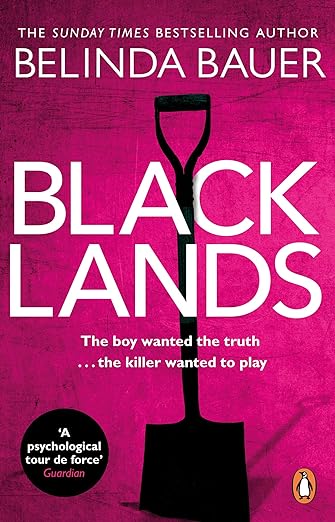
Blacklands by Belinda Bauer – her debut novel. I loved this book, so different from other crime fiction books I’ve read. It’s told mainly from Stephen Lamb’s perspective. Stephen is twelve years old. Nineteen years earlier Billy, Stephen’s uncle then aged eleven had disappeared. It was assumed that he had fallen victim to the notorious serial killer Arnold Avery, but his body had never been found. Stephen is determined to find where Arnold had buried his body and writes to him in prison.

What follows is an absolutely gripping battle of wits between Stephen and Arnold as they exchange letters. This is a dark and chilling story that took me inside the minds of both Stephen and Arnold, making this a disturbing experience and also a very moving and heartbreaking story. Since reading this book I’ve also read Snap, which although I enjoyed it I don’t think it is as good as Blacklands. I shall certainly be reading more of her books!

A Life in Questions

A Life in Questions by Jeremy Paxman (one of my TBRS). This is an interesting and entertaining autobiography, which is mainly about his career with little about his personal life, written in a very readable style. His sardonic wit and sense of humour come across, often aimed at himself. He tells of his childhood and his career first with the BBC in Northern Ireland and then in various war zones and trouble spots before becoming a presenter on Newsnight, where his interviews with politicians both infuriated and delighted me, and quizmaster on University Challenge. He has also done documentary programmes including an enlightening one on the EU, on art, and on history and has written several books on a variety of subjects. The only one I’ve read is The English: A Portrait of a People.

As I would expect from such a forthright person Paxman’s book is full of his opinions, but I couldn’t help wondering how much of  his grumpiness is a facade and what the real man behind it is really like. Maybe his reflections on his love for fly fishing and for nature, give us a glimpse of the real person. I liked these passages very much. Extending to 6 pages he describes how fishing is

essentially about trying to inserting yourself into an environment where you don’t belong, without being noticed. If you blunder about you won’t catch anything – on a sunny day you will be able to see the trout darting off in all directions when they sense your footfall on the bank, their flicking tails a snub to your clumsiness. Be quiet. And then, when you’re stalking a fish, things happen around you. A grass snake swims sinuously across the river. A water vole plops into a stream. Wagtails and oystercatchers dance at the water’s edge. Swallows and martins swoop low over the water, snatching flies. A kingfisher flashes that spectacular iridescent blue above the river; it is gone in an instant.

… To become absorbed in the natural world frees your mind: fish cannot survive in our element, and only imagination will allow us to live in theirs. …

In essence it is a solitary occupation. But the best fishing days are those spent with friends, meeting for a picnic lunch on the riverbank, united in the awareness that we are doing something which defies rational explanation. (extracts from pages 254-255)


Although I don’t fish I think I’d like to read his book on fishing: Fish, Fishing and the Meaning of Life.