Timekeepers: How the World Became Obsessed with Time by Simon Garfield

Timekeepers: How the World Became Obsessed With Time

3*

Synopsis:

Time flies like an arrow, but fruit flies like a banana. The Beatles learn to be brilliant in an hour and a half. An Englishman arrives back from Calcutta but refuses to adjust his watch. Beethoven has his symphonic wishes ignored. A US Senator begins a speech that will last for 25 hours. The horrors of war are frozen at the click of a camera. A woman designs a ten-hour clock and reinvents the calendar. Roger Bannister lives out the same four minutes over a lifetime. And a prince attempts to stop time in its tracks.

Timekeepers is a book about our obsession with time and our desire to measure it, control it, sell it, film it, perform it, immortalise it and make it meaningful. It has two simple intentions: to tell some illuminating stories, and to ask whether we have all gone completely nuts.

My thoughts:

Timekeepers fulfils Simon Garfield’s intentions – to tell some illuminating stories, and to ask whether we have all gone completely nuts. It covers a wide variety of topics, all in one way or another about time – how it’s been recorded, the development of the calendar, the standardisation of time to aid with railway timetables, and aspects of time management, for example.

The chapters vary in length and some are more interesting than others. The one that interested me most was Movie Time, with an account of how the silent film, Safety Last! was made in 1923.

File:Safetylast-1.jpg
Harold Lloyd dangling from the clock in Safety Last! (1923)

Harold Lloyd climbs the outside of a department store, obstacles falling on him as he does so, until he reaches the giant clock at the top, grabs hold of it, and dangles above the street below. Garfield recalls that for the first audiences time just froze, some went into hysterics and others fainted. Garfield’s focus is on the concept of time that the movies portrayed and goes on to explain how films were originally produced and shown when the timing depended on the cranking skills of the cameraman during filming and the projectionist during showing.

I was also interested in the chapter on performances of Beethoven’s Ninth Symphony, a long and complex piece of music involving a large orchestra, solo singers and a chorus, where Garfield’s focus is on the tempo of the music and the differences made by different composers’ interpretations; and also in the chapter on Nic Ut’s photograph of children fleeing after a napalm bomb had been dropped on a village in Trảng Bàng, Vietnam. Garfield’s focus here is on the fraction of a second when the photograph was captured that brought the story home to its viewers.

Several other chapters also interested me but I wasn’t taken with those on the technicalities of time measurement, time management,or the production of clocks and watches, that Garfield describes in great detail. The book jumps about from topic to topic with, as far as I can make out, no chronological order. But it is full of facts, and going off the Further Reading and Acknowledgement section it is well researched. A book to dip into rather than read straight through.

  • Format: Kindle Edition
  • File Size: 4503 KB
  • Print Length: 369 pages
  • Publisher: Canongate Books; Main edition (29 Sept. 2016)
  • Source: Canongate Books via NetGalley
  • My Rating: 3 stars

Thanks to Canongate Books and NetGalley for my copy of this book for review.

New-To-Me Books

Another visit to  Barter Books in Alnwick means I’ve added 5 more books to my TBRs.

img_20181011_073308703

From top to bottom they are:

Fair Stood the Wind for France by H E Bates – a Penguin modern classic. It was first published in 1944 and is about a British pilot, John Franklin, whose plane was shot down in occupied France, and Francoise, the daughter of a French farmer who hid Franklin and his crew from the Germans. I haven’t read any other books by Bates (1905 – 1974) – he was a prolific writer.

Recalled to Life by Reginald Hill, the 13th Dalziel and Pascoe book.  Dalziel reopens the investigation into a murder that took place in 1963 – the year of the Profumo Scandal, the Great Train Robbery and the Kennedy Assassination. I should be on safe ground with this book as I’ve enjoyed all the other Dalziel and Pascoe books I’ve read.

Mystic River by Dennis Lehane. Three boys’ lives were changed for ever when one of them got into a stranger’s car and something terrible happened. Twenty five years later they have to face the nightmares of their past. I’m not sure what to expect from this book, not having read any of Lehane’s books before, but a reviewer in the Guardian described it as one of the finest novels he’d read in ages.

The Hog’s Back Mystery by Freeman Willis Crofts, first published in 1933 during the Golden Age of detective fiction between the two world wars. It’s an Inspector French murder mystery set in Surrey, where first one person then others disappear. Have they been murdered? I’ve read just one of Crofts’ books before, Mystery in the Channel, which completely baffled me – will this be just as complicated?

The Virgin Blue by Tracy Chevalier, the story of two women, born centuries apart and the ancestral legacy that binds them. This was Tracy Chevalier’s first novel. I’ve read and enjoyed some of her later books, including The Girl with a Pearl Earring and Falling Angels, so I’m looking forward to reading this book.

Please let me know if you’ve read any of these books and whether you enjoyed them – or not.

A-Z of TBRs: E-Books: A, B and C

Earlier this year I looked through my TBRs – the ‘real’ books – and as it did prompt me to read more of them, I’ve decided to take a fresh look at some of the TBRs on my Kindle. I have a bad habit of downloading books and then forgetting all about them – it’s as though they’ve gone into a black hole.

So here is the first instalment of my A – Z of my e-book TBRs – with a little ‘taster’ from each. I’ve picked books from different genres – fantasy fiction, crime fiction and non-fiction – a biography.

Assassin's Apprentice (Farseer Trilogy, #1)

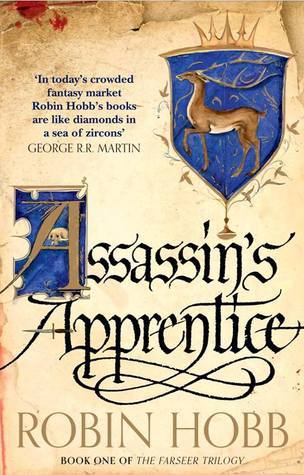
A is for Assassin’s Apprentice by Robin Hobb, Book One of the Farseer Trilogy  (On my Kindle since September 2014.)  It’s fantasy fiction set in the  imaginary realm of the Six Duchies and tells the story of the illegitimate son of a prince, assassin FitzChivalry Farseer. He is raised in the stables, rejected by all his family apart from his uncle Chade, who trains him as an assassin.

My memories reach back to when I was six years old. Before that, there is nothing, only a black gulf no exercise of my mind has ever been able to pierce. Prior to that day at Moonseye, there is nothing. But on that day they suddenly begin, with a brightness and detail that overwhelms me. Sometimes it it seems too complete, and I wonder if it is truly mine. Am I recalling it from my own mind, or from dozens of retelling by legions of kitchen maids and ranks of scullions and herds of stable-boys as they explained my presence to each other? Perhaps I have heard the story so many times, from so many sources, that I now recall it as an actual memory of my own. (page 2)

The Big Sleep (Philip Marlowe, #1)

B is for The Big Sleep by Raymond Chandler, with an introduction by Ian Rankin. It’s been on my Kindle since July 2017. Crime fiction is one of my favourite genres – I read a lot of it, but have never read any of Chandler’s books. This is his first book featuring Philip Marlowe. Rankin writes that is ‘a story of sex, drugs, blackmail and high society narrated by a cynical tough guy, Philip Marlowe‘ and that it is ‘such fun to read that you won’t notice how clever its author is being.’

The the old man dragged his voice up from the bottom of a well and said: ‘Brandy, Norris. How do you like you like your brandy, sir?’

‘Any way at all,’ I said.

The butler went away among the aboriginal plants. The General spoke again, slowly using his strength as carefully as an out-of-work showgirl uses her last good pair of stockings.

‘I used to like mine with champagne. The champagne as cold as Valley Forge and about a third of a glass of brandy beneath it.’ (page 4)

The Churchill Factor: How One Man Made History

C is for The Churchill Factor: How One Man made History by Boris Johnson, on my Kindle since June 2016. The extract below is from the Introduction in which Boris explains why he wants to convey something of Churchill’s genius in this book, and asking what made up his character.

I knew that he had been amazingly brave as a young man, and that he had seen bloodshed at first hand, and had been fired at on four continents, and that he was one of the first men to go up in an aeroplane. I knew that he had been a bit of a runt at Harrow, and that he was only about 5 foot 7 and with a 31-inch chest, and that he had overcome his stammer and his depression and his appalling father to become the greatest living Englishman.

I gathered there was something holy and magical about him, because my grandparents kept the front page of the Daily Express from the day he died, at the age of ninety. … So it seems all the more sad and strange that today – nearly fifty years after he died – he is in danger of being forgotten or at least imperfectly remembered. (page 3)

If you’ve read any of these please let me know what you think?

Books Read in September 2018

How my reading habits have changed! It was only a few years ago that I read mostly paper books, but these days I read mostly e-books – six out of the nine books I read in September are e-books. Another major change is the amount of review copies I read. This month I read five review copies that came to me via NetGalley. I also read one library book and the other three books are all my own books – but only one of those is an actual physical book! And only one of the nine books is non-fiction.

They range from 5 star to 2 star books and are a mix of crime and historical fiction plus one biography. My ratings are based solely on my reactions to the books.

I’ve written about five of these books – click on the links to read my reviews:

  1. The Way of All Flesh by Ambrose Parry 5* – historical fiction set in Edinburgh in 1847 as Dr James Young Simpson, a professor of midwifery, discovered the anaesthetic properties of chloroform.
  2. The Dancer at the Gai-Moulin by Georges Simenon 3.5* – one of the early Maigret books, set in Belgium not France.
  3. The Clockmaker’s Daughter by Karen Morton 3* – historical fiction set over multiple time-lines and with multiple narrators. I loved parts of it and it’s richly descriptive, but found it hard to keep track of all the characters and separate strands of the story.
  4. Appleby’s End by Michael Innes 3* – an Inspector Appleby book. It’s surreal, a macabre fantasy with a  complex and completely unrealistic plot and strange characters.
  5. Down to the Woods by M J Arlidge 2.5* – crime fiction, a DI Helen Grace murder mystery, tense and dark with several twists and turns. Not my favourite book of the month!

Here are some brief notes about the remaining four books:

Dead Woman WalkingDead Woman Walking by Sharon Bolton 5* – Sharon Bolton is a brilliant storyteller and this is a brilliant book – complex, very cleverly plotted, full of suspense and completely gripping with great characters and set in Northumberland. It begins with a balloon flight that ends in disaster and only Jessica survives as the balloon crashes to the ground, but she is pursued by a man who is determined to kill her.  I loved this book.

Wedlock: How Georgian Britain's Worst Husband Met His Match

Wedlock:  How Georgian Britain’s Worst Husband Met His Match by Wendy Moore 4* – a biography of Mary Eleanor Bowes, who was one of Britain’s richest young heiresses. Her first husband was the Count of Strathmore – the Queen Mother, Elizabeth Bowes-Lyon, was a direct descendant of their marriage. Her second marriage to Andrew Robinson Stoney was an absolute disaster. He was brutally cruel and treated her with such violence, humiliation, deception and kidnap, that she lived in fear for her life. This is non-fiction and is full of detail, but even so it reads like a novel.

East of Eden

East of Eden by John Steinbeck 4* –  the story of two families—the Trasks and the Hamiltons—whose generations helplessly re-enact the fall of Adam and Eve and the poisonous rivalry of Cain and Abel. I enjoyed this beautifully written book, which begins slowly, but not as much as The Grapes of Wrath, which I thought was amazing. It’s long – too long really – and to my mind it reads like a morality tale of good versus evil. There are many parallels to the Bible stories, with surely one of the most evil characters ever in Cathy. I liked the way Steinbeck set out the moral dilemmas and gave the characters choice using the Hebrew word ‘timshel‘, meaning ‘thou mayest’.

The Gaslight Stalker (Esther & Jack Enright Mystery #1)The Gaslight Stalker by David Field 2* – historical crime fiction set in London in 1888. This was a disappointing book, that provides a new solution to the Jack the Ripper murders. There are two elements to the plot and I don’t think they mixed well. I liked the historical facts based on the evidence in the Jack the Ripper case and thought they were well written, if a little repetitive. But the romance between Esther, a young seamstress and Jacob Enright, a young police officer, felt out of place and is too simplistically narrated.

The Dancer at the Gai-Moulin by Georges Simenon

The Dancer at the Gai-Moulin (Maigret #10)

Penguin is publishing the entire series of Maigret novels in new translations. This novel has been published in a previous translation as Maigret at the “Gai-Moulin”.

The Dancer at the Gai-Moulin by Georges Simenon, translated by Siân Reynolds is one of the early Maigret books, first published in 1931. Two teenage boys, Delfosse and Chabot, attempt to burgle Le Gai-Moulin, a nightclub in Liege in Belgium, but on finding a body they panic and leave, fearing they’ll be suspected of murder. The next day, to the boys’ amazement, the corpse is found in the Botanical Gardens in a large laundry basket in the middle of a lawn. Who was he, who killed him, why was he killed and who had moved the body from the nightclub to the Botanical Gardens?

This short book is mainly concerned with Delfosse and Chabot and their subsequent actions that set them at odds with each other and land them in police custody. It’s an unusual Maigret book in that Detective Chief Inspector Maigret is not immediately involved in the police investigation – that is carried out by Chief Inspector Delvigne of the Belgian police and part of the mystery is why Maigret is even in Liege. Adèle is the dancer referred to in the title but she doesn’t play a major role in the book, although the two teenagers are obsessed with her. It’s quite a puzzle and Maigret doesn’t reveal his thoughts, or his reasoning until the end, much to the annoyance of Delvigne.

The plot is unconvincing and Maigret’s actions seem quite implausible, but that didn’t spoil my enjoyment of this book. It’s not really the crime that is in focus, as Simenon is skilled at setting the scene and drawing convincing characters in a few paragraphs. In this novel the two boys and Adèle stand out:

She wasn’t beautiful, especially now, lounging about in her mules and shabby peignoir. But perhaps, in the familiarity of this intimacy, she held even more allure for him.

How old was she, twenty five, thirty? She’d certainly seen life. She often talked about Paris, Berlin, Ostend. She mentioned the names of famous nightclubs.

But without any excitement or pride, without showing off. On the contrary. Her main characteristic seemed to be weariness, as could be guessed from the expression in her green eyes, from the casual way she held a cigarette in her mouth, from all her movements and smiles. Weariness with a smile. (page 28)

I knew that Simenon was a prolific author, writing seventy five novels and twenty eight short stories featuring Maigret, but I was surprised to find that The Dancer at the Gai-Moulin was the 10th book that he published in 1931. By the end of 1931 his books had been translated into 18 languages.

  • Paperback: 160 pages
  • Publisher: Penguin Classics (7 Aug. 2014)
  • Language: English
  • ISBN-10: 0141393521
  • ISBN-13: 978-0141393520
  • Source: my own copy – thanks to Sarah’s Giveaway at Crimepieces blog
  • My rating: 3.5*

This book slots into the only reading challenge I’m doing this year – What’s in a Name 2018. It fits into the category of a book with the word ‘the‘ used twice in the title. It is also one of my TBR books (a book I’ve owned prior to 1 January 2018) and also a book on my Classics Club list.

He Who Whispers by John Dickson Carr

He Who Whispers by John Dickson Carr was my Classics Club Spin book for August. It was first published in 1946. Carr (1906 – 1977) was an American writer who also wrote under the pseudonym of Carter Dickson and Carr Dickson. In 1936 he was elected to the Detection Club in London. He Who Whispers is one of his ‘locked room’  mysteries/impossible crimes, featuring Dr Gideon Fell, an amateur sleuth.

He Who Whispers by John Dickson Carr

I really didn’t know what to expect so I was pleased to find that I thoroughly enjoyed this book. It’s well written, set in 1945 just after the end of the Second World War when Miles Hammond is finding it hard to getting used to peacetime. London is still showing the scars of the war and he feels that his life is unreal. He has been discharged from the Army after being in hospital suffering from diesel-oil poisoning.

Then, gasping out to the end like a gauleiter swallowing poison, the war is over. You come out of hospital – a little shakily, your discharge papers in your pocket – into a London still pinched by shortages; a London of long queues, erratic buses, dry pubs; a London where they turn on the street-lights and immediately turn them off again to save fuel; but a place free at last from the intolerable weight of threats.

People didn’t celebrate that victory hysterically, as for some reason or other the newspapers liked to make out. What the newsreels showed was only a bubble on the huge surface of the town. Like himself, Miles Hammond thought, most people were a little apathetic because they could not yet think of it as real. (page 6)

His friend, Dr Gideon Fell, has invited him to dinner as a guest at the Murder Club, their first meeting in five years, where the speaker is Professor Rigaud. But when he arrives he finds none of the members of the Club have turned up. The only other people there are the Professor, and a beautiful blonde called Barbara Morell. Rigaud, however, tells them the story he had prepared for the Club – a tale of an impossible murder on the top of a ruined tower, that had once been part of a French chateau burnt down by the Hugeunots in the 16th century, and a mysterious woman, Miss Fay Seton.

The body of Howard Brooke was found lying on the parapet of the tower by two children between 10 minutes to 4 and 5 minutes past 4. He had been stabbed through his body with a sword-stick and yet the evidence showed conclusively that during this time not a living soul came near him. Rigaud points out the difficulties of scaling the wall of the tower, leading Miles to suspect he is alluding to ‘some sort of supernatural being that could float in the air‘ – in other words, a vampire.

Now, six years later Miles, Rigaud and Barbara together with Dr Fell set about trying to solve the mystery. I was fascinated by Dr Fell, supposedly based upon G. K. Chesterton (author of the Father Brown stories), in his appearance and personality. He’s immensely tall and fat, with a big mop of grey-streaked hair, and wearing a long, dark cape. He strides along ‘with a rolling motion like an emperor, and the sound of his throat-clearing preceded him like a war-cry‘.

I thought the characterisation was excellent and there is a great sense of location. The book is full of tension and there is a real sense of approaching danger and disaster as the characters struggle to uncover the truth. It is only due to Dr Fell’s ingenuity that their fears are calmed and he produces a rational explanation and reveals the truth. I too was puzzled and the book had kept me guessing right to the end. Even then when I knew what had happened I was so involved with the characters that  I was left wondering –  what happened next? 

Now, I’m keen to read more of John Dickson Carr’s books. There are a lot of them – see the list at Fantastic Fiction.

  • Paperback: 206 pages
  • Publisher: Penguin Books in association with H.Hamilton (1953)
  • Source: I bought my copy
  • Rating: 4*