Indefensible by James Woolf

Bloodhound Books| 5 January 2024| 413 pages| E-book review copy| 3*

Synopsis from Amazon UK

A lawyer crosses a dangerous line with a former client and discovers that some decisions are indefensible…

Daniel, a criminal barrister, is working all hours on a sensational trial, defending a client he believes is wrongfully accused of a grisly murder. Determined to keep Rod out of prison, he begins to neglect his wife—and soon suspects she’s having an affair.

After Daniel triumphs in court, the bond with his newly acquitted client grows even stronger. And when Rod offers Daniel a favour that he really shouldn’t accept, things take a catastrophic turn.

Daniel realises the lethal consequence of his actions and now his dream case threatens to become his worst nightmare…

My thoughts

I received a copy of Indefensible from the author, James Woolf for review. It’s his debut novel, although 30 of his short stories have appeared in magazines and books, including four in the longstanding arts magazine Ambit. James also writes stage plays (about 15 have been professionally produced) and has written radio plays for Radio 4 and LBC. He has worked in professional ethics within the law for 20 years, including taking calls from barristers when they have a question about their code of conduct. So his book explores the consequences of not following the code of conduct.

After a dramatic opening it took me a while to settle into this book. I couldn’t warm to Daniel at first, a barrister, recently appointed as a QC. He is a complex character who comes across as very needy, insecure and vulnerable, having left his wife on acrimonious terms. This has knocked his confidence and he finds personal relationships difficult. He is disappointed as his clerk is not getting him the cases he wants. But then he gets his first major case defending Rod, accused of a particularly grisly murder. During the course of the trial he meets Michaela, who is a crime reporter, and the two develop a relationship. I was never sure about the characters, were they telling the truth, and were they really what they seemed.

I enjoyed the setting – London in the 1990s with reference to real court cases, such as the trial of Fred and Rosemary West. For me the strength of this book is the court case, keeping me guessing about the outcome and eager to find out who was telling the truth. But as Daniel says the trial process is about testing the evidence – it’s the test that is important and not the truth. As the trial continued I began to fear the worst, that the truth was being obscured. What happened afterwards was not quite what I expected, as Daniel’s decisions and subsequent choices proved to be indefensible.

After a slow start I found this book compelling reading and I’ll be looking out for more books by James Woolf.

My thanks to James Woolf and Bloodhound Books, the publishers, for sending me the Kindle edition for review.

Munich Wolf by Rory Clements

This is yet another one of my short posts about books I’ve read this year. This one is a review copy by one of my favourite authors, due to be published in January:

Bonnier Books| 18 January 2024|400 pages| E-book review copy| 3.5*

Description

Munich, 1935 – The Bavarian capital is a magnet for young, aristocratic Britons who come to learn German, swim in the lakes and drink beer in the cellars.

What they don’t see – or choose to ignore – is the brutal underbelly of the Nazi movement which considers Munich its spiritual home. When a high-born English girl is murdered, Detective Sebastian Wolff is ordered to solve the crime. Wolff is already walking a tight line between doing his job and falling foul of the political party he abhors. Now Hitler is taking a personal interest in the case. Followed by the secret police and threatened by his own son, a fervent member of the Hitler Youth, the stakes have never been higher. And when Wolff begins to suspect that the killer might be linked to the highest reaches of the Nazi hierarchy, he fears his task is simply impossible – and that he might become the next victim.

I’ve enjoyed several books by Rory Clements. Munich Wolf is a standalone murder mystery, a police procedural investigation set in Hitler’s Munich in 1935. I enjoyed it although I found the first half slow moving and disjointed, but the pace picks up in the second half. It is a darker novel than his Tom Wilde books, with some unsavoury and definitely unlikable characters, some of whom I found difficult to identify. The murder mystery takes second place to the historical setting. The novel is full of tension and suspense, some of which made it an uncomfortable read but conveyed what a dangerous time and place Germany was in the 1930s.

However, I really liked Detective Sebastian Wolff (Seb), and the way he investigates the murder of a young English woman, under orders from Hitler to close the case as soon as possible. And I really want to know more about Unity Mitford’s involvement. The time period seems well researched – I’m not familiar with the situation in Germany between the two World Wars as Hitler rose to power – and I found that fascinating.

I do hope Rory Clements will write more books featuring Seb Wolff.

Many thanks to Bonnier Books for a review copy via NetGalley.

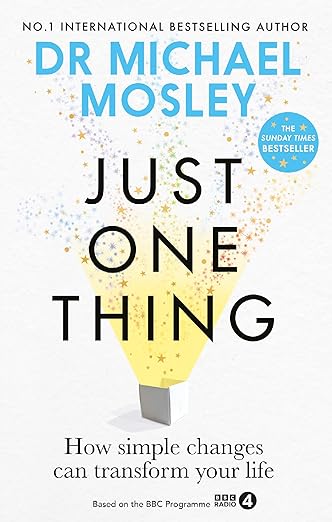
Just One Thing by Michael Mosley

Octopus Publishing Short Books| 22 October 2022|206 pages| E-book review copy| 5*

I was keen to read Just One Thing by Michael Mosley because I’ve enjoyed his TV programmes and I wasn’t disappointed. I think it’s an excellent source of information about improving your health. He picked 30 of his favourite things that you could fit into your life and explains the benefits of each one. He divides the day into periods – morning, mid morning, lunch time, afternoon and evening, giving examples of things to try throughout the day.

I’ve highlighted just a few in this post. S0me of them I already knew about, like doing exercise, doing squats and lunges, drinking water, meditation, spending time outdoors, taking a break to reduce stress, deep breathing, and so on. And I was very pleased to see that reading fiction for 30 minutes a day is a whole brain workout!

Other ideas that were new to me are things like drinking coffee, which lowers the risk of strokes, heart disease, cancer and dementia, and eccentric exercise – which involves walking downhill, down stairs and lowering weights, which have been shown to be more effective than running uphill, up stairs and lifting weights.

I knew about eating an apple a day, but not about the benefits of eating beetroot (which I love) two to three times a week. One thing that really pleased me is finding out that eating two squares of dark chocolate a day instead of eating sweet treats, lowers blood pressure and boosts your brain. In fact most of the ideas improve your mood and sleep, how your brain functions, and reduce anxiety, stress, fatigue and depression and so on. Standing on one leg, for example improves your balance, improves your core strength, and posture which reduces the likelihood of falling and breaking bones. Singing loudly for 5 minutes a day not only boosts your mood, and reduces anxiety, but can also relieve chronic pain.

It’s an inspiring book to read for making small changes, and some not so small changes, to improve your health and well-being. I’ve already started to stand on one leg whilst brushing my teeth and doing squats/lunges whilst waiting for the kettle to boil and will be trying more of the ideas too.

Many thanks to the publishers for a review copy via NetGalley.

Restless Dolly Maunder by Kate Grenville

Canongate Books| 2 November 2023|257 pages| Review copy| 4*

Synopsis

Dolly Maunder is born at the end of the nineteenth century, when society’s long-locked doors are just starting to creak ajar for determined women. Growing up in a poor farming family in rural New South Wales, Dolly spends her life doggedly pushing at those doors. A husband and two children do not deter her from searching for love and independence.

Restless Dolly Maunder
 is a subversive, triumphant tale of a pioneering woman working her way through a world of limits and obstacles, who is able – despite the cost – to make a life she could call her own.

My thoughts:

Kate Grenville is one of my favourite authors, so I was looking forward to reading Restless Dolly Maunder. I was not disappointed.

This is the fictionalised life story of Kate Grenville’s maternal grandmother, Sarah Catherine Maunder, known as Dolly. She was the sixth child of Thomas and Sarah Maunder, born in Currabubula, New South Wales, Australia in 1881. She was not only restless but also clever and determined – she knew what she wanted and she did her best to achieve it.

As a child she longed to be a pupil-teacher but in a world where women were subservient to men she had to obey her father who wouldn’t allow it. She could marry or be a spinster. Eventually she married Bert Russell and began a life away from the farm and her family, moving from place to place and from one business to the next to better herself and her family – a shop, a boarding house, a pub, and a grand hotel.. But she was a difficult person, not easy to like and unable to show love. Hers was a success story but also a tragedy as her wanderlust impelled her to keep striving for more and better things in life.

Restless Dolly Maunder casts light not just on Dolly’s life but also on life in Australia for most of the 20th century. The book has a relentless pace as it tells her life story as she propels herself from place to place and from business to business, enjoying success whilst it lasted and enduring all else, not stopping to pause breath in her restless pursuit of what came next.

Many thanks to the publishers for a review copy via NetGalley.

I can recommend all of Kate Grenville’s books. One of my favourites is One Life:My Mother’s Story, her biography of Nance Russell, Dolly’s daughter. Hers was a happier and more fulfilled life.

The Bone Chests by Cat Jarman

A history of the making of England as a nation, told through six bone chests, stored for over a thousand years in Winchester Cathedral.

William Collins| 14 September 2023| 400 pages| Review copy| 4*

The front cover shows a section of the Great West Window of Winchester Cathedral, made up of mosaics created after 1660 from the glass that had been smashed during the Civil War in 1642. I think it is just beautiful.

Description:

In December 1642, during the Civil War, Parliamentarian troops stormed the magnificent cathedral, intent on destruction. Reaching the presbytery, its beating heart, the soldiers searched out ten beautifully decorated wooden chests resting high up on the stone screens.

Those chests contained some of England’s most venerated, ancient remains: the bones of eight kings, including William Rufus and Cnut the Great – the only Scandinavian king to rule England and a North Sea empire; three bishops ; and a formidable queen, Emma of Normandy. These remains belong to the very people who witnessed and orchestrated the creation of the kingdom of Wessex in the seventh century, who lived through the creation of England as a unified country in response to the Viking threat, and who were part and parcel of the Norman conquest.

On that day, the soldiers smashed several chests to the ground, using the bones as missiles to shatter the cathedral’s stained glass windows. Afterwards, the clergy scrambled to collect the scattered remains.

In 2012, the six remaining chests were reopened. Using the latest scientific methods, a team of forensic archaeologists attempted to identify the contents: they discovered an elaborate jumble of bones, including the remains of two forgotten princes. In The Bone Chests, Cat Jarman builds on this evidence to untangle the stories of the people within. It is an extraordinary and sometimes tragic tale, and one of transformation. Why these bones? Why there? Can we ever really identify them? In a palimpsest narrative that runs through more than a millennium of British history, it tells the story of both the seekers and the sought, of those who protected the bones and those who spurned them; and of the methods used to investigate.

My knowledge of the Anglo-Saxons from school history lessons is very basic – little more than Alfred the Great on the run from the Vikings and letting the cakes burn, and King Canute, sitting in his throne placed at the water’s edge and trying unsuccessfully to forbid the waves from advancing and wetting his feet.

So I was looking forward to learning more in The Bone Chests: Unlocking the Secrets of the Anglo-Saxons. In her Author’s Note Cat Jarman clarifies that her intention with this book is to tell the stories of the chests, and of the tumultuous times that they and the people interred in them, lived through. She has concentrated on the south and south-west of England to consider why Wessex and Winchester took on such significance in the history of England in the early medieval period. So, the main emphasis in this book is on the history, on the kings and politics of the period rather than on the forensic archaeology and the modern scientific techniques.

Having said that there is enough about the use of DNA and isotopic analysis of teeth to investigate the diet and origins of the owners of the bones for me as a non scientist to understand. I found it all fascinating even though in places I was left wondering what century I was in, having moved from the 11th to the 21st century (when Richard III’s remains were discovered under a Leicester car park), via various Viking raids and the 17th century. At times I had to keep reminding myself which chest was being described.

The mortuary, or bone chests, themselves, are most interesting and I would love to visit Winchester Cathedral to see them for myself. There are six chests, painted wooden caskets which are displayed high on stone screen walls on either side of the high altar area. The bones are the remains of many kings and bishops who were originally buried in the Anglo-Saxon cathedral known as Old Minster, north of the present cathedral.

Jarman describes the chests in, vaguely, chronological order and has relied on the Mortuary Chests Project, a research project led by archaeologists from Bristol University in collaboration with Winchester Cathedral that began in 2012. She is not involved in the Project but has incorporated details of the team’s partial results released in May 2019 in her book.

The book is very detailed and well researched and I learned so much, bringing the medieval period to life as I read. I had never heard of Queen Emma and the details about her life stand out for me. She was the daughter of Richard I, Duke of Normandy, wife of two Anglo- Saxon kings – Æthelred the Unready and Cnut (Canute) – and the mother of Edward the Confessor and Harthacnut of Denmark. She was given the name Ælfgifu and in 1017 she married Cnut. I was fascinated to read that the Project team has put together a set of bones that they confidently determine to be a female that could be the body of Emma. (See – details of an exhibition at Winchester Cathedral, Kings and Scribes: the birth of a nation. This includes a 3D model of the female skeleton thought to be Queen Emma).

The last section of the book is made up of Notes of the sources used, an extensive Bibliography, and an Index. There is also a List of Illustrations; the illustrations were not included in my review copy.

Many thanks to the publishers for a review copy via NetGalley.
Dr Cat Jarman is a bioarchaeologist and field archaeologist specialising in the Viking Age, Viking women, and Rapa Nui. She uses forensic techniques like isotope analysis, carbon dating, and DNA analysis on human remains to untangle the experiences of past people from broader historical narratives. Dr Jarman has contributed to numerous TV documentaries as both an on-screen expert and historical consultant, including programmes for the BBC, Channel 4, History, Discovery, and more.

Just Another Missing Person by Gillian McAllister

Penguin Michael Joseph| 3 August 2023| 369 pages| Review copy| 5*

OLIVIA.
22 years old.
Last seen on CCTV, entering a dead-end alley.
And not coming back out again.
Missing for one day and counting . . .

Julia is the detective heading up the case. She knows what to expect. A desperate family, a ticking clock, and long hours away from her husband and daughter. But Julia has no idea how close to home it’s going to get. Because there’s a man out there. And his weapon isn’t a gun, or a knife: it’s a secret. Her worst one. He tells her that her family’s safety depends on one thing: Julia must NOT find out what happened to Olivia – and must frame somebody else for her murder . . .

Just Another Missing Person is the fifth book by Gillian McAllister that I’ve read. They have all been excellent books, tense, tightly plotted and completely compelling reading. But this one surpasses them all.

Needless to say but I was totally gripped and baffled – how could Olivia just disappear from a dead-end alley without being seen coming back out? The investigating police officer is DCI Julia Day, a detective with a passion for solving things, piecing things together and helping people to get to the truth. But she has come up against what seems to be an impossible crime and to make matters worse she has her hands tied because she has a secret. And one person knows what she did and is threatening to reveal it unless she frames someone for Olivia’s disappearance.

It’s very readable and well written, with clearly defined and believable characters, and a complex plot with plenty of twists and turns. There are two major twists – the first one that shocked me and took me completely by surprise, whilst the second one, also surprising, I’d figured out but only just before it happened. The pace is quite slow to start off, but soon ratchets up as the tension rises. It really is a book that keeps you on your toes. You need to concentrate, paying close attention to details. It’s told mainly from Julia’s perspective with further insight from the other characters’ points of view.

Just Another Missing Person is simply excellent, written with assurance and with great insight into human nature. It is without doubt one of the best books I’ve read this year.

Many thanks to the publishers for a review copy via NetGalley.