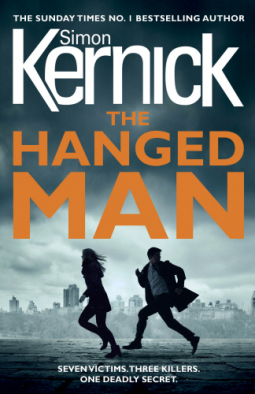
The Hanged Man by Simon Kernick

Expected publication date 16 November 2017

Review copy from the publishers, Random House, Century, via NetGalley

My rating: 2.5 stars

In December 2016 I read the first book in this series The Bone Field by Simon Kernick. It ended on a cliff-hanger in the last sentence (just when you thought it was all over). The Hanged Man is the second book in the series and refers back to events in The Bone Field, but in enough detail so it probably doesn’t matter much if you haven’t read the first book. It’s packed full of action right from the opening chapter as Hugh Manning and his wife are on the run from some very dangerous and violent people who are out to kill them. The police are also looking for Hugh as he is the only witness to what had happened at the farmhouse (dubbed ‘The Bone Field‘) where the bodies of seven women had been found.

Ray Mason, suspended from the police after the events told in The Bone Field, and now exonerated, is back on the case, working with Dan Watts in the National Crime Agency. The main suspects are the Kalamans,  brother and sister, Alastair and Lola Sheridan and a mysterious character called Mr Bone. It’s  told through different characters’ viewpoints, including Ray’s partner, ex-cop and now a PI, Tina Boyd. With so many characters acting as narrator it’s useful that Kernick uses the first person when telling what happens as seen through Ray’s eyes, whereas the rest are told in the third person.

It’s complicated, maybe over-complicated and I found myself racing through it. There are too many characters and sub-plots. Some characters are like cardboard cut-outs, the ‘baddies’ really bad and the ‘goodies’, particularly Ray Mason, who breaks all the rules, not much better. It’s a world full of corruption and secrets, where life is of little account and murder commonplace, and nobody is safe. But because I knew the identities of the criminals from the start there is no mystery – it’s just a matter of who will get to Manning first, the police or the villains and will the villains be caught? There’s climatic ending – but is this really the end …?

My thanks to the publishers for a review copy via NetGalley.

Amazon UK
Amazon US


Birdcage Walk by Helen Dunmore

Birdcage Walk

Blurb:

It is 1792 and Europe is seized by political turmoil and violence. Lizzie Fawkes has grown up in Radical circles where each step of the French Revolution is followed with eager idealism. But she has recently married John Diner Tredevant, a property developer who is heavily invested in Bristol’s housing boom, and he has everything to lose from social upheaval and the prospect of war. Soon his plans for a magnificent terrace built above the two-hundred-foot drop of the Gorge come under threat. Tormented and striving Diner believes that Lizzie’s independent, questioning spirit must be coerced and subdued. She belongs to him: law and custom confirm it, and she must live as he wants—his passion for Lizzie darkening until she finds herself dangerously alone.

Weaving a deeply personal and moving story with a historical moment of critical and complex importance, Birdcage Walk is an unsettling and brilliantly tense drama of public and private violence, resistance and terror from one of our greatest storytellers.

My thoughts:

This is Helen Dunmore’s last book, but the first one of hers I’ve read, although Exposure is sitting in my Kindle waiting to be read. It’s historical fiction, although I think it’s mainly a meditation on death and the legacy we leave behind. And that is most poignant as although at the time she was writing the book Helen Dunmore didn’t know it she was seriously ill and she died earlier this year. She was the author of 12 novels, three books of short stories, numerous books for young adults and children and 11 collections of poetry.

As she wrote in the Afterword:

I suppose that a writer’s creative self must have access to knowledge of which the conscious mind and the emotions are still ignorant, and that a novel written at such a time, under such a growing shadow, cannot help being full of a sharper light, rather as a landscape becomes brilliantly distinct in the last sunlight before a storm. I have rarely felt the existence of characters more clearly, or understood them more deeply – or enjoyed writing about them more.

I was completely absorbed in this book as I read it. It’s written beautifully and poetically, moving slowly as the details of Lizzie and Diner’s marriage come sharply into focus. Birdcage Walk was first published in March 2017, so I’m coming a bit late to reading it and the drawbacks of that are that I’ve seen several reviews and have realised that (like many books) there are mixed opinions about it. I’ve seen criticisms that the pace is too slow, and that much of the plot is given away in the opening chapters. But I felt the pace was just right for the story and the subject matter, and I think the opening chapters set the scene and the theme of the book – that is, that life is transitory, that the individual vanishes, as it were, that no record is left of the lives of many of past generations, despite the effect they had on the lives of their contemporaries.

The Prelude reveals that Birdcage Walk in the present day is a paved path between railings with pleached lime trees arching overhead on their cast-iron frame. But back at the end of the 18th century it was where Diner had started to build a terrace of houses with fantastic views over the Avon Gorge (before the building of the Clifton Suspension Bridge). When war was declared between Britain and France in 1793 this had a disastrous effect and like many builders and developers, Diner’s building work slowed and then ceased as he went bankrupt.

The novel shows the effect of the French Revolution on England through newspaper reports and letters, which I thought was effective casting light on the contemporary scene and showing the horror of what was happening across the Channel. The main focus, however, is on Lizzie. Diner’s repressive and jealous nature comes increasingly to the fore as his building work decreases, and the tension between him and Lizzie soars, accelerated when she discovers what had happened to Lucie, his first wife. The sense of foreboding and menace present in their marriage pervades the whole novel.

Many thanks to Grove Atlantic for providing me with an ARC copy through NetGalley.

My rating: 4*

Amazon UK
Amazon US

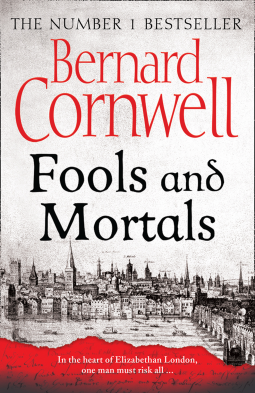
Fools and Mortals by Bernard Cornwell

Publication: 19 October 2017, Harper Collins

Source: Review copy from the publisher via NetGalley

My rating: 5*

Fair of Face by Christina James

Tina Brackenbury and her baby daughter Bluebell are dead …

Fair of Face

Fair of Face is the sixth novel in the DI Yates series and  I think it stands well on its own. It is not a book you can read quickly as there are plenty of characters and several plot threads that need to be kept in mind. It is an intricately plotted mystery, re-assessing a crime from the past whilst investigating a present day murder, set in Spalding in Lincolnshire. I  didn’t find it an easy book to review.

The book begins with Tristram Arkwright, a prisoner in HMP Wakefield. He works in the prison library and is secretly in correspondence with Jennifer Dove, a bookseller who regularly supplies the prison. Jennifer is bored and finds Tristram a welcome diversion. He, meanwhile, is planning an appeal against his sentence insisting he is innocent.

Tina’s 10 year old foster daughter, Grace Winter was staying with a friend, Chloe and arrives home as DI Tim Yates and DS Juliet Armstrong are beginning their investigations into the deaths of Tina and Bluebelle. Grace acts strangely and doesn’t seem very upset by the murders and asks to see the bodies. But Grace has had a difficult life as this isn’t the first murder that she has encountered. Four years earlier her mother, sister and grandparents had been killed at their farmhouse and Grace had escaped by hiding in a cupboard. Grace was then adopted by Amy Winter, and only later sent to live with Tina. Her friend, Chloe, also has a troubled background, with brothers who are regularly in trouble with the police. She is noticeably intimated by them and by Grace. As both girls are only 10 years old the police work with Social Services in order to question them

I struggled for a while to sort out the relationships between all the characters and the relationship between the opening chapters and Tina and Bluebell’s murders. The narrative switches between the first person present tense (Juliet) and the third person past tense, which I found a bit awkward until I got used to it. And I was confused by characters with similar names – Tom and Tim for example – regularly having to check who was who. I also failed to see relevance of Jennifer Dove’s character in the opening chapters. But despite these drawbacks I enjoyed the book and was eager to solve the mysteries.

My thanks to the publishers for a review copy of the book.

  • Paperback: 320 pages
  • Publisher: Salt Publishing (15 Oct. 2017)
  • Language: English
  • ISBN-10: 1784631086
  • ISBN-13: 978-1784631086
  • My rating: 3*

Trump’s Christmas Carol by Lucien Young

 I have the best ghosts, everyone says so’

Publication: Penguin Random House UK – Ebury Press, 2 November 2017

Source: review copy from the publishers via NetGalley

My Rating: 3*

Blurb:

President Ebenezer Trump is a rich old fool, whose heart is as small as his hands and whose words are as false as his hair. On Christmas Eve, he is visited by three spirits, all intent on changing his evil ways: Bill Clinton, the jovial Ghost of Christmas Past; Barack Obama, the big-eared Ghost of Christmas Present; and the terrifying Ghost of Christmas Yet to Come, who shows him how abolishing Obamacare will finish off Tiny Tim…

‘This Scrooge is gonna be yooooge…’

Trump’s Christmas Carol by Lucien Young (Watt T. Dickens) sub-titled Being a Ghost Story of Democracy is a short book (112 pages in hardcover) parodying Charles Dickens’ A Christmas Carol. It’s easy reading, amusing and entertaining and Young doesn’t pull his punches, mercilessly portraying Trump as Scrooge, with Richard Nixon standing in for Jacob Marley,  warning him he is on a path to impeachment and eternal damnation. He offers him a way to escape his fate – three spirits will visit him to show him the error of his ways.

Whilst this is a clever version of Dickens’ book I doubted that Young’s Scrooge would wake up on Christmas Day a changed man. And I much prefer Dickens’ original version where he is criticising Victorian society, its greed, self interest and lack of charity, drawing attention to the terrible living conditions of the poor – in particular to child poverty. Its timeless message is still applicable today.

My thanks to the publishers for a review copy via NetGalley.

The Last Hours by Minette Walters

Blurb:

June, 1348: the Black Death enters England through the port of Melcombe in the county of Dorsetshire. Unprepared for the virulence of the disease, and the speed with which it spreads, the people of the county start to die in their thousands. 

In the estate of Develish, Lady Anne takes control of her people’s future – including the lives of two hundred bonded serfs. Strong, compassionate and resourceful, Lady Anne chooses a bastard slave, Thaddeus Thurkell, to act as her steward. Together, they decide to quarantine Develish by bringing the serfs inside the walls. With this sudden overturning of the accepted social order, where serfs exist only to serve their lords, conflicts soon arise. Ignorant of what is happening in the world outside, they wrestle with themselves, with God and with the terrible uncertainty of their futures. 

Lady Anne’s people fear starvation but they fear the pestilence more. Who amongst them has the courage to leave the security of the walls?

And how safe is anyone in Develish when a dreadful event threatens the uneasy status quo…?

My thoughts:

I liked the historical setting of The Last Hours in 1348 at the time of the Black Death.  It’s well researched, giving vivid descriptions of the setting in an moated manor in the Dorsetshire countryside and of the Black Death, the plague that ravaged the population in 1348. The characters are interesting, showing the clear division between the serfs and the lord of the manor, but I thought some of them were rather one-dimensional, such as Sir Richard of Develish (Lady Anne’s husband) who is portrayed as irredeemably villainous.

I think the book as a whole is overlong and so slow in parts where the description is so detailed that it slows down the action to snail’s pace. It could have been shorter without losing any of the drama.

What really interested me was the medical development and health issues, as people struggled to understand the nature of the plague, what caused it, how it spread so quickly and how could they treat it. And what disappointed me most is the ending – there isn’t one. The last sentence reads: ‘To be continued …

You can watch Minette Walters talking about her book:

My thanks to the publishers and NetGalley for a digital review copy.

Amazon UK