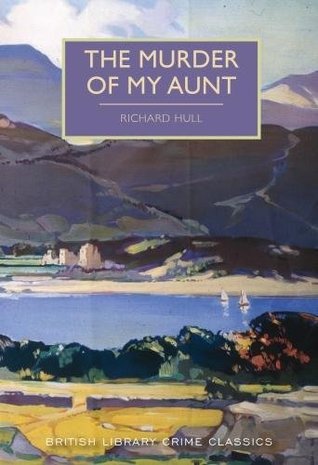
The Murder of My Aunt by Richard Hull

The Murder of My Aunt Poisoned Pen Press|4 September 2018 |227 pages|e-book |Review copy|5* This edition, published in association with the British Library, has an introduction by Martin Edwards. It was first published in 1934 by Hamish Hamilton. It was Richard Hull’s first novel. His real name was Richard Henry Sampson (1896 – 1973) and up until 1934 he had worked as a chartered accountant. With the success of The Murder of My Aunt he devoted himself to writing. The Murder of My Aunt is one of the best of the classic crime fiction novels from the Golden Age that I’ve read. On the face of it has a straightforward plot as Edward Powell, the narrator for most of the book, plots to murder his Aunt Mildred. They live in a house called Brynmawr on the outskirts of the Welsh town of Llwll. Mildred is his guardian, his parents having died in mysterious circumstances when Edward was very young. He detests living in Lwll and he also detests his aunt. It’s a contest of wills as Mildred finds Edward a great trial, she sees all his faults – he is selfish, self-centred, vain and lazy and foppishly effeminate – and she constantly nags him to change his ways, or she will ‘have to take action’. Edward, though decides that he will take action, thinking his life would be so much better without Mildred and he sets out to find a way to arrange her death so that no suspicion will fall on him. He makes copious notes of various methods and the steps he plans to take and that’s more difficult than he expected as his attempts keep failing. But it’s the writing that lifts this book from the ordinary to an original and funny murder mystery and, whilst not laugh-out-loud funny, I thought it was brilliant. It’s witty and ironic from the start as Edward pontificates on the pronunciation of the word ‘Lwll’.  Neither Edward nor Mildred come across as caricatures, but as real people, both of them with their own faults. Edward is just so insufferably awful that I felt on Mildred’s side in their battle of wits, even though she shows him up in front of the whole village – and after all she had brought him up. Once I started to read The Murder of My Aunt I was captivated and I had to read it quickly, anxious to find out if Edward did manage to kill his aunt. It makes very entertaining reading and I loved the ending, which took me by surprise and I thought was so clever – definitely a 5* read for me! Now I’m looking forward to reading more of  Richard Hull’s books and have Excellent Intentions lined up to read soon. My thanks to the publishers, Poisoned Pen Press, for my review copy via NetGalley. This is qualifies for the Mount TBR Challenge and for the Calendar of Crime Challenge for March in the category of a book in which money/fortune/inheritance has a major role.

The Glass Woman by Caroline Lea

The Glass Woman

Penguin UK Michael Joseph|7 February 2019 |400 pages|e-book |Review copy|3*

Dirty Little Secrets by Jo Spain

Quercus Books|7 February 2019 |416 pages|e-book |Review copy|4.5*

I first came across Jo Spain’s books last year when I read The Confession, a standalone novel and then The Darkest Place, her 4th Inspector Tom Reynolds Mystery book, both very good books. So I was keen to read her latest book, a psychological thriller, Dirty Little Secrets, another standalone book. I really enjoyed this very readable page-turner, keen to discover all the secrets.

It’s set in Withered Vale, a small, gated community of just seven houses, outside the small village of Marwood in Wicklow in Ireland. On the surface it is a perfect place where the wealthy live their  privileged lives and keep themselves to themselves – until a cloud of bluebottles stream out of the chimney of number 4 and Olive Collins’ dead and disintegrating body is discovered inside. She had been dead for three months and none of the neighbours had bothered to find out why she hadn’t been seen all that time. But someone must have known what had happened to her – the question being who?

When DI Frank Brazil, near to his retirement, and his partner young Emma Child arrive it’s not clear whether Olive’s death was accidental death or suicide. But they quickly establish that the boiler had been pumping out carbon monoxide and the vents and the letter box had been taped up.  It was then obvious that her death was either suicide or murder. There is plenty of DNA in the house, as it turns out that all the neighbours had visited Olive. She had tried to interfere in each of their lives and each one of them had something to hide, from past crimes, past relationships, addictions, and blackmail. They’re all suspects as each one had a motive for killing Olive.

I liked the way Jo Spain has structured her book – each character is introduced and gradually more and more facts about their lives and personalities are revealed. And Olive’s dead voice is interspersed among these people, revealing her personality, thoughts and relationships with the others, and showing just went on behind all the closed doors. I was fascinated and went from one person to the next wondering who was guilty, changing my mind as the book progressed. The characters are convincing and so it was easy to work out who was who and how they all interacted. The ending surprised me as although I had suspected what had taken place I hadn’t foreseen the whole picture.

I was hooked from the beginning to the end. Withered Vale went from being a place where the neighbours lived their lives in isolation to a much more united community as together they faced the enormity of what had happened.

My thanks to the publishers, Quercus, for my review copy via NetGalley.

Note: this book is one of my TBRs, so qualifying for Bev’s Mount TBR challenge and as it will be published in February it also qualifies for Bev’s Calendar of Crime challenge in the category of a February publication.

The Good Son by You-Jeong Jeong

Blurb When Yu-jin wakes up covered in blood, and finds the body of his mother downstairs, he decides to hide the evidence and pursue the killer himself.  Then young women start disappearing in his South Korean town. Who is he hunting? And why does the answer take him back to his brother and father who lost their lives many years ago. The Good Son by You-jeong Jeong, translated by Chi-Young Kim, is the first of her books to be translated into English. You-jeong Jeong is a South Korean writer of psychological crime and thriller fiction. She is the author of four novels including Seven Years of Darkness, which was named one of the top ten crime novels of 2015 by the German newspaper Die Zeit. My thoughts: I thought that maybe I’d made a mistake in requesting The Good Son from NetGalley when I started reading it. And at 23% I was ready to abandon it – I was tired of reading about Yu-jin trying to get rid of all the blood in the apartment and on himself after he discovered his mother lying in a pool of blood – it was so repetitive and slow going. So I did something that I very rarely do and went to the end of the book to see if it was like that all the way through – and as it looked as though it wasn’t, I carried on reading. This is a dark book, but although there is a lot of blood around at the start it isn’t actually a gory, blood and guts story. It’s a psychological did-he-do-it murder mystery. It’s tense and puzzling as Yu-jin tries to uncover what happened, at first unable to remember the events of the night before the murder. It’s written totally from Yu-jin’s perspective, so for most of the book it was as though I was reading his mind – and it’s a very strange, mixed up mind. He has difficulty with honesty and admits that he tells more lies than other people, which means that he can tell any kind of story in a believable way, and for a large part of this book I was willing to believe him, or to think the murder was all in his mind and that his mother wasn’t dead. For years he had been taking pills which his mother told him were to control his epilepsy but he didn’t like the side effects so he had stopped taking them without telling his mother. Now he’s worried about having seizures and the blank spots in his memory are confusing him.  As more of his past life is revealed in flashbacks I began to revise my opinion of him and wondered if he could have killed his mother. When he was nine his father and older brother had died in tragic circumstances that are only revealed later on in the book and even then there are different versions of what actually happened. It’s an intricate plot and just as soon as I thought I could see where it was going I realised that I’d been hoodwinked. The book is set in South Korea, mainly in Incheon, a city south of Seoul but the main focus is on this dysfunctional family and their relationships. I’m glad I didn’t give up on the book at 23% as after that point the story picked up pace and it held my interest to the end. But it is certainly a dark and unsettling character study of a psychopath. My thanks to the publishers, Little, Brown Book Group, for my review copy via NetGalley.
  • Format: Kindle Edition
  • File Size: 1126 KB
  • Print Length: 322 pages
  • Publisher: Little, Brown Book Group (3 May 2018)
  • Source: Review copy
  • My Rating: 3*

Once Upon a River by Diane Setterfield

An intriguing and mystifying book by Diane Setterfield – Once Upon a River – without doubt one of the best books I read last year – I was entranced from the beginning to the end. It’s a mystery beginning in the Swan Inn at Radcot, an ancient inn, well-known for its storytelling, on the banks of the Thames. A badly injured stranger enters carrying the drowned corpse of a little girl. It’s mystifying as hours later the dead child, miraculously it seems, takes a breath, and returns to life. The mystery is enhanced by folklore, by science that appears to be magic, and by romance and superstition.

The story has a timeless feel to it but it is set somewhere towards the end of the nineteenth century. There are numerous strands and characters to the story and Diane Setterfield drew me slowly into the book with a leisurely description of the characters and their situations. Just as the river, a character in its own right, takes many twists and turns and has many tributaries, it becomes apparent that the little girl could belong to a number of different families all with links to the river. As the story progresses these individual families each claim the child as theirs and I was never really certain which of them – if any – were telling the truth. Much is hidden and much eventually is revealed.

It’s a multi-layered book that you need time to digest, richly atmospheric and told from multiple viewpoints. I loved all the detail – about the river itself, about photography as Henry Daunt (based on Henry Taunt, the real-life photographer of the Thames and surrounding areas) travelled along the river in a houseboat with its own darkroom, about the body’s metabolism and the treatment of injuries and diseases of the late Victorian period and about belief in the afterlife. Various people refer to Quietly, the ferryman who featured in the stories people told – he appeared when you were in trouble on the water, gliding in his punt, either guiding you to the safety of the bank, or if it is your time he takes you to another shore ‘on the other side of the river.

Once Upon a River is a beautifully and lyrically told story, and cleverly plotted so that I was not completely sure at times what it was that I was reading. It’s historical fiction with a touch of magic that completely beguiled me with its mysteries and fascinating characters. I enjoyed reading her first book, The Thirteenth Tale, years ago before I began my blog, but I loved this one so much more!

My thanks to the publishers, Transworld Digital, for my review copy via NetGalley.

  • Format: Kindle Edition
  • File Size: 2336 KB
  • Print Length: 419 pages
  • Page Numbers Source ISBN: 0857525662
  • Publisher: Transworld Digital (4 Dec. 2018)
  • Source: Review copy
  • My Rating: 5*

The Division Bell Mystery by Ellen Wilkinson

Poisoned Pen Press|4 December 2018 |227 pages|e-book |Review copy|5* This edition, published in association with the British Library, has a preface by Rachel Reeves, Member of Parliament for Leeds West and an introduction by Martin Edwards. It was first published in 1932 by George G Harrap & Co. I thoroughly enjoyed reading The Division Bell Mystery – it’s entertaining on several levels both from the mystery ‘locked room’ aspect and historically, socially and culturally with its insight into how Parliament worked in the 1930s and the status of women in Parliament in the inter-war years. In fact political commentary runs throughout the novel. It was a period of great social injustice, people were still struggling in the aftermath of the Great War – a period of mass unemployment with demands for both political and social change. Ellen Wilkinson was one of the first women Labour MPs. I’ve come across her before as a fiery politician, known as ‘Red Ellen’ both for her red hair and her left-wing politics. She supported the men from Jarrow in Tyneside in 1936 as they marched from their home town to London to present a petition against the mass unemployment and extreme poverty in the north-east of England. She marched with them for part of the way and handed in their petition to the House of Commons. She was a keen murder mystery fan and The Division Bell Mystery is her one entry into the Golden Age Detective fiction. The classic mystery was popular in the interwar years as people entertained themselves with puzzles such as the ‘locked room’ mysteries as in this book. The main character is the Home Secretary’s Parliamentary Private Secretary, young Robert West. As a Parliamentary Private Secretary herself, Ellen Wilkinson portrays his role and political intrigue with convincing detail. There’s a financial crisis and the Home Secretary is negotiating with the American financier Georges Oissel for a loan. The Division Bell rings – a signal to MPs to cast their votes – and West is shocked to hear a gunshot as he is making his way down the corridor leading to Room J, where the Home Secretary and Oissel had been dining. On entering the room he finds the Home Secretary has left to vote and Oissel is slumped on the floor, his shirt front stained with blood and a revolver lying beside him. No one else was in the room, no one had been seen entering or leaving the room and there is no evidence of who had killed him. It falls to West to work with the police investigating his death. It is a nicely complicated mystery but for me it is the setting and the characters that makes this book so interesting. West is the main character but I particularly liked Grace Richards, a young female MP, based on Ellen Wilkinson herself – in her preface Rachel Reeves points out the similarities between Ellen and Grace. Once I started to read The Division Bell Mystery I didn’t want to put it down – definitely a 5* read for me! My thanks to the publishers, Poisoned Pen Press, for my review copy via NetGalley.