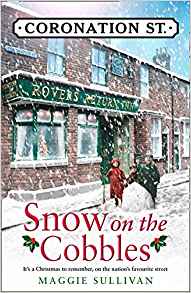
Snow on the Cobbles by Maggie Sullivan


snow on the cobbles

Harper Collins|14 November 2019|344 pages|e-book via NetGalley|Review copy|3*

I’ve been watching Coronation Street for years so when I saw Snow on the Cobbles, a Coronation Street story on NetGalley described as ‘perfect for Coronation Street fans’ I requested it. It’s the third book in the Coronation Street series. It’s set in 1945 as the Second World War is coming to an end with some of the familiar Street characters – the main one being a young Hilda Ogden, with minor roles for others such as Elsie Tanner, Albert Tatlock, Ena Sharples and the young Ken Barlow. But there are also other characters who have never appeared in the TV soap.  

The story centres around Hilda Ogden and new characters, Lizzie Doyle, her mother and her brothers, who have recently moved into No. 9 (currently  home to Tyrone Dobbs, his daughter Ruby DobbsFiz Stape and her daughter Hope Stape).  Their new neighbour, Elsie Tanner, tells them that the house is said to have bad luck and they are worried about strange noises from the loft. Lizzie makes friends with Hilda when they both start working at the Pride of Weatherfield, a pub that had recently reopened in competition with the Rovers Return, where Annie Walker is in sole charge whilst her husband Jack is away at the war.

The story is of their daily lives, struggling to make ends meet and their joy and celebrations as the war comes to an end and the men return from the war. Lizzie, however, has a secret that threatens her relationship with Steve, the barman at the Rovers Return. And the new manager at the Pride of Weatherfield is involved in some very dodgy dealings.

I read it quickly and enjoyed it as I liked the setting and the historical details about the end of the war. I also liked the biography of Jean Alexander, who played the role of Hilda Ogden and I think Maggie Sullivan has captured the essence of Hilda in this book.

My thanks to the publishers for my review copy via NetGalley.
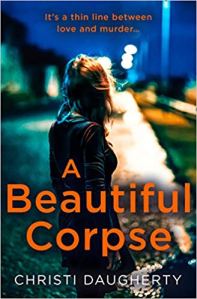
A Beautiful Corpse by Christi Daugherty

a beautiful corpse

Harper Collins|March 2019|384 pages|e-book via NetGalley|Review copy|5*

I saw A Beautiful Corpse by Christi Daugherty on NetGalley and thought I would like it from the description, but not expecting to enjoy it as much as I did. I didn’t realise that it’s the 2nd in the Harper McClain series but I think it works very well as a standalone.

I liked a lot about it – it is well written, has a fast-paced plot, but not at the expense of the characters, and it’s set in Savannah, with its historic buildings, parks and ancient oak trees covered in Spanish moss.

Harper McLain is a crime reporter with the Savannah Daily News. The book begins late one evening as she is playing pool in the Library Bar with her friend and bartender, Bonnie. The crime photographer rings her, telling her about a murder on downtown River Street, a narrow cobblestoned lane between the old wharves and warehouses and the Savannah River. And she is shocked to discover that the young woman sprawled on the uneven cobbles is Naomi, a law student, who had worked with Bonnie at the Library Bar. She had been shot dead.

There are three men who are all suspects, but her current boyfriend Wilson Shepherd is the prime suspect. The Library Bar owner, Fitz, is also a suspect especially as no one has seen him after the shooting. And then there is her ex-boyfriend Peyton Anderson, the powerful DA’s son. The police are convinced that Wilson is the killer, but after Harper talked to him, she just can’t believe that it was him. There were no witnesses to the shooting and when Harper talks to Jerrod, Naomi’s father, she realises that Peyton’s alibi may not be as solid as the police maintain it to be. 

This a story of obsession and jealousy and the tension rises as the killer’s focus shifts on to Harper herself. She is a strong determined character, determined to find out the truth. But as well as the murder investigation Harper has her own personal problems to contend with. Her job as a reporter is under threat, someone is breaking into her apartment and her personal relationship with Detective Luke Walker seems about to be revived, but she is wary where it will end. On top of all that she is desperate to find out who had killed her mother twelve years earlier. 

I loved it and it has made me eager to read the first book, The Echo Killing, to find out more about Harper and her background and also to read the next book in the series – Revolver Road due to be published in March next year – to find out what happens next.

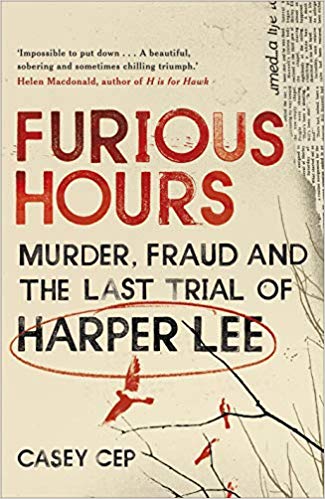
Furious Hours by Casey Cep

The stunning story of an Alabama serial killer and the true-crime book that Harper Lee worked on obsessively in the years after To Kill a Mockingbird

Furious hours

Cornerstone|May 2019|311 pages|e-book via NetGalley|Review copy|4*

In the first half of the book Casey Cep tells the story of the Reverend Willie Maxwell, who murdered members of his own family in the 1970s and held his rural community in Alabama, in fear and dread as they believed he was practising voodoo. He was shot dead at the funeral of his step-daughter by a relative, Robert Burns. Maxwell’s lawyer, Tom Radney, who had successfully defended Maxwell for years, then defended Burns, who confessed to the shooting, on the grounds of temporary insanity.

The second half is about the author, Harper Lee, who decided to write a book about all three men. In doing so Cep has written a remarkable biography of Harper Lee, her friendship with Truman Capote, her part in writing his book, In Cold Blood and her attempts to follow up the success of her book, To Kill a Mockingbird.

My favourite part of the book is without doubt the part about Harper Lee. All I knew about her before is that she wrote To Kill a Mockingbird, thought to be her only book until Go Set a Watchman was published in 2015. Cep explains that Watchman was an early version of Mockingbird, that Lee hadn’t edited or revised, and although it appears to be a sequel it isn’t  – it is the story she wrote first.

The section on Lee’s work in helping Capote  research his ‘nonfiction novel’ set in Kansas, In Cold Blood is equally as fascinating. They had lived next door to each other in Monroeville and as Cep phrased it ‘before Nelle was out of toddlerhood, she and Truman had become partners in crime and just about everything else.‘ (‘Nelle’ is her first name, the name she was known by for the first thirty-four years of her life, pronounced Nell, not Nellie.) Once they ran out of stories to read they started writing them. Cep goes into detail about the development of crime writing, and how Capote applied the techniques of fiction to nonfiction. Not everyone was happy with this novelisation of crime, not did they believe that Capote’s book was strictly factual, accusing him of  producing a sensational novel. Harper Lee minded very much about his fabrications, although she never objected publicly and this caused a rift between them.

So, this presented her with a challenge when it came to writing her book about Maxwell and his crimes, determined it would be based strictly on facts and she spent many years researching and writing her book, provisionally called The Reverend, but never finished it.

The sheer detail of Furious Hours made it quite a difficult book to read in some parts, digressing from the bare bones of the story into details such as the history of insurance, for example. But I was impressed by that detail and by Cep’s meticulous research. The book has an extensive Acknowledgements section, Notes and Bibliography, citing numerous books, journal articles and documentary films. And it has made me keen to read Go Set a Watchman, which although I bought a copy I have not read yet fearing it would spoil my love of To Kill a Mockingbird. I also must get round to reading Capote’s In Cold Blood, which I bought earlier this year, without knowing of Harper Lee’s involvement in the book.

My thanks to Cornerstone for an e-book review copy via NetGalley

Concerto by Hannah Fielding

Concerto

London Wall Publishing|6 June 2019|560 pages|e-book via NetGalley|Review copy|2*

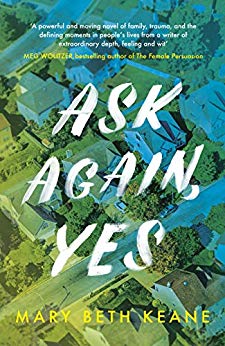
Ask Again, Yes by Mary Beth Keane

Ask Again Yes

Penguin Michael Joseph|3 October 2019|384 pages|e-book |Review copy|2*

A Single Thread by Tracy Chevalier

 I’ve enjoyed all of Tracy Chevalier‘s books that I’ve read so far, so it was no surprise to me. to find that I loved her latest book, A Single Thread

A single thread

This is historical fiction, a mix of fact and fiction, set mainly in Winchester in the 1930s. It is a a simple straightforward story, beautifully written, with the emphasis on everyday life. The main character is Violet Speedwell, a single woman of 38, regarded by society as a ‘surplus woman’ unlikely to marry  because her fiancé, Laurence was killed in the First World War. The 1921 census revealed that there were 1.75 million more women than men in the UK.  Surplus women were patronised and were expected to stay at home looking after their elderly relatives, but at the age of 38 in 1932 Violet decides to leave her overbearing mother and move on her own to Winchester. There is a lot of information about embroidering cushions and kneelers for the the Choir stalls and Presbytery seats in the Cathedral and about bell-ringing, both of which formed integral parts of the book.

Violet knew nobody in Winchester, but whilst looking round the Cathedral she came across a group of women, calling themselves the Winchester Cathedral Broderers, dedicated to embroidering hassocks and cushions for the seats and benches. She joins the group, led by Miss Louisa Pesel (a real person) and the stern Mrs Biggins and as well as learning to embroider, she makes new friends. One of these friends is Gilda, who introduces her to two of the bell-ringers, Arthur, a older married man and a younger, unmarried man, called Keith.

She is determined to be independent, not relying on her mother or her brother to support her. So she finds a job as a typist and takes a room in house shared with two other women and her landlady, Mrs Harvey, who discourages male visitors other than family. The difficulties of being independent are brought home to Violet as she struggles on her wages to pay for her lodgings, laundry and coal, let alone feed herself. And then her mother is admitted to hospital and she has to decide whether to return home to look after her.

The characters are drawn with fine detail and the descriptions of the settings, particularly in the Cathedral are so clear that I could easily visualise both the building and its interior. I particularly liked the details about the embroidery and the stitches used. As the Nazi Party and Hitler rise to power in Germany, the use of fylfots in the embroidery designs are mistaken for swastikas which are ancient symbols of light and life and good fortune.

The book gives an detailed look at life between the two World Wars. It has a slow gentle pace following Violet’s new life, but there is a sense of change on the horizon as her relationship with Arthur develops.  It gives a lively picture of the difficulties of life for unmarried women, including Gilda and Dorothy’s unconventional relationship that they have to keep secret to avoid the prejudice this would attract. And there is an indication of the sense of unease in society as the threat of another war loomed. 

It is obvious throughout the book that Tracy Chevalier has meticulously carried out her research and in the acknowledgements she lists a number of the many resources she has used, including details of Louisa Pesel’s embroidery work as well as the history of Winchester Cathedral, bell-ringing, 1930s women and life in Britain in the 1930s .

My thanks to the publishers and NetGalley for my copy of this book for review.

  • Format: Kindle Edition
  • File Size: 1382 KB
  • Print Length: 353 pages
  • Page Numbers Source ISBN: 0008153817
  • Publisher: The Borough Press (5 Sept. 2019)
  • Source: Review copy from the publishers via NetGalley
  • My Rating: 4*