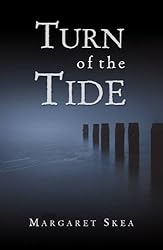
Turn of the Tide by Margaret Skea

I have read some wonderful debut novels this year –  Turn of the Tide by Margaret Skea is one of them. I loved it. It’s historical fiction and it captivated me completely transporting me  back in time to 16th century Scotland. If you have ever wondered,  as I have, what it must have been like to live in a Tower House in the Scottish Borders then this book spells it out so clearly. And it puts you firmly in the middle of the centuries old feud between the Cunninghames and the Montgomeries, with all the drama of their battles, ambushes and schemes to further their standing with the young King James VI. It’s a tale of love, loyalty, tragedy and betrayal.

It’s no wonder that the book was  the Historical Fiction Winner in the 2011 Harper Collins / Alan Titchmarsh People’s Novelist Competition and won the Beryl Bainbridge Award for Best First Time Author 2014.

There is a map setting the scene in Ayreshire on the west of Scotland between the Firth of Clyde and the Solway Firth, showing the major sites in the book. I found both the map and the list of main characters most useful whilst following the story. And to complete my understanding there is a Glossary of Scottish words at the back of the book, although the meaning of most of them was clear from the context.

It begins in 1586  with an ambush in which several of the Montgomerie Clan, on their way to James VI’s court at Stirling are killed, followed by the Clan’s reprisal on the Cunninghames. James, anxious to settle the feud between his nobles, asks them to swear to bring their feud to an end, which brings an uneasy peace between them – for a while.

Most of the characters are real historical figures, includingJames VI, the Cunninghames – William, the Master of Glencairn and the Montgomeries – Hugh, the Master of Braidstane and their families. The feud is also a matter of fact. It began in 1488 when James IV gave control of the Balliewick of Cunninghame to a Montgomerie! It didn’t come to an end until the beginning of the 17th century.

The main characters,  Munro and his wife Kate and a few of the others are fictional. Munro is a minor laird who whilst owing allegiance to the Cunninghames, has increasing sympathy and liking for the Montgomeries. His dilemma only increases throughout the book.

Margaret Skea has done her research well, not just the feud and battles but also the domestic settings are detailed down to descriptions of the clothing, the food and so on – even how the town house rooms were finished with limewash, which involved carrying bucket-load after bucket-load up four flights of stairs to rejuvenate the attic chamber where the children slept. But it slots seamlessly into the story, adding colour and life to the scenes.

It’s all fascinating  – the hunt arranged for the king, the account of his journey across the North Sea to bring home his bride, Anne of Denmark, the scenes as the royal party lands at Leith and the coronation in Edinburgh, as well as the jockeying for positions, and the battles all culminating in a tense and dramatic finale.

Not only is this riveting history it is also so well written, beautifully descriptive:

Across the valley the castle reared against the skyline, the town tumbling down the slope below, wisps of smoke beginning to unfurl, first one, then another, then too many to count, as Stirling awoke.

The countryside was spread out before him like a map; the distant hills to the south west smudged against the watery sky; the river a dark ribbon snaking through the marshland below, cradling Cambuskenneth in a giant u-shaped loop. (pages 98-99)

and this – such a startling image:

Daylight slipped into their bedchamber like wraith; grey and insubstantial, filtered through the grime and soot that coated the outside of the windowpanes. (page 247)

And I’m delighted that Margaret Skea is writing a sequel as I really want to know what happened next to Munro and his family. The working title is A House Divided, continuing the story in the late 1590s.

  • Paperback: 416 pages – also available on Kindle
  • Publisher: Capercaillie Books Limited; first edition (22 Nov. 2012)
  • Language: English
  • ISBN-10: 1909305065
  • ISBN-13: 978-1909305069
  • Source: I bought my copy
  • Author’s website: Margaret Skea, Writing yesterday, today

Read Scotland 2015

Read Scotland 2015Read Scotland 2015 is back again for a second year, Hosted by Peggy Ann @ Peggy Ann’s Post!

Challenge levels:

Just A Keek (a little look): 1-4 books
The Highlander: 5-8 books
The Hebridean: 9-12 books
Ben Nevis: 13-24 books
Back O’ Beyond: 25+ books

Read and review Scottish books -any genre, any form- written by a Scottish author (by birth or immigration) or about or set in Scotland.

Challenge runs January 1 to December 31, 2015

I’m going to do the “Just A Keek” level, 1-4 books to start with and maybe progress to the higher levels later.

Corvus: A Life With Birds by Esther Woolfson

Corvus by Esther Woolfson is a remarkable book about the birds she has has had living with her; birds that were found out of the nest that would not have survived if she had not taken them in.

‘Corvus’ is a genus of birds including jackdaws, ravens, crows, magpies and rooks. The specific birds Esther Woolfson has looked after are a rook, called Chicken (short for Madame Chickieboumskaya), a young crow, a cockatiel, a magpie, two small parrots and two canaries. But it all started with doves, which live in an outhouse, converted from a coal store into a dove-house, or as they live in Aberdeen in Scotland, a doo’cot.

Although the book is mainly about the rook, Chicken, Esther Woolfson also writes in detail about natural history, the desirability or otherwise of keeping birds, and a plethora of facts about birds, their physiology, mechanics of flight, bird song and so on. As with all good non-fiction Corvus has an extensive index, which gives a good idea of the scope of the book. Here are just a few entries for example under ‘birds’ the entries include – aggression in, evolution of, navigation, in poetry, speeds of, vision, wildness of, wings’

It’s part memoir and part nature study and for me it works best when Esther Woolfson is writing about Chicken and the other birds living in her house, how she fed them, cleared up after them, and tried to understand them. Although at times I had that feeling I get when I visit a zoo – these are wild birds kept captivity and I’m not very comfortable with that, I am reassured by Esther Woolfson’s clarification that reintroducing these birds to the wild was unlikely to be successful and indeed they lived longer than they would have done in the wild. Though Chicken and Spike (and the other birds) live domesticated lives they are still wild birds:

I realise that if ‘wild’ was once the word for Chicken, it still is, for nothing in her or about her contains any of the suggestions hinted at by the word ‘tame’. Chicken, Spike, Max, all the birds I have known over the years, live or lived their lives as they did by necessity or otherwise, but were and are not ‘tame’. They are afraid of the things they always were, of which their fellow corvids are, judiciously, sensibly; of some people, of hands and perceived danger, of cats and hawks, of things they do not know and things of which I too am afraid. ‘Not tamed or diminished’. (pages 115-6)

At times, where Esther Woolfson goes into intricate detail, for example in the chapter on ‘Of Flight and Feathers‘ I soon became completely out of my depth, lost in the infinity of specialised wing shapes and the complexities of the structure of feathers. But that is a minor criticism, far out weighed by her acute observations of the birds, her joy in their lives and her grief at their deaths – her description of Spike’s unexpected death and her reaction is so moving:

I wept the night he died. Sitting in bed, filled with the utter loss of his person, I felt diminished, bereft. I talked about him, but not very much, in the main to members of the family, who felt the same, but to few others.

It’s the only way, this compact and measured grief, for those of us who are aware that there has to be proportion in loss and mourning; we laugh at ourselves for our grief, trying to deal with this feeling that is different in quality, incomparable with the loss of a human being.

We felt – we knew – that something immeasurable had gone. (page 209)

Anyone who has lived through the death of a loved animal can recognise that sense of loss.

Corvus is a beautiful book and I have learned so much by reading it. I must also mention the beautiful black and white illustrations by Helen Macdonald – I think this is the Helen Macdonald who was awarded the 2014 Samuel Johnson Prize for Non-Fiction for H is For Hawk.

Esther Woolfson was brought up in Glasgow and studied Chinese at the Hebrew University of Jerusalem and Edinburgh University. Her acclaimed short stories have appeared in many anthologies and have been read on Radio 4. She has won prizes for both her stories and her nature writing and has been the recipient of a Scottish Arts Council Travel Grant and a Writer’s Bursary. Her latest book, Field Notes from a Hidden City (Granta Books), was shortlisted for the 2014 Thwaites Wainwright Prize for Nature and Travel Writing. She lives in Aberdeen. For more information see her website.

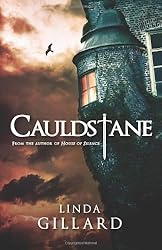
Cauldstane by Linda Gillard

Linda Gillard describes her book, Cauldstane  as ‘a gothic novel in the romantic suspense tradition of Daphne du Maurier, Mary Stewart & Victoria Holt.‘ It is a ghost story, set in a Scottish tower house in the Highlands:

Cauldstane stood, heroic, long-suffering, defying all that the centuries had thrown at it. (Wet rot and dry rot have proved more damaging to many a castle than the depredations of enemy artillery). I saw an ivy-clad tower, much taller than it was wide, with more windows than I could easily count, the whole topped by conical-roofed turrets and looking, from a distance, like a toy. (page 6)

The narrator is Jenny Ryan who is employed by Sholto MacNab, a retired adventurer and Laird of the castle, to ghost write his memoirs. Cauldstane, a beautiful castle is fast falling into disrepair and the MacNabs are struggling to maintain or even keep it.

When he employs Jenny Sholto jokes that every castle should have its ghost. Cauldstane not only has a ghost, there is also the MacNab curse, which affects the women the McNabs marry, with three deaths (two accidents and a suicide) attributed to the curse, and the legend of the Cauldstane claymore, supposed to possess supernatural powers to protect the MacNabs from evil.

Jenny immediately falls in love with the castle, but as she settles in a few things begin to disturb her – her notes on her laptop disappear. As she learns more about the MacNabs and their history, family secrets begin to surface. But what is the truth behind these stories? It seems to hinge on Meredith, Sholto’s second wife who was killed in a horrific car crash.

Cauldstane is peopled by well drawn colourful characters, a beautifully described atmospheric setting and a wealth of story-telling, recreating the past seamlessly interwoven with the present. Jenny not only falls in love with the castle, but also with Sholto’s heir, his son Alec and as she does so more strange events occur and it becomes obvious that there is a malign presence in the castle that doesn’t want her there. And it makes its presence known in a modern way – through Jenny’s laptop. No ghostly visions or  spooky voices, but a thoroughly evil presence capable of writing on the laptop as well as moving objects and putting Jenny’s life in danger, along with the music that apparently only Jenny can hear.

As well as being a gripping tale Cauldstane is also about fear. The epigraph from The Devil’s Dictionary by Ambrose Bierce (1842 – 1914) sets the tone: ‘Ghost: the outward and visible sign of an inward fear‘.  The MacNabs are not the only ones with things to fear in their past, for Jenny too has a troubled past and both have to learn how to overcome their fears. Cauldstane is also about loss and revenge, about good versus evil and the power of love.

Linda Gillard lives in the Scottish Highlands. She has written seven novels. I enjoyed this one very much but my favourite of hers is still Star Gazing. For more information about Linda Gillard and her books see her website, Linda Gillard – Author.

Reading challenges: Read Scotland 2014, My Kind of Mystery and R.I.P. IX.

A Study in Scarlet by Sir Arthur Conan Doyle

This is the first Sherlock Holmes and Dr Watson mystery, published in 1887. A Study in Scarlet is a novel in two parts. The first, narrated by Dr John Watson, begins in 1881 with Watson on nine months convalescent leave from the army, having been shot in his shoulder whilst in Afghanistan, followed by an attack of enteric fever. As a result he was weak and emaciated – ‘as thin as a lather and as brown as a nut.‘ He was looking for lodgings when he met a friend who introduced him to an acquaintance who was working in the chemical laboratory at the hospital – Sherlock Holmes, who he described as ‘a little too scientific for my tastes – it approaches to cold-bloodedness. … He appears to have a passion for definite and exact knowledge.’ 
They get on immediately and take a suite of rooms in 221B Baker Street, after Holmes astounded Watson by deducing that Watson had served in Afghanistan. Holmes describes his occupation as a ‘consulting detective‘ solving crimes for both private individuals and the police, using his intuition, observation and the rules of deduction. Tobias Gregson and Lestrade both Scotland Yard detectives regularly ask Holmes for his help.

Very soon they are involved in investigating the murder of Enoch J Drebber, an American found dead in the front room of an empty house at 3 Lauriston Gardens, off the Brixton Road,  with the word “RACHE” scrawled in blood on the wall beside the body.

A Study in Scarlet is a superb story introducing Conan Doyle’s characters – Holmes reminds Watson of

… a pure-blooded well-trained foxhound as it dashes backwards and forwards through the covert, whining in its eagerness, until it comes across the lost scent.

Holmes is his brilliant best, leaving the police officers behind as he discovers the killer. And there then follows a flashback, narrated in the third person, to Part II The Country of the Saints to America in 1847, specifically to a Mormon community, explaining the events that led up to to the murder, where John Ferrier and his adopted daughter Lucy are first rescued from death in the desert and then subjected to the community’s rules, specifically with regard to Lucy’s marriage. At first I just wanted to get back to the murder inquiry and find out how Holmes discovered the murderer’s identity, but soon I was engrossed in the American story. Eventually the two parts come together in Chapter VI as Watson resumes the narrative and  Holmes reveals how he solved the problem by reasoning backwards and from a ‘few very ordinary deductions‘ was able to catch the criminal within three days.

I thoroughly enjoyed this story, written in a straightforward style with enough description to visualise both Victorian London and the American Wild West. I’d watched the TV version A Study in Pink in the Sherlock series, which although very different in some respects is surprisingly faithful to the book in others. I like both versions.

Sir Arthur Conan Doyle was born in Edinburgh in 1859 and died in 1930. He studied medicine at Edinburgh University, becoming the surgeon’s clerk to Professor Joseph Bell said to be the model for Sherlock Holmes’ methods of deduction. He gave up being a doctor with his success as an author and became involved in many causes – including divorce law reform, a channel tunnel, and inflatable life jackets. He was instrumental in the introduction of the Court of Criminal Appeal and was a volunteer physician in the Boer War. Later in life he became a convert to spiritualism.

See Fantastic Fiction for a list of works by Sir Arthur Conan Doyle.

Challenges: Read Scotland 2014, the Colour Coded Challenge, Mount TBR 2014 and My Kind of Mystery.

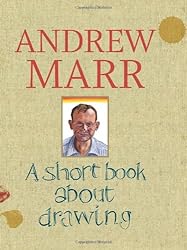
A Short Book About Drawing by Andrew Marr

I have called this a “A Short Book About Drawing” because that’s what it is. But it is also a book about being happy and the importance of drawing and making, for a happy life. I’ve written books about all sorts of things, but I have never enjoyed one as much as this. (Introduction, page 8)

Reading this book was a pleasure. I thoroughly enjoyed it – it made me happy and it encouraged me to carry on with my drawing. It’s not an instruction book, but it’s full of insight into what happens when you draw and it’s dotted throughout with personal information, such as how Marr began drawing, like most of us at school, what he drew, and how he lingered over drawings and paintings, going to exhibitions such as those at the Royal Scottish Academy.

He refers to artists and their paintings without including illustrations – the only paintings/drawings are his own!  He writes that ‘there isn’t a single drawing here I would regard as a real work of art, but I think most of them will encourage people to try for themselves.’  

He draws most days. This book was written not long before Marr suffered a stroke and it was only after he found himself drawing again – on his iPad – that he began to feel himself again. I would have liked more details about his drawings, about the medium he used –  some are obviously digital, and others are pencil sketches, but others are less obvious, maybe pen and wash?

It is a short book – just 144 pages – but there is a lot packed into those pages. Here are some more quotations that give a flavour of the book:

Chapter 2 ‘On Drawing and Happiness’:

Flow is the proposition that we are happiest when concentrating as much as possible on something that’s both quite hard  and for which we have an aptitude. … Drawing is a source of happiness and inner strength not because it is easy but because it is hard. (pages 30 -35)

Chapter 8 ‘When Did Normal People Start Drawing’. This is a very interesting chapter moving through the centuries and countries until the 1700s in London when

… the real drawing craze spreads from small numbers of enthusiasts to the new middle classes.

Marr states:

Drawing will make you a better person – not morally, necessarily, but it makes you think. It will help you see the hidden patterns all around you, and make you a discriminating lover of landscape, faces and mundane objects. It becomes an education, which changes your brain as much as learning to play the piano or to dance. It is about striving to become more fully human. (page 90)

Today we have been well educated to understand that most of us cannot draw. In the nineteenth century, foolish folk, they did not realise this, so they went off and drew anyway. (page 92)

A Short Book About Drawing is a special book. I thoroughly recommend it.

I read it because I love art, but after I finished reading I realised that it is another book, and a very different one, for the Read Scotland 2014 Challenge as

‘Andrew Marr was born in Glasgow in 1959. He studied English at the University of Cambridge and has since enjoyed a long career in political journalism, working for the Scotsman, the Independent, the Daily Express and the Observer. From 2000 to 2005 he was the BBC’s Political Editor. He has written and presented TV documentaries on history, science and politics, and presents the weekly Andrew Marr Show on Sunday mornings on BBC1 and Start the Week on Radio 4. Andrew lives in London with his family.’ (copied from the back cover)