This is the first week of Novellas in November, hosted by Bookish Beck and Cathy at 746 Books, and like Susan and Annabelle, I’m looking back at some of the novellas I’ve previously read.
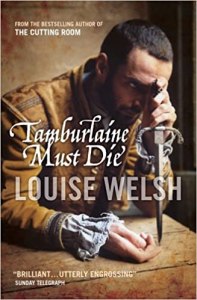
Tamburlaine Must Die by Louise Welsh – set in May 1593, it’s a tense, dramatic story of the last days of Christopher Marlowe, playwright, poet and spy. Accused of heresy and atheism, his death is a mystery, although conjecture and rumours abound. Louise Welsh has used several sources in writing this novella and it has an immediacy, that drew me in to the late Elizabethan world. It conveys the claustrophobic atmosphere of danger surrounding Marlowe; who can he trust, and who is behind the pseudonym of ‘Tamburlaine’, who posted a libellous handbill referencing Marlowe’s plays? He has just three days to find the murderous Tamburlaine, a killer escaped from the pages of his most violent play, Tamburlaine.
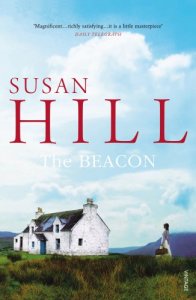
The Beacon by Susan Hill – a compelling story, drawing a picture of a family, four children and their parents living in the Beacon, an old North Country farmhouse. It’s also full of tension, of unspoken feelings and emotions as each child, Colin, May, Frank and Berenice grow up and leave home. Except that May came back after a year at university in London, unable to cope with ‘the terrors’ that began to assail her. As the years pass, May is left at home caring for her widowed mother, after she suffered a stroke. It’s a powerful book about truth and memory, about the ordinary everyday outer lives we live and the inner turmoil and tensions within us. It’s also about what we make of our lives, how we express ourselves and about how other people see us.
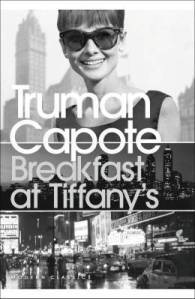
Breakfast at Tiffany’s by Truman Capote is a quick read and very entertaining. The narrator is not named, although Holly Golightly calls him ‘Fred’ after her brother. He’s a writer and at the beginning of the book he is reminiscing about Holly with Joe Bell, who ran a bar around the corner on Lexington Avenue. They hadn’t seen or heard from Holly for over two years. She used to live in the apartment below Fred’s in a brownstone in the East Seventies in New York. Her past is almost as unknown as her present whereabouts. Holly is a free spirit, charming and carefree, but craves attention. She has a cat, plays the guitar and likes to live as though she’s about to leave – all her belongings still in suitcases and crates – and has a great many friends who she entertains with numerous parties. But her life is really a mystery and not all is as it appears on the surface, longing for something wonderful to happen.
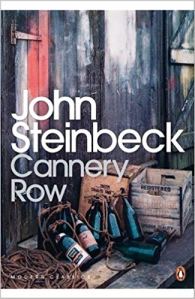
Cannery Row by John Steinbeck – I love this book. Steinbeck’s style is perfect for me, I could see Cannery Row itself, a strip of Monterey’s Ocean View Avenue, where the Monterey sardines were caught and canned or reduced to oil or fishmeal, along with all the characters – no, it was more than that -I was there in the thick of it, transported in my mind, whilst I was reading and even afterwards as I thought about the novel. There is humour and tragedy, meanness and generosity, life and death all within Cannery Row‘s 148 pages, full of fascinating characters including a group of down and outs, lead by Mack, the shop keeper, Lee Chong, who also owns the Palace Flophouse where he lets Mack and the boys live, Dora, a woman with flaming red hair, the madam who runs the Bear Flag Restaurant, Doc who lives and works at the Western Biological Laboratory and Henri the painter who is building and never finishing a boat.
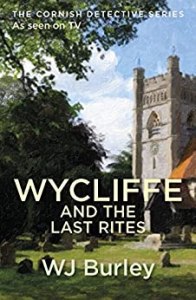
Wycliffe and the Last Rites by W J Burley – set in Cornwall a bizarre murder shakes the village of Moresk. Arriving at church on Easter morning the vicar discovers the body of a woman sprawled across the chancel steps. To add to the horror, the church is filled with the discordant sound of an organ chord, the notes apparently chosen at random and wedged down.Detective Chief Superintendent Wycliffe’s problem in finding the murderer is that all the possible leads pointed to a limited range of possible suspects but none of them matched his specification for the criminal. It seemed he had to believe the impossible. It’s a tightly plotted book, concisely and precisely written and I enjoyed it very much