Birthday Treats

Yesterday was my birthday. I had some lovely presents, including two books:

Inspector Alan Grant of Scotland Yard, recuperating from a broken leg, becomes fascinated with a contemporary portrait of Richard III that bears no resemblance to the Wicked Uncle of history. Could such a sensitive, noble face actually belong to one of the world’s most heinous villains – a venomous hunchback who may have killed his brother’s children to make his crown secure? Or could Richard have been the victim, turned into a monster by the usurpers of England’s throne?

Grant determines to find out once and for all, with the help of the British Museum and an American scholar, what kind of man Richard Plantagenet really was and who killed the Princes in the Tower.

A fascinating blend of history and mystery.

  • A Room Full of Bones by Elly Griffiths. I posted the opening lines in yesterday’s post. This book is the fourth of the Ruth Galloway investigations. The description on the back cover is –

Night falls on Halloween eve. The museum in King’s Lynn is preparing for an unusual event – the opening of a coffin excavated from the site of a medieval church. But when archaeologist Dr Ruth Galloway arrives to supervise, she finds the museum’s curator lying dead beside it. Ruth and Detective Inspector Nelson are forced to cross paths once again when he’s called in to investigate the murder, and their past tensions are reignited. And as Ruth becomes further embroiled in the case, she must decide where her loyalties lie – a choice that her very survival depends on.

It was the perfect summer’s day and we went over to the Holy Island of Lindisfarne, one of my favourite places. We’ve been there a few times, but never in such good weather. We went round the Priory, walked up to the castle and then along the coast and back inland again. Here’s one of the Priory – I’ll put up some more photos of the day later in the week. Whilst on the island D bought me this book:

Lindisfarne: the Cradle Island by Magnus Magnusson – a history of the island from the beginnings to the present day, telling the story of people and nature. Known as ‘the cradle island’ it is the ancient shrine of Celtic Christianity and the home of the Lindisfarne Gospels.

Saturday Snapshots – Jubilee Celebrations

Last Saturday I posted photos of the coronation procession I took part in in 1953. Irene asked if I would post photos of what was happening in my area for the celebration of the Queen’s Diamond Jubilee. Well, it was relatively quiet where we live, nearly 350 miles from London. We watched some of the River Pageant on television:

I liked the aerial views and the close-up shots of the Queen and Royal Family, but it was different from actually being there:

The next day our son and his family came to stay and we had a barbecue on the decking, decorated with our daughter-in-law’s hand knitted bunting:

Food was eaten, drinks were drunk and games were played:

Then in the evening we went to one of the 4,200 Diamond Jubilee Beacons that were lit all over the UK and the Channel Islands, Isle of Man, Commonwealth and Overseas UK Territories. Ours was at Watchlaw Farm in Northumberland, where there are magnificent views of the Cheviots and the Tweed Valley:

The beacon was lit just after 10pm:

and soon it was blazing away:

Click on the photos to enlarge them.

D took a video which is on YouTube – watch out for the rocket towards the end of the video!

For more Saturday Snapshots see Alyce’s blog At Home With Books.

Saturday Snapshots

Today’s Saturday Snapshots were taken on a local walk near home over two years ago. It was a few days after Christmas and the ground was still covered in snow, when we walked down to the River Tweed:

View of River Tweed from the public footpath

We walked through the woodland above the Tweed back home climbing over the ladder style from the woodland into the adjoining field. The photo below shows our  grandson climbing the style:

Climbing the ladder style

And this one is on the footpath in the field :

Walking back home

For more Saturday Snapshots see Alyce’s blog At Home With Books.

Saturday Snapshot: Bamburgh Castle

Last Monday we visited Bamburgh Castle on the coast in Northumberland overlooking the North Sea. It’s a dramatic sight, a huge castle extending over ¼ of a mile, built on a volcanic outcrop, 45 metres above sea level. (Click on the photos to enlarge.)

Bamburgh Castle from the carpark

Bamburgh Castle was bought by Lord Armstrong (who built Cragside) and renovated by him at the end of the 19th century. The castle still belongs to the Armstrong family, and is open to the public. It also hosts weddings and corporate events and has been used as a film location since the 1920s, featuring in films such as Ivanhoe (1952), El Cid (1961), Mary, Queen of Scots (1972), and Elizabeth (1998).

The entrance is through two gatehouse towers, which still have some of the original stonework. They were altered and added to in the 19th century.

Gatehouse Towers

From there you walk along the Battery Terrace, with its cannons facing the sea, placed there ready to defend the castle when Napoleon threatened to invade Britain.

Battery Terrace

From the Battery Terrace you can see Lindisfarne to the north and the Farne Islands to the south. Lindisfarne is just a dot on the horizon above the first cannon in the photo.

Inner Farne on the horizon

The photo below is of the Keep, which was originally built in the 12th century. It sits on a massive plinth to prevent attackers digging beneath it and setting fires to collapse it.

The Keep

And finally a view of Bamburgh Castle taken from the road from Seahouses to Bamburgh:

Bamburgh Castle taken from Seahouses

See Alyce’s blog At Home With Books for more Saturday Snapshots.

Saturday Snapshot

Not very far from where we live stands Twizel Castle, high up on the hillside above the River Till. You can see it from the road glimpsed through the trees. I imagined what it was like to have lived there and wondered who had built it. It’s now in ruins, was it one of the castles that had been attacked centuries ago by the Scots, from just over the border?

Twizel Castle

One day instead of just looking as we passed it we stopped and walked up to see it properly. It’s up a steep footpath:

Footpath up to Twizel Castle

and this is what we found:

Twizel Castle

and inside, dereliction:

Twizel Castle inside

It’s amazing it’s still standing:

Twizel Castle

This castle is not what it seems. It was never lived in as it’s an 18th century castle that was never completed. It stands on the site of a medieval tower house, that was, indeed, destroyed by the Scots in 1496. It’s a Grade 2 Listed Building and is on English Heritage’s At Risk Register. For more information see Images of England and Gatehouse Gazetteer.

See more Saturday Snapshots on Alyce’s blog At Home With Books.

Saturday Snapshot: Dewars Lane

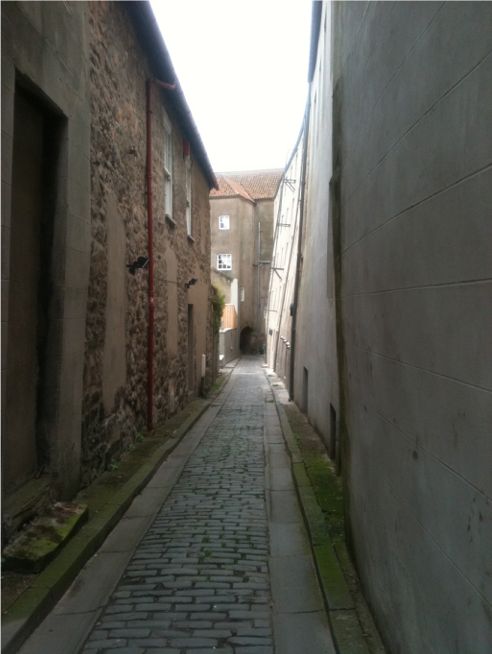
Berwick-upon-Tweed is an interesting English town near the border with Scotland, with three bridges crossing the Tweed. There are the Elizabethan Town Walls, Ramparts, Barracks, a ruined castle and quaint passageways like Dewars Lane, which dates back to medieval times. This is what it looks like today.

Dewars Lane, Berwick

The white building on the right at the end of the passageway is now a Youth Hostel, Art Gallery and Bistro. It was built in 1769 and was originally a granary. Its fantastic tilted walls are the result of a fire in 1815, after which it was propped up rather than being rebuilt. It was used for storing grain up until 1985 and was then left unoccupied, gradually becoming derelict. It has recently been restored by the Berwick Preservation Trust.

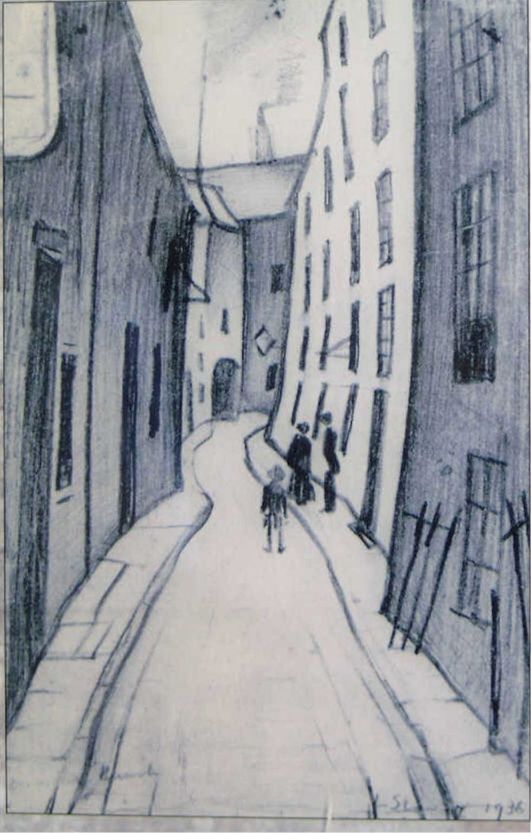
The artist L S Lowry sketched it in 1936  on one of his many visits to the town and it is now part of the town’s Lowry Trail. Below is Lowry’s pencil drawing of the Lane.

Lowry Dewars Lane

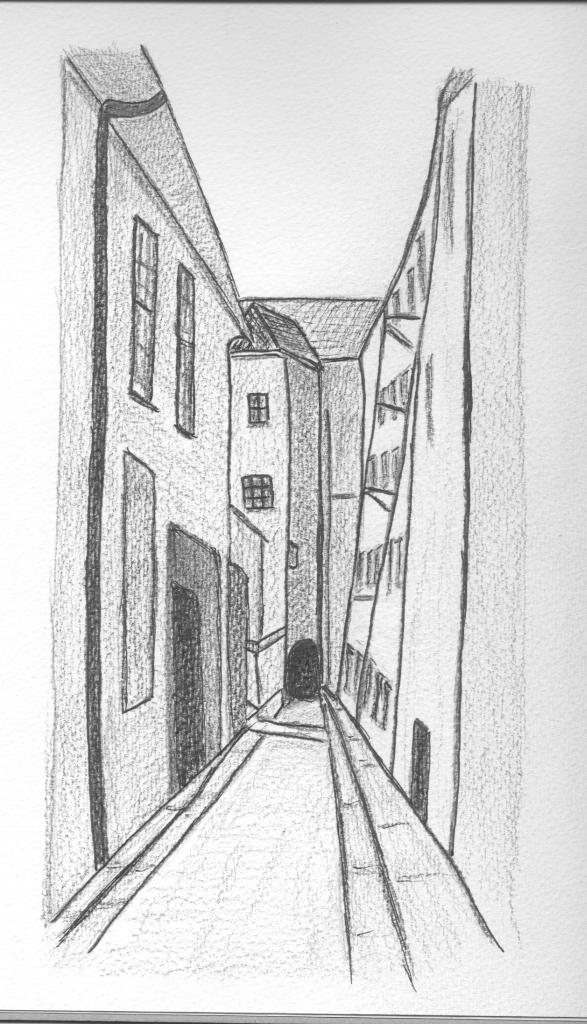
And here is my sketch:

Dewars Lane 001

See more Saturday Snapshots on Alyce’s blog At Home With Books.