Top 5 Tuesday was created by Shanah at Bionic Book Worm, and it is now being hosted by Meeghan at Meeghan Reads. For details of all of the latest prompts for January to March, see Meeghan’s post here.
Today the topic is Top 5 books with a place in the title – any location or place in a title is fine. I decided to feature books in different countries than my own (UK) – namely Italy, Japan, Greece, Russia and France.
These are all books I’ve read with links to my reviews.
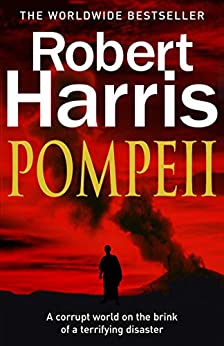
Pompeii by Robert Harris – one of my favourite books. Vesuvius erupts destroying the town of Pompeii and killing its inhabitants as they tried to flee the pumice, ash, searing heat and flames. The story begins just two days before the eruption of Mount Vesuvius and builds up to a climax.
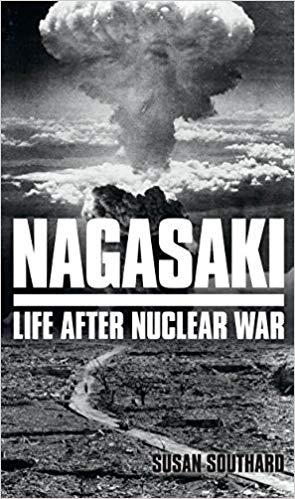
Nagasaki : Life After Nuclear War by Susan Southard, nonfiction, an amazing, heart-wrenching book. On August 9th 1945, two days after the atomic bombing of Hiroshima, a five-ton plutonium bomb was dropped on the small coastal town of Nagasaki. The effects were cataclysmic. It follows the lives of five of the survivors from then to the present day.
This must be one of the most devastatingly sad and depressing books I’ve read and yet also one of the most uplifting, detailing the dropping of the bomb, which killed 74,000 people and injured another 75,000.
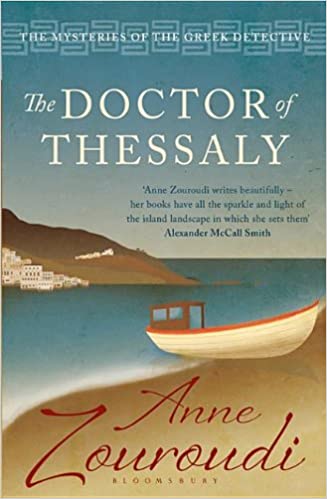
The Doctor of Thessaly by Anne Zouroudi, the third in the series of her Mysteries of the Greek Detective, about Hermes Diaktoros, a mysterious fat man. I was never sure who he worked for, or how he knew of the mystery to solve. Each of the books in the series features one of the Seven Deadly Sins – in this one it is envy, a tale of revenge and retribution.
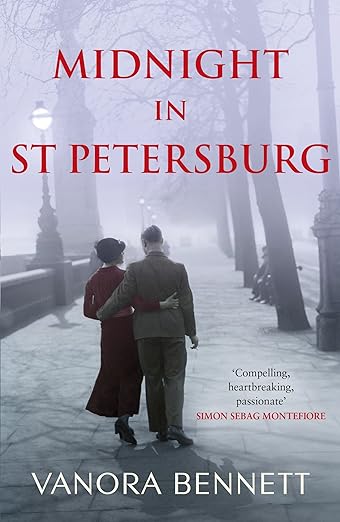
Midnight in St Petersburg by Vanora Bennett. It begins in 1911 in pre-revolutionary Russia with Inna Feldman travelling by train to St Petersburg to escape the pogroms in Kiev hoping to stay with her distant cousin, Yasha Kagan. The book is split into three sections – September – December 1911, 1916-17 and 1918-19 as Russia enters the First World War and is plunged into Revolution and life becomes increasingly dangerous for them all.
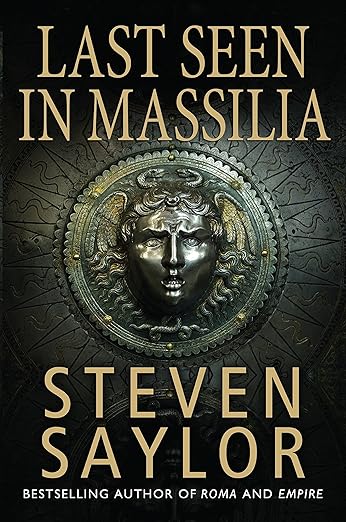
Last Seen in Massilia by Steven Saylor, historical crime fiction set in in Massilia – modern day Marseilles. It’s 49BC during Caesar’s siege of the city., featuring an investigator called Gordianus the Finder. I really liked all the details about Massilia – how it was governed – the hierarchy of the Timouchoi its ruling officials, its relationship to Rome, its traditions and customs. This is the 8th book in Saylor’s Roma Sub Rosa series set in ancient Rome.
It’s been a while since I posted about the books I’ve borrowed from the mobile library van. It’s one of three mobiles in the County Library service that comes round once a month, visiting villages and remote rural areas. It parks near our house. This week I borrowed three books.
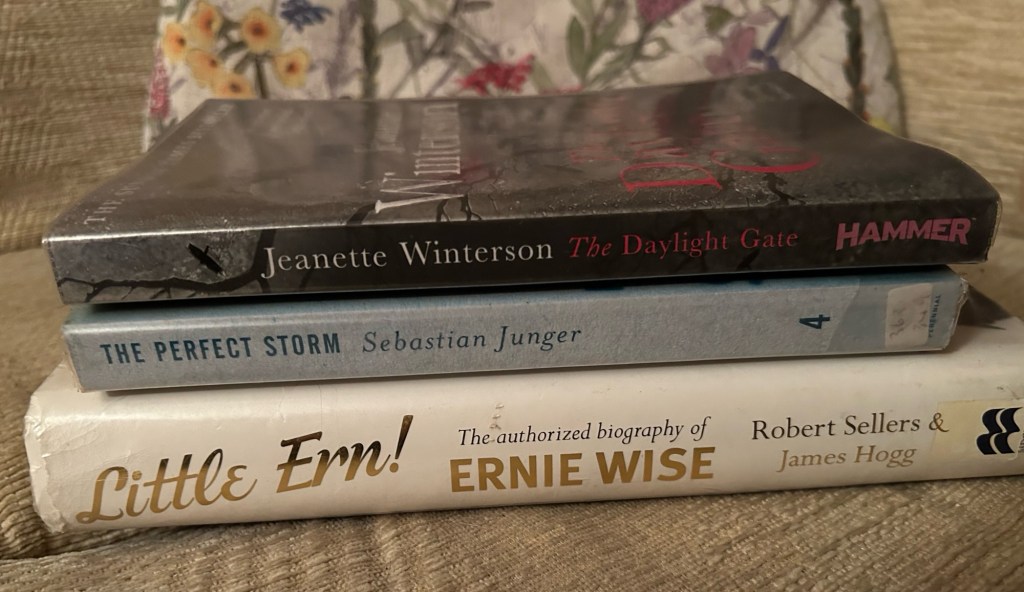
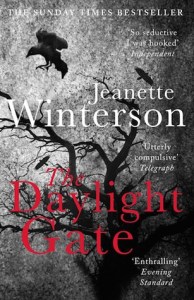
The Daylight Gate by Jeanette Winterson. I thought this looks promising. The Trial of the Lancashire Witches in 1612 was the first witch trial to be documented. Thomas Potts, a lawyer, wrote his account: The Wonderfull Discoverie of Witches in the County of Lancashire. It’s supposedly an eyewitness verbatim account and Winterson follows the historical account and the religious background in telling her story. The places are real places and the characters were real people, although she has taken liberties with their motives and means. She states that the story of Alice Nutter (not the Alice Nutter of history) and Elizabeth Southern is her own creation and has no basis in fact. And she was pleased that there might have been a connection with Dr John Dee, and with Manchester, London as well as with Shakespeare himself. And she says: ‘Pendle Hill is still the enigma it ever was though the Malkin Tower is long gone.’
The Forest of Pendle used to be a hunting ground, but some say that the hill is the hunter – alive in its black-and-green coat cropped like an animal pelt.
Good Friday, 1612. Two notorious witches await trial and certain death in Lancaster Castle, whilst a small group gathers in secret protest. Into this group the self-made Alice Nutter stakes her claim and swears to fight against the rule of fear. But what is Alice’s connection to these witches? What is magic if not power, and what will happen to the women who possess it? (Amazon UK)
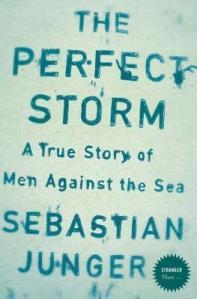
The Perfect Storm: A True Story of Men Against the Sea by Sebastian Junger I took this off the shelf and flicked through the pages, wondering what to expect from this book, described as creative nonfiction. It recounts a storm in October 1991 that resulted in the fishing boat AndreaGail going down off the coast of Nova Scotia with the loss of all six crew members.
In 2000, the book was adapted by Warner Brothers as a film of the same name, starring George Clooney and Mark Wahlberg.
It was the storm of the century, boasting waves over one hundred feet high—a tempest created by so rare a combination of factors that meteorologists deemed it “the perfect storm.” In a book that has become a classic, Sebastian Junger explores the history of the fishing industry, the science of storms, and the candid accounts of the people whose lives the storm touched. The Perfect Storm is a real-life thriller that makes us feel like we’ve been caught, helpless, in the grip of a force of nature beyond our understanding or control. (Amazon UK)
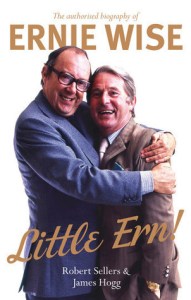
Little Ern! the Authorized Biography of Ernie Wise by Robert Sellers and James Hogg. For years I loved watching comedians Morecambe and Wise, also known as Eric and Ernie, on TV. Their partnership lasted from 1941 until Morecambe’s sudden death in 1984. And watching their shows years later they still make me laugh.
Even though they are the most famous comedy double act Britain has ever seen, until now there has never been a biography of Ernie Wise. Seen by some as just the straight man in the partnership, in fact ‘Little Ern’ was regarded by his peers as a great comedian in his own right. It took no ordinary talent to be the perfect foil for the genius of Eric Morecambe, and to be his friend, business partner and co-performer for nearly forty years. Morecambe’s personality flared with ego and insecurity, and theirs was a personal relationship that had to be nurtured as carefully as were their on-screen personas.
Nearly thirty years after their last appearances, the pair still dominate the landscape of British comedy, and are loved and revered as ever. With the cooperation of Ernie’s widow Doreen, and drawing on unpublished material from the family archive as well as interviews with friends, Robert Sellers and James Hogg have shifted the spotlight sideways to examine for the first time the true and patient genius of one of the greatest entertainers of his generation. (Goodreads)
Spell the Month in Books is a linkup hosted by Jana on Reviews From the Stacks on the first Saturday of each month. The goal is to spell the current month with the first letter of book titles, excluding articles such as ‘the’ and ‘a’ as needed. That’s all there is to it! Some months there are optional theme challenges, such as “books with an orange cover” or books of a particular genre, but for the most part, any book you want to use is fair game!
This month I’m not taking the option, which is Valentine’s Day/something sweet on the cover, but instead I’m featuring books from my blog, some from the early days of the blog.
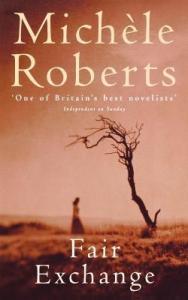
F is for Fair Exchange by Michele Roberts – historical fiction set in England and France in the late 1700s/early 1800s during the French Revolutionary period. While drawing hints and facts from the lives and secret affairs of two of the most famous and passionate figures of the late 18th century – Mary Wollstonecraft and William Wordworth – the intriguing mystery surrounding these two women, is Michèle Roberts own fascinating creation. It’s about William Saygood a fictional friend of Wordsworth’s. Mary Wollstonecraft appears in the novel but Roberts has ‘plundered various aspects of her life’ for the character, Jemima Boote. There is a fair bit in this book about women’s rights and their place in society, and about the question of nurture versus nature in bringing up children.
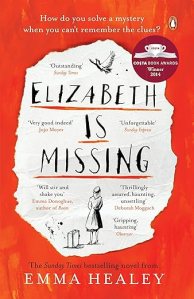
E is for Elizabeth is Missing by Emma Healey – Maud has dementia – but she knows her friend Elizabeth is missing. I enjoyed the TV adaption with Glenda Jackson as Maud much more than the book. Emma Healey’s depiction of dementia is convincing showing the confusion and bewilderment that Maud must have felt. It’s heart-rending. As Maud continues her search for Elizabeth, she also recalls the search for her sister, Sukey, who disappeared in 1946. And no matter who tells her to stop going on about it, to leave it alone, to shut up, Maud will get to the bottom of it. Because somewhere in Maud’s damaged mind lies the answer to an unsolved seventy-year-old mystery. One everyone has forgotten about.
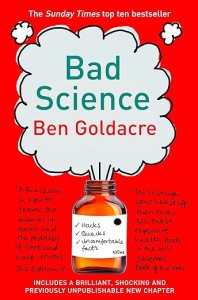
B is for Bad Science by Ben Goldacre – a splendid rant against the lack of education and knowledge about health with the inevitable result that we are unable to understand and judge for ourselves the effectiveness of the various treatments on offer. He describes how placebos work, just what homeopathy is, the misunderstandings about food and nutrition, and above all how to decide what works and what is quackery, scaremongering or downright dangerous. I found this easy to understand, apart from the statistics, which cause my eyes to glaze over at the mere sight of a graph, tables or columns of figures. Fortunately there’s not a lot of that in this book.
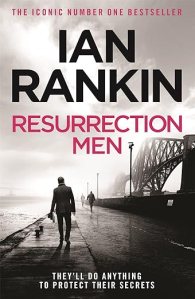
R is for Resurrection Men by Ian Rankin, an Inspector Rebus book. Resurrection Men isn’t about body-snatchers (as I wondered it might be), but about the cops who need re-training, including Rebus. They’re at Tullialian, the Scottish Police College and they are a tough bunch indeed, ‘the lowest of the low‘ as one of them, DI Gray tells a witness he is interrogating. To help them become team players – fat chance of that I thought – they’ve been given on old, unsolved case to work on. But Rebus was involved in the case at the time and begins to get paranoid about why is on the course. It’s a tough, gritty story and as with other Rebus books, there’s more than one investigation on the go, several, in fact, needing concentration to keep tabs on each one. I thought it was excellent.
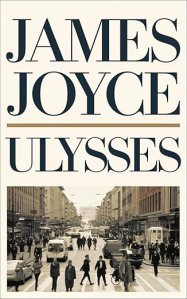
U is for Ulyssesby James Joyce – I have started this book and given up several times. I’d love to say I’ve finished it, but I haven’t. It deals with the events of one day in Dublin, 16th June 1904, now known as “Bloomsday”. The principal characters are Stephen Dedalus, Leopold Bloom and his wife Molly. Loosely modelled on the wanderings of Homer’s Ulysses as he travelled homewards to Ithaca, Joyce’s novel follows the interwoven paths of Stephen, estranged from his father and Leopold, grieving for his dead infant son. Written over a seven-year period, from 1914 to 1921, Ulysses has survived bowderlization, legal action and bitter controversy.
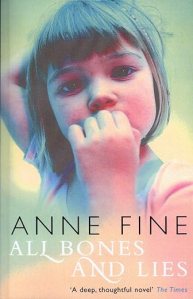
A is for All Bones and Lies by Anne Fine. I had high hopes I would like this book and that it would be a funny book – Anne Fine has won Awards for her children’s books and the film, Mrs Doubtfire, starring Robin Williams, is based on her book Madame Doubtfire. Although I didn’t enjoy the story, I did find it an indictment of how old age is looked upon by some people – an angry, unsettling and cruel look at our society.
Colin, works for the council and visits his aged mother, Norah. Norah is a grumbler, completely self-absorbed and constantly belittling Colin who can never please her. At times I found it confusing, just what was real and what was in his imagination and how the book hung together. Of course, everything goes wrong as events spiral out of Colin’s control.
R is for The Return of the Native by Thomas Hardy, one of my favourite authors and I thoroughly enjoyed this book. It’s a dramatic and tragic love story. It has a large cast of characters, with lovers who change their affections throughout the novel and it’s full of intrigue with striking moonlit scenes, disputes, heated quarrels and misunderstandings, along with rustic characters and traditional celebrations, for example Guy Fawkes night, May Day and a Mummers’ play at Christmas. It’s not a book to read quickly and it transported me back to a time that ceased to exist before I was born, where time moved more slowly, ruled by the seasons and the weather, and with a clearly defined social hierarchy. And yet, I was surprised to find that youngsters were scribbling graffiti on ‘every gatepost and barn’s doors’, writing ‘some bad word or other’ so that a woman can hardly pass for shame some time.’
Y is for You Talkin’ To Me?: Rhetoric from Aristotle to Obama by Sam Leith a TBR. Sam Leith traces the art of argument from ancient Greece down to its many modern mutations. He introduces verbal villains from Hitler to Donald Trump – and the three musketeers: ethos, pathos and logos. He explains how rhetoric works in speeches from Cicero to Richard Nixon, and pays tribute to the rhetorical brilliance of AC/DC’s “Back In Black”. Before you know it, you’ll be confident in chiasmus and proud of your panegyrics – because rhetoric is useful, relevant and absolutely nothing to be afraid of.
The next link up will be on March 1, 2025 when the theme be Science Fiction
Who are some new authors that you want to read from in 2025
Top 5 Tuesday was created by Shanah at Bionic Book Worm, and it is now being hosted by Meeghan at Meeghan Reads. For details of all of the latest prompts for January to March, see Meeghan’s post here.
Today the topic is 5 authors I want to try in 2025. Who are some new authors that you want to read from in 2025? These books are from my TBRs.
I was really excited to read Schindler’s List when I bought it as I’d recently watched the film, Schindler’s List for a second time and was very moved by it – it had me in tears. It was first published as Schindler’s Ark. It recreates the story of Oskar Schindler, a member of the Nazi party, who risked his life to protect Jews in Nazi-occupied Poland. He rescued more than a thousand Jews from the death camps.
The Agony and the Ecstasyby Irving Stone is a book I’ve been longing to read for years. I’ve had it since 2007. It’s a biographical novel about Michelangelo. The copy I had was impossible to read as it was falling apart so I bought a new copy – but it’s still sitting waiting to be read. Why? Well because I have so many other books I really want to read.
Another book I’ve had since 2007, still waiting to be read for the same reason is 1599: A Year in the Life of William Shakespeare by James Shapiro. 1599 was the year the Globe Theatre was built and that Shakespeare wrote Julius Caesar, Henry V, As You Like It and Hamlet. it’s full of detail, not just about Shakespeare, his plays and the theatre, but also about the events of his life and times!
Version 1.0.0
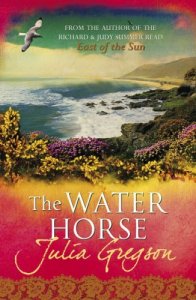
The Water Horse by Julia Gregson, a book I’ve had since 2009. It’s historical fiction based on the true story of a young Welsh woman, Jane Evans, a Welsh woman who in 1853 ran off with Welsh cattle drovers and volunteered as a nurse with Florence Nightingale in the Crimea. Catherine Carreg has grown up a tomboy, spending her days racing her ponies with Deio, the drover’s son, in a small Welsh village. But Catherine is consumed by a longing to escape the monotony of village life and, with Deio’s help, runs away to London.
Alone in the unfamiliar bustle of the city, Catherine finds a position in a rest home for sick governesses in Harley Street, run by Miss Florence Nightingale. Then, as the nation is gripped by reports of the war in the Crimea, Catherine volunteers as a nurse – and her life changes beyond all recognition.
Jeremy Hutchinson’s Case Histories by Thomas Grant – I bought this in February 2020 after watching the BBC series,The Trial of Christine Keeler, the story of the Profumo affair in 1962 as seen from her perspective. Hutchinson was Keeler’s defence barrister.
Born in 1915 into the fringes of the Bloomsbury Group, Jeremy Hutchinson went on to become the greatest criminal barrister of the 1960s, ’70s and ’80s. The cases of that period changed society for ever and Hutchinson’s role in them was second to none. In Case Histories, Jeremy Hutchinson’s most remarkable trials are examined, each one providing a fascinating look into Britain’s post-war social, political and cultural history.
It’s Saturday and time for Stacking the Shelves, hosted by Marlene at Reading Realityand the details are on her blog, as well as a huge amount of book reviews. Why not visit her blog if you haven’t already found it? The gorgeous graphic is also used courtesy of the site.
The idea is to share the books you are adding to your shelves, may they be physical or virtual. This means you can include books you buy in physical stores or online, books you borrow from friends or the library, review books, gifts and of course e-books!
These are all e-books I’ve either bought or acquired for free from Amazon since the beginning of this year:
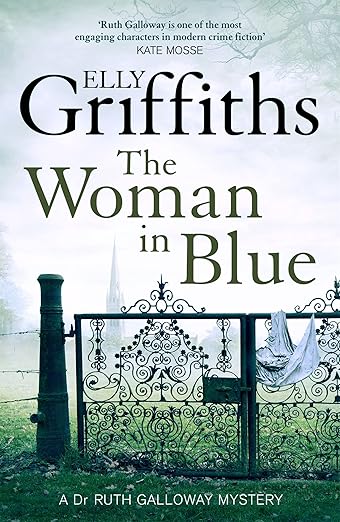
The Woman In Blue: The Dr Ruth Galloway Mysteries 8 by Elly Griffiths. Somehow I missed reading this book when it first came out in 2016, so when I saw it was 99p on Amazon I bought it. It’s book 8 out of 15 in the series. When Ruth’s friend Cathbad* sees a vision of the Virgin Mary, in a white gown and blue cloak, in Walsingham’s graveyard, he takes it in his stride. Walsingham has strong connections to Mary, and Cathbad is a druid after all; visions come with the job. But when the body of a woman in a blue dressing-gown is found dead the next day in a nearby ditch, it is clear that a horrible crime has been committed, and DCI Nelson and his team are called in for what is now a murder investigation.
*I’ve read most of this series. Cathbad is one of my favourite characters.
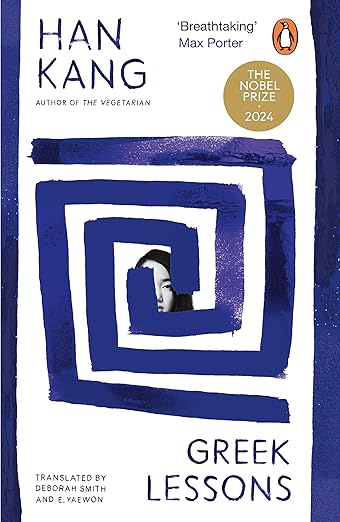
Greek Lessons by Han Kang, the winner of the 2024 Nobel Prize in Literature, a new-to-me author. This is a new translation by Deborah Smith and Emily Yae Won, of the 2011 novel that explores how a teacher losing his sight and a pupil losing her voice form a poetic bond. It is a short book, of just 149 pages narrated by the two unnamed characters, one a woman grieving for her mother and her son, now in the custody of her ex-husband. She is also experiencing the loss of her ability to speak. The other is a man losing his connection to place and family, as well as the loss of his eyesight. They meet when the woman attends his Ancient Greek lessons.
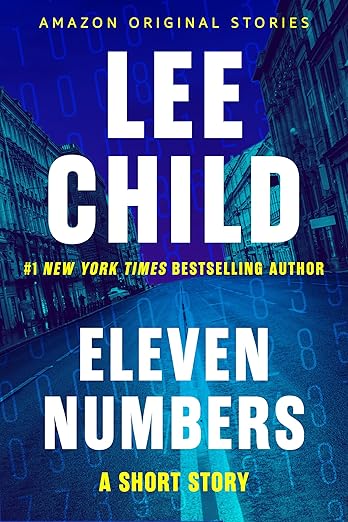
Eleven Numbers, a short story by Lee Child. Nathan Tyler is an unassuming professor at a middling American university with a rather obscure specialty in mathematics—in short, a nobody from nowhere. So why is the White House calling? Summoned to Washington, DC, for a top-secret briefing, Nathan discovers that he’s the key to a massive foreign intelligence breakthrough. Reading between the lines of a cryptic series of equations, he could open a door straight into the heart of the Kremlin and change the global balance of power forever. All he has to do is get to a meeting with the renowned Russian mathematician who created it. But when Nathan crashes headlong into a dangerous new game, the odds against him suddenly look a lot steeper.
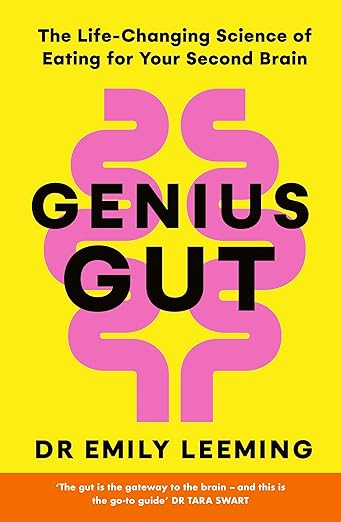
Genius Gut: 10 New Gut-Brain Hacks to Revolutionise Your Energy, Mood, and Brainpower by Emily Leeming. Microbiome scientist and registered dietitian Dr Emily Leeming explains the ground-breaking evidence on the relationship between food and mood, unveiling the powerful gut-brain connection…and exciting new links to your gut bacteria. I downloaded the sample before deciding to buy this book and think it looks very interesting and easy to read for a non-scientist like me. I never thought much about my gut until I had bowel cancer eighteen months ago!
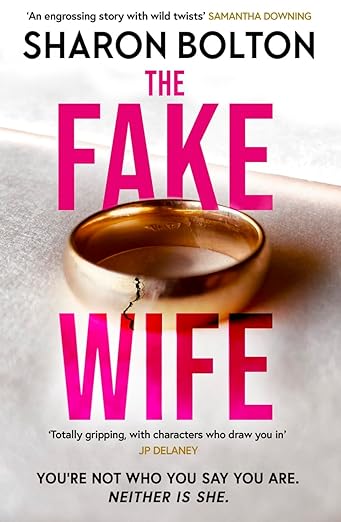
The Fake Wife by Sharon Bolton. I’ve a lot of her books and have enjoyed them all, so this is one I’m really looking forward to reading. It’s described as an absolutely gripping psychological thriller with jaw-dropping twists. Olive Anderson is dining alone at a hotel when a glamourous stranger joins her table, pretending to be her wife. What starts as a thrilling game quickly turns into something dangerous. But as much as the fake wife has her secrets, Olive just might have more . . .
Top 5 Tuesday was created by Shanah at Bionic Book Worm, and it is now being hosted by Meeghan at Meeghan Reads. For details of all of the latest prompts for January to March, see Meeghan’s post here.
Today the topic is Top 5 books I will definitely* read in 2025. What are 5 books you really want to tick off your TBR this year? * Same disclosure every year: you won’t be subjected to punishment (from Meeghan) if you don’t read these.
I have so many TBRs that it is difficult to choose just 5. These are 5 of the books that I’ve had for several years but I’m a mood reader so just like Meeghan when I say “definitely” I mean “maybe, you know, if I feel like it”.
Whispers Under Ground by Ben Aaronovitch – Book 3 in the Rivers of London series, from Sunday Times Number One bestselling author Ben Aaronovitch.
I’ve read the first two of this series, and loved them, so why haven’t I read any more?
Peter Grant is learning magic fast. And it’s just as well – he’s already had run-ins with the deadly supernatural children of the Thames and a terrifying killer in Soho. Progression in the Police Force is less easy. Especially when you work in a department of two. A department that doesn’t even officially exist. A department that if you did describe it to most people would get you laughed at. And then there’s his love life. The last person he fell for ended up seriously dead. It wasn’t his fault, but still.
Now something horrible is happening in the labyrinth of tunnels that make up the tube system that honeycombs the ancient foundations of London. And delays on the Northern line is the very least of it. Time to call in the Met’s Economic and Specialist Crime Unit 9, aka ‘The Folly’. Time to call in PC Peter Grant, Britain’s Last Wizard.
This Poison Will Remain by Fred Vargas. The 9th book in her Commissaire Adamsberg series. I’ve read some of the earlier books.
After three elderly men are bitten by spiders, everyone assumes that their deaths are tragic accidents.
But at police headquarters in Paris, Inspector Adamsberg begins to suspect that the case is far more complex than first appears.
It isn’t long before Adamsberg is investigating a series of rumours and allegations that take him to the south of France. Decades ago, at La Miséricorde orphanage, shocking events took place involving the same species of spider: the recluse.
For Adamsberg, these haunting crimes hold the key to proving that the three men were targeted by an ingenious serial killer. His team, however, is not convinced. He must put his reputation on the line to trace the murderer before the death toll rises…
Thomas Cromwell: The untold story of Henry VIII’s most faithful servant by Tracy Borman. After reading Hilary Mantell’s historical fiction trilogy about Thomas Cromwell, I want to read this biography about him – just haven’t got round to it yet.
I feel bad about not reading the next two books, both biographies as I’ve had them for so long, I’d love to read both of them this year …
The Brontes by Juliet Barker. I visited the Bronte Parsonage Museum in Haworth, way back in 2014, and have been meaning to read this book about the family ever since.
The story of the tragic Bronte family is familiar to everyone: we all know about the half-mad, repressive father, the drunken, drug-addicted wastrel of a brother, wild romantic Emily, unrequited Anne and ‘poor Charlotte’. Or do we? These stereotypes of the popular imagination are precisely that – imaginary – created by amateur biographers from Mrs Gaskell onwards who were primarily novelists, and were attracted by the tale of an apparently doomed family of genius.
Juliet Barker’s landmark book was the first definitive history of the Brontes. It demolishes myths, yet provides startling new information that is just as compelling – but true. Based on first-hand research among all the Bronte manuscripts, many so tiny they can only be read by magnifying glass, and among contemporary historical documents never before used by Bronte biographers, this book is both scholarly and compulsively readable. THE BRONTES is a revolutionary picture of the world’s favourite literary family.
Paradox ruled Thomas Hardy’s life. His birth was almost his death; he became one of the great Victorian novelists and reinvented himself as one of the twentieth-century’s greatest poets; he was an unhappy husband and a desolate widower; he wrote bitter attacks on the English class system yet prized the friendship of aristocrats.
In the hands of Whitbread Award-winning biographer Claire Tomalin, author of the bestselling Charles Dickens: A Life and The Invisible Woman, Thomas Hardy comes vividly alive.