‘New to Me’ Books

I had a good time at Barter Books in Alnwick yesterday. Bartering books is a good way to recycle the books I’m not going to read again. I took in a box of books and came home with these. As I had built up a nice little sum over my last few visits, I was able to indulge myself!
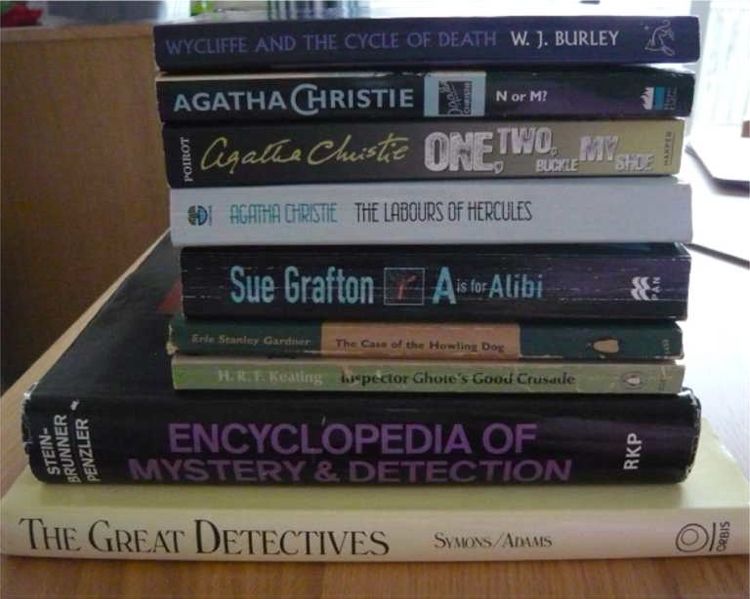
Crime fiction

As you can see I was looking out for crime fiction and found three Agatha Christie’s I haven’t read:

  1. The Labours of Hercules – Poirot undertakes twelve cases before he retires to grow superior vegetable marrows.
  2. N or M? – a Tommy and Tuppence wartime mission.
  3. One, Two, Buckle My Shoe – Poirot investigates the death of his dentist.

I also got another Wycliffe book by W J Burley – Wycliffe and the Cycle of Death, in which he investigates the murder of a bookseller.

And another Perry Mason book by Erle Stanley Gardner- The Case of the Howling Dog – according to superstition a howling dog means a death in the neighbourhood, then both the dog and his owner are killed.

I’ve read one of H R F Keating’s books before but none of his Inspector Ghote’s books – this one caught my eye, Inspector Ghote’s Good Crusade, in which a millionaire philanthropist, the founder of a Bombay home for vagrants is murdered.

I’ve never read any of Sue Grafton’s books but have read reviews of a few, so I was pleased to find the first of her A-Z series – A is for Alibi. Kinsey Malone, Private Investigator has a cold case, hired by Nikki Fife, convicted of the murder of her husband eight years earlier, to find the real killer. If I like these there are plenty more in the series to look out for – and yesterday Barter Books had a shelf-full.

As I still had credit left I splashed out and bought two rather more expensive hardback books on crime fiction, which are at the bottom of the pile in my photo:

  1. The Great Detectives by Julian Symons, fictional ‘biographies’ of seven detectives, including Sherlock Holmes in retirement! I’ve been watching the fantastic TV series Sherlock, so my interest is very high right now.
  2. Encyclopedia of Mystery and Detection by Chris Steinbrunner and Otto Penzler. I’m really excited by this book, even though it’s over 30 years since it was published. It’s a big, heavy volume which I’m sure is an excellent reference book, containing biographies and bibliographies of crime writers and articles on films, plays radio and TV series and so on. I’ll be dipping into it regularly.

And because I do like to read other books than crime fiction I also got these two books:

How to draw anything

I’ve been attempting to draw and paint and this book, How to Draw Anything by Angela Gair makes it look easy, which of course it isn’t. But I’m hoping it will help me improve.

A Still Life Byatt

I looked briefly at the many bookcases of general fiction and was drawn (pun not intended!) to Still Life by A S Byatt. Maybe my mind was still on art but this book certainly caught my eye. It’s a novel set in the 1950s. The cover is Still Life with Coffeepot by Vincent Van Gogh.
Mini Reviews

I’ve been reading books recently and not writing anything about them. So, before they drop out of my mind completely here are a few notes:

Body Parts: Essays on Life Writing by Hermione Lee – this is a book about writing biography, which I’ve been reading on and off since I started it in 2007! I first wrote about my impressions in this post. It’s very good with an interesting selection, although some essays are a lot shorter than others. As with all books about writing it includes books and authors I haven’t read – and makes me want to read them – Eudora Welty for one. There are essays on T S Eliot, J M Coetzee, Jane Austen and Virginia Woolf, to name but a few.

My rating 4/5

A Wrinkle in Time by Madeleine L’Engle – I bought this book several years ago, so it’s one off my to-be-read list. A fantasy/science fiction magical classic and 1963 Newbery Medal winning book, which I thoroughly enjoyed. It’s the story of Meg and Charles, searching for their father, a scientist, lost through a ‘wrinkle in time’, with wonderful characters such as Mrs  Whatsit, Mrs. Who and Mrs. Which to help them.

My rating 4.5/5

Maigret in Court by Georges Simenon. Maigret is two years from retirement and is wondering about this with foreboding. He does seem rather tired as he investigates the murder of a woman and small child. The book begins in court as Maigret gives evidence against Gaston Meurat, but he is beginning to have doubts that Meurat is the murderer and carries on investigating to save Meurat from execution. A complicated story, packed into 126 pages, that at times had me completely puzzled.

My rating 3/5

I read two books on Kindle:

Breakfast at the Hotel Deja Vu by Paul Torday. I rather liked this little e-book about a politician, a former MP exposed in the expenses scandal and staying in a hotel abroad, whilst he recovers from an illness and writes his memoirs. All is not as it seems, however, as each day he discovers he hasn’t actually written anything.And just who are the woman and young boy he sees each morning?

My rating 4/5

Crime in the Community by Cecilia Peartree – a free e-book from Amazon. I was disappointed with this one – too wordy, and convoluted. It’s about a small group of people who are supposed to be organising events to improve their community, but who actually don’t do anything except go to meetings. I found this part quite true to life for some committees I’ve known. But then it got tedious and eventually too far-fetched with a retired spy, a missing person and a mental breakdown.

My rating 2/5

Faulks on Fiction by Sebastian Faulks

I didn’t watch the TV series Faulks on Fiction but was interested enough to buy the book. It seemed a good idea to trace the history of the novel through a selection of fictional characters. To a certain extent Sebastian Faulks has done that, but the book is really about the characters and only touches on the development of the novel. Faulks, he reveals in the Acknowledgements, would prefer his book to be called Novel People, which I think would be better.

And if you haven’t read the books and don’t want to know the plot don’t read this book, because Faulks gives these in detail. There are 28 characters, categorised into Heroes, Lovers, Snobs and Villains. It is a very personal book as Faulks himself features in his descriptions, telling of when he first read a book and what he thought on reading it and his impressions on re-reading. I liked that. He also discusses the way literary criticism has changed in that over the last twenty years the author’s life and its bearing on the works has become an issue:

The bad news was that it opened the door to speculation and gossip. By assuming that all works of art are an expression of the authors’ personality, the biographical critics reduced the act of creation to a sideshow. It has now reached such a pass that the only topic some literary journalists seem able to approach with confidence is the question of whom or what people and events in novels are ‘based on’. (page 2)

Accordingly, Faulks focuses on the plot and the characters rather than on the authors, although oddly enough he does indulge in some ‘based on’ descriptions, eg in his chapter on Graham Greene’s The End of the Affair where he discusses whether or not the character of Sarah was ‘based on’ a real life lover of Greene’s.

Faulks is rather disparaging about monthly book groups where the topic is not the novel but a discussion about the author’s life and how it is reflected in the book, together with how this is borne out by the ‘readers’ own experience of such matters’. (page 6) His book aims to show how novelists ‘create – from nothing, or from imagination’. It’s hard to imagine that novels are so divorced from life!

However, despite this and despite not agreeing with all of his interpretations – it would be strange if we all agreed about everything – I enjoyed reading this book. I’d read the majority of the books he discusses and enjoyed being reminded of them – books such as Pride and Prejudice, although Faulks fails to see the attraction of Mr Darcy, who he places in the section on Lovers, describing him as a  ‘rude and gloomy man‘, a ‘manipulative, hypocritical, self-centred depressive‘ and considers that Elizabeth is his ‘lifelong Prozac‘.  I really must re-read Pride and Prejudice, because my memory of Darcy and Elizabeth is very different from Faulks’s picture of them.

Other books he discusses include Robinson Crusoe, Vanity Fair, Wuthering Heights, Lady Chatterley’s Lover, The Prime of Miss Jean Brodie, Clarissa and Great Expectations, to name but a few.

I haven’t read Wilkie Collins’s The Woman in White and as I  want to read it without Faulks’s opinion in my mind I haven’t read the chapter on Count Fosco in the section on Villains.

As for the other books I haven’t read, which he describes, I think I don’t need or want to read them, such as Lucky Jim by Kingsley Amis, Money by Martin Amis,or The Line of Beauty by Alan Hollingsworth. I also don’t want to read Faulks’s new James Bond book, Devil May Care, which he plugs in the section on Snobs. But maybe I’m being too dismissive, because as I didn’t agree with all his views on the books I have read, so maybe I should read the books for myself.

  • Paperback: 384 pages
  • Publisher: BBC Books (1 Sep 2011)
  • Language English
  • ISBN-10: 1846079608
  • ISBN-13: 978-1846079603
  • Source: I bought the book
  • My Rating: 3/5

War Through the Generations Challenge – World War One

I’ve been thinking about Reading Challenges for next year. At first I thought I would only do one or two, because I start out full of enthusiasm and then find that by listing the books I want to read often ends up with me forgetting about them and reading something completely different. I’m very much a ‘mood’ reader. This made me feel a bit pressured when I remembered that I haven’t read the books/finished a particular challenge.

But then I realised that the pressure is purely of my own making, and as I really enjoy making lists and seeing which books I already own would fit into a challenge, I’ve decided to go ahead, make my lists and if I do complete the challenge, so much the better. This of course, means that I’m not treating it as a ‘challenge’, but then I don’t consider reading is or should be a ‘challenge’.  I  think I’ll call it ‘themed reading‘.

My books fit so well into this theme, so I’m signing up for The War Through the Generations:World War 1 Challenge.

Here are the details:

The challenge will run from January 1, 2012, through December 31, 2012.
The books, whether fiction or non-fiction must have WWI as the primary or secondary theme and occur before, during, or after the war, so long as the conflicts that led to the war or the war itself are important to the story. Books from other challenges count so long as they meet the above criteria.

  • Dip: Read 1-3 books in any genre with WWI as a primary or secondary theme.
  • Wade: Read 4-10 books in any genre with WWI as a primary or secondary theme.
  • Swim: Read 11 or more books in any genre with WWI as a primary or secondary theme.

And these are my books:

  • All Quiet on the Western Front by Erich Maria Remarque – a book I mean to read each year. I started it a couple of years ago and never finished it. I’ll have to start again.
  • The Ghost Road by Pat Barker – set in 1918 as the War came to an end. This is the third in the trilogy. I haven’t got the first two, so hope this stands well on its own.
  • Testament of Youth by Vera Brittain. This is Vera Brittain’s autobiography. She was 21 in 1914.
  • Chronicle of Youth by Vera Brittain. This is her war diary 1913 – 1917 on which she based Testament of Youth.

Book Beginnings on Friday

This morning I finished reading Faulks on Fiction by Sebastian Faulks, a book I’ve been reading slowly for a few weeks (my review coming soon). It’s time to choose another non-fiction book to take its place. It’s got to be a book I can read in small bites and not lose the thread, maybe a biography/autobiography, or a diary, collection of letters, or a history book.

I’ve looked at a few and have decided on this one:

The half-timbered mansion disappeared long ago, and the paved thoroughfare lies buried beneath the dust of centuries. The Great Fire tore the heart out of this corner of Elizabethan London, devouring books, buildings and streets. One of the few things that survived is a small and insignificant-looking map – crinkled, faded, but still bearing the proud name of its owner. (page 1)

This is the beginning of Giles Milton’s about the first English settlement in the New World in the sixteenth century. It’s Big Chief Elizabeth: how England’s Adventurers gambled and won the New World. I’ve read his earlier book Nathaniel’s Nutmeg, which is a fascinating tale of the ‘competition between England and Holland for possession of the spice- producing islands of South-East Asia throughout the 17th century.’

I like the beginning of Big Chief Elizabeth, which within a few words captures the mystery and appeal of history for me. I’m looking forward to discovering more about the map and its owner.

Blurb from the back cover:

Big Chief Elizabeth has it all: gallant English seadogs, coiffured courtiers, exotic locations and lots of fights with pirates, Spaniards and Indians. (Sunday Telegraph)

Plus I’m interested to read Giles Milton’s newest book, Wolfram: the Boy who Went to War.

Book Beginnings on Friday is hosted by Katy at A Few More Pages.

Saturday Snapshots – Great Hetha Walk

We’ve been having a mix of weather recently what with wet days, windy days, dull grey days and a few beautiful sunny days. Wednesday was one of the days when the sun shone the sky was blue and it even felt a bit spring-like. So that afternoon Dave and I decided it was time we took a walk in the Cheviot Hills.

We’ve lived just north of the Cheviots for nearly two years now and have been saying ever since we arrived that we must go walking in the hills. I don’t know how many hills there are that form the range, but there are many of these rounded hills bisected by valleys. They straddle the border between England and Scotland, that area of land fought over in the past, a land where the Border Reivers held sway. The Cheviot, itself is the highest point at 815 metres and the last major peak in England, but we decided to start small with Great Hetha above College Valley and work up to walking the Marilyns.

The photo above shows the view at the start of our walk with Great Hetha on the skyline. It’s 210 metres at the summit where there are the remains of an ancient hillfort. We parked in the car park just south of Hethpool and the walk began easily enough along the private road through the Valley. The photo below shows the Valley looking south:

After a short distance and turning right it’s a steep uphill climb described in Walks in the Cheviot Hills by David Haffey as a ‘strenuous climb‘! I was soon struggling for breath. We stopped halfway up to look at the view northwards to Scotland (and to get our breath back!).

Looking up at that point we could see a small cairn on the summit, still a steep climb ahead.

It was worth the climb to reach the hillfort. This is an Iron Age hillfort dating from about 500BC. The remains of the stone ramparts are still there and it was easy to imagine what it must have been like in such an isolated place, being able to see for miles around, aware of any approach to the hill. According to the Walks guidebook such hillforts would have contained several timber-built round-houses within the stone ramparts, probably being occupied for several centuries.

From there we left the route in the guidebook and walked down the other side of the hill to the valley below and crossed the Elsdon Burn. The sky was most dramatic:

It was getting towards the end of the afternoon and as we headed back to the car, the sheep were being rounded up in the field, below a wooded dome-shaped hill known locally as the Collingwood Oaks (after Admiral Lord Collingwood – there is a hotel in Cornhill called the Collingwood Arms, more about that another time maybe). I wasn’t quick enough to take a photo of the running sheep (they were galloping!) but I managed to snap the farmer and his three sheepdogs on their way back, with the Collingwood Oaks in the background.

There are more photos of our walk on Flickr.

Saturday Snapshot is hosted by Alyce, At Home With Books.