Teaser Tuesday: Laurie Lee

Teaser Tuesdays is a weekly bookish meme, hosted by MizB of ‘˜Should Be Reading’.

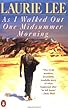
I’m currently reading As I Walked Out One Midsummer Morning by Laurie Lee, his autobiographical account of what he did after he left home in the Cotswolds in 1934 and walked through Spain. (He tells the story of his early years in Cider With Rosie, which I read and wrote about over three years ago.) Initially he had travelled to London, where he worked as a labourer on a building site, then knowing just one Spanish phrase for ‘Will you please give me a glass of water?’, he decided to go to Spain.

This passage shows how that phrase came in useful in one of the hottest days of that Spanish summer when he set out in the morning to walk to Valladolid:

After a while, being out-doors became a hallucination, and I felt there was no longer any air to breathe, only clinkered fumes and blasts of sulphur that seemed to rise through cracks in the ground. I remember stopping for water at silent farms where even the dogs were too exhausted to snarl, and where the water was scooped up from wells and irrigation  ditches and handed to me warm and green.

By mid-morning I was in a state of developing madness, possessed by deliriums of thirst, my brain running and reeling through all the usual obsessions that are said to accompany the man in the desert. Fantasies of water rose up and wrapped me in cool wet leaves, or pressed the thought of cucumber peel across my stinging eyes and filled my mouth with dripping moss. (page 72)

Just like Cider With Rosie, this book is beautifully written, lyrical and poetic capturing Spain as it was in the 1930s before the Civil War, beautiful countryside, both dazzling and squalid.

A book to savour.

A Card From Angela Carter by Susannah Clapp: Book Notes

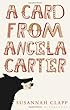
I liked the look of A Card from Angela Carter when I saw it in the library. It’s a small book that slots easily into a pocket or handbag and is very short – just 103 pages. I thought it would be a nice change after some of the very long books I’ve been reading recently.

I also liked the concept – a study of Angela Carter using the postcards she had sent to Susannah Clapp, who is the literary executor of Angela Carter as well as being a publisher’s reader, editor and critic. She and Angela had been friends for a number of years.

Now, Angela Carter is one of those writers whose books I’ve been meaning to read and have never got round to them, so I thought this book, which forms a sort of biography would give me at least an elementary picture  of her life and work. And that’s just what it did. Now I really do want to read some of her books – Angela Carter’s Book of Fairy Tales and Nights at the Circus, for example. I really find it hard to realise that it is twenty years ago now since she died at the age of 51 from lung cancer.  The fact that she had never made the shortlists of the Booker Prize led to the foundation of the Orange Prize, but this book, slight as it is, is the only biographical work to have been published.

Susannah Clapp uses the postcards Angela had sent to her ‘form a paper trail through her life.’ Sent from various places around the world some have a full message, some only a few words, which Susannah uses to paint a picture of what Angela was like, a ‘great curser’, capable of the sharpest of remarks, clever, unpredictable, quirky, and funny. She laughed and talked a lot. Using the postcards as a trigger, the book is mainly Susannah’s recollections of Angela, full of stories of her family life, her political views and what the critics made of her work. There’s also a considerable amount, considering the length of the book, about her physical appearance.

As for the postcards, I was disappointed at the black and white reproductions. I was also disappointed that as she was a cat lover, Angela had not sent her any cards featuring felines, although she did send them to her friend and publisher Carmen Callil. Angela herself loved cats and her first book written at the age of six was called ‘Tom Cat Goes to Market’, which her mother eventually threw away!

Susannah Clapp, whilst allowing that Angela’s fiction and prose did not go unacknowledged while she was alive, considers that her work did not receive the acclamation it deserved because:

She was ten years too old and entirely too female to be mentioned routinely alongside Martin Amis,  Julian Barnes and Ian McEwan as being a young pillar of British fiction. She was twenty years too young to belong to what she considered the ‘alternate pantheon’ of Iris Murdoch, Doris Lessing and Muriel Spark in the forties, when ‘in a curious way, women formed the ascendancy.’ (page 3)

This is an entertaining and vivid account in miniature which left me wanting to know more and to read Angela Carter’s books for myself.

Library Loot

It’s been ages since I did a Library Loot post. These reflect the variety of books that I enjoy. For more details about the books click on the links which take you to Amazon UK:

  • D H Lawrence – Daughters of the Vicar. This is a novella written in 1911. I’d never come across this before and thought it looked interesting. It has a foreword by Anita Desai – she writes that ‘here in the little story, Daughters of the Vicar (could any title be more redolent of the England of its time?) we have the essential D H Lawrence – the little contained world in a mossy valley of coal-veined hills from which that D H Lawrence grew’.
  • Kate Atkinson – Started Early, Took My Dog. This is the fourth Jackson Brodie book, described by The Times as ‘A comic novel of great wit and virtuosity.’ I’ve been meaning to get this since it came out a couple of years ago.
  • Edna O’Brien – The Country Girls. This was first published in 1960 and it’s set in a country village in Ireland in the early 1960s – a period piece now. Her books then were both successful and scandalous. In her native Ireland she was considered irreligious.
  • Guilty Consciences: a Crime Writers’ Association Anthology, edited by Martin Edwards (himself a successful crime fiction writer and blogger). I had to borrow this collection of short stories from some of my favourite crime fiction authors.
  • Peter James – Looking Good Dead. Even though I’ve had a couple of Peter James’s books for a few years I’d never read them, until I started Dead Simple (the first Detective Superintendent Grace book) this week. I’m hooked – it’s really good. So when I saw this in the library today I was delighted – it’s the second of his Roy Grace books!
  • M R Hall – The Flight. Another series of crime fiction that I like – this is the fourth in Hall’s Coroner Jenny Cooper series. I’ve read the first and the third – Jenny Cooper is a coroner who acts as a detective. Again, another series that has me captivated.

And finally, two books on a subject that is equally as absorbing as reading and blogging – painting:

Both books include demonstrations and advice on techniques, types of paint and pastels, and composition. I just need to get painting – and reading!

Books of the Month: April

I’ve finished reading 8 books this month, 7 of them fiction and 1 non-fiction. Three of them are books from my to-be-read shelves (TBR), one is a library book, one borrowed from a friend and one is an e-book.
They are (listed in the order I finished them), with links to my posts:
  1. My Cousin Rachel by Daphne du Maurier 4/5 (from TBR bks)
  2. The Murder on the Links by Agatha Christie 3/5 (Poirot)
  3. Agnes Grey by Anne Bronte 3/5 (Kindle)
  4. The Hanging Valley by Peter Robinson 3/5 (from TBR books)
  5. The Village by Marghanita Laski 5/5 (borrowed from a friend)
  6. Daphne du Maurier: a Daughter’s Memoir by Flavia Leng (library book) 3.5/5
  7. Ninepins by Rosy Thornton (author review copy) 4.5/5
  8. A Place of Greater Safety by Hilary Mantel 4/5 (post to follow)

So, going off my ratings (which are purely subjective) my pick of the month is The Village by Marghanita Laski, with Ninepins by Rosy Thornton a close second.

Kerrie at Mysteries in Paradise is hosting the Crime Fiction Pick of the Month. My crime fiction reading this month has been less than usual, with just two books:

The Murder on the Links by Agatha Christie and The Hanging Valley by Peter Robinson

and I’ve rated them both 3/5 – so a dead heat.

Daphne du Maurier: Fact and Fiction

Recently I’ve had a bit of a run on books by and about Daphne du Maurier. First of all I read The Parasites, which reminded me that I’d had Justine Picardie’s novel, Daphne sitting on my bookshelves unread, so I immediately got it down. Then I just had to read My Cousin Rachel, a book I’ve had for years and never got round to reading before now. After that I read Daphne du Maurier: a Daughter’s Memoir by Flavia Leng, just because it was one of the books Justine Picardie consulted in writing her novel. I’ve previously read Margaret Forster’s biography Daphne du Maurier and Daphne du Maurier’s The ‘Rebecca’ Notebook and Other Memories, which is mainly autobiographical.

Daphne by Justine Picardie (2008) – synopsis (from the back cover):

It is 1957. As Daphne du Maurier wanders alone through her remote mansion on the Cornish coast, she is haunted by thoughts of her failing marriage and the legendary heroine of her most famous novel, Rebecca, who now seems close at hand. Seeking distraction, she becomes fascinated by Branwell, the reprobate brother of the Bronte sisters, and begins a correspondence with the enigmatic scholar Alex Symington in which truth and fiction combine. Meanwhile, in present day London, a lonely young woman struggles with her thesis on du Maurier and the Brontes and finds herself retreating from her distant husband into a fifty-year-old literary mystery.

My view: 4/5

This book merges fact and fiction so well that it’s hard to differentiate between the two. I much preferred the story of Daphne herself and her search for information about Branwell. I had to go back to Forster’s biography of Daphne to compare the accounts of her life, which matched up pretty well. I was less keen on the modern day story of a young woman, the second wife of an older man. It had too many obvious parallels with Rebecca for my liking. And if you haven’t read Rebecca, this book gives away the plot. There are also references to My Cousin Rachel, which I glossed over in case there were any spoilers there too (I don’t think there were). All in all, a very satisfying mystery about Daphne and the missing Bronte documents.

My Cousin Rachel by Daphne du Maurier (1951) – synopsis (Amazon):

Orphaned at an early age, Philip Ashley is raised by his benevolent older cousin, Ambrose. Resolutely single, Ambrose delights in Philip as his heir, a man who will love his grand home as much as he does himself. But the cosy world the two construct is shattered when Ambrose sets off on a trip to Florence. There he falls in love and marries – and there he dies suddenly. In almost no time at all, the new widow – Philip’s cousin Rachel – turns up in England. Despite himself, Philip is drawn to this beautiful, sophisticated, mysterious woman like a moth to the flame. And yet …might she have had a hand in Ambrose’s death?

My view: 4/5

I thoroughly enjoyed this book, completely taken in by the characters and loving the setting in an old mansion in Cornwall. The story is narrated by Philip, so the other characters are seen through his eyes. The tension mounts as Philip becomes obsessed with Rachel and I was never quite sure what was real and what to believe. He is not a stable character and as Rachel’s own thoughts are not revealed it’s not clear if she can be believed either, whether she is sincere or evil and manipulative.

Daphne du Maurier: a Daughter’s Memoir (1994) – synopsis (from the back cover):

In this moving and revealing memoir, Flavia Leng paints a powerful portrait of her mother, Daphne du Maurier. She presents an account of an unusual and often lonely childhood spent in London and especially Cornwall, at her mother’s beloved home, Menabilly. Family friends included Nelson and Ellen Doubleday, Gertrude Lawrence and Noel Coward. However, at the centre of this story is Daphne du Maurier herself. The book reveals a writer with a deep attachment to Cornwall, where she put down her roots and found inspiration for her novels, and who spent much of her life as a recluse, withdrawn not only from the outside world but also from members of her own family. A picture emerges of a woman who lived in a world of her own creation that was beyond the comprehension of those around her.

My view: 3.5/5

In the epilogue Flavia Leng, Daphne du Maurier younger daughter, explained that she began to write this memoir of her childhood two years before her mother died in 1989 and it was never meant for publication – it was just for the family. And that to me epitomises this memoir – it’s an account of her childhood and of her family as seen through a child’s eyes. It seems a lonely childhood, despite being the middle child. As children Flavia and her older sister Tessa didn’t get on and both she and Tessa saw that their mother lavished more affection on her beloved son, Christopher who they called Kits. But a picture emerges of Daphne, who they called Bing, as a solitary person, closeted away with her typewriter or lost in her world of ‘never, never land’, peopled by the characters she invented, with little time for her children, who were looked after by Nanny and then ‘Tod’, their governess.

Like her mother Flavia has a great love of Cornwall which shines through the book – she was never happier than when alone in Menabilly and the surrounding woodlands. It’s a sad memoir ending with Flavia feeling she had no roots left after her parents died:

I have heard it said that a person only really grows up when both parents have gone; what I do know is that life will never be quite the same again. Cornwall no longer holds the enchantment it once did. Gone is the excitement of driving down those leafy, winding roads to the lovely old houses, my beloved Menabilly, and then later Kilmarth where Bing lived out her years.

Testament of Youth by Vera Brittain

Testament of Youth by Vera Brittain is based on her diaries, telling of her life up to 1925, concentrating on the World War One years.

It is an absolutely fascinating account of the war and all its horror and sufferings, and very moving. Vera was a VAD (Voluntary Aid Detachment) during the war, nursing casualties both in Britain and France. The conditions were appalling.

During the war her fiance, Roland Leighton, her brother, Edward, and two friends, Geoffrey Thurlow and Victor Richardson, were all killed. Roland was killed the day before he was due home on leave at Christmas 1915 and Edward was killed just a few months before the Armistice – all heart-breaking. Vera’s life was irrevocably changed – as were those of so many others.

For me, her account of the war years is the most outstanding in this book, the most personal and vivid. The preceding years are about her childhood and youth and bring to life the social conditions and her struggles for education. By the outbreak of war she was an undergraduate at Somerville College, Oxford. But I found the final section after the war to be more detached. It’s about her work as a speaker on the League of Nations and International Relations, about the development of the peace ideal. The language in this section is more formal and so does not come across as fresh and immediate as in those on her childhood and war years.

 I read this book as a result of reading Climbing the Bookshelves by Shirley Williams, Vera’s daughter. It slots nicely into the War through the Generations Challenge – World War One.

  • Paperback: 640 pages
  • Publisher: Virago; New Edition with new cover edition (2004)
  • Language English
  • ISBN-10: 0860680355
  • ISBN-13: 978-0860680352
  • Source: borrowed from a friend – I’ve now bought the e-book version
  • My rating 4/5 (it would have been 5/5 apart from the change in writing in the last section)