The Way Home by Mark Boyle

I am way behind with writing about the books I’ve been reading. It seems to be getting worse this year. It all began last year during the first lockdown when my ability to concentrate just disappeared and it’s not fully come back yet. Now I have five books that I’ve read but not reviewed.

This is review of just one of them. When I sat down to write this post I’d intended to write short reviews of at least two or three of the books, but once I began I found that was impossible – I had too much to say about them. From being a post with short notes on what I’ve read recently this post as morphed into one of the longest posts about just one book that I’ve written – and I still don’t think I’ve captured the essence of it.
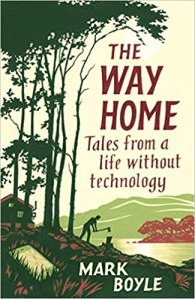
The Way Home:Tales from a Life Without Technology by Mark Boyle, a former business graduate, who lived entirely without money for three years. He has written columns for the Guardian and has irregularly contributed to international press, radio and television. He lives on a smallholding in Co. Galway, Ireland. This book follows the events of his first year of living without technology, interspersed with an account of a visit to Great Blaskett off the coast of County Kerry, to the south of Boyle’s new home. The Islanders were eventually evacuated to the mainland in the early 1950s.

The first thought I had about this book is that the concept of living without technology is alien to me. There is no way I could live like that and I wondered how he came to that decision and how he managed it with no running water, no car, no electricity or any of the things it powers: the internet, phone, washing machine, radio or light bulb. He built his home with his bare hands, learning to make fire, collecting water from the stream, foraging and fishing.

He had to clarify just what constitutes technology and what doesn’t. It wasn’t that easy to decide when you consider that even the pencil can be described as technology. He questioned where to draw the line such as the Stone Age, the Iron Age, or the eighteenth century? The more he thought about it the less important it seemed. He wanted to explore what it means to be human,

… to discover what it might feel like to become part of one’s landscape using only tools and technologies (if I must call them that) which, like the Old Order Amish people of North America, do not make me beholden to institutions and forces that have no regard for the principles and values on which I wish to live my life. (page 14)

The book follows the seasons of the year and rather than being the story of his life without technology is a collection of

observations, practicalities, conversations over farmyard gates, adventures and reflections, which I hope will provide an insight into the life of someone attempting to pare the extravagance of modernity back to the raw ingredients of life. (page 15)

It’s not a ‘how to’ book, nor is it a guide to living without technology. It’s an account of what it was like for him. He writes about the loneliness he experienced, the lack of contact with his parents and friends, and the damage to his relationships, particularly to his girlfriend, Kirsty, who initially shared his technology-free life. Without the internet and a phone it is difficult to keep in touch with people. There are letters and these became important to him, otherwise the way to communicate face to face was by walking. Formerly a vegan he found it difficult to adapt to killing in order to eat, for example killing a deer, skinning and butchering it. His thoughts on life and death had to undergo a dramatic change.

Life without technology is inevitably slower and more arduous. Living where there is no tap for instant water, and no switches to turn on a light is not simple either. One of the things he found difficult to adapt to was the way of writing. Previously he had used computers to write everything. Hand writing, however, involves a whole new way of thinking. He could no longer use the typed word, or online research, and without the use of spell-check, copy and paste or delete it is much harder to restructure a page and you have to start again. Eventually his thinking slowed down, so that he thought twice in order to write once. As I’m older than Boyle, I remember the process in reverse and my delight at being able to organise my writing using copy and paste with much more ease and speed than before, when I did literally ‘cut’ and ‘paste’, or rather staple, when writing.

There is so much more in this book that I haven’t covered in this post. I think it’s a remarkable and fascinating book, and it gave me much to think about. It’s ironic really, considering its subject, that I bought the e-book version, read it on my Kindle and wrote and posted this review on my laptop. It is also ironic that in order to publish the book, having written every word of it by hand, Mark Boyle had to get it typed up – which he did himself, reluctantly and with big reservations. It was not easy for him. He describes the effects of doing it as follows:

I felt less purposeful, like I no longer knew what my life was about, or what I stood for. By evening I felt entirely disconnected from the landscape around me, like I was no longer a part of it, but in some strange virtual universe instead. The natural light hurt my eyes as I re-emerged outside.

In some ways it was good and important for me to temporarily re-enter that world of things, so as to dispel any romantic memories I had about life being much better and easier with machines. The experience of it was such that, having made the compromise, I’m not sure I would make it again. (page 324)

  • Publisher ‏ : ‎ Oneworld Publications (4 April 2019)
  • Language ‏ : ‎ English
  • Paperback ‏ : ‎ 334 pages
  • ISBN-10 ‏ : ‎ 1786077272
  • ISBN-13 ‏ : ‎ 978-1786077271
  • Source: I bought the e-book
  • My rating: 4*

A Z of TBRs: E-Books – J, K and L

It’s been a long time since I last looked at the forgotten e-books on my Kindle, so it’s time to dip into it again. I have a bad habit of downloading books and then forgetting all about them – it’s as though they’ve gone into a black hole.

Today I’m looking at books with titles beginning with the letters J, K and L, with a little ‘taster’ from each. The summaries are from Goodreads.

Jeremy Hutchinson’s Case Histories by Thomas Grant – I bought this in February 2020 after watching the BBC series,The Trial of Christine Keeler, the story of the Profumo affair in 1962 as seen from her perspective. Hutchinson was Keeler’s defence barrister.

Summary: Born in 1915 into the fringes of the Bloomsbury Group, Jeremy Hutchinson went on to become the greatest criminal barrister of the 1960s, ’70s and ’80s. The cases of that period changed society for ever and Hutchinson’s role in them was second to none. In Case Histories, Jeremy Hutchinson’s most remarkable trials are examined, each one providing a fascinating look into Britain’s post-war social, political and cultural history.

A cartoon by Cummings appeared in the Daily Express on 10 July 1963 headed ‘The adventures of James Macbond’. It showed the beleaguered figure of Harold Mavmillan fleeing from three assailants. Kim Philby and his fellow spy John Vassall are both dressed as shady hoodlums, one wielding a knife, the other a pistol both aimed at Macmillan. Christine Keeler is the third, incarnated on the page as a sort of vampiric harpy, her long-nailed hand outstretched trying to clutch the Prime Minister’s coat tails.

That year was a kind of horror show for Macmillan, and he was not to see out 1963 as Prime Minister. His resignation was accepted by the Queen in October.(page 95)

The Keeper of Lost Things by Ruth Hogan – I bought this in May 2017 and can’t remember how I first came across it.

Summary: Anthony Peardew is the keeper of lost things. Forty years ago, he carelessly lost a keepsake from his beloved fiancée, Therese. That very same day, she died unexpectedly. Brokenhearted, Anthony sought consolation in rescuing lost objects—the things others have dropped, misplaced, or accidentally left behind—and writing stories about them.

He took a sip from his drink and lovingly kissed the cold glass of the photograph before replacing it on the table next to his chair. She was not a classic beauty; a young woman with wavy hair and large dark eyes that shone, even in an old black and white photograph. But she was wonderfully striking, with a preserve that still reached out from all those years ago and captivated him. She had been dead for forty years, but she was still his life, and her death had given him his purpose. It had made Andrew Peardew the Keeper of Lost Things. (page 4)

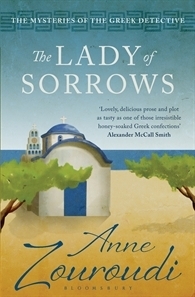
The Lady of Sorrows by Anne Zouroudi – I bought this in April 2013! It is the fourth in Anne Zouroudi’s Mysteries of the  Greek Detective series featuring Hermes Diaktoros. Hermes is a detective with a difference. Just who he is and who he works for is never explained. I have read three of the books in the series. Each one features one of the Seven Deadly Sins.

Summary: A painter is found dead at sea off the coast of a remote Greek island. For our enigmatic detective Hermes Diaktoros, the plot can only thicken: the painter’s work, an icon of the Virgin long famed for its miraculous powers, has just been uncovered as a fake. But has the painter died of natural causes or by a wrathful hand? What secret is a dishonest gypsy keeping? And what haunts the ancient catacombs beneath the bishop’s house?

‘Allow me to introduce myself. I am Hermes Diaktoros, of Athens. Diaktoros being, as you may know, an ancient word for messenger. My father has a strange idea of humour. He’s something of a scholar of the classical world.’

Politely, the priest took the fat man’s hand, which was, in spite of the day’s heat was quite cool to touch.

‘Father Linos Egiotis,’ said the priest.

‘A pleasure,’ said the fat man. ‘Now, I know you must be anxious to close up for siesta, and I won’t keep you.’ He turned back to the icon. ‘She’s very lovely, isn’t she?’ he said. ‘I have been wanting to make her acquaintance for many years. Quite by chance we were passing within a few miles, and had time enough before my next engagement to make the detour. She has quite a reputation, I believe, for performing magic tricks. Magic tricks are a paerticular interest of mine.’

‘Magic tricks?’ queried the priest, with annoyance. ‘The Lady occasionally sees fit to grant miracles. They are acts of divine grace, not magic tricks.’ (page 31)

So, three very different books from the depths of my Kindle. I’m not sure which one to read first. If you’ve read any of these books please let me know what you think. Or if you haven’t read them do they tempt you?

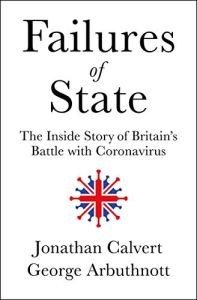
Failures of State by Jonathan Calvert and George Arbuthnott

The inside story of the UK’s response to the pandemic from the Insight investigations unit at The Sunday Times

Mudlark, Harper Collins| 18 March 2021| 422 pages| My own copy| 4*

I don’t read a lot of nonfiction, but this year I have been reading more than usual. This book caught my eye in August and although I’ve watched countless TV programmes and interviews and read numerous articles about the coronavirus pandemic I just had to read it.

Blurb:

Failures of State: The Inside Story of Britain’s Battle with Coronavirus recounts the extraordinary political decisions taken at the heart of Boris Johnson’s government during the global pandemic.

Meticulously researched and corroborated by hundreds of inside sources, politicians, emergency planners, scientists, doctors, paramedics and bereaved families, along with leaked data and documents, this is the insider’s account of how the government sleepwalked into disaster and tried to cover up its role in the tragedy – and it exposes one of the most scandalous failures of political leadership in British history.

In the eye of the storm was Boris Johnson, a Prime Minister who idolised Winston Churchill and had the chance to become a hero of his own making as the crisis engulfed the nation. Instead he was fixated on Brexit, his own political destiny and a myriad of personal issues, all while presiding over the UK government’s botched response to the global coronavirus pandemic. After missing key Cobra meetings, embracing and abandoning herd immunity and dithering over lockdown, Johnson left the NHS facing an unmanageable deluge of patients. His inaction resulted in the deaths of many thousands of British people and his own hospitalisation at the hands of the pandemic, yet further reckless decisions allowed a deadly second wave to sweep across the country in the autumn months with the economy on the brink of collapse.

With access to key figures at the top of government during the most tumultuous year of modern British history, Failures of State is an exhaustive and thrillingly told story – and one of the most essential pieces of investigative reporting for a generation.

My thoughts:

The book covers the period from 24 January 2020 – 23 January 2021, with a Prologue covering the period from 24 April 2012 – 23 January 2020. Since it was written time has moved on and further information has become available, but this book is a reminder of how it started and described what subsequently happened. So, much of it was what I already knew, especially about the steps that were taken in the UK to cope with the situation.

In considering the two phrases ‘we were following the science’ and ‘we have taken the right steps at the right time’ they ask was this in fact what happened? They used many sources as described in the blurb and their research gave them the answer ‘no’.

In particular, they question why the government failed to act more swiftly, what the scientists told ministers, whether Britain was equipped to fight a pandemic and what were the consequences. I’m a cautious person and I remember being anxious that not enough was being done at the time and thought that we should have locked down earlier than we did. Reading this book makes me think that I wasn’t being over-cautious. I am also a bit cynical about what I read in the papers and what I hear and see being reported, so I viewed this book with caution too. Many of the sources are named in the book, but many are not.

I am appalled at what this book reveals. I am appalled by the corruption, outright lies, obfuscations, misinformation and incompetence they report – worse than I had thought at the time.

But most of all I am utterly appalled by what is revealed about the NHS and the restrictions that were imposed on reporting what was taking place in hospitals. The NHS had limited capacity to deal with the pandemic and the public were not made aware of the selection process that was used in deciding who could be given intensive care. If it had been reported there would have been widespread panic, terror and outrage. It is appalling that so many people were not given intensive care, and that so many had died who could otherwise have survived.

It is a shocking account of a terrible year – words fail me.

Book Beginnings & The Friday 56: Another Journey through Britain by Mark Probert

Every Friday Book Beginnings on Friday is hosted by Gillion at Rose City Reader where you can share the first sentence (or so) of the book you are reading. You can also share from a book you want to highlight just because it caught your fancy.

This week I’m featuring the latest book I’ve just started reading, Another Journey Through Britain by Mark Probert, which was free on Amazon UK, although it’s currently on offer for 99p.

In this book Mark Probert follows the route taken by John Hillaby in his 1960s book Journey through Britain, telling the story of his 1,100 mile walk from Land’s End in south-west England to the north-east coast of Scotland at John o’Groats. It had captured Probert’s imagination and when he entered semi-retirement in 2018 he decided to repeat Hillaby’s book, looking out for the things he wrote about in his original book and comparing how today’s Britain differed from that of fifty years earlier. He didn’t walk, though but he did it on a motor bike, a Royal Enfield Classic 500.

The Book Begins:

The visitor car park at Land’s End was almost empty and ghostly silent. It was just after 10 am on a chilly May morning.

Also every Friday there is The Friday 56, hosted by Freda at Freda’s Voice. *Grab a book, any book. *Turn to Page 56 or 56% on your  ereader . If you have to improvise, that is okay. *Find a snippet, short and sweet, but no spoilers!

These are the rules:

  1. Grab a book, any book.
  2. Turn to page 56, or 56% on your eReader. If you have to improvise, that is okay.
  3. Find any sentence (or a few, just don’t spoil it) that grabs you.
  4. Post it.
  5. Add the URL to your post in the link on Freda’s most recent Friday 56 post.

Pages 55-56:

Beside the National Parks there are thirty four Areas of Outstanding National Parks (AONB) in England and Wales, less than half of which were in existence in 1966. Being British, we have to make things complicated. In Scotland they have two National Parks, forty five National Nature Reserves, three UNESCO GeoParks and two UNESCO Biospheres. The original purpose of the Parks was to conserve and preserve, but also to open the areas up for people to enjoy. Nowadays, the National Parks cover approximately 10 percent of England, 20 percent of Wales and 7 percent of Scotland.

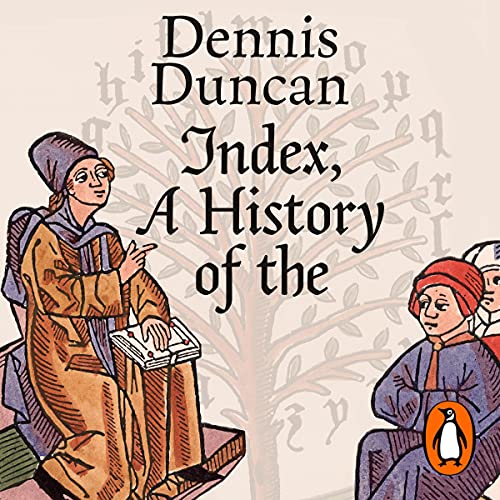
Index, A History of the by Dennis Duncan

Penguin| 19 August 2021| 339 pages| Review copy| 4*

Synopsis:

Most of us give little thought to the back of the book – it’s just where you go to look things up. But here, hiding in plain sight, is an unlikely realm of ambition and obsession, sparring and politicking, pleasure and play. Here we might find Butchers, to be avoided, or Cows that sh-te Fire, or even catch Calvin in his chamberwithaNonne. This is the secret world of the index: an unsung but extraordinary everyday tool, with an illustrious but little-known past. Here, for the first time, its story is told.

Charting its curious path from the monasteries and universities of thirteenth-century Europe to Silicon Valley in the twenty-first, Dennis Duncan reveals how the index has saved heretics from the stake, kept politicians from high office and made us all into the readers we are today. We follow it through German print shops and Enlightenment coffee houses, novelists’ living rooms and university laboratories, encountering emperors and popes, philosophers and prime ministers, poets, librarians and – of course – indexers along the way. Revealing its vast role in our evolving literary and intellectual culture, Duncan shows that, for all our anxieties about the Age of Search, we are all index-rakers at heart, and we have been for eight hundred years.

My thoughts:

This book is not just about the history of the index, but also about the history of reading and the evolution of the book from the scrolls, manuscripts and the codex before the the invention of printing – how they were produced and used. I was interested in reading it as I’m an ex-librarian and cataloguer, later an assistant in a county record office where a large part of my job involved indexing. If you think like me that an index is an indispensable part of a non fiction book then you’ll enjoy this book, which is both informative and entertaining. And I often wish fiction books were indexed too – one of the advantages of an e-book is that you can search the text, even better if it has the X-Ray feature.

It explains the difference between the index and the table of contents, goes into the evolution of page numbers and the problems of alphabetisation. This is not a dry, factual account it is written with humour and insights into the past, using examples from historical texts, and from indexes complied as satirical attacks on their authors. I never knew indexes had been used as weapons! Nor did I know that some works of fiction had been indexed in the past – full details in Chapter 6 ‘Indexing Fictions: Naming was Always a Difficult Art’, quoting from Lewis Carroll’s works. Carroll was fascinated with indexes, leaning particularly towards the whimsical, using his logician’s wit.

Neither is it stuck in the far distant past, Duncan brings it up to date in the digital age and the ubiquity of the search engine with the rise of anxiety that this is changing our brains, shortening our attention spans and eroding our capacity for memory. But this, Duncan explains is nothing new as the history of the index shows that there have always been fears that nobody will read properly any more when they could just use an index to replace the ways of close reading. The ways we read have changed over the generations.

The Index, a History of the is simply fascinating.

About the Author

Dennis Duncan is a writer, translator and lecturer in English at University College London. He has published numerous academic books, including Book Parts and The Oulipo and Modern Thought, as well as translations of Michel Foucault, Boris Vian, and Alfred Jarry. His writing has appeared in the Guardian, the Times Literary Supplement, and the London Review of Books, and recent articles have considered Mallarmé and jugs, James Joyce and pornography, and the history of Times New Roman. 

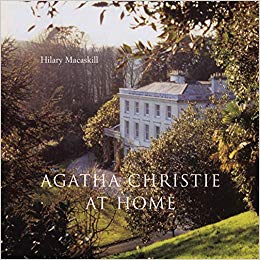
Throwback Thursday: Agatha Christie at Home

Today I’m looking back at my post on Agatha Christie at Home by Hilary Macaskill, which I first posted on 19 August 2013.

Here’s the first paragraph:

One of the things that struck me when I was reading Agatha Christie’s An Autobiography was her love of houses. It stemmed from her childhood dolls’ house. She enjoyed buying all the things to put in it – not just furniture, but all the household implements such as brushes and dustpans, and food, cutlery and glasses. She also liked playing at moving house, using a cardboard box as a furniture van.

Click here to read my full review

The next Throwback Thursday post is scheduled for September 30.