My Friday Post: Wedlock by Wendy Moore

Book Beginnings Button

Every Friday Book Beginnings on Friday is hosted by Gillion at Rose City Reader where you can share the first sentence (or so) of the book you are reading, along with your initial thoughts about the sentence, impressions of the book, or anything else the opener inspires.

This week I’m featuring Wedlock: How Georgian Britain’s Worst Husband Met His Match by Wendy Moore, a library book, that my friend recommended to me.

Wedlock: How Georgian Britain's Worst Husband Met His Match

It begins in London on 13 January 1777:

Settling down to read his newspaper by the candlelight illuminating the dining room of the Adelphi Tavern, John Hull anticipated a quiet evening. Having opened five years earlier, as an integral part of the vast riverside development designed by the Adams brothers, the Adelphi Tavern and Coffee House had established a reputation for its fine dinners and genteel company.
Also every Friday there is The Friday 56, hosted by Freda at Freda’s Voice. These are the rules:

  1. Grab a book, any book.
  2. Turn to page 56, or 56% on your eReader.
  3. Find any sentence (or a few, just don’t spoil it) that grabs you.
  4. Post it.
  5. Add the URL to your post in the link on Freda’s most recent Friday 56 post.

Page 56

It should have proved a memorable occasion, summoning up reminiscences of the royal wedding just six years earlier. Yet by the time that Mary walked down the aisle of St George’s Church in Hanover Square, splendidly robed in her silver and white wedding dress, on her eighteenth birthday on 24 February 1767, her teenage infatuation was over. She knew she was marrying the wrong man.

Described by the Daily Telegraph as ‘ Splendid … as gripping as any novel’ this is non-fiction, the biography of Mary Eleanor Bowes who was the richest heiress in 18th century Britain. She fell under the spell of a handsome Irish soldier, Andrew Robinson Stoney. When Mary heard her gallant hero was mortally wounded in a duel fought to defend her honour, she felt she could hardly refuse his dying wish to marry her.

I’ll be reading this book soon. What do you think? Does it tempt you too?
Library Books

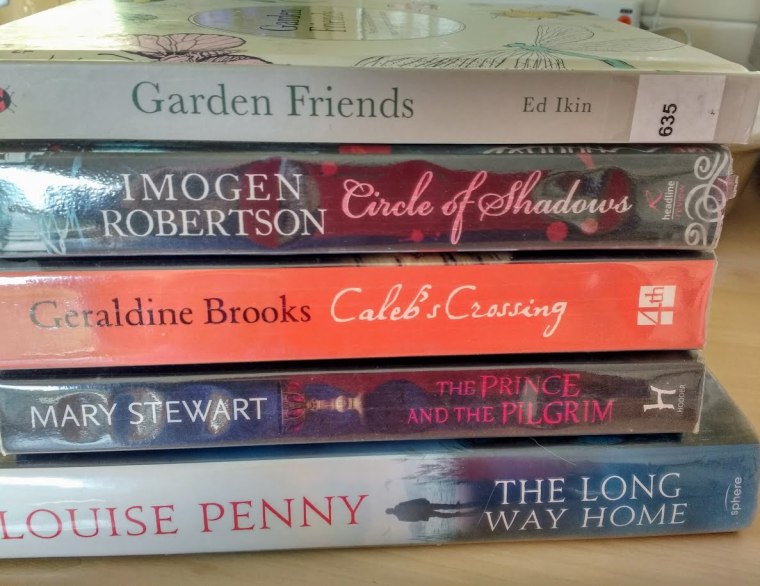
These are the latest library books I have out on loan, borrowed from the mobile library that visited here on Tuesday. I didn’t have any authors or titles in mind but browsed the shelves, choosing each one purely on instinct – hoping I’d like each one:

Lib bks Jan 2018

Garden Friends by Ed Ikin. This is a beautiful little book subtitled, Plants, animals and wildlife that are good for your garden. It’s full of information and photos and drawings, with chapters on plants, animal and insects that can help improve your garden, on dead wood, composting and planting by the moon – apparently there is ‘more than just hippy wisdom behind paying heed to the moon and its potential influence over your garden and wildlife.

Circle of Shadows by Imogen Robertson – historical fiction set in Germany in 1783. I haven’t read any her books before and as this is the third book in her series of books featuring Harriet Westerman and Gabriel Crowther, I’m hoping it won’t matter that I haven’t read the earlier books. The two English sleuths investigate the murder of Lady Martenson at a masked ball. There’s alchemy involved and automata – mirroring the luxury and artificiality of the German court.

Caleb’s Crossing by Geraldine Brooks. I’m a fan of her books so I have great hopes for this one. It’s inspired by a true story, but is a work of imagination. Set in the island now known as Martha’s Vineyard in the 1650s this is the story of Caleb, the son of a Wampanoag chieftain, who ‘crosses’ into the culture of the English settlers.

The Prince and the Pilgrim by Mary Stewart. This is a companion book to her Merlin trilogy, but I’m not too sure that I’ll enjoy this one as much. It’s not about Merlin and Arthur. Instead we have Alexander, nephew of King March of Cornwall seeking to avenge his father on a journey to Camelot in quest of justice. It leads him to the Dark Tower of the sorceress of Morgan le Fay.

The Long Way Home by Louise Penny. I hesitated before deciding to borrow this book, because it’s the 10th Chief Inspector Gamache novel – and I haven’t read any of the previous books. But I know that several bloggers love these books and I’d recently read Kay’s post on the 13th book – Glass Houses – describing Louise Penny’s books  as ‘some of the best and deepest character studies I’ve ever read‘ and  ‘filled with imagination and beautiful descriptions and pathos and terror.’ So I had to bring this one home to see for myself.

Set in Quebec, Gamache’s friend Clara’s has asked him for help as her husband, Peter had not come home on the first anniversary of their separation as he had promised. Gamache uncovers a deadly trail of jealousy and deceit.

If you’ve read any of these books do let me know what you think about them. If you haven’t, are you tempted by any of them?

First Chapter First Paragraph: The Earth Hums in B Flat

eca8f-fistchapEvery Tuesday Diane at Bibliophile by the Sea hosts First Chapter First Paragraph Tuesday Intros to share the first paragraph sometimes two, of a book that she’s reading or is planning to read soon.

This week’s opening is from The Earth Hums in B Flat by Mari Strachan.

The Earth Hums in B Flat

It begins:

I fly in my sleep every night. When I was little I could fly without being asleep; now I can’t even though I practise and practise. And after what I saw last night I want more than ever to fly wide-awake. Mam always says: I want never gets. Is that true?

Blurb (from the back cover):

Young Gwenni Morgan has a gift. She can fly in her sleep. She’s also fond of strawberry whip, detective stories and asking difficult questions. When a neighbour mysteriously vanishes, she resolves to uncover the secret of his disappearance and return him to his children. She truthfully records what she sees and hears: but are her deductions correct? What is the real truth? And what will be the consequences – for Gwenni, her family and her community – of finding it out?

Gwenni Morgan is an unforgettable creation, and this portrait of life in a small Welsh town on the brink of change in the 1950s is enthralling, moving and utterly real. Mari Strachan’s debut is a magical novel that will transport you to another time and place.

I like the idea of being able to fly.

What do you think – would you read on?

First Chapter First Paragraph: A Lovely Way to Burn

eca8f-fistchapEvery Tuesday Diane at Bibliophile by the Sea hosts First Chapter First Paragraph Tuesday Intros to share the first paragraph sometimes two, of a book that she’s reading or is planning to read soon.

This week’s opening is from A Lovely Way to Burn by Louise Welsh.

A Lovely Way to Burn (Plague Times, #1)


It begins with a Prologue:

London witnessed three shootings that summer, by men who were part of the Establishment. The first  was the Right Honourable Terry Blackwell, Tory MP for Hove who, instead of going to his consistency as planned, sat in a deck chair on the balcony of his Thames-side apartment on sweltering Saturday in June and shot dead six holidaymakers.

Blurb:

It doesn’t look like murder in a city full of death.

A pandemic called ‘The Sweats’ is sweeping the globe. London is a city in crisis. Hospitals begin to fill with the dead and dying, but Stevie Flint is convinced that the sudden death of her boyfriend Dr Simon Sharkey was not from natural causes. As roads out of London become gridlocked with people fleeing infection, Stevie’s search for Simon’s killers takes her in the opposite direction, into the depths of the dying city and a race with death.

A Lovely Way to Burn is the first outbreak in the Plague Times trilogy. Chilling, tense and completely compelling, it’s Louise Welsh writing at the height of her powers.

I’ve borrowed this book from the library as I’ve read and enjoyed other books by Louise Welsh and I’m hoping it’ll be just as hypnotically compulsive reading as her other books.

What do you think – would you read on?

The Skeleton Road by Val McDermid

The Skeleton Road (Inspector Karen Pirie, #3)

The Skeleton Road by Val McDermid is the third of her DCI Karen Pirie novels. Investigating the identity of the skeleton found, with a bullet hole in its skull, on the rooftop of a crumbling, gothic building in Edinburgh takes Karen and her Historic Cases Unit into a dark world of intrigue and betrayal during the Balkan Wars in the 1990s.

It begins slowly, introducing rather a bewildering number of characters one after the other. It moves between the past and the present in Scotland, England and Croatia, told through different viewpoints, and interweaving the sequence of events in the past and the present in a way that I found rather disjointed. Dr River Wilde a forensic anthropologist, discovers that the skeleton is a male, he’d been dead between five and ten years and his dental work shows he was originally from one of the Eastern bloc countries.

It’s a complex story with several strands, including the search for war criminals through the work of two lawyers at the International Criminal Tribunal for the former Yugoslavia. Karen’s investigations take her to Oxford and then to a small village in Croatia, a place scarred by fear, where people have endured unspeakable acts of violence.

At times I thought I was reading an account of the wars and the search for justice and revenge rather than a murder mystery. Even given the traumatic events it describes I didn’t feel there was much tension in the search for the killer and I was able to figure out who it was fairly quickly. I enjoyed the sections focusing on Karen’s and her assistant DS James, ‘the Mint’ Murray’s detective work, and I liked all the details of her relationship with her partner, Phil (also a police officer, now working on a different team).  But I didn’t enjoy this as much as the first two Karen Pirie books – in fact I think the first book, The Distant Echo is by far the best.

  • Hardcover: 416 pages
  • Publisher: Little, Brown (11 Sept. 2014)
  • Language: English
  • ISBN-10: 1408704579
  • ISBN-13: 978-1408704578
  • Source: a library book
  • My rating: 3*

The Fear Index by Robert Harris

The Fear Index

The Fear Index by Robert Harris is a fast-paced story set in the world of high finance and computer technology but it didn’t appeal to me as much as the other books by him that I’ve read. It’s about scientist Dr Alex Hoffman, who together with his partner Hugo Quarry, an investment banker, runs a hedge fund based in Geneva, that makes billions. Alex has developed a revolutionary form of artificial intelligence that tracks human emotions, enabling it to predict movements in the financial markets. It’s built around the standard measure of market volatility: the VIX or ‘Fear Index’.

Alex wakes up one morning in the early hours to find an intruder has managed to bypass the elaborate security of the house. He challenges him only to receive a blow to his head that knocks him out and the intruder escapes. That is just the start of his troubles. A brain scan indicates he may have MS or possibly dementia and he is advised to take further advice, which of course, he doesn’t want to do. It appears that someone is out to destroy him and his company and even worse it soon looks as though this will cause a major global economic crisis. He is at a complete loss as to who it can be. It’s someone who has infiltrated into all areas of his life, affecting his marriage as well as his business.  He even begins to doubt his sanity.

On the one hand it helped me understand a bit more about hedge funds and how they operate but I got lost in the computer technology details. The characters are all not particularly likeable, but it’s definitely a page turner with plenty of suspense as the story raced to a conclusion, and it kept me puzzling over what or who was really causing the paranoia and violence. I thought it began well but didn’t find the ending very illuminating or satisfying and was left wondering what it was really all about.

I liked the chapter headings with extracts from books such as Charles Darwin’s On the Origin of Species and The Descent of Man and Mary Shelley’s Frankenstein which made me wonder if the book was about the evolution of man into machine. Just an idea – if you’ve read the book what did you make of it all?

  • Hardcover: 336 pages
  • Publisher: Hutchinson; First Edition, First Printing edition (29 Sept. 2011)
  • Language: English
  • ISBN-10: 0091936969
  • ISBN-13: 978-0091936969
  • Source: Library book
  • My rating: 3*