The Wicked Cometh by Laura Carlin

‘We have no need to protect ourselves from the bad sort 
because we ARE the bad sort . . .’

Publication date 1 February 2018, Hodder and Stoughton

Review copy from the publishers, via NetGalley

My rating:  3 stars 

The Wicked Cometh is Laura Carlin’s debut novel.

The title of this book comes from Proverbs XVIII, 3: When the wicked cometh, then cometh also contempt, and with ignominy reproach.

The opening chapter sets the scene as The Morning Herald reports on the growing numbers of missing people in London in September 1831. So, you know straight away that this is a tale of wickedness and evil. It begins well, setting the scene with detailed descriptive writing full of vivid imagery, evoking the sights, smells, and sounds of life in the darkest and foulest corners of London in the 1830s.

It’s narrated in the present tense by Hester White, a young woman of eighteen. She grew up in a parsonage in Lincolnshire but she was orphaned at the age of 12 and went to live in London with Jacob, formerly her father’s gardener, and his wife Meg in a slum dwelling, just one room with a brick and dirt floor. I liked Hester, who originally came from a reasonably well-off family and was educated. She lives in hope of leaving London and escaping from her miserable life.

A way out presents itself when she is knocked down and injured by Dr Calder Brock’s carriage and whisked away to stay at his family’s country house, Waterford Hall near Stratford. Calder intends to use her as an experiment, to build up her physical health, and to give her the chance of improving her life he persuades his sister Rebekah to educate her. He wishes to prove that even those from the gutter can be educated and Hester exaggerates her ignorance in order to escape being sent to the London Society for the Suppression of Mendicity, a place of shame feared by the poor. Known as the ‘Dicity’ it was one step on the downward path either to transportation in the hulks or to the poorhouse.

So far, so good but the first part of the book moves very slowly and my attention began to wander as I thought the wicked were a long time in coming. But come they did in abundance in the latter part of the book and as the relationship between Hester and Rebekah develops they begin to uncover the sinister secrets of what is behind the mystery of the missing people. And it is a dark, gruesome and grim secret.

Overall, I’m rather torn about this book – parts of it I really enjoyed, even though it’s written in the present tense, which I don’t like. The characters are well-drawn and the settings are superb, but the slow pace failed to provide enough tension especially in the middle section. The suspense and drama increased rapidly towards the end, but the final twist seemed contrived and not very convincing. But I can see from Goodreads that other readers enjoyed this book far more than I did.

My thanks to the publishers for a review copy via NetGalley.

Amazon UK link
Amazon US link

Library Books

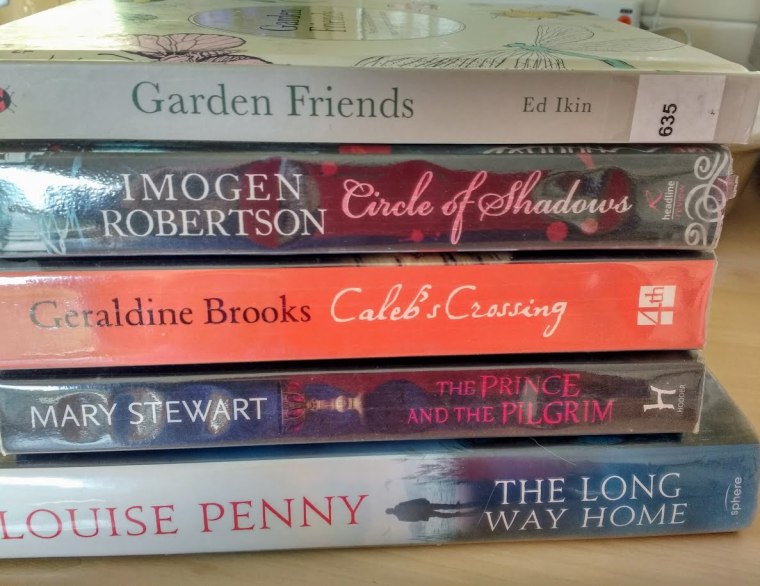
These are the latest library books I have out on loan, borrowed from the mobile library that visited here on Tuesday. I didn’t have any authors or titles in mind but browsed the shelves, choosing each one purely on instinct – hoping I’d like each one:

Lib bks Jan 2018

Garden Friends by Ed Ikin. This is a beautiful little book subtitled, Plants, animals and wildlife that are good for your garden. It’s full of information and photos and drawings, with chapters on plants, animal and insects that can help improve your garden, on dead wood, composting and planting by the moon – apparently there is ‘more than just hippy wisdom behind paying heed to the moon and its potential influence over your garden and wildlife.

Circle of Shadows by Imogen Robertson – historical fiction set in Germany in 1783. I haven’t read any her books before and as this is the third book in her series of books featuring Harriet Westerman and Gabriel Crowther, I’m hoping it won’t matter that I haven’t read the earlier books. The two English sleuths investigate the murder of Lady Martenson at a masked ball. There’s alchemy involved and automata – mirroring the luxury and artificiality of the German court.

Caleb’s Crossing by Geraldine Brooks. I’m a fan of her books so I have great hopes for this one. It’s inspired by a true story, but is a work of imagination. Set in the island now known as Martha’s Vineyard in the 1650s this is the story of Caleb, the son of a Wampanoag chieftain, who ‘crosses’ into the culture of the English settlers.

The Prince and the Pilgrim by Mary Stewart. This is a companion book to her Merlin trilogy, but I’m not too sure that I’ll enjoy this one as much. It’s not about Merlin and Arthur. Instead we have Alexander, nephew of King March of Cornwall seeking to avenge his father on a journey to Camelot in quest of justice. It leads him to the Dark Tower of the sorceress of Morgan le Fay.

The Long Way Home by Louise Penny. I hesitated before deciding to borrow this book, because it’s the 10th Chief Inspector Gamache novel – and I haven’t read any of the previous books. But I know that several bloggers love these books and I’d recently read Kay’s post on the 13th book – Glass Houses – describing Louise Penny’s books  as ‘some of the best and deepest character studies I’ve ever read‘ and  ‘filled with imagination and beautiful descriptions and pathos and terror.’ So I had to bring this one home to see for myself.

Set in Quebec, Gamache’s friend Clara’s has asked him for help as her husband, Peter had not come home on the first anniversary of their separation as he had promised. Gamache uncovers a deadly trail of jealousy and deceit.

If you’ve read any of these books do let me know what you think about them. If you haven’t, are you tempted by any of them?

A – Z of TBRs: P, Q and R

I’m now up to P, Q and R in my A – Z of TBRs, a series of posts in which I take a fresh look at some of my TBRs to inspire me to read more of them, or maybe to decide not to bother reading them after all. This time I’ve included one e-book.

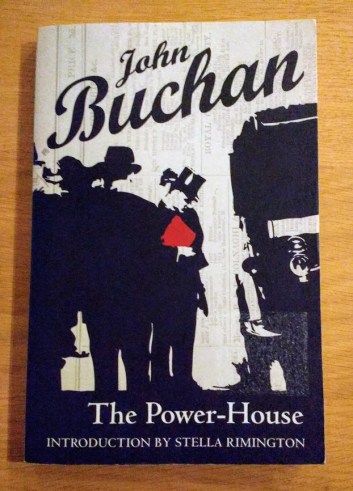
– is for The Power House by John Buchana book I’ve had since 2014. I bought this book because I’d read and enjoyed John Buchan’s The Thirty-Nine Steps.

The Power House

It’s a short book of just 108 pages and my copy has an introduction by Stella Rimington. She writes:

The Power House is one of the least known of Buchan’s mature works, a tale without a plot, and so full of holes that it calls to mind Samuel Johnson’s definition of a ‘network’ – ‘anything reticulated and desuccated at equal distances, with interstices between the intersections’. It is pure essence of Buchan – a demonstration of his magical power to weave a tale out of no materials but the threads and colours of his imagination.

When his friend Charles Pitt-Heron vanishes mysteriously, Sir Edward Leithen, MP, is at first only mildly concerned. But a series of strange events that follow Pitt-Heron’s disappearance convinces Leithen that he is dealing with a sinister secret society. Their code name is ‘The Power-House’.

I cast my mind back to gather recollections of Pitt-Heron, but all I could find was an impression of a brilliant, uncomfortable being, who had been too fond of the byways of life for my sober tastes. There was nothing crooked in him in the wrong sense, but there might be a good deal that was perverse. I remember consoling myself with the thought that, though he might shatter his wife’s nerves by his vagaries, he would scarcely break her heart.

To be watchful, I decided, was my business. And I could not get rid of the feeling that I might soon have cause for my vigilance. (page 9)

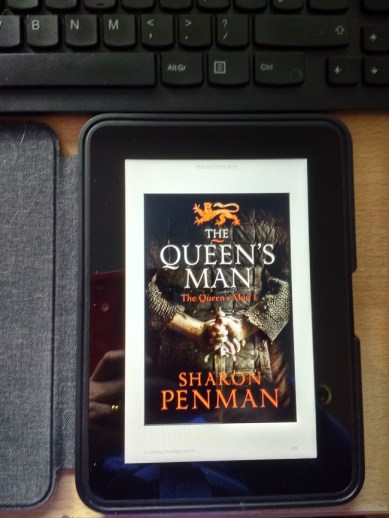
Q – is for The Queen’s Man by Sharon Penman (on my Kindle for two years). I bought this after reading her Sunne in Splendour, which I absolutely loved.

The Queen's Man

It’s set in AD 1183, when Richard the Lionheart is missing, thought to be dead and his brother Prince John is scheming to take the Crown. Justin de Quincy has just discovered his father is the Bishop of Chester. A dying man, a goldsmith, gives him a letter to deliver to Queen Eleanor, (Richard’s and John’s mother) which brings him into great danger as it reveals whether Richard is alive or dead.

Captured by Henry’s soldiers, she [Eleanor] was held prisoner for sixteen years, freed only by Henry’s death. Such a lengthy confinement would have broken most people. It had not broken Eleanor. The passionate young queen and the embittered, betrayed wife were ghosts long since laid to rest. Now in her seventy-first year, she was acclaimed and admired for her sagacity and shrewd counsel, reigning over England in her son’s absence, fiercely protective of his interests, proud matriarch of a great dynasty. A living legend. And this was the woman expecting a letter from a murdered goldsmith? Justin thought it highly unlikely. (location 323)

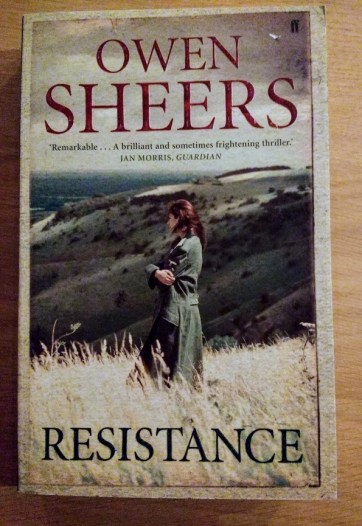
R– is for Resistance by Owen Sheers a book I’ve had for nearly ten years. One of the reasons I haven’t read this before now is that I couldn’t find it for a while until I discovered it out of order behind other books that I’d double-shelved. I can’t remember now what had prompted me to buy this book. Owen Sheers is an author, poet and playwright.

Resistance

Resistance gives an alternative outcome to World War Two, one in which the D-Day landings had failed in 1944 and the Nazis had invaded the UK. Sarah Lewis wakes to discover her husband and all the men in the Welsh border valley of Olchon have gone. It’s the story of a community under siege.

The meeting with Atkins had happened too quickly for George to think on the consequences yet. His head was light, open, and he swung his scythe with a renewed energy. He felt exposed, as if a layer of skin had been shaved from him, bringing him into closer contact with the world. The blade’s edge against the young stalks of bracken, the calligraphy of the swallows above him. Everything seemed clearer, brought into sharper focus. Just an hour ago the war was a different country, the contours of which he’d traced through the newspapers, in radio reports. But now he was involved, connected. He had the strange sensation of his life simultaneously diminishing and expanding under the impression of Atkins’s words and for the second time that week he felt older than his seventeen years. (page 25)

What do you think? Do you fancy any of them? Would you ditch any of them?

Six Degrees from No. 1 Ladies Detective Agency to White Nights

I love doing Six Degrees of Separation, a monthly link-up hosted by Kate at Books Are My Favourite and Best. Each month a book is chosen as a starting point and linked to six other books to form a chain. A book doesn’t need to be connected to all the other books on the list, only to the one next to it in the chain.

This month the chain begins with Alexander McCall Smith’s No.1 Ladies Detective Agency, a book I haven’t read although I have watched the TV version.

The No. 1 Ladies' Detective Agency  (No. 1 Ladies' Detective Agency #1)

Precious Ramotswe is a kind, warm-hearted and large African lady. She is also the only female private detective in Botswana. Her agency – the No.1 Ladies’ Detective Agency – is the best in the country. With help of her secretary, Mma Makutsi, and her best friend, Mr JLB Matekoni, she solves a number of difficult problems. A missing husband, a missing finger and a missing child – she will solve these mysteries in her own special way.

Although I haven’t read No.1 Ladies Detective Agency I have read a few of Alexander McCall Smith’s books including The Careful Use of Compliments, an Isabel Dalhousie Novel, one of the Sunday Philosophy Club series, set in Edinburgh.

The Careful Use of Compliments (Isabel Dalhousie, #4)

Isabel has just had a baby, Charlie, and is in a relationship with his father, Jamie (14 years her junior) who is her niece’s, ex-boyfriend. There is a mystery about a painting, whether or not it is a forgery, but for me it’s the philosophical questions that are always uppermost in Isabel’s mind and conversations, her way of ‘interring’ in matters which she considers ‘helping’, and her kindhearted nature that was more interesting.

The next link in my chain is to an another book set in Edinburgh. The Inspector’s Daughter by Alanna Knight, the first in the Rose McQuinn Mystery series, set in Edinburgh in 1895, when the Forth Railway Bridge had just been opened.

The Inspector's Daughter

Rose, recently returned from America’s Wild West, steps into the shoes of her father, DI Faro. She lives in an isolated house at the foot of Arthur’s Seat and is helped by a wild deerhound who appears just when she needs him.

Arthur’s Seat, the extinct volcano within Holyrood Park, east of Edinburgh Castle is also mentioned in Ian Rankin’s The Falls, the 12th Inspector Rebus book.

The Falls (Inspector Rebus, #12)

Rebus investigates the disappearance of ‘Flip’ a university student. One lead is a carved wooden doll found in a tiny coffin. Rebus concentrates on the tiny coffin and finds a whole series of them had turned up over the years dating back to 1836 when 17 were found on Arthur’s Seat.

The Strange Case of Dr. Jekyll and Mr. Hyde and Other Tales of Terror

In The Falls Rankin also refers to Burke and Hare, the 19th century resurrectionists and this leads me on to the next link in my chain – to The Body Snatcher, which is one of the Tales of Terror by Robert Louis Stevenson, published in the same volume as The Strange Case of Dr. Jekyll and Mr Hyde. This is a traditional Christmas ghost story, beginning with four men gathered in an inn on a dark winter’s night telling tales of grisly deeds as they sit round the fireside. One of the stories is based on the activities of body snatchers, Burke and Hare in Edinburgh in the 1820s.

The next book, also by Robert Louis Stevenson is in contrast to his tale of terror  – it’s A Child’s Garden of Verses, poems I loved as a child.

This is one of my favourite poems – it brings to mind the power  and fury of the wind:

Windy Nights

Whenever the moon and stars are set,
Whenever the wind is high,
All night long in the dark and wet,
A man goes riding by.
Late in the night when the fires are out,
Why does he gallop and gallop about?

Whenever the trees are crying aloud,
And ships are tossed at sea,
By, on the highway, low and loud,
By at the gallop goes he;
By at the gallop he goes, and then
By he comes back at the gallop again.

The last link in my chain is to a book with Nights in its title – White Nights by Ann Cleeves, the second in her Shetland Quartet, featuring DI Jimmy Perez. The ‘white nights’ are the summer nights when the sun never really goes down.

White Nights (Shetland Island, #2)

It’s set mainly in Biddista, a fictional village where artist Bella Sinclair throws an elaborate party to launch an exhibition of her work at The Herring House, a gallery on the beach. The party ends in farce when one the guests, a mysterious Englishman, bursts into tears and claims not to know who he is or where he’s come from. The following day the Englishman is found hanging from a rafter, and Jimmy Perez is convinced that the man has been murdered.

From books about different detective series my chain moved through a tale of terror, then to a children’s book of poetry and back to another murder mystery –  from Botswana to Edinburgh and the Shetland Isles.

Next month (February 3, 2018),  the chain begins with the book that won the Man Booker Prize in 2017 – Lincoln in the Bardo by George Saunders.
Historical Fiction read in 2017

Historical fiction is one of my favourite genres and this year I’ve read 28 books. The majority are set in the 19th/20th centuries. I rated the starred books with 5 stars and my favourite book, ie the one I enjoyed the most is Days without End by Sebastian Barry.

Days Without End

I was spellbound, the storytelling is superb, the characters are unforgettable, and the setting comes across so vividly that I had no difficulty in imagining the locations. Add to that the narration written in Thomas McNulty’s own uneducated voice, fluent and richly descriptive, lyrical and so easy to read.

20th century: 

  1. An Artist of the Floating World by Kazuo Ishiguro
  2. The Vanishing Box by Elly Griffiths
  3. The Buttonmaker’s Daughter by Merryn Allingham
  4. The Secret of Summerhayes by by Merryn Allingham
  5. Past Encounters by Davina Blake
  6. The Stars are Fire by Anita Shreve
  7. All the Light We Cannot See by Anthony Doerr
  8. A Death in the Dales by Frances Brody
  9. The Kill Fee by Fiona Veitch Smith
  10. The Taxidermist’s Daughter by Kate Mosse

19th century

  1. Property by Valerie Martin
  2. Beneath a Burning Sky by Jenny Ashcroft
  3. His Bloody Project by Graeme Macrae Burnet
  4. The Invention of Wings by Sue Monk Kidd*
  5. At the Edge of the Orchard by Tracy Chevalier
  6. See What I Have Done by Sarah Schmidt
  7. The Good People by Hannah Kent*
  8. Days without End by Sebastian Barry*

18th century

  1. Birdcage Walk by Helen Dunmore
  2. The Body in the Ice by A J MacKenzie*

17th century

  1. The Witchfinder’s Sister by Beth Underdown*

16th century

  1. Fools and Mortals by Bernard Cornwell*
  2. Six Tudor Queens: Anne Boleyn: a King’s Obsession by Alison Weir
  3. Katharina by Margaret Skea

14th century

  1. The Last Hours by Minette Walters

10th century

  1. Dunstan by Conn Iggulden*

Roman Britain

  1. The Eagle of the Ninth by Rosemary Sutcliff*
  2. Vindolanda by Adrian Goldsworthy

Six Degrees from It to The Vanishing Box

I love doing Six Degrees of Separation, a monthly link-up hosted by Kate at Books Are My Favourite and Best. Each month a book is chosen as a starting point and linked to six other books to form a chain. A book doesn’t need to be connected to all the other books on the list, only to the one next to it in the chain.

This month the chain begins with It by Stephen King – in the storm drains, in the sewers, IT lurks, taking on the shape of every nightmare, each one’s deepest dread. Sometimes IT appears as an evil clown named Pennywise and sometimes IT reaches up, seizing, tearing, killing…

It

I haven’t read It but I have read  a few of Stephen King’s books including Joyland, which is a ghost story, a love story, a story of loss and heartbreak, set in a funfair. It’s also a murder mystery and utterly compelling to read. (my review)

13596166

The next link in my chain is to an another ghost story – Dark Matter by Michelle Paver, a chilling book, very chilling, both in the setting in the High Arctic and in atmosphere.

Dark Matter

It’s a ghost story in the form of a diary – that of Jack Miller who in 1937 was part of an expedition to the High Arctic to study its biology, geology and ice dynamics and to carry out a meteorological survey. As the darkness descends, Jack is left alone at the camp and his nightmare really begins. And it is very scary! (my review)

I’m moving away from dark and scary stories to another book with ‘matter in its title – to Alive, Alive Oh! And Other Things That Matter by Diana Athill.

Alive, Alive Oh!: and Other Things that Matter

It’s only a short book but it covers a wide range of Diana Athill’s memories, many images of beautiful places, and the friends and lovers she has known. The chapters follow on chronologically but are unconnected except for the fact that they demonstrate her love of life. It was heart breaking to read her remarkably candid account of  the miscarriage she had when she was in her early 40s and she nearly died. (my review)

Katherine of Aragon also suffered from miscarriages during her marriage to Henry VIII. Antonia Fraser’s Six Tudor Queens: Katherine of Aragon, the True Queen is fictional biography at its most straight forward, written in an uncomplicated style.

It’s a long and comprehensive study, told from Katherine’s point of view it follows her life from the time she arrived in England at the age of sixteen to marry Prince Arthur, the elder of Henry VII’s two sons, to her death in 1536. (my review)

Another Katherine living in the Tudor period is Lady Katherine Grey, who was one of the heirs to the throne and a rival to the Tudor Queens, Mary and Elizabeth I. Leanda de Lisle tells her story and that of her sisters in The Sisters Who Would Be Queen: The tragedy of Mary, Katherine and Lady Jane Grey. 

The Sisters Who Would Be Queen


Lady Jane Grey  is remembered in British history as the monarch with the shortest reign… just nine days. In 1553 after the death of her cousin, the protestant King Edward VI she was proclaimed Queen in place of his Catholic half sister, Mary Tudor. Mary overthrew Jane 13 days later, and she was tried for treason, found guilty and was executed. (this is one of my TBR books)

Lady Jane Grey features in The Vanishing Box by Elly Griffiths, the fourth book in the DI Stephens and Max Mephisto series.

Lily Burtenshaw was murdered. She was found in her room tied to a chair, leaning forward and pointing to an empty crate with ‘King Edward Potatoes’ written on the side. She had been posed to look like Lady Jane Grey in the painting by Delaroche, of her execution at the moment she was being helped to lay her head upon the block. (my review)

My chain began with a book  about a scary clown, moved to a scary funfair to yet another scary book set in the Arctic. It then travelled to a different matter – that of miscarriages, then to the sister of a short-lived queen and finally to a murder mystery in which the victim was posed as Lady Jane Grey.  From America to England in both the past and the present, from fiction to historical biography and then to a murder mystery – from horror to murder in six steps!

Next month January 6, 2018), the chain will begin with an international bestseller (that I haven’t read) – Alexander McCall Smith’s No.1 Ladies Detective Agency.