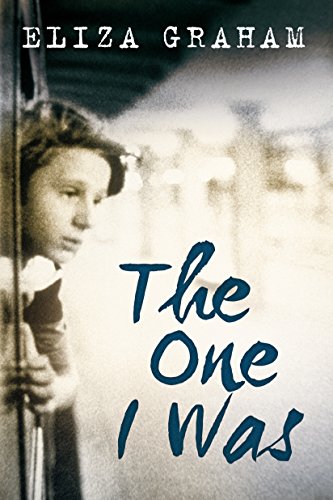
I downloaded The One I Was by Eliza Graham soon after it was published in May 2015 and I’ve just got round to reading it. It was worth waiting for as I really enjoyed it and think it is one of the best books I’ve read recently. It’s historical fiction split between the present and the past following the lives of Benny Gault and Rosamund Hunter.
It begins in the present as Rosamund goes to Fairfleet, her childhood home, to nurse Benny Gault, who first came to Fairfleet in 1939, having fled Nazi Germany on a Kindertransport train. As an adult he bought the house and now he is dying of cancer. It’s a difficult time for Rosamund as she has painful memories of her life at Fairfleet and she is wary about returning – so much so that she doesn’t tell Benny of her connection to the house.
Throughout the book events from both their pasts are revealed, and gradually they discover the connections between them and they come to terms with the traumas that have haunted them. This is a novel about friendship, palliative care, redemption and forgiveness across generations. I was totally engrossed in both their life stories as the various strands of the story eventually combined. Although it was Benny’s story that appealed to me the most – particularly his early life in Germany and the story of how he came to live at Fairfleet – I was also fascinated by the story of Rosamund’s grandmother, one of the few women pilots who flew Spitfires for the Air Transport Auxiliary.
This is obviously a well researched book and Eliza Graham has listed the books she had found invaluable whilst writing The One I Was.
I’ve read just two of Eliza Graham’s books, Playing With the Moon and Another Day Gone (linked to my reviews). I hope to read more of her books this year:
Playing with the Moon (2007) Restitution (2008) Jubilee (2010) The History Room (2012) The One I Was (2014) Another Day Gone (2016) The Lines We Leave Behind (2018) The Truth in Our Lies (2019) You Let Me Go (2021) – publication date 25 March 2021
Every Friday Book Beginnings on Friday is hosted by Gillion at Rose City Readerwhere you can share the first sentence (or so) of the book you are reading. You can also share from a book you want to highlight just because it caught your fancy.
This morning I started to read The One I Was by Eliza Graham. I’ve read a couple of her books before and I’m hoping this one will be just as good.
It begins:
Every bone in my body screamed at me to run away from the elegant and classical white house at whose door I stood.
Also every Friday there is The Friday 56, hosted by Freda at Freda’s Voice. *Grab a book, any book. *Turn to Page 56 or 56% on your ereader . If you have to improvise, that is okay. *Find a snippet, short and sweet, but no spoilers!
These are the rules:
Grab a book, any book.
Turn to page 56, or 56% on your eReader. If you have to improvise, that is okay.
Find any sentence (or a few, just don’t spoil it) that grabs you.
Post it.
Add the URL to your post in the link on Freda’s most recent Friday 56 post.
Grab a book, any book.
Turn to page 56, or 56% on your eReader. If you have to improvise, that is okay.
Find any sentence (or a few, just don’t spoil it) that grabs you.
Post it.
Add the URL to your post in the link on Freda’s most recent Friday 56 post.
Page 56:
‘Sometimes people think it is strange to try so hard,’ he said.
‘The world depends on some of us refusing to be the same as everyone else.’
~~~
My first thought was, of course, to wonder why this person wanted to run away from the house so desperately.
Random House UK, Cornerstone| 17 September 2020| 314 pages| Kindle review copy| 5*
Description
Victory is close. Vengeance is closer.
On the brink of defeat, Hitler commissioned 10,000 V2s – ballistic rockets that carried a one-ton warhead at three times the speed of sound, which he believed would win the war.
Dr Rudi Graf who, along with his friend Werner von Braun, had once dreamt of sending a rocket to the moon, now finds himself in November 1944 in a bleak seaside town in Occupied Holland, launching V2s against London. No one understands the volatile, deadly machine better than Graf, but his disillusionment with the war leads to him being investigated for sabotage.
Kay Caton-Walsh, an officer in the WAAF, has experienced first-hand the horror of a V2 strike. When 160 Londoners, mostly women and children, are killed by a single missile, the government decides to send a team of WAAFs to newly-liberated Belgium in the hope of discovering the location of the launch sites. But not all the Germans have left and Kay finds herself in mortal danger.
As the war reaches its desperate end, their twin stories play out, interlocked and separate, until their destinies are finally forced together.
My thoughts:
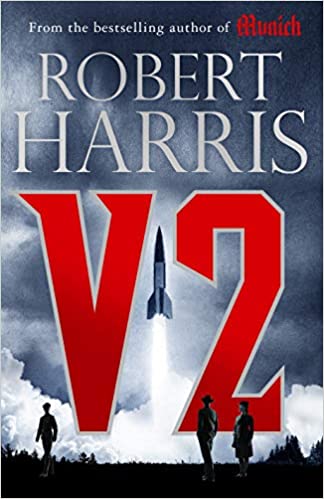
V2 is historical fiction with a solid factual framework. I like to know when I’m reading historical fiction how much is history and how much is fact. So, I was pleased to find that at the end of the book Harris has included a list of the sources he consulted on the history of the V2 and how it worked, including the work of the photographic reconnaissance interpreters, before writing V2. In particular he acknowledges Eileen Younghusband’s two volumes of memoirs – Not an Ordinary Life and One Woman’s War. She had worked as a WAAF officer on the Mechelen operation, working on detecting the location of the V2 launch sites, and her memoirs had provided him with a vivid insight into her wartime life. Without them he would not have written V2.
It’s set over five days at the end of November 1944 as the Germans fired V2 missiles on London from the woods around Scheveningen on the Dutch coast. The British response was a counter-operation, including a team of WAAFs. The cast includes some historical figures such as Werner von Braun, the real-life head of the Nazi rocket programme, and SS-General Hans Kammler. It’s told in alternating chapters from two of the fictional characters’ perspectives – Dr Rudi Graf, a rocket engineer on the V2 team and Kay Caton-Walsh of the Women’s Auxiliary Air Force. Kay was part of the team based at Mechelen using radar to try to locate the V2 firing sites. Harris emphasises that his fictional character, Kay, bore no resemblance to Mrs Younghusband, apart from the fact that she worked on the Mechelen project.
I thoroughly enjoyed reading this novel, learning a lot about that period of the Second World War and about the V2. It is detailed and tense, and very readable, describing the intricate details of the launching of the V2s and Kay’s work, which became increasingly dangerous as their location became known to the Germans.
Many thanks to the publishers and NetGalley for my digital proof copy.
It’s Christmas 1845 and Haworth is in the grip of a freezing winter.
Hodder and Stoughton|5 November 2020| 309 pages| e-book| Review copy|4*
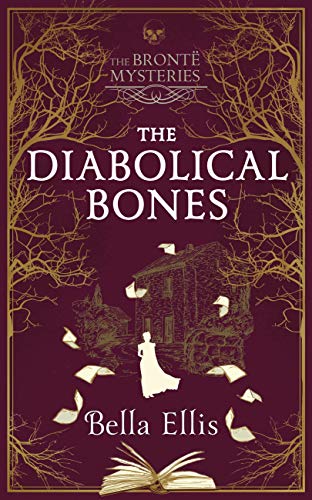
The Diabolical Bones is the second novel by Bella Ellis about the Brontë sisters. It’s historical fiction that brings the period (1845) and the setting vividly to life. It begins with Charlotte in 1852 looking back to that December of 1845 when her brother and sisters had still been alive and they had faced the hidden horror that lay within Top Withins Hall. This is a dark story, as the four Brontës discover – it involves not only murder, but also the occult and child exploitation. It highlights what life was like in the mid nineteenth century, the living conditions and the inequalities between the well-to-do and the poor.
Charlotte, Emily and Anne and their brother, Branwell became real people before my eyes, seeing them in their home in the Parsonage at Howarth. And together they make a formidable team as they set about discovering the truth about the bones of a child hidden in a chimney in the oldest part of Top Withins Hall, an ancient house high up on the moors above Howarth.
The Hall is the home of the Bradshaw family, known by Tabby, the Brontes’ housekeeper as a ‘bad lot’. She is steeped in the local superstitions and folklore and believes the land where the Bradshaws live is where the ‘hidden folk’ live. It fills her with horror as she tells the sisters about the children of Adam and Eve who live among the rocks and woodland, moors and rivers, unseen. In the past people would leave out offerings for them to keep away ill fortune. She warns them that now that there is a heavy price to be paid – and that the discovery of the bones is just the start of it.
There are links to other Brontë books in the names of some of the characters – for example, imagine finding Mrs Grace Poole, the guardian of the mad woman in the attic in Jane Eyre in charge of an orphanage. And I was delighted to find Emily in particular was inspired by Top Withins Hall and the events that took place there to write a novel, because its resemblance to Wuthering Heights struck me immediately. The more I read the more I could believe that the Brontë family were just as Bella Ellis has described them.
Bella Ellis’ is the Brontë inspired pen name for the author Rowan Coleman, who has been a Brontë devotee for most of her life – and it shows so well in this book. The setting is superb, the characters are ‘real’ and the book is well plotted. It was only towards the end that I suspected the identity of the main culprit and the danger that the four siblings had to face. I do hope there will be a third Brontë book.
My thanks to Hodder & Stoughton for an e-book review copy via NetGalley
I last wrote about the books I’ve borrowed from the library in February – just before the lockdown in March. Although the libraries opened up a while ago with a Select and Collect service I haven’t used it and now there is time-limited browsing at some branches, and the mobile library is also operating. On Tuesday it came here and I ventured up the road to the library van.
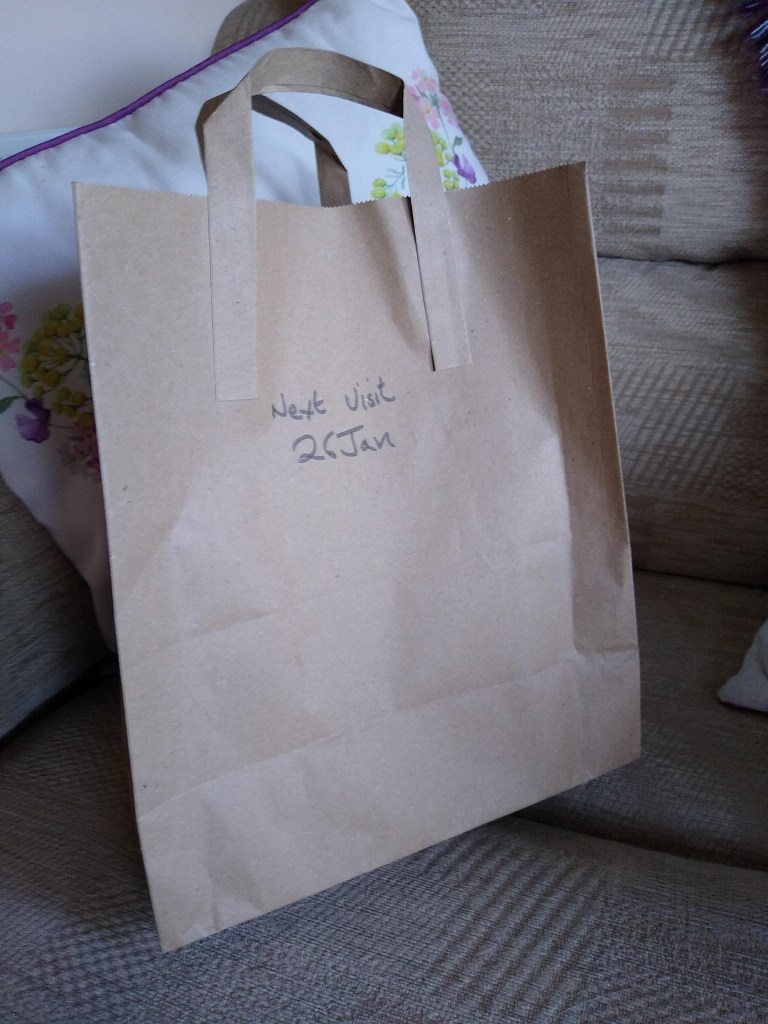
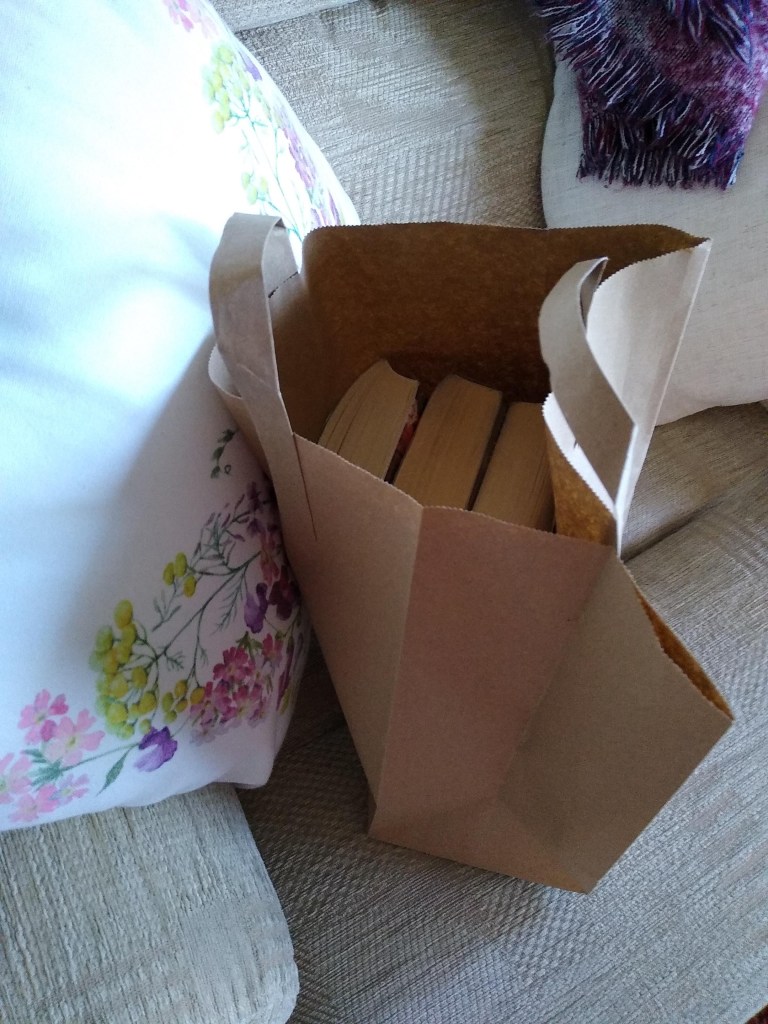
We can’t actually go into it but I could ask for books – I came home with just three. I had to wait for a couple of days before I could actually touch them. Here they are in a library bag showing the date of the next mobile visit.
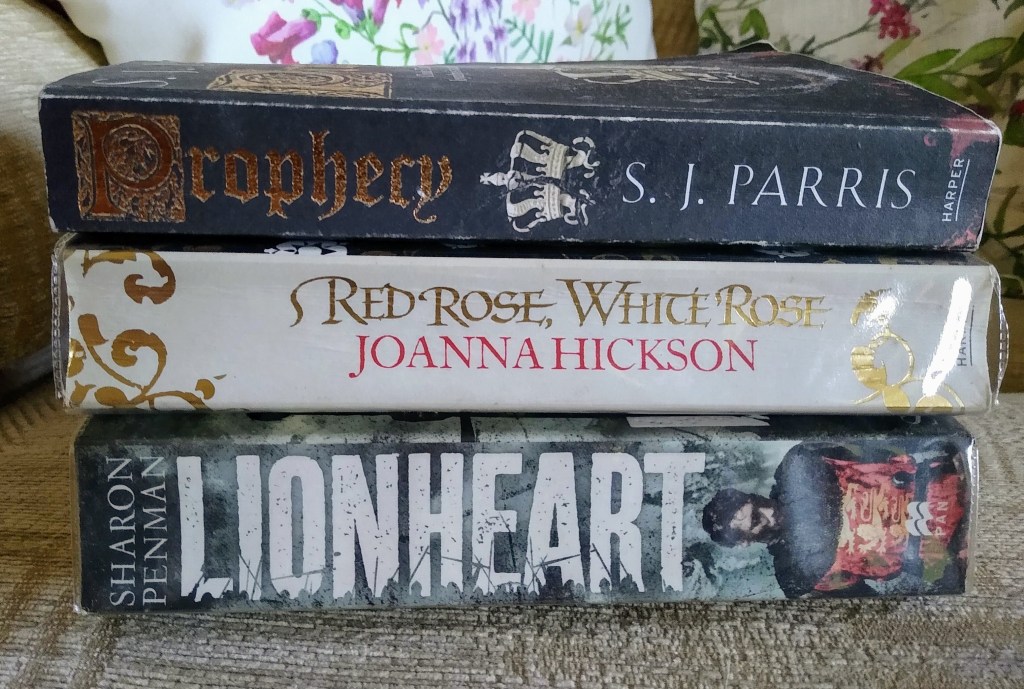
Today I took them out of the bag – all historical fiction:
I haven’t read any of S J Parris’ books before but Prophecy looks very interesting. It’s the second in her Giordano Bruno series set in the reign of Elizabeth I. Bruno was a monk, poet, scientist, and magician on the run from the Roman Inquisition on charges of heresy for his belief that the Earth orbits the sun and that the universe is infinite. In this book set in 1583, Elizabeth’s throne is in peril, threatened by Mary Stuart’s supporters scheme to usurp the rightful monarch.
Next Red Rose, White Rose by Joanna Hickson, set in 15th century England during the Wars of the Roses when Cecily Neville was torn between both sides. Her father was Richard Neville, the Duke of Westmorland and a staunch Lancastrian and she married Richard Plantagenet of York and became the mother of Edward IV and Richard III. I’ve read and enjoyed two of her books, The Tudor Crown and The Lady of the Ravens, so I’m expecting to like this book too.
I’ve always been fascinated by stories of Richard the Lionheart, so Lionheart by Sharon Penman about Richard I appeals to me. Richard was crowned King in 1189 and set off almost immediately on the Third Crusade to regain the Holy Land. Sharon Penman’s The Sunne in Splendour is one of my all time favourite books, and I have four more by her in my Kindle waiting to be read – Here Be Dragons, The Queen’s Man, Prince of Darkness and When Christ and His Saints Slept. So I can see that next year will be a Penman reading feast – and I may have to buy an e-book copy of Lionheart as the font is minute in the printed book!
It’s time again for Six Degrees of Separation, a monthly link-up hosted by Kate atBooks Are My Favourite and Best. Each month a book is chosen as a starting point and linked to six other books to form a chain. A book doesn’t need to be connected to all the other books on the list, only to the one next to it in the chain.
This month it begins with a book that is celebrating its 50th birthday this year – Are You There God? It’s Me Margaret by Judy Blume. I’ve not read this book, but the title, with my name in it, intrigues me. Margaret Simon, almost twelve, likes long hair, tuna fish, the smell of rain, and things that are pink. She’s just moved from New York City to Farbook, New Jersey, and is anxious to fit in with her new friends.
There are several ways I thought of to go from this book – my name, or the author’s name, or the subject matter of a coming of age novel, or a relationship with God.
After several false starts, I chose another coming , bof age novel. TheHighest Tideby Jim Lynch is about Miles O’Malley, a thirteen year old boy and about life, growing up, relationships and love. It’s narrated by an adult Miles, looking back at that summer when he found a giant squid, dying on the mudflats at Skookumchuck Bay, at the southern end of Puget Sound, near his house. That was the summer he had a crush on Angie, his ex-babysitter, and his best friend, old Florence was getting sicker each week.
Moving on to another book about ‘tides‘ toThe Sea Detective by Mark Douglas-Hume set in Scotland on the fictional island of Eilean Iasgaich. Cal McGill uses his knowledge of tides, winds and currents to solve mysteries, which helps in the investigation of the appearance of severed feet in trainers that had been washed on shore on islands miles apart. It’s a story of unsolved mysteries both from the present day and from the Second World War, and of two Indian girls, sold into the sex trafficking trade.
And the next link is the word ‘sea‘ in the title in The Sea Change by Joanna Rossiter set in lost landscapes this is a novel revolving around a mother and daughter caught up in catastrophic events. The lost landscapes are the village of Imber, a Wiltshire village that was requisitioned by the army during World War Two, where Violet had grown up, and the coastal village of Kanyakumari in Southern India, where her daughter Alice was caught up in the tsunami that devastated the area in 1971.
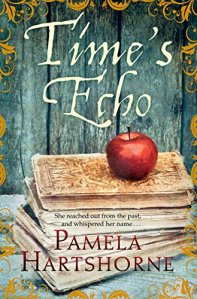
Time’s Echo by Pamela Hartshorne is a time-slip story with an element of mystery and suspense. Grace Trewe is drawn into Hawise Aske’s life, four and a half centuries earlier in York, 1577. Grace likes to travel and although she survived the Boxing Day tsunami she is suppressing her memories of what happened. As she learns how Hawise died it gets to the point where she dreads slipping out of current time into not only Hawise’s past but also into her own as she remembers what happened to her in the tsunami.
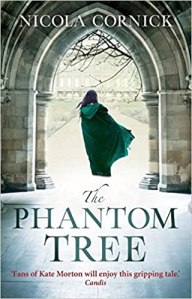
Another time-slip novel is The Phantom Tree by Nicola Cornick which alternates between the Tudor period and the present day following the life of Alison Banestre (known as Bannister in the present day) as she moves between the centuries trying to find out what happened to Mary Seymour. It’s a mystery, based on the true story of Mary Seymour, the daughter of Katherine Parr (Henry VIII’s sixth wife) and ThomasSeymour, who she married after Henry’s death.
Thomas Seymour was Jane Seymour’s brother. Their family home wasWolf Hall, an early 17th-century manor house where Mary Seymour was taken in 1557 as an unwanted orphan and presumed dead after going missing as a child. This brings me to Hilary Mantel’s trilogy, Wolf Hall and specifically to the second book in the trilogy, Bring Up the Bodies, which begins at Wolf Hall, where Henry VIII is visiting the Seymours. And it is at Wolf Hall that Henry begins to fall in love with Jane.
My chain this month includes a coming of age novel, books with tides and seas in their titles, time-slip novels and books in which Wolf Hall features. It begins in America in 1970, moves forward and backwards in time and place to the 16th century in England.
Next month (January 2, 2021), we’ll start with the winner of the 2020 Women’s Prize for Fiction, Hamnet by Maggie O’Farrell.





 BooksPlease