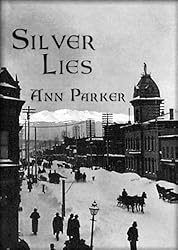
Silver Lies by Ann Parker

From out of the black hole that is my Kindle came Silver Lies by Ann Parker, a new-to-me author. Books have been known to disappear for ever in there and this one had been languishing down in the depths for three years, so I thought it was time to read it. It looked as though it would be a bit different from other books I’ve been reading this year. Apart from True Grit I don’t think I’ve read any westerns for years and actually this one is not a typical western. It’s not a Cowboys and Indians type western at all but is set in 1879/80 in the silver-mining town of Leadville, Colarado in the heart of the Rocky Mountains. It probably fits in more with the crime fiction genre than with westerns, but it was the setting  that attracted me to it.
It’s a really good story beginning when Joe Rose, a silver assayer, facing a bleak future as the last of his money has gone and the hope of making his fortune in silver has disappeared, is found dead in Tiger Alley propped up behind the Silver Queen saloon. Inez Stannert’s husband Mark had won the saloon in a poker game and eight months before the story begins he had left her and their friend and business partner, Abe Jackson to run it on their own. Inez has no idea where he is and whether he’ll ever return.

Joe’s death is just the start of the mystery – was his death an accident or was he murdered and if so why?  Inez sets out to discover the truth and although his wife Emma has asked her to settle his affairs for her what is she keeping from Inez? Where is Mark and why did he leave? There is a new Reverend in town. Inez falls for his charms but is he to be trusted? She had him pegged as a gambler rather than a man of the cloth. And she doesn’t trust the new marshall either – ‘a thin man with the look of a hungry rattlesnake’. Inez knows he is ‘just a two-bit gunslinger from Texas’ hired by the ‘silver barons to keep the peace after last month’s lynching’. So it’s no wonder that she uncovers a web of deceit, counterfeit, blackmail and murder.

With plenty of memorable characters I could easily imagine I was in the silver rush town, a town where:

People rush in – from the East, from the West – and collide at the top of the Rockies. They’re looking for riches or looking to escape. And running. Everyone’s either from their past or running toward some elusive vision of the future. (location 5896)

Leadville was a colourful place, a boom-town, bustling with life -everything is there – the Silver Queen saloon and the Crystal Belle Saloon, Leadville’s leading parlor house, a brick built opera house, whose patrons ‘swelled the after-midnight crowds’ in the Silver Queen saloon, five banks and a small white church with a steeple.

Silver Lies won the Willa Award for Historical Fiction and the Colorado Gold Award and was chosen as best mystery of the year by Publishers Weekly and The Chicago Tribune.  For more information about Ann Parker and her books see her website.

I was completely engrossed in this book with its multi-layered and intricate plot that kept me guessing all the way through.  I hope to read more of this series:
  1. Silver Lies (2003)
  2. Iron Ties (2006)
  3. Leaden Skies (2009)
  4. Mercury’s Rise (2011)

Reading challenges: Mount TBR Reading Challenge 2015Historical Fiction Reading ChallengeColor Coded Challenge

House of Shadows by Nicola Cornick

Nicola Cornick is a new-to-me author, but she is by no means a new author. She has written many books – see her website for more details. Not having read any of her books I wasn’t sure I’d like House of Shadows, her latest book due to be published on 5 November,  but the publishers’ press release persuaded me to read and review an uncorrected proof copy. I’m glad I did as I thoroughly enjoyed House of Shadows.

Press Release synopsis:

One House, Three Women. And a lie that will change history.

February 1662

On the eve of her death Elizabeth Stuart hands her faithful cavalier William Craven an ancient pearl with magical properties to be kept safe for her rightful heir. Craven, distraught with grief, builds Ashdown Estate in Elizabeth’s memory and places the pearl at the centre.

February 1801

Notorious Regency courtesan Lavinia Flyte is brought to Ashdown House with her protector, Lord Evershot, who is intent on uncovering the Winter Queen’s treasures. Evershot’s greedy pillage of the ancient house will unleash a dark power which has lain dormant for a hundred and fifty years.

February 2014

Holly Ansell’s brother has gone missing. As Holly retraces his footsteps, she discovers that her brother was researching the mystery of Elizabeth Stuart and her alleged affair with William Craven. A battered mirror and the diary of a Regency courtesan are the only clues she has, but Holly is determined to discover the truth: Where is the fabled pearl that Elizabeth gave to William Craven? What happened to Lavinia Flyte? And who is the Winter Queen’s rightful heir?

My thoughts:

This is a successful time-slip novel as I had no difficulty in following each strand of the story. And each is set firmly in its historical context. It’s a fascinating mix of factual history combined with historical interpretation/imagination to fill in the gaps in the records. Elizabeth Stuart, known as the Winter Queen, the daughter of James I of England and VI of Scotland was married to Frederick V, briefly the King of Bohemia, before his lands were taken from him after the Battle of White Mountain in 1620. There are rumours from 1660 onwards, but no proof, that Elizabeth either had an affair or secretly married William, the first Earl of Craven.

Once I started reading the House of Shadows I didn’t want to stop as the history of crystal mirror and the Sistrin pearl, a jewel of rare beauty and price unfolds. Both were inherited by Elizabeth from her godmother Elizabeth I. They had previously belonged to Mary Queen of Scots, Elizabeth Stuart’s grandmother. They were said to hold great magic – the mirror was said to have the power to destroy its enemies by fire, whilst the ring was supposedly a talisman for good. It was reported that Frederick was involved with the Knights of the Rosy Cross and the legend is that the Knights used the mirror and the pearl together in their necromancy to create firewater in which they could both see and transform the future.

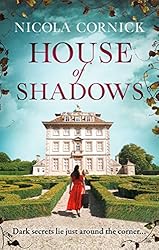
There is so much I loved in this book ‘“ the history, all the storylines,  the characters, and the settings against the backdrop of years from the 16th to the 21st centuries. It has mystery, elements of the supernatural as well as being a love story, not just the story of Elizabeth and William in the 17th century, but also of Lavinia in the early 19th century and Holly in the 21st. I loved the details of each period and in particular of Ashdown House, a real house in Oxfordshire that was built by William Craven for Elizabeth. It’s now owned by the National Trust, where Nicola Cornick has been a volunteer guide and historian for the last fourteen years. She has certainly done her research very well and incorporated it seamlessly into her book. The house shown on the front cover is Ashdown House

I also loved the details of Holly’s family history which her brother Ben had been researching before he went missing and how it all linked in to each time line. It’s the sort of thing you hope you be able to would find if you did your own family history.

It is a fascinating book. There is so much packed into its pages, a real page turner in each timeline, making me eager to find out what happened next. If this is representative of Nicola Cornick’s books there are plenty of others that I’m going to enjoy.

  • Paperback: 448 pages
  • Publisher: MIRA; First edition edition (5 Nov. 2015)
  • Language: English
  • ISBN-10: 1848454163
  • ISBN-13: 978-1848454163
  • Source: Uncorrected Proof Copy

Last Seen in Massilia by Steven Saylor

 Last Seen in Massilia is the eighth book in Steven Saylor’s series of books Roma Sub Rosa, historical crime fiction set in ancient Rome, featuring an investigator called Gordianus the Finder. I’ve begun the series with this book, rather than with the first book, because it was in a pack of books I bought earlier this year from Barter Books. This one is not set in Rome, but in Massilia – modern day Marseilles. It’s 49BC during Caesar’s siege of the city. I liked it for it’s physical and historical setting but I think the crime element is secondary.

It begins as Gordianus is on his way to Massilia to look for his adopted son, Meto, who has been reported dead.  Massilia is surrounded, access extremely difficult, if not impossible and Gordianus and his son-in-law Davus join the Roman troops attempting to enter the city through a tunnel taking them underneath the city walls. An attempt that ends almost in disaster as the tunnel is flooded and they are almost drowned. Fortunately they are rescued by Heironymous, the elected scapegoat doomed to take on the sins of the people by throwing himself off the Sacrifice Rock.

Whilst he is unable to find out what has happened to Meto, he and Davus witness the fall of a young woman from the Sacrifice Rock. The question is was it suicide, did she just slip or was she pushed. All this is going on, although Gordianus doesn’t actually do much detective work, whilst the siege of the city comes to a fiery and dramatic end.

What I really liked was all the detail about Massilia – how it was governed – the hierarchy of theTimouchoi its ruling officials, its relationship to Rome, its traditions and customs. So it’s no surprise to me that Saylor has used the available sources for his book – Aristotle, Cicero, Strabo and Plutarch. For the details of the siege he used Caesar’s The Civil War, amongst other primary sources.

However, I am glad I read it and will look out for more books in the series:

Roma Sub Rosa
1. Roman Blood (1991)
2. Arms of Nemesis (1992)
3. Catilina’s Riddle (1993)
4. The Venus Throw (1995)
5. A Murder On the Appian Way (1996)
6. The House of the Vestals: The Investigations of Gordianus the Finder (1997)
7. Rubicon (1999)
8. Last Seen in Massilia (2000)
9. A Mist of Prophecies (2002)
10. The Judgement of Caesar (2004)
11. A Gladiator Dies Only Once: The Further Investigations of Gordianus the Finder (2005)
12. The Triumph of Caesar (2008)

I also have Roma by Steven Saylor – a book that has sat unread on my shelves for a few years now, unread so far mainly because it is so long. Maybe this year …

Reading challenges – Historical Fiction and What’s in a Name, category a book with a city in its title.

The Outcast by Sadie Jones: Book and TV

The Outcast

As I wrote earlier The Outcast by Sadie Jones is a book that has sat unread on my shelves for seven years until I noticed that it was being broadcast as a TV drama. I read half the book before the first episode and finished it before the second episode was broadcast.

First of all the blurb from Goodreads:

1957, and Lewis Aldridge is travelling back to his home in the South of England. He is straight out of jail and nineteen years old. His return will trigger the implosion not just of his family, but of a whole community. A decade earlier, his father’s homecoming casts a different shape. The war is over and Gilbert has recently been demobbed. He reverts easily to suburban life – cocktails at six thirty, church on Sundays – but his wife and young son resist the stuffy routine. Lewis and his mother escape to the woods for picnics, just as they did in wartime days. Nobody is surprised that Gilbert’s wife counters convention, but they are all shocked when, after one of their jaunts, Lewis comes back without her. Not far away, Kit Carmichael keeps watch. She has always understood more than most, not least from what she has been dealt by her own father’s hand. Lewis’s grief and burgeoning rage are all too plain, and Kit makes a private vow to help. But in her attempts to set them both free, she fails to predict the painful and horrifying secrets that must first be forced into the open. As menacing as it is beautiful, The Outcast is a devastating portrait of small-town hypocrisy from an astonishing new voice.

The TV adaptation, also written by Sadie Jones is faithful to the book, so for once I could enjoy them both – although maybe enjoy isn’t quite the right word. The TV drama is, of course a condensed version and whilst the cast was good the characters didn’t, of course, match up to my mental image of them whilst reading the book. I thought the boy (Finn Elliot) playing the young Lewis was excellent, whereas the adult Lewis (George MacKay) just didn’t seem to be right physically in episode one. However, he was much more convincing in the second episode. Overall, the themes of the book and the drama are relentlessly depressing, in post-war Britain, the men all maintaining a stiff upper lip, emotions securely repressed. Lewis witnessing his mother’s drowning is unable to express his grief and things just go from bad to worse as he resorts to self-harm.

Meanwhile, the Carmichael family, not fully portrayed in episode one, have a secret, again closely guarded in a world where child abuse is just not acknowledged. In episode two the secret comes out in a dramatic scene, which I thought was really well done. Nathaniel Parker as Dicky Carmichael made a terrifying bully and Jessica Barden as the teenager, Kit was impressive.

The book is written in the passive 3rd person narrative, which I wasn’t keen on. I didn’t like most of the characters, I didn’t like what happened to them and I’m not sure the ending is believable – it left me wondering what really happened next. But the descriptive passages are good, the characters of Lewis and Kit are well-defined, emotions are racked up high and it is truly tragic.

I’m glad I read the book before watching the drama – and I’m glad I watched it, the scenery is beautiful and the repressed and yet emotional atmosphere came over better than in the book.  I did have to watch behind my fingers at some scenes, which I was able to read without visualising them completely, but when it’s there in front of you on the screen it’s not so easy to cast a blind eye. Although you get an insight into Lewis’ mind and feelings when you read a description of him cutting his arm, it’s not as real as seeing it happen.

So, a powerful story, which compelled me to read on and also to watch. This was Sadie Jones’ debut novel. She has since written Small Wars (2009), The Uninvited Guests (2012) and Fallout (2014). I have Small Wars amongst my TBRs – I must dig that one out soon.

Reading challenges: Mount TBR 2015 and the Historical Fiction Reading Challenge 2015.

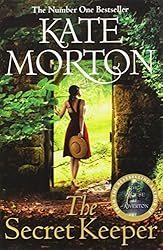
The Secret Keeper by Kate Morton

This is a book that really captured my imagination. I loved everything about it – the descriptive passages, the mystery, the secrets and the people involved. It was all real to me. It’s one of the best books, if not the best book, I’ve read this year.

The Secret Keeper by Kate Morton has been sitting unread for two years on my bookshelves, but if I’d read it earlier I wouldn’t have had the pleasure of reading it now – it was well worth the wait!

It begins on a summer’s day in 1961 in Suffolk when sixteen-year old Laurel is shocked when she sees her mother stabbing a stranger who had come to their farm. Fast forward 50 years Laurel and her three sisters and brother are coming to terms with the fact that their mother, Dorothy is moving closer to the end of her life. Laurel realises that there is so much she doesn’t know about Dorothy’s life and when they find a photograph of Dorothy and a friend, Vivien, in a book of the play Peter Pan, it arouses old and ugly memories for Laurel – images of her mother’s frightened face as she confronted the stranger. Who was Vivien and who was the stranger? Why was Dorothy so scared? Laurel is determined to find out.

It’s a story moving between time periods from 2011, back to the 1960s and also to the 1940s when Dorothy first met and fell in love with Jimmy, a war photographer, and also became friends with the wealthy and beautiful Vivien, married to a successful novelist.  Laurel, with the help of her brother, Gerry, tracks down records throwing light on Dorothy’s and Vivian’s past, back to war-time England and pre-war Australia.

It’s not a straight forward story. By that I don’t mean it’s difficult to read, because each time period is clearly headed and the characters are clearly defined. But there are so many twists and turns – I thought several times I’d got things clear and knew where the story was heading only a bit later on to realise that not all the clues had been revealed and I had to revise my thoughts. It’s so cleverly written and so well plotted that it was only near the end that I had an inkling of Dorothy’s relationship with Vivien and what had really happened to them all. It really is a book I didn’t want to put down and also a book I wanted to enjoy as long as possible. By the end, though, I couldn’t turn the pages fast enough!

Kate Morton’s next book, The Lake House is due to be published in October 2015. I’m looking forward to reading it.

Note: as well as being my 17th book for the Mount TBR Challenge 2015 this is my 3rd book for the TBR Pile Challenge 2015. And the 9th book for the Historical Fiction Reading Challenge 2015.

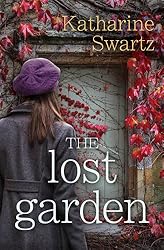
The Lost Garden by Katharine Swartz

The Lost Garden is  an emotionally intense novel of love, loss and grief, set in both the past and the present day, in a small village on the Cumbrian coast.

In 1919 Eleanor, the daughter of the vicar of Goswell, is struggling to adjust to the loss of her brother, Walter who died just before the Armistice was declared and in the present day half-sisters Marin and Rebecca are coming to terms with the death of their father and his wife.

The link between the two stories centres around the walled garden at the back of the Bower House, a small house next to the church. It was said to have been the herb garden for the monastery before the Reformation.

In 1919 the garden is covered in brambles and Eleanor decides she wants to make it into a garden of remembrance, a place to just be, to remember or to forget as much as you need. And she begins to restore it with the help of the church gardener, Jack. As they do so the garden begins to blossom as winter moves into spring and summer, but the mood of both the family and the country remains sombre as they come to terms with the aftermath of the First World War.

In the present day, Marin has bought the Bower House, not knowing its history. Rebecca discovers the walled garden once more overgrown with brambles and weeds and it captures her imagination. And when Marin she sees a photo of a young woman in the garden, thought to have been taken around 1920 she is determined to find out more – just who was the young woman and what is underneath the brambles. With the help of the local gardener, Joss, she begins to restore the garden and in doing so they discover secrets about both the past and the present.

The Lost Garden is a gentle story, well told and an enjoyable read, switching between the past and the present. The differences in attitudes and social conventions of the times provide a distinct contrast and highlights the parallels between the two stories. I liked the story-lines for both Marin and Eleanor, both have difficult relationships with their sisters and both are coming to terms with their grief, but on the whole I was more interested in Eleanor’s story, set against the backdrop of the post First World War.

My thanks to Lovereading for providing an advance proof of this novel, due to be published 15 May 2015. The Lost Garden is the second book in Katharine Swartz’s Tales from Goswell series – the first is The Vicar’s Wife.