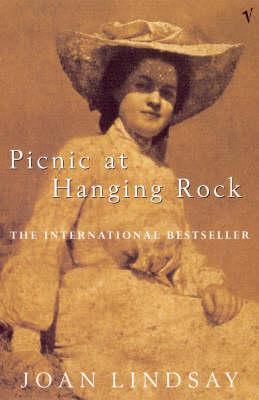
which for me is Picnic at Hanging Rockby Joan Lindsay. The rules of the Spin are that this is the book for me to read by 12 December, 2021.
I am delighted as this just the book I wanted to read next! It was one of my 20 books of Summer, but I didn’t get round to reading it then.
It was a cloudless summer day in the year nineteen hundred.
Everyone at Appleyard College for Young Ladies agreed it was just right for a picnic at Hanging Rock. After lunch, a group of three of the girls climbed into the blaze of the afternoon sun, pressing on through the scrub into the shadows of Hanging Rock. Further, higher, till at last they disappeared.
They never returned.
Whether Picnic at Hanging Rock is fact or fiction the reader must decide for themselves. (Goodreads)
Did you take part in the Classics Spin? What will you be reading?
Every Friday Book Beginnings on Friday is hosted by Gillion at Rose City Readerwhere you can share the first sentence (or so) of the book you are reading. You can also share from a book you want to highlight just because it caught your fancy.
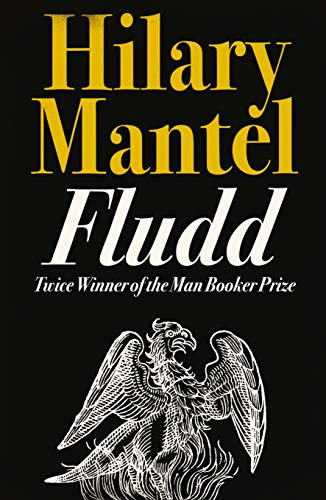
This week I’m featuring Fludd by Hilary Mantel, described as’a dark fable of lost faith and awakening love amidst the moors.’ It’s very different from the other books by her that I’ve read. For one thing it’s short!
The Book Begins:
On Wednesday the bishop came in person. He was a modern prelate, brisk and plump in his rimless glasses, and he liked nothing better than to tear around the diocese in his big black car.
Also every Friday there is The Friday 56, hosted by Freda at Freda’s Voice. *Grab a book, any book. *Turn to Page 56 or 56% on your ereader . If you have to improvise, that is okay. *Find a snippet, short and sweet, but no spoilers!
These are the rules:
Grab a book, any book.
Turn to page 56, or 56% on your eReader. If you have to improvise, that is okay.
Find any sentence (or a few, just don’t spoil it) that grabs you.
Post it.
Add the URL to your post in the link on Freda’s most recent Friday 56 post.
Page 56:
That afternoon, Father Fludd undertook a parish tour. Father Angwin accompanied the curate to the front door. ‘They may ask you into their houses’, he said. ‘For God’s sake don’t eat anything. Be back before dark.’ He hovered, anxious. ‘Perhaps you shouldn’t go alone?’
‘Don’t fuss, man’, Fludd said.
Summary (from Amazon)::
Fetherhoughton is a drab, dreary town somewhere in a magical, half-real 1950s north England, a preserve of ignorance and superstition protected against the advance of reason by its impenetrable moor-fogs. Father Angwin, the town’s cynical priest, has lost his faith, and wants nothing more than to be left alone. Sister Philomena strains against the monotony of convent life and the pettiness of her fellow nuns. The rest of the town goes about their lives in a haze, a never-ending procession of grim, grey days stretching ahead of them.
Yet all of that is about to change. A strange visitor appears one stormy night, bringing with him the hint, the taste of something entirely new, something unknown. But who is Fludd? An angel come to shake the Fetherhoughtonians from their stupor, to reawaken Father Angwin’s faith, to show Philomena the nature of love? Or is he the devil himself, a shadowy wanderer of the darkest places in the human heart?
Full of dry wit, compassionate characterisations and cutting insight, Fludd is a brilliant gem of a book, and one of Hilary Mantel’s most original works.
~~~
What do you think – does this book appeal to you too?
It’s been a long time since I last looked at the forgotten e-books on my Kindle, so it’s time to dip into it again. I have a bad habit of downloading books and then forgetting all about them – it’s as though they’ve gone into a black hole.
Today I’m looking at books with titles beginning with the letters J, K and L, with a little ‘taster’ from each. The summaries are from Goodreads.
Jeremy Hutchinson’s Case Histories by Thomas Grant – I bought this in February 2020 after watching the BBC series,The Trial of Christine Keeler, the story of the Profumo affair in 1962 as seen from her perspective. Hutchinson was Keeler’s defence barrister.
Summary: Born in 1915 into the fringes of the Bloomsbury Group, Jeremy Hutchinson went on to become the greatest criminal barrister of the 1960s, ’70s and ’80s. The cases of that period changed society for ever and Hutchinson’s role in them was second to none. In Case Histories, Jeremy Hutchinson’s most remarkable trials are examined, each one providing a fascinating look into Britain’s post-war social, political and cultural history.
A cartoon by Cummings appeared in the Daily Express on 10 July 1963 headed ‘The adventures of James Macbond’. It showed the beleaguered figure of Harold Mavmillan fleeing from three assailants. Kim Philby and his fellow spy John Vassall are both dressed as shady hoodlums, one wielding a knife, the other a pistol both aimed at Macmillan. Christine Keeler is the third, incarnated on the page as a sort of vampiric harpy, her long-nailed hand outstretched trying to clutch the Prime Minister’s coat tails.
That year was a kind of horror show for Macmillan, and he was not to see out 1963 as Prime Minister. His resignation was accepted by the Queen in October.(page 95)
The Keeper of Lost Things by Ruth Hogan – I bought this in May 2017 and can’t remember how I first came across it.
Summary: Anthony Peardew is the keeper of lost things. Forty years ago, he carelessly lost a keepsake from his beloved fiancée, Therese. That very same day, she died unexpectedly. Brokenhearted, Anthony sought consolation in rescuing lost objects—the things others have dropped, misplaced, or accidentally left behind—and writing stories about them.
He took a sip from his drink and lovingly kissed the cold glass of the photograph before replacing it on the table next to his chair. She was not a classic beauty; a young woman with wavy hair and large dark eyes that shone, even in an old black and white photograph. But she was wonderfully striking, with a preserve that still reached out from all those years ago and captivated him. She had been dead for forty years, but she was still his life, and her death had given him his purpose. It had made Andrew Peardew the Keeper of Lost Things. (page 4)
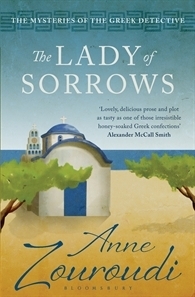
The Lady of Sorrows by Anne Zouroudi – I bought this in April 2013! It is the fourth in Anne Zouroudi’s Mysteries of the Greek Detective series featuring Hermes Diaktoros. Hermes is a detective with a difference. Just who he is and who he works for is never explained. I have read three of the books in the series. Each one features one of the Seven Deadly Sins.
Summary: A painter is found dead at sea off the coast of a remote Greek island. For our enigmatic detective Hermes Diaktoros, the plot can only thicken: the painter’s work, an icon of the Virgin long famed for its miraculous powers, has just been uncovered as a fake. But has the painter died of natural causes or by a wrathful hand? What secret is a dishonest gypsy keeping? And what haunts the ancient catacombs beneath the bishop’s house?
‘Allow me to introduce myself. I am Hermes Diaktoros, of Athens. Diaktoros being, as you may know, an ancient word for messenger. My father has a strange idea of humour. He’s something of a scholar of the classical world.’
Politely, the priest took the fat man’s hand, which was, in spite of the day’s heat was quite cool to touch.
‘Father Linos Egiotis,’ said the priest.
‘A pleasure,’ said the fat man. ‘Now, I know you must be anxious to close up for siesta, and I won’t keep you.’ He turned back to the icon. ‘She’s very lovely, isn’t she?’ he said. ‘I have been wanting to make her acquaintance for many years. Quite by chance we were passing within a few miles, and had time enough before my next engagement to make the detour. She has quite a reputation, I believe, for performing magic tricks. Magic tricks are a paerticular interest of mine.’
‘Magic tricks?’ queried the priest, with annoyance. ‘The Lady occasionally sees fit to grant miracles. They are acts of divine grace, not magic tricks.’ (page 31)
So, three very different books from the depths of my Kindle. I’m not sure which one to read first. If you’ve read any of these books please let me know what you think. Or if you haven’t read them do they tempt you?
Every Friday Book Beginnings on Friday is hosted by Gillion at Rose City Readerwhere you can share the first sentence (or so) of the book you are reading. You can also share from a book you want to highlight just because it caught your fancy.
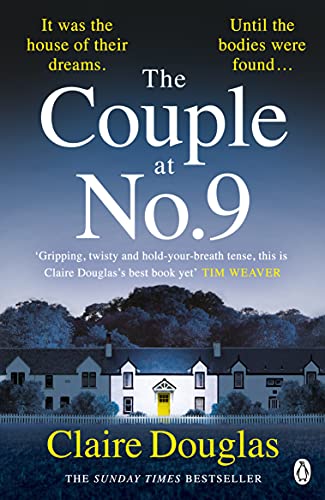
This week I’m featuring The Couple at No. 9 by Claire Douglas. I’ve read three of Claire Douglas’s books before and loved each one, so I have high hopes for this one. They are dramatic, tense, and full of atmosphere and suspense.
The Book Begins:
I’m in the front garden pulling at weeds that spill out from the borders of the driveway, like gigantic spiders, when I hear yells. Deep and gutteral.
Also every Friday there is The Friday 56, hosted by Freda at Freda’s Voice. *Grab a book, any book. *Turn to Page 56 or 56% on your ereader . If you have to improvise, that is okay. *Find a snippet, short and sweet, but no spoilers!
These are the rules:
Grab a book, any book.
Turn to page 56, or 56% on your eReader. If you have to improvise, that is okay.
Find any sentence (or a few, just don’t spoil it) that grabs you.
Post it.
Add the URL to your post in the link on Freda’s most recent Friday 56 post.
Page 56:
Lorna had envisaged the day she’d become a grandmother. She knew she wouldn’t be old, because she’d been such a young mother. But she’d expected to be older than forty-sodding-one. What will Alberto think?
Summary::
When Saffron Cutler and boyfriend Tom move into 9 Skelton Place, they didn’t expect to find this.
Two bodies, buried under the patio over thirty years ago.
When the police launch a murder investigation, they ask to speak to the cottage’s former owner – Saffy’s grandmother, Rose, whose Alzheimer’s clouds her memory.
But it is clear she remembers something . . .
What happened thirty years ago? What part did her grandmother play? And is Saffy now in danger? . . .
~~~
What do you think – does this book appeal to you too?
Faber and Faber| 4 May 2021| 208 pages| My own copy| 4*
Second Place by Rachel Cusk was longlisted for the Booker Prize 2021.
Synopsis – A woman invites a famed artist to visit the remote coastal region where she lives, in the belief that his vision will penetrate the mystery of her life and landscape. Over the course of one hot summer, his provocative presence provides the frame for a study of female fate and male privilege, of the geometries of human relationships, and of the struggle to live morally between our internal and external worlds. With its examination of the possibility that art can both save and destroy us, Second Place is deeply affirming of the human soul, while grappling with its darkest demons.
My thoughts: I enjoyed Second Place, but not as much as I had hoped. The narrator is a writer, a woman known only as ‘M’. The book is a series of letters she writes to Jeffers, a friend and also a writer, in which M pours out her thoughts and perceptions in a stream of consciousness .The location, near a coast, is extremely well defined and I had a clear picture of where ‘M’ lived and its setting, although there is no indication of where it is in the world. But the time period is not specified and you only know that some event has taken place that has disrupted the economy and that travel is difficult – maybe climate change, or a pandemic, although these events are not mentioned.
The ‘second place’ of the title is a cottage that M and her husband, Tony, have renovated and furnished, where their visitors stay. It’s also the relationship that develops between her and ‘L’, a well-known artist, she invites to stay at the cottage. He upsets her when he arrives, unexpectedly bringing with him Brett, a beautiful young woman. And then he continues to disrupt her life. In addition, M’s daughter Justine is also visiting, along with her Kurt, her German partner, expecting to stay in the cottage. She is most upset at having to give it up for L and Brett. It all makes for a bit of a nightmare situation.
I found it a puzzling book. It raises several unanswered questions and it is not a novel you read for its plot, as that is secondary to the fluctuating relationships and interactions, between the characters. Having read D. H. Lawrence: the Life of an Outsider by John Worthen, I’d had an inkling that L was based on D H Lawrence and indeed in her Acknowledgement at the end of the book Cusk refers to Mabel Dodge Luhan’s 1932 memoir of the time D H Lawrence stayed with her in Taos, New Mexico. She acknowledges that her version of that event is intended as a tribute to her spirit. I think I’d have a clearer picture of it if I reread it, because knowing what comes later, the earlier scenes would be more meaningful.
I’ve read some of Dorothy L Sayers’s Lord Peter Wimsey Mystery series and enjoyed them immensely. But up until now have not read the first book in the series, Whose Body?, first published in 1923. It’s an amusing Golden Age mystery that kept me entertained throughout. Lord Peter is a wealthy amateur detective, a friend of Inspector Charles Parker, a Scotland Yard detective. He called ‘Lord’ as he is the younger son of a duke.
When the naked body of a man, wearing only a pair of pince-nez is found in Mr Alfred Thipp’s Battersea bathroom, Lord Peter is asked by his mother, the Dowager Duchess of Denver, to help solve the mystery of whose body had found its way into the bath. The police investigation is being led by Inspector Sugg, who doesn’t welcome what he calls Lord Peter’s ‘interference’ in the case. He thinks the dead body might be that of Sir Reuben Levy, a wealthy London financier who had vanished from his bedroom, leaving no trace. Meanwhile Charles is investigating Sir Reuben’s disappearance himself. Although the body in the bath at first appears to be Sir Reuben it soon becomes clear that it is not and that the two cases are not connected. But are they?
As I began reading I was a bit put off by the dialogue between Lord Peter and his valet Bunter, who used to be his batman in the army. The dialogue is supposed to be witty banter between the two of them but to my mind it was irritating and superficial, definitely dated, and reminded me a just a tiny bit of the Jeeves and Wooster stories. But that was just at the start – it’s not at all like Jeeves and Wooster! I enjoyed watching the mystery unfold, which put Lord Peter’s life into grave danger. There are many complications and twists and turns that did stretch my credulity. It has a serious side too as events trigger traumatic memories for Lord Peter of his time in the trenches of the First World War
My rating: 4*
There are 15 books in the series (linked to my reviews when I’ve read the book):
1. Whose Body? (1923) 2. Clouds of Witness (1926) 3. Unnatural Death (1927) 4. Lord Peter Views the Body (1928) 5. The Unpleasantness at the Bellona Club (1928) 6. Strong Poison (1930) 7. Five Red Herrings (1931) 8. Have His Carcase (1932) 9. Hangman’s Holiday (1933) 10. Murder Must Advertise (1933) 11. The Nine Tailors (1934) 12. Gaudy Night (1935) 13. Busman’s Honeymoon (1937) 14. In the Teeth of the Evidence (1939) 15. Striding Folly (1972)