The Sittaford Mystery by Agatha Christie

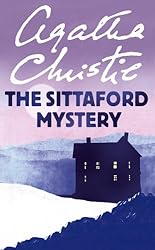
The Sittaford Mystery is one of the earlier of Agatha Christie’s books, first published in the UK in 1931 and in the US as Murder at Hazelmoor. It’s not one of her Poirot or Miss Marple mysteries, but features Inspector Narracott, ably assisted, if not lead, by Emily Trefusis, a remarkably resourceful and determined young woman. I really liked Emily.

The Sittaford Mystery begins with a seance, or rather a table-turning session at Sittaford House in a tiny moorland village near Dartmoor, not very far from the prison at Princetown. Snow has been falling for four days and now Sittaford is almost completely cut off from the rest of the world. At the seance are the tenants of Sittaford House, Mrs Willett and her daughter Violet, and their neighbours. When the message of Captain Trevelyan’s death is tapped out, followed by the word M-U-R-D-E-R, his friend Major Burnaby immediately decides to see if Trevelyan has indeed been murdered, walking in the snow walking six miles to Exhampton. Of course, when he gets there, he does indeed discover that his friend is dead, probably killed at the precise time that the message was received in the seance.

Inspector Narracott is called in and a young man, James Pearson, Trevelyan’s nephew is arrested for the murder. Emily, his fiancée is convinced of his innocence. She enlists the help of the journalist, Charles Enderby and together they set out to discover the real culprit. Inspector Narracott is a quiet man, a thoughtful and efficient police officer, with a logical mind and attention to detail but Emily is determined and courageous in her search for the truth.

There are two mysteries in this book, who killed Trevelyan and why have the Willetts rented the house from him for the winter? I found it all very interesting, with plenty of clues, red herrings and suspects. Added to that is the escaped prisoner on Dartmoor, reminding me a bit of Dickens’ novel, Great Expectations, and of Conan Doyle’s The Hound of the Baskervilles, emphasised Charles Enderby’s reference to the seance as a ‘queer’ business, and thinking of getting Sir Arthur Conan Doyle’s opinion on the matter.

The setting and the characterisation are good. But although the plotting is good for most of the book, I felt the ending and the motive for the murder are rather inadequate, not least because I don’t think you could actually deduce who the murderer is – I guessed, but it was only a guess – not all of the facts are revealed until the denouement. For this reason I can’t rank The Sittaford Mystery with Agatha Christie’s best mysteries, but it is still a good read.

Note: the TV version in the Agatha Christie Marple series not only changes the identity of the killer but also inserts Miss Marple into the story!

First Chapter, First Paragraph: Time's Echo

First chapterEvery Tuesday Diane at Bibliophile by the Sea hosts First Chapter First Paragraph Tuesday Intros, where you can share the first paragraph, or a few, of a book you are reading or thinking about reading soon.

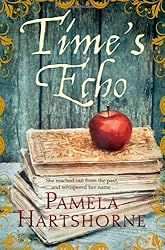
My choice this week is Time’s Echo by Pamela Hartshorne, historical timeslip fiction.

It begins:

I feel no fear, not yet. I am just astounded to find myself in the air, looking down the murky rush of the river. It is as if time itself has paused, and I am somehow suspended between the sky and the wate, between the past and the present, between then and now. Between disbelief and horror.

It is All Hallows’ Eve, and I am going to die.

Time’s Echo mixes time as Grace Trewe is drawn into Hawise Aske’s life, four and a half centuries earlier in York, 1577. I saw this book in the library and although I hadn’t heard of Pamela Hartshorne I thought the title was interesting, and from the description on the back cover and the opening paragraphs, I thought it was worth borrowing.  From what I’ve read so far I’m hoping it will be an enjoyable book.

What's In A Name 7: Completed

Whats in a name 7Hosted by  by Charlie at The Worm Hole this challenge runs from January to December 2014. During this time you choose a book to read from six categories.

I’ve now completed the challenge and these are the books I read:

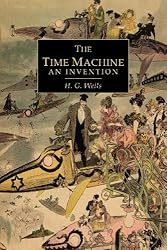
  • A reference to time €“ The Time Machine by H G Wells, first published in 1895, is a work of imagination and an early example of science fiction, but it is also a commentary on late 19th century society and a vehicle for H G Well’s views on socialism and industrialisation.

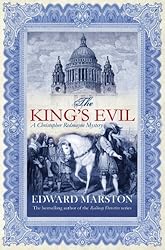
  • A position of royalty €“ The King’s Evil by Edward Marston. This is historical crime fiction set in London in September 1666, just as the Great Fire of London has begun, eventually devastating a large part of the old medieval City of London

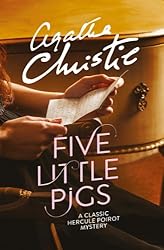
  • number written in letters – Five Little Pigs by Agatha Christie, a Poirot mystery
    first published in 1943. Caroline Crale was convicted of the murder of her husband, Amyas and died in prison. Sixteen years later, her daughter, a child of five at the time of the murder, asks Poirot to clear her mother’s name, convinced that she was innocent.
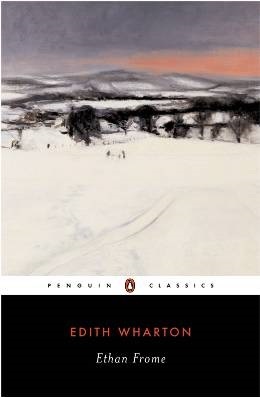
  • forename or names  Ethan Frome by Edith Wharton  a beautifully told tale €“ a tragedy, signalled right from the beginning of the book, when the unnamed narrator first saw Ethan Frome and was told he had been disfigured and crippled in a €˜smash up’, twenty four years earlier. Ethan Frome
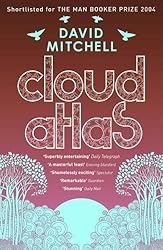
  • type or element of weather – Cloud Atlas by David Mitchell covers a time period from the 19th century to a post apocalyptic future. It’s not a book to read quickly; it requires patience, but on the whole I enjoyed it. I liked the change in style, suited to each time period, moving between straight narrative and letters and journal entries, encompassing historical fiction, thriller and sci-fi.

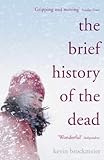
  • A book with a school subject in the title €“ The Brief History of the Dead by Kevin Brockmeier  fantasy fiction set some time in the future, about a place between heaven and earth, and the people who end up there after they’ve died and what happens to them. 

My favourite of these books is Ethan Frome by Edith Wharton.

Thanks to Charlie for an interesting challenge that helped me reduce my to-be-read piles.

The Sunrise by Victoria Hislop

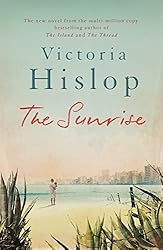
I love historical fiction – books that take me away to another time and place. I think one definition of historical fiction is that it should be written about 50 years after the events it describes and so The Sunrise by Victoria Hislop just falls short of that, set 40+ years ago in Cyprus, but I think it would be pedantic to say it’s not ‘historical fiction’.
Forty years ago Famagusta, on the east coast of Cyprus was one of the island’s most visited and most glamorous tourist resorts with its beautiful coastline and its luxury hotels and apartments in the modern district, now known as Varosha. The medieval walled city to the north of the beach resort was a historian’s dream, with its Byzantine churches, treasures and14th century cathedral. Then in 1974, following a Greek military coup, Cyprus was split in two as Turkish forces invaded the northern part of the island to protect the minority Turkish Cypriots. The population of Famagusta fled and the city was sealed off with barbed wire, leaving it a ghost town.

The Sunrise begins in 1972 before the war erupted. Everything is looking good – on the surface – the tourist trade in Famagusta is booming.

‘It was one of the world’s finest resorts, purpose-built for pleasure, with little in its conception that did not have the comfort of the holidaymaker in mind. The tall buildings that hugged the coastline mostly comprised hotels with smart cafes and expensive shops beneath them. They were modern, sophisticated and reminiscent of Monaco and Cannes, and existed for leisure and pleasure, for a new international jet set ready to be seduced by the island’s charms.’

Hotel owner Savvas Papacosta is aiming to build up a chain of international hotels as recognisable as the Hilton chain. He and his beautiful wife, Aphroditi, have just opened the island’s largest and most luxurious hotel in Famagusta, unmatched by any other in the resort, offering better facilities and entertainment – The Sunrise.

But beneath the surface tension is building as fear and suspicion grows not only between the Greek Cypriots and the Turkish Cypriots, but also amongst the Greek Cypriots themselves, a minority wanting unification with Greece.

Cyprus was like a vine leaf that looked opaque and green in the hand but held up to the light was lined with veins. The threat of violence coursed invisibly through the island, and while its sunny, sensual image continued to attract visitors, conspiracies were being hatched and whispers clandestinely exchanged behind closed doors.

The first part of the book sets the scene and introduces the main characters against this prosperous but tense atmosphere. This part began really well focussing on the Papacostas and their hotels. But I felt it was rather too long, with so much emphasis on the wealth and prosperity of the owners and their guests. There is so much description of clothes, jewellery and their wealthy lifestyle that I began to tire of it, but I can see why the glamour and lavish lifestyle was emphasised as it provides such a contrast to the deprivations and horrors that came later.

The second part of the book details what happens after Famagusta was isolated, following the lives of the Papacostas and of two families who were employed by the Pappacostas – the Georgious (Greek Cypriots) and the Ozkans (Turkish Cypriots). These two families remain in the city in secret, living in fear for their lives, scouring the streets for food and hiding from the Turkish soldiers.

The tension between the characters is maintained throughout the book and they are well-drawn, so much so that I found myself being irritated by some of their actions – in particular I thought that Aphroditi’s behaviour was so predictable and a little naïve. The story is told through the different characters’ perspective, which gives a rounded view of the events as they unfold and also means that the gory atrocities are reported at a distance rather than seeing them in close-up.

Overall, despite my feelings about the first part of the book, I liked The Sunrise very much – a story of human tragedy in the face of war. It’s a novel about love, friendship and war, the love between parents and their children, and the relationships between men and women. It’s about the struggle for power, about greed, betrayal and deceit. It’s about religion and nationality and the conflict these can cause. Above all it’s about the effect war has on individuals, in particular the brutality and the horrors it engenders.

It is very readable, but I didn’t find it too quick or too easy to read. Victoria Hislop has certainly done her research. I’ve visited the Greek part of Cyprus several times and was aware of the history of the conflict between the north and south of the island, but not in such detail. Victoria Hislop has filled in that detail very well, having visited Cyprus since 1978. Over the last two years she has been there regularly to research this book, although she not been allowed to visit Varosha, which remains entirely sealed with rusting barbed wire and guarded by Turkish troops.

For those who, like me, like historical fiction The Sunrise is a must-read book, especially if you also like Cyprus.

This review of The Sunrise was also in the Autumn edition of Shiny New Books.

The Brief History of the Dead by Kevin Brockmeier

The Brief History of the Dead by Kevin Brockmeier, has been sitting on my bookshelves for 7 years (and moved house with me). It’s one of those books that I kept taking down off the shelf, flicking through it and putting it back.

As we’re in the middle of the R.I.P. IX Challenge it seemed this could be a good book to read as it’s fantasy fiction set some time in the future, about a place between heaven and earth, and the people who end up there after they’ve died and what happens to them. Amazingly they eat, sleep, fall in love and go to work in a city that looks like any on Earth with trees, houses, roads, businesses, shops, cafés and so on. It seems they are kept there as long as there is someone alive who remembers them. Parallel with this is the story of Laura, trapped in the Antarctic.  She is one of an expedition exploring methods of converting polar ice to use in manufacturing soft drinks. When their communication system fails two of the team go for help leaving Laura on her own. Eventually she too ventures out across the snow towards the Ross Sea, where there is a station studying emperor penguins.

I’m glad I read this book even if it didn’t quite live up to my expectations. The idea is good, and the two stories are dealt with in alternate chapters. It’s soon obvious that there has been some sort of worldwide disaster or epidemic and at first I was caught up with both stories, but the link between them is so obvious that the element of surprise or suspense just frittered away very quickly.

There is plenty of description; rather too much though and I got tired of reading about Laura’s struggle to cross the Antarctic, and the numerous descriptions of her battles to get in and out of her frozen sleeping bag, and hauling the sledge across the snow. There are plenty of flashbacks and digressions that promised to be interesting but were left undeveloped. It’s as though Brockmeier compiled the book from a series of short stories and scenic descriptions. By the end I really didn’t care what happened to any of the characters as they all waited for whatever came next. It’s a shame because I thought the idea had so much promise – what does happen when we die?

Reading Challenges

September's Books & Pick of the Month

September was a good month – we had a holiday in the Lake District, the sun shone and it’s been a dry September, according to the Met Office it was the driest September since records began in 1911!

And I read a fair number of books (the links are to my posts on the books), which brings my total for the year so far to 83. Four of the books are TBRs (to-be-reads) and six are crime fiction (marked with *):

  1. The Sunrise by Victoria Hislop – my review will be on the next issue of Shiny New Books (I think!) Set 40+ years ago in Cyprus, I liked this very much – a story of human tragedy in the face of war.
  2. The Goldfinch by Donna Tartt – review to follow.
  3. Wycliffe and the House of Fear* by W J Burley – Wycliffe investigates the disappearance of Roger Kemp’s second wife.  A complex story with sinister undercurrents.
  4. Testament of a Witchby Douglas Watt –MacKenzie investigates the death of Grissell Hay, Lady Lammersheugh accused of witchcraft in a village overwhelmed by superstition, resentment and puritanical religion.
  5. The Moving Finger* by Agatha Christie – anonymous poison-pen letters, an apparent suicide and a murder in a peaceful country backwater in this Miss Marple mystery.
  6. The Yellow Wallpaper by Charlotte Perkins Gilmore – a suspense story of a young woman slowly but surely losing her mind – or is it a case of a woman suffering from post-natal depression. 
  7. Entry Island* by Peter May- set in present day Magdalen Islands, part of the province of Quebec, in the Gulf of St Lawrence, and in the nineteenth century on the Isle of Lewis at the time of the Highland Clearances.  It mixes together two stories and two genres, crime fiction and historical fiction.
  8. The Brimstone Weddingby Barbara Vine €“ one of the best of Barbara Vine’s books that I’ve read. Stella gradually confides in Jenny, telling her things she has never said to her son and daughter €“ things about her life she doesn’t want them to know. Barbara Vine, writes beautifully and powerfully yet in a controlled manner, and the subtle horror of what I was reading gripped me. 
  9. The Shroud Maker* by Kate Ellis €“ a complex, historical mystery intertwined with a modern day murder mystery for D I Wesley Peterson to solve with plenty of characters, red-herrings, twists and turns, and sub-plots.

Pick of the monthI enjoyed all of them. It was a good month for reading crime fiction and my Book of the Month is also my Crime Fiction Pick of the Month. It’s …

Brimstone wedding

The Brimstone Wedding by Barbara Vine.

For more Crime Fiction Pick of the Month books see Kerrie’s Crime Fiction Pick of the Month over at Mysteries in Paradise.