Death Comes as the End by Agatha Christie

In 1944 Agatha Christie published Death Comes as the End and in 1945 Sparkling Cyanide, neither of them featuring Hercule Poirot or Miss Jane Marple. By chance these two books are the last full length crime fiction novels by Agatha Christie that I had left to read. There are plenty of short stories of hers that I still have to read and her Mary Westmacott novels as well as her plays, so it is not the end of my reading of her work.

Death Comes As The End

The idea to write a detective story set in Ancient Egypt came from a friend, Professor Stephen Glanville – Death Comes as the End was the result. It is set on the West bank of the Nile at Thebes in about 2000 BC. But in her Authors Note Agatha Christie explained that both time and place are incidental and any other time or place would have served as well. She based her characters and plot on some letters from a Ka priest in the 11th Dynasty:

The letters painted to perfection the picture of a living family: the father fussy, opinionated, annoyed with his sons who did not do as he said; the sons, one obedient but not obviously bright, and the other sharp-tempered, showy, and extravagant. The letters the father wrote to his two sons were about how he must take care of a certain middle-aged woman, obviously one of those poor relations who all through the ages live with families, to whom the heads of families are always kindly, whereas the children usually grow up disliking them because they are often sycophants and makers of mischief. (Agatha Christie’s Autobiography page 514)

From these letters she constructed her story, adding Renisenb, a daughter, Nofret, a concubine for Imhotep, the father, a spoilt younger son and a greedy but shrewd grandmother. He is besotted by Nofret who antagonises the family, setting Imhotep against them. Things come to a head after Nofret has manipulated Imhotep to disinherit his sons and marry her and she is found dead, apparently having fallen from a cliff. More deaths follow.

The mystery in this book is actually not too puzzling. For me, its interest lay in the setting and period details. Agatha Christie, according to her Autobiography had done a lot of reading from books lent to her by Glanville and had also bombarded him with questions about daily life and customs in the 11th Dynasty – such as what food did they eat, how did they cook it, did men and women eat together, what sort of rooms did they sleep in, where did they keep their linen, what sort of houses did they have, and so on?

The end result for me was of authenticity – it all came over as real, the characters were individuals, their relationships were convincing and although Agatha Christie wasn’t happy with the ending, which she changed on Glanville’s suggestion, I thought it was fine. And just as she had pleasure in writing it I had pleasure in reading it.

Reading Challenges: Agatha Christie Reading Challenge, Mount TBR Reading ChallengeVintage Cover Scavenger Hunt for the Golden Age in the category ‘A Green Object’.

A Month in the Country by J L Carr

A Month in the Country (Penguin Modern'¦‘Ah, those days … for many years afterwards their happiness haunted me. Sometimes listening to music, I drift back and nothing has changed. The long end of summer. Day after day of warm weather, voices calling as night came on and lighted windows pricked the darkness and, at day-break, the murmur of corn and the warm smell of fields ripe for harvest. And being young.
As an old man Tom Birkin is looking back to the summer of 1920 when he was asked to uncover a huge medieval wall-painting in the village church of Oxgodby in Yorkshire. J L Carr’s A Month in the Country is a beautifully written little book of just 85 pages, set in the aftermath of World War I. Tom, his ‘nerves shot to pieces, wife gone, dead broke‘,  is still suffering from shell shock after the battle of Passchendaele. Living in the church bell tower, he begins to uncover the painting, excited and engrossed in his work.

Another war veteran, Charles Moon is also in Oxgodby, an archaeologist, camping in a meadow next to the church, whilst he looks for a lost 14th century grave. There are also two more people who are relatively new to the village – the vicar and his beautiful wife, Arthur and Alice Keach. Tom and Moon decide their marriage is an ‘outrage’ and Tom finds her enchanting – reminding him of Botticelli’s Primavera.

I loved this quiet novel, in which not a lot happens and yet so much happens as Tom describes the events of that summer – his relationships with the local people as well as with Moon and Arthur and Alice Keach. There’s the unforgettable Sunday School outing and a visit to Ripon with the Wesleyans looking for an American organ to replace the harmonium in their chapel. It’s during this visit Tom learns more about Moon.

I loved the detail of the wall-painting – the original methods of painting, the colours, the people in the painting. It’s a masterpiece, a Doom, a Christ in Judgement painting. Tom wonders about the original artist, the nameless man and why the painting had been covered and as he uncovers more of the painting thinks that he has lived with a great artist and had shared with the unknown man the ‘great spread of colour’ and feels ‘the old tingling excitement’.

But above all it is the writing that I loved the most – words that took me back in time to that glorious summer in Oxgodby. At the end Tom looks back at that summer with nostalgia for the things that have disappeared, contemplating that

We can ask and ask but we can’t have again what once seemed ours for ever – the way things looked, that church alone in the fields, a bed on a belfry floor, a remembered voice, the touch of a hand, a loved face. They’ve gone and you can only wait for the pain to pass.

I wanted to read A Month in the Country because years ago I’d watched a TV adaptation of the book and loved it. So after I finished reading it I thought I’d look for the film and watch it again. But the film was lost for years and the only available copies now are rare and expensive. So, I won’t be watching it and thinking about it I realise that it would be a mistake to watch it – as I enjoyed the book so much. But it would be good to see the wall-painting …

Reading challenges: Mount TBR Reading Challenge and maybe What’s In a Name? in the ‘Month of the Year’ category if I don’t read a book naming a month of the year!

Vintage Crime Fiction

I’ve been thinking about joining Bev’s Vintage Mystery Cover Scavenger Hunt, but I didn’t think I had enough books in the Vintage Mystery genre to attempt it.

BUT, the Scavenger Hunt idea appeals to me and so I thought I would have a look at my own books, just to see exactly how many books I do have that match Bev’s definition of ‘Vintage Mystery’, which is:

* All books must be from the mystery category (crime fiction, detective fiction, espionage, etc.). The mystery/crime must be the primary feature of the book–ghost stories, paranormal, romance, humor, etc are all welcome as ingredients, but must not be the primary category under which these books would be labeled at the library or bookstore. 

*For the purposes of this challenge, the Golden Age Vintage Mysteries must have been first published before 1960. Golden Age short story collections (whether published pre-1960 or not) are permissible provided all of the stories included in the collection were originally written pre-1960.  Silver Age Vintage Mysteries may be first published any time from 1960 to 1989 (inclusive).  Again, Silver Age short story collections published later than 1989 are permissible as long as they include no stories first published later than 1989. 

And to my surprise, when I went to my shelves – instead of looking at my list in LibraryThing – I found I actually have 14 books first published pre-1960 and 7 first published between 1960 and 1989 (inclusive). My LibraryThing catalogue is certainly not complete!

So, in theory I do have enough books to attempt the Scavenger Hunt for both eras, provided that the covers show the objects listed for the Hunt! And as I do want to read all these books, it’s a no-brainer, so I’m going to do it. And I’m going in for both Eras!

The idea is  to find as many objects on the scavenger hunt list as possible on the covers of the mystery books you read. The minimum number of items to complete the challenge is six items from the covers of books read from a single Vintage Mystery Era.

These are my books in the Golden Age Vintage era. Some are Penguin books with no pictures on the covers and so I’ll look for alternative covers.

Vintage gold

And these are my books from the Silver Age Vintage era.

Vintage silver

The Challenge runs from January 1, 2016 to December 31, 2016. Sign up any time between now and November 1, 2016.  Any books read from January 1 on may count regardless of your sign-up date.

And “On the cover” may apply to either the front or the back cover of the book. For example, if you need a map or a chart for your scavenger hunt list, then Dell Mapbacks are perfect–with the map in question on the back cover. Also, the item should be found on the cover of the edition that you read. If at all possible either post a picture showing the item on the cover or provide a link to a page showing us. Exception:  If the edition you read has no picture whatsoever (hardbacks that have no dust jacket or e-copies, for example), then you may go on another scavenger hunt online to find a cover image–again, please provide a link to the edition used.

This is the list for the Golden Age Era there are 75 items!!! (The Silver Age Era lists the same items.)Scavenger Hunt1

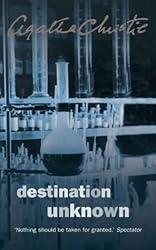
Destination Unknown by Agatha Christie

I had no great expectations when I began reading Agatha Christie’s Destination Unknown (first published in 1954) because I’ve not been keen on her stand-alone international intrigue/spy mysteries. But I thought it started very well and I was soon drawn into the story.
It’s the early 1950s and a number of scientists have disappeared, amongst them is Thomas Betterton, a brilliant nuclear scientist, who had discovered ZE Fission. The British Secret Service suspect that he and the other missing scientists have gone beyond the Iron Curtain, either kidnapped, or tempted by money or by the dream of an ideal world, working for the good of humanity. His wife, Olive, has no idea where he is, but sets off for Morocco, ostensibly on medical advice for a complete rest. However, the plane crashes and she is killed before she gets to her destination.

Hilary Craven, whose abundant red hair is similar to Olive’s, is intent on taking her own life, but she is recruited by Jessop, a British Secret Service Agent who persuades her that if she wants to kill herself she could help her country at the same time by impersonating Olive and thus trace Betterton. In doing so it leads her to a secret scientific complex hidden in the High Atlas mountains and a terrifying discovery.

It went over the top with a string of disasters, involving a faked air disaster, radio-active pearls, a leper colony, and secret laboratories all part of a vast organisation masterminded by a wealthy and powerful fanatic. And added to the international intrigue there is also a murder which is only revealed right at the end of the book. If the plot is bizarre and rather weak, and some of the characters are stereotypes, Hilary’s character is more convincing. And as in her other spy thrillers, Agatha Christie uses it as a vehicle for her own concerns about the state of the post-war world, decrying what she saw as the attempt to impose a world order and discipline, where individuality is suppressed. Hilary thinks she:

would rather have a world of kindly, faulty human beings, than a world of superior robots who’ve said goodbye to pity and understanding and sympathy. (page 102)

It’s a dangerous world where

Once you have got into that state of mind where the taking of human lives no longer counts, then if it is simpler to put a little explosive package under a seat in a plane than to wait about at the corner on a dark night and stick a knife in someone, then the package will be left and the fact that six other people will die also is not even considered. (pages 143-144)

Just as true today as in the 1950s!

I am nearing the end of reading Agatha Christie’s full length novels and now have just 2 left to read. Although Destination Unknown is not one of my favourites I did enjoy reading it – it moves quickly and kept me interested in its twists and turns. There’s a lot going on and it’s not easy to know who is telling the truth and who to trust.

****

Added on 15th January 2016:

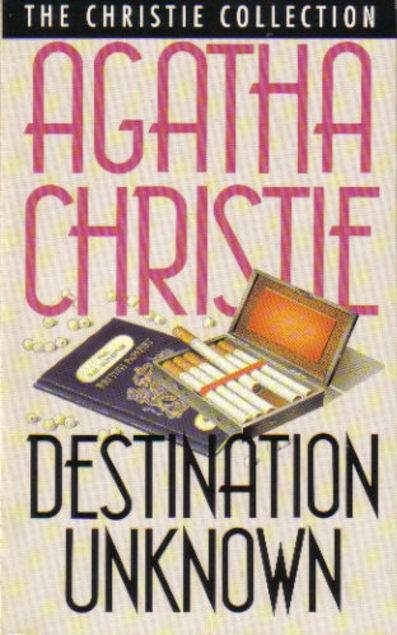
The edition of Destination Unknown that I read has this cover, fulfilling the cigarette/pipe category on the Golden Age Vintage Mystery Hunt card, as well as the Mount TBR Reading Challenge:

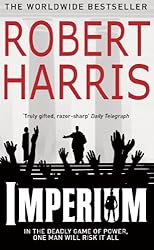
Imperium by Robert Harris

With not many days left until Christmas and the New Year I’ve just about got time to write a bit about two books I’ve read this month from my to-be-read books. I’ll be writing about the second book in a later post.

The first one is Imperium by Robert Harris, the first in his Cicero Trilogy.

I love historical fiction and over the years I’ve read quite a lot of it, including novels set in Ancient Rome, so I’m familiar with the characters in this book, but not about all the details that Robert Harris has packed into Imperium.

Beginning in 79 BC, this book set in the Republican era is a fictional biography of Marcus Tullius Cicero by Tiro, his slave secretary. Tiro was a real person who did write a biography of Cicero, which has since been lost in the collapse of the Roman Empire. Tiro is credited with the invention of shorthand. Harris has based Imperium on, among other sources, Cicero’s letters, which Tiro had recorded, successfully interweaving Cicero’s own words with his own imagination.  It is basically a political history, a story filled with intrigue, scheming and treachery in the search for political power as Cicero, a senator, works his way to power as one of Rome’s two consuls.

The first part of the book (and I think the best part) covers the trial of Verres, a corrupt governor of Sicily. I found this gripping as it was by no means obvious that Verres would be found guilty. Cicero builds the case against him and the resulting trial is a dramatic showdown.

After that the book dragged just a little bit for me as it moved on to describing a complicated struggle to change Rome’s government from a Republic to having an Emperor as absolute ruler. But it picked up again towards the end and overall I thought this was a very good book and I’m keen to read the second in the trilogy, Lustrum.

In such a short post as this is I cannot go into much detail – and the novel is very detailed. I marked many passages that struck me as interesting and felt much of the struggle for power applies as much today as it did in Ancient Rome. I’ll finish this post with one quotation (there are plenty of others I could have chosen):

You can always spot a fool, for he is the man who will tell you he knows who is going to win an election. But an election is a living thing – you might almost say, the most vigorously alive thing there is – with thousands upon thousands of brains and limbs and eyes and thoughts and desires, and it will wriggle and turn and run off in directions no one ever predicted, sometimes just for the joy of proving the wiseacres wrong. (page 471)

Stacking the Shelves: 19 December 2015

STSmall

Stacking The Shelves is all about sharing the books you are adding to your shelves. This means you can include ‘˜real’ and ‘˜virtual’ books (ie physical and ebooks) you’ve bought, books you’ve borrowed from friends or the library, review books, and gifts.

I’ve added just one book to my Kindle this week:

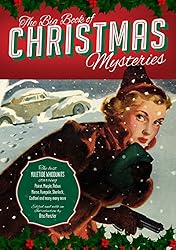
The Big Book of Christmas Mysteries: The Most Complete Collection of Yuletide Whodunits Ever Assembled

Blurb

Here, for your yuletide reading pleasure, are the collected crimes of Christmases Past and Present: sixty classic Christmas crime stories gathered together in the largest anthology of its kind ever assembled. And its an all-star line-up: Sherlock Holmes, Brother Cadfael, Miss Marple, Hercule Poirot, Ellery Queen, Rumpole of the Bailey, Inspector Morse, Inspector Ghote, A.J. Raffles, Nero Wolfe and many, many more of the world’s favourite detectives and crime fighters face unscrupulous Santas, festive felonies, deadly puddings, and misdemeanors under the mistletoe. Almost any kind of mystery you’re in the mood for – suspense, pure detection, humour, cozy, private eye, or police procedural – can be found within these pages.

Includes stories from (many of which are difficult or nearly impossible to find anywhere else): Arthur Conan Doyle, Robert Louis Stevenson, Thomas Hardy, Isaac Asimov, Sara Paretsky, Ed McBain, Agatha Christie, Ellis Peters, Mary Higgins Clark, H.F Keating, Donald E. Westlake and John Mortimer and more.

I couldn’t resist getting it! Some of the authors are familiar to me, some I’ve heard of and some are completely new-to-me. I hope to read some before Christmas.

I’ve also borrowed two from the library this week, which I’ll probably leave until after New Year. They are:

Blurb

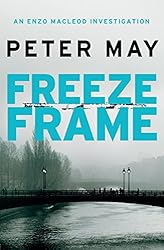
A promise made to a dying man leads forensics ace Enzo Macleod, a Scot who’s been teaching in France for many years, to the study which the man’s heir has preserved for nearly twenty years. The dead man left several clues there designed to reveal the killer’s identity to the man’s son, but ironically the son died soon after the father.

So begins the fourth of seven cold cases written up in a bestselling book by Parisian journalist Roger Raffin that Enzo rashly boasted he could solve (he’s been successful with the first three). It takes Enzo to a tiny island off the coast of Brittany in France, where he must confront the hostility of locals who have no desire to see the infamous murder back in the headlines. An attractive widow, a man charged but acquitted of the murder–but still the viable suspect, a crime scene frozen in time, a dangerous hell hole by the cliffs, and a collection of impenetrable messages, make this one of Enzo’s most difficult cases.

I’ve enjoyed Peter May’s Lewis Trilogy. I hope this works well as a stand alone book as it’s the fourth Enzo Macleod book and I haven’t read the first three.

And

Blurb

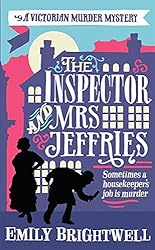
This charming series of Victorian murder mysteries features mild-mannered Inspector Witherspoon of Scotland Yard and, more importantly, Mrs Jeffries, his housekeeper. A policeman’s widow herself, her quick wits allow her to nudge the Inspector in the right direction to solve the crime.

When a doctor is discovered dead in his own office, Mrs Jeffries is on the look-out for a prescription for murder, determined to discover the culprit, despite how her employer feels about interviewing suspects . . . “He hated questioning people. He could never tell whether or not someone was actually lying to him, and he knew, shocking as it was, that there were some people who lied to the police on a regular basis.”

Emily Brightwell is a new-to-me author. I thought I’d see what this one is like.