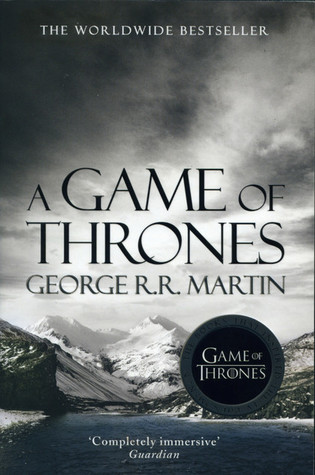
A Game of Thrones by George R R Martin

‘When you play the game of thrones, you win or you die. There is no middle ground.’
22740513

When we began watching the HBO TV series, A Game of Thrones, I was hooked and once we finished watching I immediately wanted to read the series, A Song of Fire and Ice. I’d just read The Sunne in Splendour by Sharon Penman, about the Wars of the Roses and had noticed the similarities between that and A Game of Thrones, the battles between the Houses of York and Lancaster paralleled by those between the Houses of Stark and Lancaster for example.

I don’t often read a book after seeing an adaptation, but in this case it proved ideal – the actors and scenery were perfect for my reading of the book, although there are some differences (the ages of the Stark children for example). I loved both the book and the TV series.

Blurb:

Summers span decades. Winter can last a lifetime. And the struggle for the Iron Throne has begun.

As Warden of the north, Lord Eddard Stark counts it a curse when King Robert bestows on him the office of the Hand. His honour weighs him down at court where a true man does what he will, not what he must ‘¦ and a dead enemy is a thing of beauty.

The old gods have no power in the south, Stark’s family is split and there is treachery at court. Worse, the vengeance-mad heir of the deposed Dragon King has grown to maturity in exile in the Free Cities. He claims the Iron Throne.

I was completely immersed in this world inhabited by numerous characters and set in different locations (Seven Kingdoms), all portrayed in meticulous detail and expertly constructed so that all the fantastic creations are credible, and complete with back stories and histories. Beginning with a Prologue the book is then narrated through different characters’ points of view – each chapter is headed by that character’s name making the plotlines easy to follow:

  • Lord Eddard “Ned” Stark, Warden of the North and Lord of Winterfell, Hand of the King.
  • Lady Catelyn Stark, of House Tully, wife of Eddard Stark.
  • Sansa Stark, elder daughter of Eddard and Catelyn Stark.
  • Arya Stark, younger daughter of Eddard and Catelyn Stark.
  • Bran Stark, second-youngest son of Eddard and Catelyn Stark.
  • Jon Snow, illegitimate son of Eddard Stark, mother unknown.
  • Tyrion Lannister, son of Lord Tywin Lannister, called the Imp, a dwarf, brother of the twins, the beautiful and ruthless Queen Cersei and Ser Jaime, called the Kingslayer,
  • Daenerys Targaryen, Stormborn, the Princess of Dragonstone, sister of Prince Viserys, the last of the Targaryens.

Other characters include:

  • King Robert of the House Baratheon, Lord of the Seven Kingdoms, Eddard Stark’s oldest friend, married to Queen Cersei, his son Joffrey, spoiled and wilful with an unchecked temper, heir to the Iron Throne.
  • Robb Stark, oldest true born son of Eddard Stark. He remained at Winterfell when Eddard became the Hand of the King.
  • Tywin Lannister, Lord of Casterly Rock, Warden of the West, Shield of Lannisport.
  • Khal Drogo – a powerful warlord of the Dothraki people on the continent of Essos, a very tall man with hair black as midnight braided and hung with bells.

Locations:
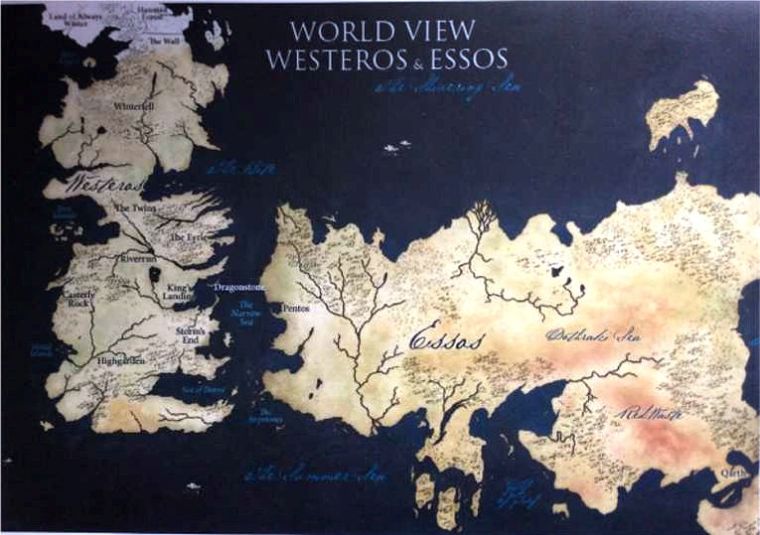
GOT Map1

  • Winterfell: the ancestral castle of House Stark.
  • The Wall: built of stone, ice and magic, on the northern border of the Seven Kingdoms, guarded by the Night’s Watch to protect the Kingdoms from the dangers behind the huge wall from ‘the Others’ and the Wildings.
  • Beyond the Wall: the first book begins Beyond the Wall with members of the Night’s Watch on the track of a band of Wildling raiders.
  • King’s Landing: a walled city, the capital of the continent of Westeros and of the Seven Kingdoms.
  • Essos: across the Narrow Sea from Westeros, includes the grassland known as the Dothraki Sea.

This article in The Telegraph lists the locations used in the TV series.

This is no fairy tale – it’s set in a grim and violent world full of tragedy, betrayals and battles; a tale of good versus evil in which family, duty, and honour are in conflict, the multiple viewpoints giving a rounded view of the conflicts the characters face. It’s a love story too. There are knights, soldiers and sorcerers, priests, direwolves, giants, assassins and bastards.  It’s complex and multifaceted, and it’s full of stories and legends – here for example Maester Luwin tells young Bran Stark about the children of the forest:

“They were people of the Dawn Age, the very first before kings and kingdoms,” he said. “In those days there were no castles or holdfasts, no cities, not so much as a market town to be found between here and the sea of Dorne. There were no men at all. Only the children of the forest dwelt in the lands we now call the Seven Kingdoms.

‘They were a people dark and beautiful, small of stature, no taller than children even when grown to manhood. They lived in the depths of the wood, in caves and crannogs and secret tree towns. Slight as they were, the children were quick and graceful. Male and female hunted together, with weirwood bows and flying snares. Their gods were the gods of the forest, stream and stone, the old gods whose names are secret. Their wisemen were called greenseers and carved strange faces in the weirwoods to keep watch on the woods. (page 713)

I shall be reading the next book in the series soon, A Clash of Kings. The other books are A Storm of SwordsA Feast for Crows, and A Dance with Dragons.

I read the Kindle Edition:

  • File Size: 8515 KB
  • Print Length: 819 pages
  • Page Numbers Source ISBN: 0007448031
  • Publisher: Harper Voyager (23 Dec. 2010)

Reading Challenges: Mount TBR Reading Challenge  – a book I’ve had since October 2015, and the What’s In a Name Challenge – in the category of a book with a piece of furniture in the title.

First Chapter, First Paragraph:

First chapterEvery Tuesday Diane at Bibliophile by the Sea hosts First Chapter First Paragraph Tuesday Intros to share the first paragraph sometimes two, of a book that she’s reading or planning to read soon.

The Wench is Dead by Colin Dexter is one of those books I’ve been meaning to read for some time and it’s one of my 20 Books of Summer. It’s an Inspector Morse book.

It begins:

Intermittently, on the Tuesday, he felt sick. Frequently, on the Wednesday, he was sick. In the Thursday, he felt sick frequently, but was actually sick only intermittently. With difficulty, early on the Friday morning – drained, listless, and infinitely weary – he found the energy to drag himself from his bed to the telephone, and seek to apologise to his superiors at Kidlington Police HQ for what was going to be an odds-on non-appearance at the office that late November day.

Blurb:

That night he dreamed in Technicolor. He saw the ochre-skinned, scantily clad siren in her black, arrowed stockings. And in Morse’s muddled computer of a mind, that siren took the name of one Joanna Franks . . .

The body of Joanna Franks was found at Duke’s Cut on the Oxford Canal at about 5.30 a.m. on Wednesday, 22nd June 1859.

At around 10.15 a.m. on a Saturday morning in 1989 the body of Chief Inspector Morse – though very much alive – was removed to Oxford’s John Radcliffe Hospital. Treatment for a perforated ulcer was later pronounced successful.

As Morse begins his recovery he comes across an account of the investigation and the trial that followed Joanna Franks’ death . . . and becomes convinced that the two men hanged for her murder were innocent . . .

What do you think? Would you keep reading? I’m predisposed to like this book, because I loved the Morse TV series and also because I’m a fan of cold case investigations – especially one this old.

My Week in Books: 17 August 2016

This Week in Books is a weekly round-up hosted by Lypsyy Lost & Found, about what I’ve been reading Now, Then & Next.

IMG_1384-0

A similar meme,  WWW Wednesday is run by Taking on a World of Words.


Now:
 I am reading two amazing books right now – A Song of Fire and Ice Book 1 of A Game of Thrones by G R R Martin. I’ve now caught up with the TV series and I’m reading the first book. I am thoroughly enjoying it.Blurb:

Summers span decades. Winter can last a lifetime. And the struggle for the Iron Throne has begun. As Warden of the north, Lord Eddard Stark counts it a curse when King Robert bestows on him the office of the Hand. His honour weighs him down at court where a true man does what he will, not what he must ‘¦ and a dead enemy is a thing of beauty.

The old gods have no power in the south, Stark’s family is split and there is treachery at court. Worse, the vengeance-mad heir of the deposed Dragon King has grown to maturity in exile in the Free Cities. He claims the Iron Throne.

and I’ve also just started reading an uncorrected proof of The Plague Charmer by Karen Maitland, which is due to be published in October.Blurb:

1361. Porlock Weir, Exmoor. Thirteen years after the Great Pestilence, plague strikes England for the second time. Sara, a packhorse man’s wife, remembers the horror all too well and fears for safety of her children. Only a dark-haired stranger offers help, but at a price that no one will pay.

Fear gives way to hysteria in the village and, when the sickness spreads to her family, Sara finds herself locked away by neighbours she has trusted for years. And, as her husband – and then others – begin to die, the cost no longer seems so unthinkable.

The price that I ask, from one willing to pay… A human life.

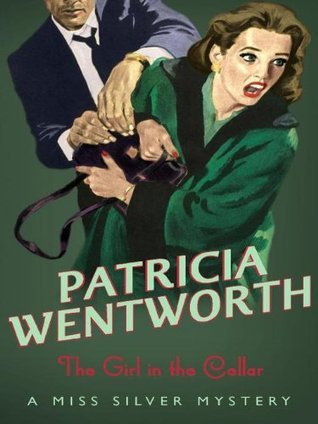
Then: I’ve recently finished The Girl in the Cellar by Patricia Wentworth, one of my 20 Books of Summer. A ‘damsel in distress’ murder mystery. It wasn’t brilliant – my review is in this post.

Next: It will be one of the books from my 20 Books of Summer list. I’m not sure which one – maybe The Girl on the Train by Paula Hawkins.Blurb:

Rachel catches the same commuter train every morning. She knows it will wait at the same signal each time, overlooking a row of back gardens. She’s even started to feel like she knows the people who live in one of the houses. ‘˜Jess and Jason’, she calls them. Their life ‘“ as she sees it ‘“ is perfect. If only Rachel could be that happy.

And then she sees something shocking. It’s only a minute until the train moves on, but it’s enough. Now everything’s changed. Now Rachel has a chance to become a part of the lives she’s only watched from afar.

Now they’ll see; she’s much more than just the girl on the train’¦

The Girl in the Cellar by Patricia Wentworth

I’m falling behind with reading for my 20 Books of Summer Challenge as I didn’t read any of them in July. I decided to read one of the shorter books to get back into the swing of the challenge and chose The Girl in the Cellar, a Miss Silver Mystery first published in 1961, by Patricia Wentworth (1878 – 1961). I wrote about the opening paragraph in this First Chapter, First Paragraph post.

It begins well as the main character finds herself in the dark in a cellar, not knowing who she is or how she got there. She is standing on the cellar steps and there is a dead girl lying at the bottom of the steps. She doesn’t recognise the dead girl either. She finds a bag beside her on the steps, which she doesn’t think is hers, but takes it with her as she escapes from the house and finds herself standing at the end of a road. She gets on a bus where she meets Miss Silver, who seeing how confused and frightened she is, takes her for a cup of tea and offers to help her. A letter in the handbag is addressed to Mrs James Fancourt and it seems that her name is Anne and she is to stay with her husband’s two aunts.

I think the opening of the book is the best part, setting up a scene of suspense and mystery. For most of the book Anne is suffering from amnesia but there is so much repetition of what little facts Anne knows that it became tedious reading, because it’s not just Anne who goes over and over what has happened but other characters too. I think the repetition lessened the sense of suspense, and overall, I thought the book was odd and not very convincing. There are too many coincidences, improbabilities, and loose ends.

This is the last of the Miss Silver Mysteries, published in the year Patricia Wentworth died. The first in the series was published in 1928. Miss Maud Silver is a retired governess who became a private investigator. She likes to help young lovers in distress – in The Girl on the Cellar, a ‘damsel in distress’ and she loves to knit and is a very sympathetic listener. I’ve only previously read one of the Miss Silver books, The Brading Collection, which is a much more convincing book.

As well as the 20 Books of Summer Challenge, this book qualifies for  Bev’s Vintage Mystery Cover Scavenger Hunt in the category, ‘Damsel in Distress’.

The Woman Who Walked into the Sea by Mark Douglas-Home

Earlier this year I read and loved The Sea Detective, the first Cal McGill book. Cal is an oceanographer using his skills in tracking human bodies and sea-borne objects. So I was really looking forward to reading the second book, The Woman Who Walked into the Sea. Maybe my expectations were too high because I was a bit disappointed – that’s not to say I didn’t like it because I did, but it lacked the pace and complexity of the first book and just didn’t grip my imagination in the same way. Cal is really a secondary character and there is very little sea detection in the story.

Set in an imaginary coastal village of Poltown in the north of Scotland, the story revolves around the main character,Violet who had been abandoned as a new-born baby. An anonymous letter to a social worker reveals that her mother, Megan Bates, had last been seen walking into the sea. Her body had never been found and it had been assumed after her bag and hat had drifted ashore that she had drowned herself. Cal helps Violet with details of the tides and currents which convinces Megan had not committed suicide. She is determined to discover what had happened.

I liked the mystery surrounding Megan and the local people, most of whom have problems/secrets and then there is the ‘local’ mafia and a controversial wind farm proposal. But the appeal of The Sea Detective for me was not just the detective elements but Cal himself and his expertise in the marine environment, the mystery of how the ocean currents and wind speeds affect where things get washed ashore and tracking back to find where they originated.  And I thought this second book was unevenly paced, the action slowed down by long descriptive passages so that the suspense that had been built up drained away and my attention drifted.

So, even though I liked this book, I don’t think it quite lived up to The Sea Detective. There is a third book, The Malice of Waves and I hope that the focus is more on Cal and his sea detective work.

Reading Challenges: Read Scotland 2016 ‘“ by a Scottish author and set in Scotland.

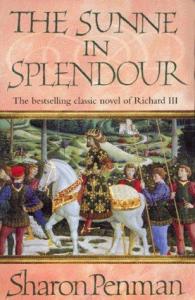
The Sunne in Splendour by Sharon Penman

Richard III (1452 – 1485), that controversial king – what was the truth about him? Did he murder his nephews, the ‘Princes in the Tower’, was he deformed, with a withered arm, a hunch back and a limp as Shakespeare portrayed him, was he a cold-blooded, evil villain? Or has he been maligned and been turned into a  monster who killed his brother’s sons in order to take the Crown?

I remembered merely the brief details about the Wars of the Roses, the conflict between the houses of York and Lancaster for the throne of England,  from my school history lessons and only became interested in Richard III years later when I read Alison Weir’s non-fictional The Princes in the Tower, which examined the available evidence and came to the conclusion that Richard III was responsible for their deaths. Some years later I read Josephine Tey’s novel The Daughter of Time, which also investigates his role in the death of his nephews and his own death at the Battle of Bosworth and concluded that Richard hadn’t murdered his nephews.

The discovery of his skeleton buried beneath a car park in Leicester in 2012 revealed that although ‘the curved spine on the skeleton does show he had Scoliosis, he did not have a withered arm or other details attributed to him in some characterisations’ (see the Incredible Discovery at the King Richard III Visitor Centre ).

But it wasn’t the discovery of his skeleton that nudged me into reading  The Sunne in Splendour, Sharon Penman’s detailed historical novel, first published in 1982. It was watching A Game of Thrones, which is based in part on the Wars of the Roses – Stark and Lannister/York and Lancaster etc.

1192920

The Sunne in Splendour is a fascinating novel about his life from his childhood to his death at Bosworth Field in 1485. Much has been written about Richard, from the time of his death onwards, that Sharon Penman points out has to be considered in the light of the writers’ bias, stating in her Author’s Note at the end of the book:

I once came upon the definition of history as ‘the process by which complex truths are transformed into simplified falsehoods’. That is particularly true in the case of Richard III, where the normal medieval proclivity for moralizing and partisanship was further complicated by deliberate distortion to suit Tudor political needs.’ (page 884)

She states that she had tried to be as accurate as possible, drawing upon facts that are not in dispute, relying on contemporary chroniclers, and when dealing with conflicting accounts ‘to choose the one most in accord with what we know of the people involved.’ 

I think this is one of the best historical novels that I’ve read. It is full of detail, but her research sits very lightly in this book, none of it feels like a history lesson, and it all brings Richard’s world to life. Penman portrays a very likeable Richard, from his childhood onwards he comes across as a kind, generous and brave man, a skilled leader on the battlefield, a loving husband to his wife, Anne, and devoted and loyal to his brother, Edward IV, who was by no means a saint. I particularly liked the way Penman showed his relationship with his family, especially with his brothers Edward and George, the Duke of Clarence.

I could easily visualise the battle scenes, that eventually brought the Wars of the Roses to an end and was fascinated by the view of Henry Tudor (Henry VII) – I’d like to know more about him. It’s his view of Richard that prevailed after his accession to the throne. During his life Richard he had a good reputation and was loved, particularly in the North of England. But he fell victim to treachery and intrigue.

One of the drawbacks of reading historical fiction is that if you have any knowledge of the period you know the eventual outcome. Penman’s skill is such that even though I knew Richard was killed at the battle of Bosworth Field I kept hoping he would survive and defeat Henry Tudor.

As for her solution to who killed the princes, that is one spoiler I’m not going to reveal – I was convinced though by her version of events. I think The Sunne in Splendour is a brilliant book, I was absolutely gripped by it and was sad when I came to the end. It’s a long book, nearly 900 pages and it took me a while to read it, but never once did I think it was too long, or needed editing. I loved it.

Reading Challenges: Mount TBR Reading Challenge – a book I’ve left too long unread as it’s been on my shelves for 5 years!