Joyland by Stephen King

I’m so glad I read Joyland by Stephen King – it’s so good.

13596166

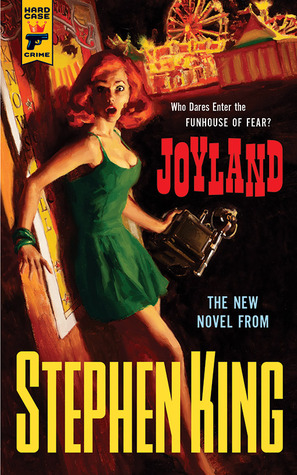
I nearly didn’t buy it, put off by the cover (you should never judge a book by its cover!) and by the publishers, Hard Case Crime – it was the word ‘hard‘ that really made me pause, especially when I looked at their site and saw they publish ‘the best in hardboiled crime fiction‘. Not being quite sure just what ‘hard boiled crime fiction‘ is, I looked it up. This is Encyclopedia Britannica’s definition:

Hard-boiled fiction, a tough, unsentimental style of American crime writing that brought a new tone of earthy realism or naturalism to the field of detective fiction. Hard-boiled fiction used graphic sex and violence, vivid but often sordid urban backgrounds, and fast-paced, slangy dialogue.

Not my sort of book, at all! But it’s by Stephen King and I like his books, so I did buy it. It’s not ‘hard boiled fiction‘ as defined above. The only way it fits that definition is that there is a lot of slang in it – ‘carny’ slang, which King explains in his Author’s Note is what he calls in this book ‘the Talk‘. It is ‘carnival lingo, an argot both rich and humorous’. So not ‘hard boiled’ at all!

Joyland is a ghost story, a love story, a story of loss and heartbreak. It’s also a murder mystery and utterly compelling to read.

It’s narrated by Devin Jones, looking back forty years at the time he was a student, suffering from a broken heart, as his girlfriend had just rejected him and he spent a summer working at Joyland, in North Carolina, an amusement park with ‘a little of the old-time carny flavor‘.

Along with various rides, ‘Happy Hounds’, and a palm-reader, there is the Horror House, a ‘spook’ house which is said to be haunted by the ghost of Linda Gray, whose boyfriend cut her throat in the Horror House. The boyfriend had not been found and it appears he may be a serial killer as there had been four other similar murders in Georgia and the Carolinas.

It’s also a story of friendship, of Tom and Erin, of children with the ‘sight’, a young boy in a wheelchair and his mother, and Dev’s search for the killer.

I loved the setting of the funfair, Dev’s nostalgia for his youth, his sensitivity, and the images the story evokes – it’s not just the story but the way King tells his tale, with just a touch of horror and the supernatural.

Who knows – maybe I should read some more of Hard Case Crime’s publications!

Reading ChallengesReaders.Imbibing.Peril XI.

Magpie Murders by Anthony Horowitz

I previously enjoyed The House of Silk by Anthony Horowitz, so when I saw Magpie Murders  on NetGalley I was keen to read it and delighted when I received an uncorrected proof. I think it is an outstanding book by a master story-teller, with a wonderfully intricate plot. It’s a prime example of a puzzle-type of crime fiction combining elements of the vintage-style golden age crime novel with word-play and cryptic clues and allusions to Agatha Christie and Arthur Conan Doyle. It’s also a novel within a novel, with mystery piled upon mystery. I loved it.

The outer story and the contemporary mystery is that of Alan Conway, the author of the Atticus Pund Mysteries. His editor, Susan Ryeland is reading a manuscript of his latest novel Magpie Murders, expecting to enjoy it as much as his earlier books, even though she really couldn’t stand Conway himself. What she wasn’t prepared for is that this book would change her life.

The inner story, that told in Conway’s novel is a whodunnit, a murder mystery full of twists and turns with plenty of red herrings. I was enjoying it as much as Susan as she read of the death of Mary Blakiston in the little village of Saxby-on-Avon in 1955. Mary was an unpleasant character. She had been found dead at the bottom of the stairs at Pye Hall where she was the cleaner for the owner, Sir Magnus Pye. It appeared that she had tripped and fallen down the stairs.Then Magnus is also found dead, but this was obviously murder as he had been beheaded.

So back to the outer story. When Susan came to the end of the manuscript she found it wasn’t finished – there was no denouement. And she couldn’t contact Conway to get the final chapters of the book and then she discovered that he was dead. So, she sets out to find the missing chapters and in so doing discovers even more mysteries – was Conway’s death an accident, suicide or murder? Like Mary Blakiston in his novel, he was not a popular man, and there are a number of other parallels between his novel and his real life.

Magpie Murders is a really satisfying read, with believable characters, set in beautifully described locations, tantalisingly mysterious and so, so readable. I also particularly liked the use of the rhyme of ‘One for Sorrow’ in the chapter headings of Conway’s novel in the same way that Agatha Christie used ryhmes in some of her books. It’s quite long, but the pages sped by as I was drawn into both stories and keen to find the answers to all the questions all the mysteries it had posed.

Many thanks to NetGalley and the publishers Orion Books for an ARC.

The Black Friar by S G MacLean

The Black Friar by S G MacLean is one of those books that has the power to transport me to another time and place. I was totally absorbed, convinced I was back in England in the 17th century.

The Black Friar (Damian Seeker, #2)

It is the second book in the Damian Seeker series, historical crime fiction set in 1655 during the Interregnum under Oliver Cromwell, the Lord Protector. Damian Seeker, Captain of Cromwell’s Guard, works for Thurloe, Cromwell’s Chief Secretary and spy master, in charge of the security of the regime. It’s a complex mystery, particularly as there are various factions and religious sects plotting rebellion against Cromwell.

A body, presumed by his black robe to be that of a Dominican friar, is found bricked up in a wall in Blackfriars, once a monastery and now a derelict building gradually falling into the River Fleet. But this was no friar, as Seeker recognised him as Carter Blyth one of Thurloe’s undercover agents, who had been working in the Netherlands, observing the Royalists colluding with foreign powers. As far as Seeker knew he had been killed in Delft three months earlier. Seeker’s task is to find why he had been killed and who killed him. He discovers that Blyth under Thurloe’s orders had in fact infiltrated a group of Fifth Monarchists who wanted to overthrow Cromwell and had been living with the Crowe family, members of the group, under the name of Gideon Fell.

It’s a complicated and intricate tale as Seeker, helped by Nathaniel Crowe, tries to discover what Blyth had been doing, and what trail he was following. There are missing children, whose whereabouts Blyth had been investigating, and plots to overthrow Cromwell as well as plots to reinstate Charles Stuart as King.

Although The Black Friar is the second book in the series, (the first is The Seeker, which I haven’t read) I think it works well as a stand-alone book. The characterisation is strong and I particularly like Damian Seeker, a man both respected and feared, and a man to trust.

I also like the way S G MacLean has based her book on solid historical research (she has an M.A. and Ph.D. in History from the University of Aberdeen) and weaves real historical figures into the story, such as the poet John Milton, now an old blind man, the Secretary of Foreign Tongues and the diarist Samuel Pepys, an Exchequer clerk, who though very personable was ‘prone to drink and some lewdness.’ It all brings to life the atmosphere and tenor of the 1650s. I loved it.

My thanks to Netgalley and Quercus books for my copy of this book. It is due to be published on 6 October.

Books Read in September 2016

Today is the last day of September and as I shan’t finish any of the books I’m currently reading today, my total for the month is eight books – all fiction.

I wrote posts about five of them. Three are books from my TBR piles (books I owned before 1 January this year), one is a library book, two are review books and two are books I bought this year:

  1. The Wench is Dead by Colin Dexter (TBR) – an Inspector Morse book in which he investigates the account of death of Joanna Franks in 1859. An enjoyable book.
  2. The Girl on the Train by Paula Hawkins – a psychological thriller in which Rachel spots a couple from the train window and sees a shocking event. I was not enthralled.
  3. Partners in Crime by Agatha Christie (Tommy & Tuppence short stories) (TBR). I  enjoyed reading them, because they are written with a light touch, and a sense of humour and fun.
  4. Sunshine on Scotland Street by Alexander MCall Smith (LB) – This is an easy read, meandering from one character to the next. It has a light, humorous tone that I enjoyed, along with thoughts about friendship, religion, spirituality and happiness.
  5. The Bottle Factory Outing by Beryl Bainbridge (RB) – I enjoyed this immensely. It is a tragicomedy, the story of two unlikely friends, Freda and Brenda.  I was completely taken by surprise at the bizarre twist at the end, which I thought was brilliant.

I  shall write a review of The Black Friar by S G MacLean (RB) later next week.

Here are some brief notes of the other two books:

Extremely Loud and Incredibly Close by Jonathan Safran Foer – I enjoyed this unusual story about a boy whose father is killed in the September 11th attacks on the World Trade Centre. Oskar is is trying to discover the facts about his father’s death and also to solve the mystery of a key he discovers in his father’s closet by attempting to search for which of the 162 million locks in New York it might open.

Oskar is an extremely bright nine-year old, most likely on the Autism Spectrum. The narrative, streams of consciousness in parts, switches between Oskar and his grandparents, touches on the bombing of Dresden during the Second World War where his grandparents were living and on the bombing of Hiroshima. The text is interspersed with what at first appear to be random photos. I thought it was fascinating and moving without being sentimental.

A Prayer for Owen Meany by John Irving – I have mixed feelings about this book, parts of it are brilliant, fascinating and funny, but parts of it are tedious and boring. It is about Owen Meany, a very small boy with a strange voice who believes his life is directed by God, and his friend Johnny Wheelwright. Owen accidentally kills Johnny’s mother during a baseball game, setting in motion most of the rest of the story. Johnny doesn’t know who his father is and the two boys try to discover his identity. One of the main themes of the book is the conflict between faith and doubt.

It begins quite slowly and there were times when I was about to give up reading it, but then it picked up pace and grabbed my attention – such as the scenes where Owen plays the part of Baby Jesus in a church nativity, which is hilarious, and the Ghost of the Future (the Ghost of Christmas Yet to Come)  in a performance of A Christmas Carol. But I got increasingly irritated by the capitalisation of everything Owen said and of the enormous amount of description of everything in the minutest detail – and I normally enjoy descriptive writing! Even so, I just had to read to the end, intrigued to find out what would happen.

My favourite book, the book I enjoyed the most, is The Bottle Factory Outing by Beryl Bainbridge.

31556087

The Bottle Factory Outing by Beryl Bainbridge

I’ve recently read The Bottle Factory Outing by Beryl Bainbridge and I enjoyed it immensely.

It is the story of two unlikely friends, Freda and Brenda. Their relationship is the central focus of this book – it’s basically a friendship of convenience as they are complete opposites. Their backgrounds and personalities are very different. They met by chance in a butcher’s shop, where Brenda having left her drunken brute of a husband and a mad mother-in-law was in floods of tears. They share a room and work together in an Italian wine factory in London, gluing labels onto the bottles. Freda is sixteen stone, with blonde hair and blue eyes, Brenda has reddish shoulder-length stringy hair, with a long thin face and short sighted eyes who never looks properly at people. The difference between them is epitomised in Bainbridge’s description,

At night when they prepared for bed Freda removed all her clothes and lay like a great fretful baby, majestically dimpled and curved. Brenda wore her pyjamas and her underwear and a tweed coat.

Brenda desperately tries to escape the the amorous attentions of Rossi, the factory manager – as Freda says Brenda is a born victim, who’s asking for trouble. But it’s not just Brenda who runs into trouble. Freda, who is in love with Vittorio, the trainee manager and nephew of the factory owner, organises a factory outing in the hope that she can seduce him, but the outing goes from bad to worse.The van arranged to take them to a stately home fails to turn up so only those who can fit into two cars set off, then there are fights at Windsor Castle, and a bizarre visit to a safari park. Passions rise, tempers flare, barrels of wine are consumed and it ends in violence and tragedy.

The book begins as a comedy, but then continues with an uneasy undercurrent as the outing gets under way before descending into a dark tragedy that is surreal and farcical and also desperately sad.  Beryl Bainbridge’s writing, so easily readable, is rich in descriptions. The book is superbly paced; the tension rises in an atmosphere of seediness, and frustration, before reaching an unbelievable and grotesque climax.  I had no idea how Bainbridge could draw this story to an end and was completely taken by surprise at the bizarre twist at the end, which I thought was brilliant. It’s savagely funny, full of pathos, touching moments, frustrations, shame, stress and unhappiness, all combining to make this a most entertaining book.

Beryl Bainbridge (1932 ‘“ 2010) was made a Dame in 2000. She wrote 18 novels, three of which were filmed, two collections of short stories, several plays for stage and television, and many articles, essays, columns and reviews. Five of her novels were nominated for the Booker Prize, but none of them won it. Years ago before I began writing BooksPlease I read two of her books, historical novels, one being According to Queenie, published in 1999, a novel about the life of Samuel Johnson as seen through the eyes of Queeney, Mrs Thrale, and the other Master Georgie, published in 1998, set in the Crimean War telling the story of George Hardy, a surgeon.

Since then I have read three more of her books and loved each one –  A Quiet Life, published in 1976, a semi-autobiographical novel, using her own childhood and background as source material; An Awfully Big Adventure, another semi-autobiographical novel set in 1950, based on Beryl Bainbridge’s own experience as an assistant stage manager in a Liverpool theatre, published in 1989 and shortlisted for the Booker Prize; and The Birthday Boys, a novel about Captain Scott’s last Antarctic Expedition, published in 1991.

The Bottle Factory was inspired by Beryl Bainbridge’s experience working part time in a bottle factory in 1959. It was first published in 1974 and was shortlisted for the Man Booker Prize in that year.

Thanks to the publishers, Open Road Integrated Media, via NetGalley for my copy of this ebook edition, featuring an illustrated biography of Beryl Bainbridge including rare images from the author’s estate. It’s due to be released in the US on 4 October.

Amazon US link

Recent Additions at BooksPlease

books-sept-2016

From top to bottom: the first seven in the pile are from Barter Books in Alnwick, my favourite bookshop where you can either swap or buy books. I took seven books in and came home with another seven. I love browsing at Barter Books and always find books I want to read.

  • Absent in the Spring by Mary Westmacott – I had to search round the various places fiction is shelved in Barter Books before I found this book in the Romance section. It’s by Agatha Christie, writing as Mary Westmacott. The books she wrote under this pseudonym are a complete change from her crime fiction – she was such a versatile writer. Her daughter, Rosalind, called them ‘bitter-sweet stories about love’. It was first published in 1944.
  • Arms and the Women by Reginald Hill – I’ve been collecting his books in an attempt to read them in chronological order. This is the 18th Dalziel and Pascoe mystery in which Ellie, Pascoe’s wife is in danger at a decaying seacoast mansion.
  • An April Shroud by Reginald Hill – the 4th Dalziel and Pascoe mystery, set in a solitary mansion in the Lake District where Pascoe is spending his honeymoon.
  • The House by the Churchyard by Sheridan Le Fanu – the Horror section is right next to Crime Fiction and I don’t usually look there but as I walked past this book caught my eye as it was displayed in one of the holders on the side of the bookcase, maybe because I’m taking part in the R.I.P. event at the moment. Le Fanu was described by Henry James as in the ‘first rank of ghost writers‘. Set in the 1760s in Ireland, it begins with the accidental disinterment of an old skull and an eerie late-night funeral.
  • A Game of Sorrows by Shona MacLean – the second book in the Alexander Seaton series. I’ve read the first and the third so I was pleased to find this one. It’s set in 1628 in Ulster as Seaton investigates a family curse – a family divided by secrets and bitter resentments.
  • The Collector by John Fowles – another author whose books I’ve enjoyed in the past. This could also be a choice for the R.I.P. event. It’s described as a thriller with psychological and social overtones, the story of a kidnapping.
  • A Walk Along the Wall by Hunter Davies – I was really pleased to find this book Hadrian’s Wall is the most important Roman monument in Britain. Hunter Davies grew up at one end of the wall and was inevitably drawn to walk its length. It’s part history, part guidebook and part personal experience and gives readers a taste of what life was like in this remote part of Britain 2000 years ago.

The bottom two books in the pile aren’t from Barter Books:

  • The Black Caravel by Harry Nicholson is a book the author sent to me for review. It’s his second novel, a sequel to ‘Tom Fleck‘ which I reviewed in 2011. It begins and ends at Hartlepool in 1536, the year of The Pilgrimage of Grace, as Barbary corsairs are raiding northwards.

and finally a birthday present (in August):

  • Rowan’s Well by C J Harter – a psychological thriller (another one for  R.I.P. maybe). Rowan’s Well is a remote house on the north-east coast of England, home to the charismatic Brooke family, the scene of murder and betrayal.

I want to start reading them all – now!