Favourite Books: October 2007 – 2010

Each month I’ve been looking back at some of my favourite books I read during the years 2007 ‘“ 2010. These are some of my favourite books I read in October in each of those years. October seems to have been another great month for books as I rated so many 5/5, but I’m highlighting just one for each month in this post. Revisiting these books makes me want to re-read all of them.

Click on the titles to see my original reviews.

2007

Crossing to SafetyCrossing To Safety by Wallace Stegner – was Wallace Stegner’s last novel published when he was 78 years old. It’s a beautiful, and thought provoking novel and I loved it. It’s a story about love, marriage, friendship, relationships, ambition, illness and death; in other words it’s about life and death. In essence, the novel recounts the lives of two couples who first met during the Depression in 1930s America and the joys and difficulties they encounter throughout their lives.

The painful honesty of this book in portraying life’s happiness, joy, pathos and sorrow is what touched me the most and makes it a book to remember and treasure.

2008

Behavior Of MothsThe Behaviour of Moths by Poppy Adams, a brilliant book! It’s the story of two sisters, Ginny and Vivi. Vivi, the younger sister left the family mansion 47 years earlier and returns unexpectedly one weekend. Ginny, a reclusive moth expert has rarely left the house in all that time. What happens when they meet again is shocking to both of them. It’s a story full of mystery and suspense as it is revealed that the two have very different memories of their childhood and the events of the past.

Two events in particular affected their lives. The first is when Vivi aged 8 fell from the bell tower and nearly died. She was impaled on an iron stake and as a result lost her ability to have children; the second when Maud, their mother died having tripped down the cellar steps changing their lives for ever.

And I loved all the detail about moths. They are not an aside but are integral to the story.

2009

The ComplaintsI thought The Complaints by Ian Rankin was one of the best books I read in 2009.

It’s the first book featuring Inspector Malcolm Fox of the PSU, or Professional Standards Unit, part of the Complaints and Conducts office.  The PSU is sometimes called  ‘˜the Dark Side’. He is asked to investigate DS Jamie Breck, a likeable young cop who is allegedly involved in a paedophile site run by an Aussie cop in Melbourne. Then Jude’s partner, Vince is murdered and Breck is the investigating officer. As Fox gets to know him it becomes increasingly difficult for him to know just who he can trust. Just who is the good guy?

I grew to really like Fox, yet another divorced cop with a drink problem. He is a good guy, he plays by the rules and looks after his family. He’s bit of a philosopher, an outsider mistrusted and hated by other cops.

2010

Quite Ugly One Morning (Jack Parlabane, #1)Quite Ugly One Morning by Christopher Brookmyre begins with a graphic description of a particularly nasty murder scene, which is normally guaranteed to make me stop reading. But it would have been a great shame if I’d let it put me off this book, because I thoroughly enjoyed it. It was  first published in 1998 when it won the First Blood Award for best crime novel of that year.

The dead man is Dr Ponsonby, a well- respected doctor working for the Midlothian NHS Trust in Edinburgh. Investigative journalist, Jack Parlabane gets involved as he lives in the flat above Ponsonby and the terrible smell coming up from below leads him into the murder scene. It soon becomes apparent to the reader who did the murder and it is the motive behind it that needs to be ferreted out.  It’s fast, full of action, and surprisingly funny.

Accidents Happen by Louise Millar

Accidents Happen is one of my TBR e-books that I’ve had for a couple of years. It’s described as a ‘gripping psychological thriller where one woman’s streak of bad luck may be something far more sinister’, so I thought it would be just the right sort of book to read for this year’s R.eaders I.mbibing P.eril XI.

It begins well with a strange, scary episode about a child waking up to the sight of something slithering, full of threat, not sure what it was but terrified as it was angry with a gaping mouth revealing a tiny white spot, where the poison came from.

Episodes like this are interspersed between the chapters of the story, each one more terrifying than the rest. These are actually much more scary than the main story, which is about Kate, a widow and her young son Jack.

Blurb:

Kate Parker has had so much bad luck in her life, she’s convinced she’s cursed. But when she tries to do her best to keep herself and her son safe, people tell her she’s being anxious and obsessive.

Just when her life starts to spin completely out of control, an Oxford professor she meets offers to help. But his methods are not conventional. If she wants to live her life again, he will expect her to take risks.

When a mysterious neighbour starts to take more than a passing interest in her, Kate tries to stay rational and ignore it.

Maybe this, however, is the one time Kate should be worried.

My thoughts:

Kate’s husband had died 5 years before the book starts and Kate is obsessed with statistics, so much so that they are now ruling her life – statistics about all the things that go wrong, or could go wrong. And this is preventing her from living a normal life – the lengths she goes to are extreme and they are affecting her Jack, her son. As readers we know that some of Kate’s fears are real, but she doesn’t focus on those, although they do bother her. I began to feel something was wrong. And when she met Jago, an Oxford professor my feelings intensified – there was definitely something suspicious going on. Why was he getting her to take such risks and putting herself into such strange situations?

At first I was enjoying this book – it’s very readable, although the concentration on Kate’s fears got a bit repetitive – but increasingly as I read on I just couldn’t believe what was happening. For me the tension that had been building up just disappeared. I didn’t think it was plausible and I couldn’t suspend my disbelief.

I think I’m in the minority about this book as it has more favourable reviews on both Amazon and Goodreads.

Reading Challenges: Mount TBR Reading Challenge and R.eaders I.mbibing P.eril XI.

First Chapter, First Paragraph

First chapterEvery Tuesday Diane at Bibliophile by the Sea hosts First Chapter First Paragraph Tuesday Intros to share the first paragraph sometimes two, of a book that she’s reading or planning to read soon.

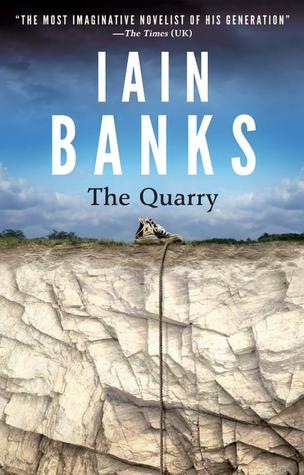
My opener this week is a book I’ve borrowed from the library, The Quarry by Iain Banks:17909006

Most people are insecure, and with good reason. Not me.

This is probably because I’ve had to think about who I am and who I am not, which is something your average person generally doesn’t have to do. Your average person has a pair of parents, or at least a mother, or at least knows roughly where they fit into all that family business in a way that I, for better or worse, don’t. Usually I think it’s for the better, though sometimes not.

These first two paragraphs certainly make me want to read on – where does this person fit into the picture?

Blurb:

Kit doesn’t know who his mother is. What he does know, however, is that his father, Guy, is dying of cancer. Feeling his death is imminent, Guy gathers around him his oldest friends – or at least the friends with the most to lose by his death. Paul – the rising star in the Labour party who dreads the day a tape they all made at university might come to light; Alison and Robbie, corporate bunnies whose relationship is daily more fractious; Pris and Haze, once an item, now estranged, and finally Hol – friend, mentor, former lover and the only one who seemed to care.

But what will happen to Kit when Guy is gone? And why isn’t Kit’s mother in the picture? As the friends reunite for Guy’s last days, old jealousies, affairs and lies come to light as Kit watches on.

Would you read on?

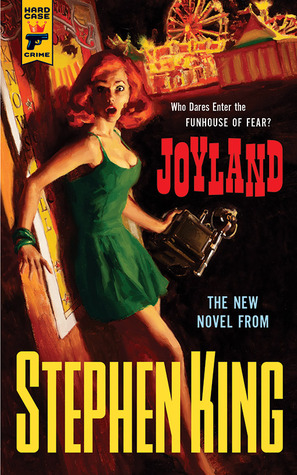
Joyland by Stephen King

I’m so glad I read Joyland by Stephen King – it’s so good.

13596166

I nearly didn’t buy it, put off by the cover (you should never judge a book by its cover!) and by the publishers, Hard Case Crime – it was the word ‘hard‘ that really made me pause, especially when I looked at their site and saw they publish ‘the best in hardboiled crime fiction‘. Not being quite sure just what ‘hard boiled crime fiction‘ is, I looked it up. This is Encyclopedia Britannica’s definition:

Hard-boiled fiction, a tough, unsentimental style of American crime writing that brought a new tone of earthy realism or naturalism to the field of detective fiction. Hard-boiled fiction used graphic sex and violence, vivid but often sordid urban backgrounds, and fast-paced, slangy dialogue.

Not my sort of book, at all! But it’s by Stephen King and I like his books, so I did buy it. It’s not ‘hard boiled fiction‘ as defined above. The only way it fits that definition is that there is a lot of slang in it – ‘carny’ slang, which King explains in his Author’s Note is what he calls in this book ‘the Talk‘. It is ‘carnival lingo, an argot both rich and humorous’. So not ‘hard boiled’ at all!

Joyland is a ghost story, a love story, a story of loss and heartbreak. It’s also a murder mystery and utterly compelling to read.

It’s narrated by Devin Jones, looking back forty years at the time he was a student, suffering from a broken heart, as his girlfriend had just rejected him and he spent a summer working at Joyland, in North Carolina, an amusement park with ‘a little of the old-time carny flavor‘.

Along with various rides, ‘Happy Hounds’, and a palm-reader, there is the Horror House, a ‘spook’ house which is said to be haunted by the ghost of Linda Gray, whose boyfriend cut her throat in the Horror House. The boyfriend had not been found and it appears he may be a serial killer as there had been four other similar murders in Georgia and the Carolinas.

It’s also a story of friendship, of Tom and Erin, of children with the ‘sight’, a young boy in a wheelchair and his mother, and Dev’s search for the killer.

I loved the setting of the funfair, Dev’s nostalgia for his youth, his sensitivity, and the images the story evokes – it’s not just the story but the way King tells his tale, with just a touch of horror and the supernatural.

Who knows – maybe I should read some more of Hard Case Crime’s publications!

Reading ChallengesReaders.Imbibing.Peril XI.

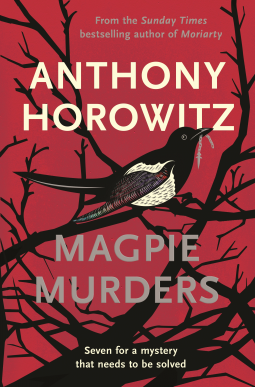
Magpie Murders by Anthony Horowitz

I previously enjoyed The House of Silk by Anthony Horowitz, so when I saw Magpie Murders  on NetGalley I was keen to read it and delighted when I received an uncorrected proof. I think it is an outstanding book by a master story-teller, with a wonderfully intricate plot. It’s a prime example of a puzzle-type of crime fiction combining elements of the vintage-style golden age crime novel with word-play and cryptic clues and allusions to Agatha Christie and Arthur Conan Doyle. It’s also a novel within a novel, with mystery piled upon mystery. I loved it.

The outer story and the contemporary mystery is that of Alan Conway, the author of the Atticus Pund Mysteries. His editor, Susan Ryeland is reading a manuscript of his latest novel Magpie Murders, expecting to enjoy it as much as his earlier books, even though she really couldn’t stand Conway himself. What she wasn’t prepared for is that this book would change her life.

The inner story, that told in Conway’s novel is a whodunnit, a murder mystery full of twists and turns with plenty of red herrings. I was enjoying it as much as Susan as she read of the death of Mary Blakiston in the little village of Saxby-on-Avon in 1955. Mary was an unpleasant character. She had been found dead at the bottom of the stairs at Pye Hall where she was the cleaner for the owner, Sir Magnus Pye. It appeared that she had tripped and fallen down the stairs.Then Magnus is also found dead, but this was obviously murder as he had been beheaded.

So back to the outer story. When Susan came to the end of the manuscript she found it wasn’t finished – there was no denouement. And she couldn’t contact Conway to get the final chapters of the book and then she discovered that he was dead. So, she sets out to find the missing chapters and in so doing discovers even more mysteries – was Conway’s death an accident, suicide or murder? Like Mary Blakiston in his novel, he was not a popular man, and there are a number of other parallels between his novel and his real life.

Magpie Murders is a really satisfying read, with believable characters, set in beautifully described locations, tantalisingly mysterious and so, so readable. I also particularly liked the use of the rhyme of ‘One for Sorrow’ in the chapter headings of Conway’s novel in the same way that Agatha Christie used ryhmes in some of her books. It’s quite long, but the pages sped by as I was drawn into both stories and keen to find the answers to all the questions all the mysteries it had posed.

Many thanks to NetGalley and the publishers Orion Books for an ARC.

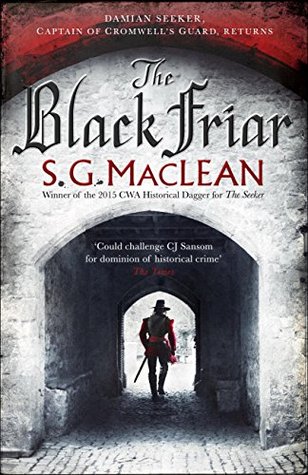
The Black Friar by S G MacLean

The Black Friar by S G MacLean is one of those books that has the power to transport me to another time and place. I was totally absorbed, convinced I was back in England in the 17th century.

The Black Friar (Damian Seeker, #2)

It is the second book in the Damian Seeker series, historical crime fiction set in 1655 during the Interregnum under Oliver Cromwell, the Lord Protector. Damian Seeker, Captain of Cromwell’s Guard, works for Thurloe, Cromwell’s Chief Secretary and spy master, in charge of the security of the regime. It’s a complex mystery, particularly as there are various factions and religious sects plotting rebellion against Cromwell.

A body, presumed by his black robe to be that of a Dominican friar, is found bricked up in a wall in Blackfriars, once a monastery and now a derelict building gradually falling into the River Fleet. But this was no friar, as Seeker recognised him as Carter Blyth one of Thurloe’s undercover agents, who had been working in the Netherlands, observing the Royalists colluding with foreign powers. As far as Seeker knew he had been killed in Delft three months earlier. Seeker’s task is to find why he had been killed and who killed him. He discovers that Blyth under Thurloe’s orders had in fact infiltrated a group of Fifth Monarchists who wanted to overthrow Cromwell and had been living with the Crowe family, members of the group, under the name of Gideon Fell.

It’s a complicated and intricate tale as Seeker, helped by Nathaniel Crowe, tries to discover what Blyth had been doing, and what trail he was following. There are missing children, whose whereabouts Blyth had been investigating, and plots to overthrow Cromwell as well as plots to reinstate Charles Stuart as King.

Although The Black Friar is the second book in the series, (the first is The Seeker, which I haven’t read) I think it works well as a stand-alone book. The characterisation is strong and I particularly like Damian Seeker, a man both respected and feared, and a man to trust.

I also like the way S G MacLean has based her book on solid historical research (she has an M.A. and Ph.D. in History from the University of Aberdeen) and weaves real historical figures into the story, such as the poet John Milton, now an old blind man, the Secretary of Foreign Tongues and the diarist Samuel Pepys, an Exchequer clerk, who though very personable was ‘prone to drink and some lewdness.’ It all brings to life the atmosphere and tenor of the 1650s. I loved it.

My thanks to Netgalley and Quercus books for my copy of this book. It is due to be published on 6 October.