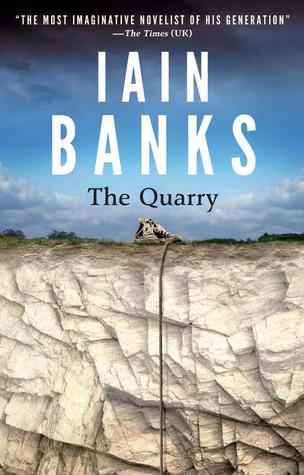
The Quarry by Iain Banks

The Quarry

Blurb:

Kit doesn’t know who his mother is. What he does know, however, is that his father, Guy, is dying of cancer. Feeling his death is imminent, Guy gathers around him his oldest friends ‘“ or at least the friends with the most to lose by his death. Paul ‘“ the rising star in the Labour party who dreads the day a tape they all made at university might come to light; Alison and Robbie, corporate bunnies whose relationship is daily more fractious; Pris and Haze, once an item, now estranged, and finally Hol ‘“ friend, mentor, former lover and the only one who seemed to care.

But what will happen to Kit when Guy is gone? And why isn’t Kit’s mother in the picture? As the friends reunite for Guy’s last days, old jealousies, affairs and lies come to light as Kit watches on.

My thoughts:

I enjoyed The Quarry, the last book Iain Banks wrote. He explained in this interview that it’s a fairly simple book with not many characters, with only really one location and “it doesn’t muck around with flashbacks or narrative order.” It is quite strange really because he had already written 90% of it before he was diagnosed with cancer. I’m sometimes a bit wary of novels on cancer, but The Quarry isn’t in the slightest a sentimental book, nor is it solely about cancer, or death, although Guy does rant about it. I particularly enjoyed his rants – as well as those about cancer he also rants about God, faith, miracles, politics, celebrities, the ‘hounding of the poor and disabled and the cosseting of the rich and privileged‘, the unfair society we live in and so on.

Kit and Guy live in a house that is gradually falling to pieces, situated on the edge of a quarry in the Pennines. Kit is the narrator so we see the events of the weekend when Guy’s friends came to visit through his eyes, as they reminisce about their time as film students and search through the house for a video tape they had made that could ruin all of their lives if it became public. And, of course, he wants to know who is mother is, is it Hol, Ali or Pris, or someone else?

Kit is my favourite character. He is ‘very clever, if challenged in other ways‘, meaning he is ‘on a spectrum that stretches from ‘highly gifted’ at one end to ‘nutter’ at the other.‘ He spends much of his time playing an online game called HeroSpace. I liked the descriptions of his rituals and his need for order – stirring tea and shopping in a certain order etc. Kit’s internal monologue on responding to conversations is also fascinating, illustrating his struggles to interact with people socially.

I read it quickly – it’s well written, easy to read and fast paced. The main characters, Kit, Guy and Hol are convincing characters, whereas the rest remained a bit blurred in my mind, despite the detailed descriptions of what they were wearing. The physical setting, whilst not actually precisely located, is good. I could easily visualise the house and its immediate setting next to the quarry, which plays a big part in the novel both as a physical entity and metaphorically – living on the edge of a precipice into which inevitably we will all fall.

I was gripped by the two strands – will they find the tape and what is on it and will Kit find out the identity of his mother? And Guy’s character is particularly intriguing. It’s an entertaining book, funny in parts, angry, sad and miserable in others and about relationships and secrets.

The Quarry is only the second book by Iain Banks that I’ve read. I’ve also read The Crow Road, which I thoroughly enjoyed, although I never got round to writing down my thoughts about it. I’m tempted to re-read it for comparison. I’ve started to read The Wasp Factory a few times and never got very far as other books pulled me away from it. So I’ll try that again and the only other book of his that I own, A Song of Stone.

The Buttonmaker’s Daughter by Merryn Allingham

The Buttonmaker's Daughter by [Allingham, Merryn]

Historical fiction is one of my favourite genres, so I was pleased when I was offered a review copy of The Buttonmaker’s  Daughter by Merryn Allingham. It will be published on 12 January. I hadn’t come across any of the author’s books before, but this is the 5th book she has written under the name of Merryn Allingham. She has also written a Regency series under the name Isobel Goddard.

Blurb:

As events in Europe and news of the impending threat of war trickle through, this is a novel that looks at the personal dramas that took place in a society already navigating huge social and political change. Born to an industry-owning father and an aristocratic mother, Elizabeth must juggle her own dreams of independence, her parents’ wishes for her ‘˜good marriage’, and the responsibility of reuniting her feuding family. Housemaid Ivy is desperate to marry before her love is pulled away to war, William is struggling with his own feelings towards his schoolboy friend, and Elizabeth is drawn to the promise a new life with a charming young architect. Everyone’s life hangs on the brink of change, and if war is declared, will there even be a future for the Summerhayes estate?

My thoughts:

The Buttonmaker’s Daughter is set in Sussex in the summer of 1914 just before the start of the First World War, a summer of sweltering heat and of rising tension not only nationally and internationally but also personally for Elizabeth Summer and her family. The novel covers just a few months, but those few months contain so much tension and heartbreak as the feud in the Summers family comes to a climax over the question of who Elizabeth should marry and war on the continent becomes inevitable.

Alice, Elizabeth’s mother was brought up on the Amberley estate which her brother, Henry inherited. But she had made a ‘marriage of convenience’ with industrialist Joshua Summer which had brought the much needed money to save Amberley and at the same time had triggered Henry’s enmity. So when Elizabeth falls in love with Aiden Kellaway, an architect’s assistant working on the landscaping of the Summerhayes gardens both her parents and uncle appear united in finding her a ‘suitable’ husband, one with the proper connections.

The Buttonmaker’s Daughter is a beautiful book. I was completely immersed in the story as the relationship between the two families deteriorates and Elizabeth becomes increasingly aware of the danger both to herself and her younger brother William. The setting is idyllic, the characters are clearly drawn and the sense of life in the immediate pre-war period made me feel I was there in the midst of it all, experiencing the social conventions and class distinctions.

I hope Merryn Allingham will write a sequel as I would like to know more about what happened to them all during the war.

  • Paperback: 384 pages
  • Publisher: HQ; First edition edition (12 Jan. 2017)
  • Language: English
  • ISBN-10: 0008193835
  • ISBN-13: 978-0008193836
  • Source: review copy

The Bone Field by Simon Kernick

The Bone Field (The Bone Field Series, #1)

I read The Bone Field by Simon Kernick in December and thoroughly enjoyed it. It’s due to be published on 12 January.

It’s the first of his books that I’ve read, but it won’t be the last. Kitty Sinn disappeared in 1990 whilst she was on holiday in Thailand with her boyfriend, Henry Forbes. There was no record that she ever left Thailand, but 26 years later her bones were discovered during building work on land that had formerly belonged to Medmenham College in Buckinghamshire. And then the bones of a schoolgirl who had gone missing in 1989 are found buried in the same field.

There’s plenty of fast paced action moving the plot swiftly along, told through different characters’ viewpoints, mainly from DI Ray Mason, who is nearly killed when he goes to question Henry and then finds himself under investigation as a suspect. From then on he acts very much on his own, with the help of PI Tina Boyd, an ex-police detective. Both find themselves in danger as they are confronted by a gang of ruthless killers, ritualistic murderers and people traffickers.

The Bone Field is the first in a new series of books, featuring Ray Mason and Tina Boyd, both of whom are the most developed and convincing of the characters and, I understand, are both characters from Kernick’s earlier books. I read the book quickly, drawn by all the twists and turns to the dramatic ending. However instead of tying up all the loose ends, the last sentence raises a new mystery, a partial cliff-hanger that, I assume, will lead on to the next book in the series.

My thanks to Lovereading who sent me a copy of this book for review.

  • Hardcover: 400 pages
  • Publisher: Century (12 Jan. 2017)
  • Language: English
  • ISBN-10: 1780894538
  • ISBN-13: 978-1780894539

Six Degrees of Separation

Six Degrees of Separation is a monthly link-up hosted by Kate at Books Are My Favourite and Best. Each month, a book is chosen as a starting point and linked to six other books to form a chain. A book doesn’t need to be connected to all the other books on the list, only to the one next to it in the chain.

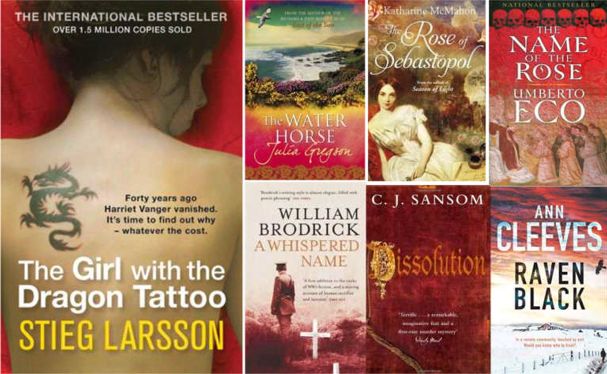
Girl with Dragon Tattoo chain

This month’s chain begins with: The Girl with the Dragon Tattoo by Stieg Larsson, a book that has been on my TBR list since 2009. I’ve been put off reading it by all the hype and by the mixed reviews it has received. Maybe this year I should give it a go and see for myself what it is like.

Another book that has been on my TBR list since 2009 and I still haven’t read it is The Water Horse by Julia Gregson, based on the true story of a young Welsh woman who ran away to nurse in the Crimea alongside Florence Nightingale. This made me think of the next book in the chain …

The Rose of Sebastopol by Katharine McMahon, this time a book I have read, also about the Crimea but in which a young Englishwoman, travels to the Crimea determined to work as a nurse.

Another book with ‘Rose’ in the title is The Name of the Rose by Umberto Eco, a fantastic historical crime mystery novel set in a Franciscan monastery in 14th century Italy. William of Baskerville and his assistant Adso are sent to the monastery to investigate a series of murders. I’ve read this book twice – probably time for another re-read!

I love historical fiction and one of my favourites is A Whispered Name by William Brodrick, his 3rd Father Anselm book, set during the Battle of Passchendaele in 1917, as an Irish soldier faced a court martial for desertion. On the panel was a young captain, Herbert Moore, charged with a responsibility that would change him for ever. It kept me glued to the pages as I read about the First World War and the effects it had on those who took part, those left at home and on future generations. 

Monks are my link to the next book in my chain with Dissolution by C J Sansom, a wonderful historical crime fiction novel set in 1537 about Henry VIII’s dissolution of the monasteries. It’s the first in the Matthew Shardlake series in which he investigates the murder of Commissioner Robin Singleton.

Which leads me to my last link, Raven Black by Ann Cleeves, also the first in a series – Ann Cleeves’ Shetland series, in which Inspector Jimmy Perez investigates the murder of a teenager, found dead in the snow, strangled with her own scarf, a few days after New Year.

My chain has taken me from Sweden to Shetland via the Crimea, Italy, Belgium and England, from the 20th century to the 19th century, and back to the medieval period and the 16th century. The covers I’ve picked are also linked, all having a shade of red.

My Friday Post: The Eagle of the Ninth

Book Beginnings Button

Every Friday Book Beginnings on Friday is hosted by Gillion at Rose City Reader where you can share the first sentence (or so) of the book you are reading, along with your initial thoughts about the sentence, impressions of the book, or anything else the opener inspires.

The Eagle of the Ninth

This year I’m hoping to read more from my own shelves than last year so I’ve been looking at some of the books that I’ve had for years. The Eagle of the Ninth by Rosemary Sutcliff is one of my TBRs – I bought it in a library book sale, not sure when that was, over 10 years ago, I should think. Today I got it down off the shelf and began reading:

From the Fosseway westward to Isca Dumnoniorum the road was simply a British trackway, broadened and roughly metalled, strengthened by corduroys of logs in the softest places, but otherwise unchanged from its old estate, as it wound among the hills, thrusting further and further into the wilderness.

Also every Friday there is The Friday 56, hosted by Freda at Freda’s Voice.

Friday 56

These are the rules:

  1. Grab a book, any book.
  2. Turn to page 56, or 56% on your eReader.
  3. Find any sentence (or a few, just don’t spoil it) that grabs you.
  4. Post it.
  5. Add the URL to your post in the link on Freda’s most recent Friday 56 post.

Page 56:

A great gust of wind swooped against the house like a wild thing striving to batter its way in; the lamplight jumped and fluttered, sending shadows racing across the chequered board – and the ghost of last year were once more a year away. Marcus looked up, and said, as much for the sake of shutting out his own thoughts as for anything else, ‘I wonder what possessed you to settle here in Britain, Uncle Acquila, when you could have gone home?’

Blurb from the back cover:

The Ninth Legion marched into the mists of northern Britain. And they were never seen again. Four thousand men disappeared and the eagle standard was lost.

Marcus has to find out what happened to his father, who led the Ninth Legion. So he sets out into the unknown, on a quest so hazardous that no one expects him to return …

This is the first of Sutcliff’s series of novels about Roman Britain. The film, The Eagle (2011) is adapted from her book. I read some of her books when I was a child and loved them. I’m hoping this one will be as good.

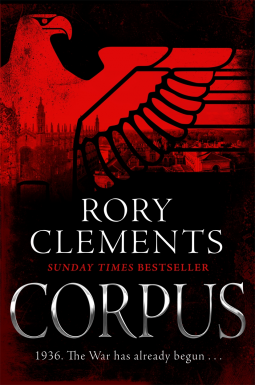
Corpus by Rory Clements

Rory Clements is best known for his John Shakespeare series, but Corpus is the first of his books I’ve read, so I was unsure that I would like it when I received an ARC from NetGalley. It is due to be published on 26 January 2017. (I read Corpus in December 2016.)

Blurb

1936.

Europe is in turmoil.

The Nazis have marched into the Rhineland.

In Russia, Stalin has unleashed his Great Terror.

Spain has erupted in civil war.

In Berlin, a young Englishwoman evades the Gestapo to deliver vital papers to a Jewish scientist. Within weeks, she is found dead in her Cambridge bedroom, a silver syringe clutched in her fingers.

In a London club, three senior members of the British establishment light the touch paper on a conspiracy that will threaten the very heart of government. Even the ancient colleges of Cambridge are not immune to political division. Dons and students must choose a side: right or left, where do you stand?

When a renowned member of the county set and his wife are found horribly murdered, a maverick history professor finds himself dragged into a world of espionage which, until now, he has only read about in books. But the deeper Thomas Wilde delves, the more he wonders whether the murders are linked to the death of the girl with the silver syringe – and, just as worryingly, to the scandal surrounding King Edward VIII and his mistress Wallis Simpson…

Set against the drumbeat of war and moving from Berlin to Cambridge, from Whitehall to the Kent countryside, and from the Fens to the Aragon Front in Spain, this big canvas international thriller marks the beginning of a major new series from bestselling author Rory Clements.

My thoughts:

The setting in 1936 is well done, a time when Europe was once more on the brink of war. Civil war has broken out in Spain, in Britain some people are openly supporting the Nazis in Germany and politicians are torn between wanting Edward VIII to abdicate the throne or give up his relationship with Wallis Simpson. Against this background Corpus focusses on Tom Wilde’s investigations first into Nancy’s death, aided by her friend Lydia, who is convinced that Nancy was murdered, and then into yet more murders.

I was totally convinced by the characters, in particular Tom Wilde, a professor of history who is writing a biography of Sir Robert Cecil, the Elizabethan and Jacobean statesman, the successor to Sir Francis Walsingham as the Queen’s spymaster (a nod to his earlier series, I thought). And I was immersed in the mysteries, with spies, communists and Nazis, Spanish Gold, Soviet conspirators, politicians and academics all intricately woven into the plot. It’s pacy, full of action, violence and double-cross – a most satisfying and compelling thriller.

I loved Corpus and I shall certainly look out for Rory Clements’ other books.

  • Hardcover: 384 pages
  • Publisher: Zaffre (26 Jan. 2017)
  • Language: English
  • ISBN-10: 1785762613
  • ISBN-13: 978-1785762611
  • Source: review copy via NetGalley