My Friday Post

Book Beginnings Button

Every Friday Book Beginnings on Friday is hosted by Gillion at Rose City
Reader
 where you can share the first sentence (or so) of the book you are reading, along with your initial thoughts about the sentence, impressions of the book, or anything else the opener inspires.

I’ve recently finished reading Gallows View by Peter Robinson, the first Inspector Banks book and have decided to read the series in the order they were written. The second Inspector Banks book is A Dedicated Man. A Dedicated Man

When the sun rose high enough to clear the slate roofs on the other side of the street, it crept through a chink in Sally Lumb’s curtain and lit on a strand of gold blonde hair that curled over her cheek. She was dreaming.

This opening doesn’t tell me much about the book. If I didn’t know it’s an Inspector Banks book I’d probably not bother reading much further. But reading the blurb encourages me to read on:

Blurb:

Near the village of Helmthorpe, Swainsdale, the body of a well-liked local historian is found half-buried under a dry stone wall. Harry Steadman has been brutally murdered. But who would want to kill such a thoughtful, dedicated man?

Chief Inspector Alan Banks is called in to investigate and soon discovers that disturbing secrets lie behind the apparently bucolic facade. It is clear that young Sally Lumb, locked in her lover’s arms on the night of the murder, knows more than she is letting on. And her knowledge could lead to danger . . .

Also every Friday Freda at Freda’s Voice hosts The Friday 56

Friday 56

These are the rules:

  1. Grab a book, any book.
  2. Turn to page 56, or 56% on your eReader. (If you have to improvise, that’s ok.)
  3. Find any sentence (or a few, just don’t spoil it) that grabs you.
  4. Post it.
  5. Add the URL to your post in the link on Freda’s most recent Friday 56 post.

From Page 56:

‘He was a fine man, good-tempered, even-natured. He had a sharp mind – and a tongue to match when it came to it – but he was a good man; he never hurt a soul, and I can’t think why anyone would want to kill him.’

‘Somebody obviously felt differently,’ Banks said. ‘I hear he inherited a lot of money.’

I’m pleased that page 56 provides information about the man in the title and provides an answer to the question of why anyone would want to kill such a good man. I haven’t read much more of the book so I’m still in the dark about the motive – was the man really killed for his money?

What do you think? Would you continue reading?


The Unquiet Dead by Ausma Zehanat Khan

A powerful and thought provoking story

The Unquiet Dead by Ausma Zehanat Khan

I read The Unquiet Dead by Ausma Zehanat Khan in May. It’s due to be published by No Exit Press on 27 July 2017 (first published December 30th 2014).

Blurb:

One man is dead.

But thousands are his victims.

Can a single murder avenge that of many?

When Christopher Drayton’s body is found at the foot of the Scarborough Bluffs, Detectives Esa Khattak and Rachel Getty are called to investigate his death. But as the secrets of his role in the 1995 Srebrenica Massacre surface, the harrowing significance of the case makes it difficult to remain objective. In a community haunted by the atrocities of war, anyone could be a suspect. And when the victim is a man with far more deaths to his name, could it be that justice has at long last been served?

In this striking debut, Ausma Zehanat Khan has written a compelling and provocative mystery exploring the complexities of identity, loss, and redemption.

The harrowing account of the atrocities of Srebrenica in 1995 and the search for justice forms the basis of this intriguing novel. Extracts from statements and reports from survivors of the massacre head each chapter, giving voice to the ‘unquiet dead‘. These are immensely powerful and drive the novel. Alongside that is the investigation by detectives Esa Khattak and Rachel Getty into the death of Christopher Drayton who fell from the heights of the Scarborough Bluffs. Was it suicide, or an accident? Or was he pushed -and if so, who pushed him and why?

This is Ausma Zehanat Khan‘s debut novel but at times events in the past lives of the characters are referred to without much explanation and I felt I must have missed an earlier novel. For me, the investigation into Drayton’s death is the weaker part of the book. I think Rachel is the most convincing character, with Esa more of a shadowy personality, seemingly easily influenced by the women he meets. The other characters and there are a lot, aren’t particularly well-drawn and some are really just caricatures.

But these criticisms aside I think it is a powerful and thought provoking story that brought home to me the devastating and heart breaking horrors of the Srebrenica massacre of 8,000 Bosnian Muslims.

  • Paperback: 320 pages
  • Publisher: No Exit Press (27 July 2017)
  • Language: English
  • ISBN-10: 1843449447
  • ISBN-13: 978-1843449447
  • Source: Review copy via Lovereading
  • My rating: 3*

Gallows View by Peter Robinson

Gallows View: DCI Banks (Inspector Banks 1)

This year marks the 30th anniversary of the first Inspector Banks bookGallows View by Peter Robinson* (see below). I’ve read some of the later Banks books, totally out of order, which doesn’t seem to matter as I think they work well as stand alone books.

Inspector Alan Banks has been in Eastvale in the Yorkshire Dales for six months, having relocated from London. He has now got used to the slower pace of life and is working well with his colleagues. Sandra, his wife, has also settled well in Eastvale, making friends with Harriet and joining the local photography club.

There’s a peeping tom in the area, targeting young, blonde women, following them as they leave the pub and then watching as they undress for bed and there is also spate of break-ins by two balaclava-wearing thugs who rob old ladies and vandalize their homes. It’s clear quite early in the book that the two thugs are teenagers, Trevor Sharp and his friend, Mick Webster, who progress from robbing old ladies to burgling more prosperous homes when their owners are away from home, guided by Mick’s older brother, Lenny.

The main mystery is that of Alice Matlock, an old woman, living on her own, who is is found dead in her ransacked house in Gallows View, a row of old terraced  cottages. Her body was discovered by her friend, Ethel Carstairs, lying on her back, having fractured her skull on the corner of a table while falling backwards – or had she been pushed? Was she also a victim of Trevor and Mick, could it have been the peeping tom, or was someone else responsible? It might have just been an accident – she was old and her bones were brittle.

Dr Jenny Fuller, a psychologist at York University, has been brought in to help by providing a profile for the peeping tom case. Banks, a happily married man, is immediately attracted to her. They work well together, although Sandra, his wife, is rather suspicious at first about their relationship when she discovers that Dr Fuller is a young, attractive redhead.

It’s a good start to the series, which has now reached 24 books. It has quite a relaxed pace, with a complex and well constructed plot. The characters are convincing and realistic, and I like Banks, a hard working dedicated detective who gets on well with his boss, Superintendent Gristhorpe, who likes to build dry stone walls in his spare time.

As well as the crimes Robinson also explores a number of other issues – for example, feminism and gender, and education, comparing comprehensives and grammar schools. One thing that really dates it is the frequent mention of smoking in pubs!

As with other detective novels that have since been adapted for TV there are differences from the books. Peter Robinson explains on his website he has no power in the TV universe, and he thinks of the Banks books and the TV series as parallel universes. The characters are clearly meant to be different versions of the same person; they look different, have different personalities and meet different fates in different worlds.

  • Format: Kindle Edition
  • File Size: 826 KB
  • Print Length: 324 pages
  • Publisher: Pan; Reprints edition (21 Aug. 2009)
  • Source: I bought the e-book
  • My Rating: 4*

Gallows View is a book I’ve owned for over 2 years, so it qualifies for Bev’s Mount TBR Challenge.

*Peter Robinson later wrote a novella, Like A Virgin published in a short story collection, The Price of Love, which is about his last case in London just before he moved to Yorkshire.

My Friday Post: The Taxidermist’s Daughter

Book Beginnings ButtonEvery Friday Book Beginnings on Friday is hosted by Gillion at Rose City
Reader
 where you can share the first sentence (or so) of the book you are reading, along with your initial thoughts about the sentence, impressions of the book, or anything else the opener inspires.

This week I’m featuring The Taxidermist’s Daughter by Kate Mosse ‘“ set in 1912 in a Sussex village where a grisly murder has taken place, this is part ghost story and part psychological thriller.

The Taxidermist's Daughter

Prologue

April 1912

Midnight

In the graveyard of the church of St Peter and St Mary, men gather in silence on the edge of the drowned marshes. Watching, waiting.

A good start I think, definitely full of foreboding.

Also every Friday there is The Friday 56, hosted by Freda at Freda’s Voice.

Friday 56

These are the rules:

  1. Grab a book, any book.
  2. Turn to page 56, or 56% on your eReader.
  3. Find any sentence (or a few, just don’t spoil it) that grabs you.
  4. Post it.
  5. Add the URL to your post in the link on Freda’s most recent Friday 56 post.

From Page 56:

He thought back to the painting on his easel in his studio, to the woman frozen lifeless in time, and realised it was the colour of her skin he’d got wrong. Too pink, no hollows and no shadows. No life in it.

Blurb:

The clock strikes twelve. Beneath the wind and the remorseless tolling of the bell, no one can hear the scream…

1912. A Sussex churchyard. Villagers gather on the night when the ghosts of those who will not survive the coming year are thought to walk. And in the shadows, a woman lies dead.

As the flood waters rise, Connie Gifford is marooned in a decaying house with her increasingly tormented father. He drinks to escape the past, but an accident has robbed her of her most significant childhood memories. Until the disturbance at the church awakens fragments of those vanished years …

What do you think? Would you continue reading?

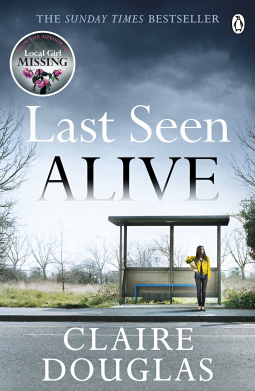
Last Seen Alive by Claire Douglas

Publication date: 13 July 2017, Penguin

Source: review copy via NetGalley

Blurb:

Libby Hall never really wanted to be noticed. But after she saves the children in her care from a fire, she finds herself headline news. And horrified by the attention. It all reminds her of what happened nine years ago. The last time she saw her best friend alive.

Which is why the house swap is such a godsend. Libby and her husband Jamie exchange their flat in Bath for a beautiful, secluded house in Cornwall. It’s a chance to heal their marriage – to stop its secrets tearing them apart.

But this stylish Cornish home isn’t the getaway they’d hoped for. They make odd, even disturbing, discoveries in the house. It’s so isolated-yet Libby doesn’t feel entirely alone. As if she’s being watched.

Is Libby being paranoid? What is her husband hiding? And. As the secrets and lies come tumbling out, is the past about to catch up with them? 

Last Seen Alive is the first novel by Claire Douglas that I’ve read and I loved it. It’s everything the blurb promised, and the secrets and lies never stop coming, right up to the end of the book. To write too much about the plot would only spoil it – you have to experience it as you read to get the full impact.

I can only say that right from the beginning of the book I was hooked as Jamie and Libby arrive at their house swap in the Roseland Peninsula in Cornwall (I’ve been there – it is beautiful) and I felt the suspense and tension as they explored the house by the sea. It’s a remote detached rectangular house with a round turret at one end and inside it had been recently restored. They are dismayed by the contrast with their poky two bed flat in Bath. Immediately alarm bells are going off in Libby’s head, what were the owners’ real reasons for wanting to swap this house for their little flat?

Strange things happen, Libby’s fears escalate and then Jamie begins to question her about her past. He knew that Karen, her best friend had died in a fire when the two of them were in Thailand and that Libby had been lucky to escape. But she doesn’t want to talk about that and she knows that he is keeping things from her too. Then Jamie comes down with a bad attack of food poisoning and ends up in hospital. Their stay in Cornwall comes to an end as the owner tells them he is leaving their flat. They return and from then on everything gets worse – much worse.

Needless to say this is a complicated and complex story, perfectly paced as the secrets are revealed and the lies are exposed. The characterisation is good. As I read I grew to like Libby a lot but began to suspect that maybe she wasn’t as genuine as I first thought and Jamie’s attitude began to irritate me – signs that the characters are well drawn. At one point I began to get a glimmer about the truth as I realised how the Prologue fitted into the story.

I was never really sure who I could believe, just who was telling the truth. It’s one of those books that keeps you guessing right up to the end and this one is excellent, dramatic, tense and so very, very twisty.

My thanks to NetGalley and Penguin, the publishers for a review copy.

  • Format: Kindle Edition
  • File Size: 2751 KB
  • Print Length: 389 pages
  • Page Numbers Source ISBN: 1405926422
  • Publisher: Penguin (13 July 2017)
  • My rating: 5*

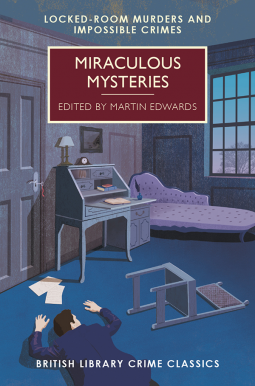
Miraculous Mysteries: Locked Room Mysteries and Impossible Crimes edited by Martin Edwards

I’ve said before that I’m not a big fan of short stories, often finding them disappointing. So I’m glad to say that I enjoyed this anthology edited by Martin Edwards: Miraculous Mysteries: Locked Room Mysteries and Impossible Crimes. Some stories, of course, are better than others.

These are the sixteen stories in the collection. Martin Edwards has prefaced each one with a brief biographical note, which I found useful as some of the authors were new to me. I read the collection slowly, which I find is the best way to approach a short story collection.

  • The Lost Special by Arthur Conan Doyle (not a Sherlock Holmes/Dr. Watson story) about a train that disappears on its route from Liverpool to London. This was first published in The Strand Magazine in 1898.
  • The Thing Invisible by William Hope Hodgson, an author I hadn’t come across before. First published in 1913 this is a murder mystery dressed up as a ‘ghost’ story. Very atmospheric.
  • The Case of the Tragedies in the Greek Room by Sax Rohmer, another new-to-me author, although I had heard of his most well known character, the master criminal Dr Fu Manchu. In this story amateur detective Moris Klaw  and his beautiful daughter investigate a locked room murder in a museum, involving ‘psychic photographs’.
  • The Aluminum Dagger by Richard Austin Freeman, featuring one of Dr. John Thorndyke’s scientific stories, describing in detail how a man was discovered in a locked room, stabbed to death.
  • The Miracle of Moon Crescent by G. K. Chesterton, a Father Brown story set in America, in which the cleric investigates a death by a curse.
  • The Invisible Weapon by Nicholas Olde, an impossible murder mystery, in which there is only one man who could have done it – and he could not have done it.
  • The Diary of Death by Marten Cumberland – an impossible crime, a kind of chess problem. Lilian Hope’s diary provides a list of victims -people she had hated.
  • The Broadcast Murder by Grenville Robbins, in which a murder takes place in a radio station and is broadcast has it happens.
  • The Music-Room by Sapper (not a Bulldog Drummond story), featuring a secret passage and a falling chandelier.
  • Death at 8:30 by Christopher St. John Sprigg, in which a murderer predicts the date and exact time of the death of the victim unless a ransom is paid.
  • Too Clever By Half by G. D. H. and Margaret Cole – Dr Tancred’s advice, if you intend to commit a murder, is don’t make the mistake of trying to be clever!
  • Locked In by E. Charles Vivian – a death by shooting in a locked room.
  • The Haunted Policeman by Dorothy L. Sayers (a Lord Peter Wimsey story) – probably my favourite in the collection. It had me completely mystified. The policeman is new to the beat and can’t believe his eyes.
  • The Sands of Thyme by Michael Innes (a John Appleby story) murder at Thyme Bay, or was it suicide? Footprints in the sand provide a clue.
  • Beware of the Trains by Edmund Crispin (a Gervase Fen story), a clever and baffling story about a lost train driver.
  • The Villa Marie Celeste by Margery Allingham (an Albert Campion and Inspector Luke story) – another favourite, in which a young couple disappear, leaving behind their half-eaten breakfast, taking only a couple of clean linen sheets. There was no clue why they left and no signs of any violence.

My thanks to the publishers for my review copy via NetGalley.