The Classics Club Spin Result

Classics Club

The spin number in The Classics Club Spin was announced today. It’s number …

1

which for me is Greenmantle by John Buchan. The rules of the Spin are that this is the book for me to read by January 31, 2019.

Greenmantle

Greenmantle is the second of five novels by John Buchan featuring the character of Richard Hannay, first published in 1916. I’ve read the first, The Thirty-Nine Steps.

Here’s the blurb from Amazon:

Richard Hannay is tasked to investigate rumours of an uprising in the Muslim world and takes off on a hair-raising journey through German-occupied Europe to meet up with his old friend Sandy Arbuthnot in Constantinople, where they must thwart the Germans’ plans to use religion to help them win the war. Set during World War I, Greenmantle is a contraversial meditation on the power of political Islam (it was pulled from Radio 4’s schedule at the time of the 7 July bombings).

I’m really pleased this book came up in the Spin for me as it will fit in with my reading about World War I.

Did you take part in the Classics Spin? What will you be reading?

In a Dark, Dark Wood by Ruth Ware

In a Dark, Dark Wood

Nora hasn’t seen Clare for ten years. Not since the day Nora walked out of her old life and never looked back.

Until, out of the blue, an invitation to Clare’s hen party arrives. A weekend in a remote cottage – the perfect opportunity for Nora to reconnect with her best friend, to put the past behind her.

But something goes wrong.

Very wrong.

And as secrets and lies unravel, out in the dark, dark wood the past will finally catch up with Nora.

I featured In a Dark, Dark Wood by Ruth Ware in this Friday Post on book Beginnings and said that I wasn’t sure I wanted to read it having been disappointed  by the only other book by her that I’ve read, The Woman in Cabin 10.  But as some people commented that they had enjoyed it and as it has good reviews on Amazon and Goodreads I decided to read on. It promises to be a psychological thriller – a scary book – but maybe I’ve read too many psychological thrillers as I didn’t find it thrilling or scary. It’s mystery novel that slowly reveals why Leonora, known either as Lee or Nora or Leo, and Clare haven’t seen  or even spoken to each other since they were 16, ten years ago. That was also when Nora’s heart was broken when her relationship with James came to an abrupt end. She had never come to terms with their break up.

I thought the setting was good – the hen party is held in a glass house in the middle of a wood in Northumberland. The mobile phone signal is practically nonexistent and they are cut off from the outside world and isolated when the snow sets, in cutting off the landline. But the characters are stereotypes – a new mother pining for her baby back home, a gay male actor, a gay female doctor (who is in my opinion the most sensible of the group), the dippy devoted friend of the bride who has organised this terrible hen party, the bride, self-obsessed, selfish and manipulative as well as Nora, who can’t move on from her past. The outcome is predictable when footprints appear in the snow, the backdoor that was supposed to be locked is found open and the hen party keep arguing and antagonising each other. It’s obvious from the start that something terrible had happened when Nora wakes up in a hospital bed and realises that she can’t remember what had happened … or what she had done.

In a Dark, Dark Wood is Ruth Ware’s debut novel and the film rights have been optioned  by New Line Cinema.  I can imagine that a film would be much more terrifying than the book – it should be, the potential is there. I don’t like being critical of a book, but I can’t recommend this book.


First Chapter First Paragraph: The Twilight Hour by Nicci Gerrard

Every Tuesday First Chapter, First Paragraph/Intros is hosted by Vicky of I’d Rather Be at the Beach sharing the first paragraph or two of a book she’s reading or plans to read soon.

This week I’m featuring The Twilight Hour by Nicci Gerrard, one of the books I’ve borrowed from the library.

The Twilight Hour

It begins:

Eleanor woke to what was not there. Outside, the wind still roared,dashing pellets of rain against the windows; inside it was too silent, not a breath or a heartbeat save hers. The darkness felt uninhabited. Before she reached out her hand, groping past the water jug and the vase of dying flowers to touch the bed and find it empty, the blanket thrown back and the pillow dislodged, she knew she was alone. She let fear seep through her, into every space in her body. She could taste the muddy, metal ache of it in her mouth; feel it in the palms of her hands and the base of her spine and in her throat like a rippling, oily snake; she could smell it on her skin, sour as spoilt milk.

That’s a terrifying feeling to wake up with – that image of a rippling, oily snake in her throat leaves me feeling sick –  and wondering why she is so scared.

Blurb:

Eleanor Lee has lived a fiercely independent existence for over ninety years, but now it’s time to tidy her life away – books, photographs, paintings, letters – a lifetime of possessions all neatly boxed up for the last time. But amongst them there are some things that must be kept hidden. And, nearing blindness, Eleanor needs help to uncover them before her children and grandchildren do.

Peter, a young man with a broken heart who feels as lost as Eleanor’s past, is employed to help with this task. And together they uncover traces of another life – words and photographs telling a story of forbidden love, betrayal, passion, grief and self-sacrifice, which Eleanor must visit one last time.

By speaking her memories out loud, and releasing the secrets of her past, Eleanor can finally lay them to rest. To honour them at last, and protect those who must never know.

What do you think? Would you keep reading?

More New-to-Me Books

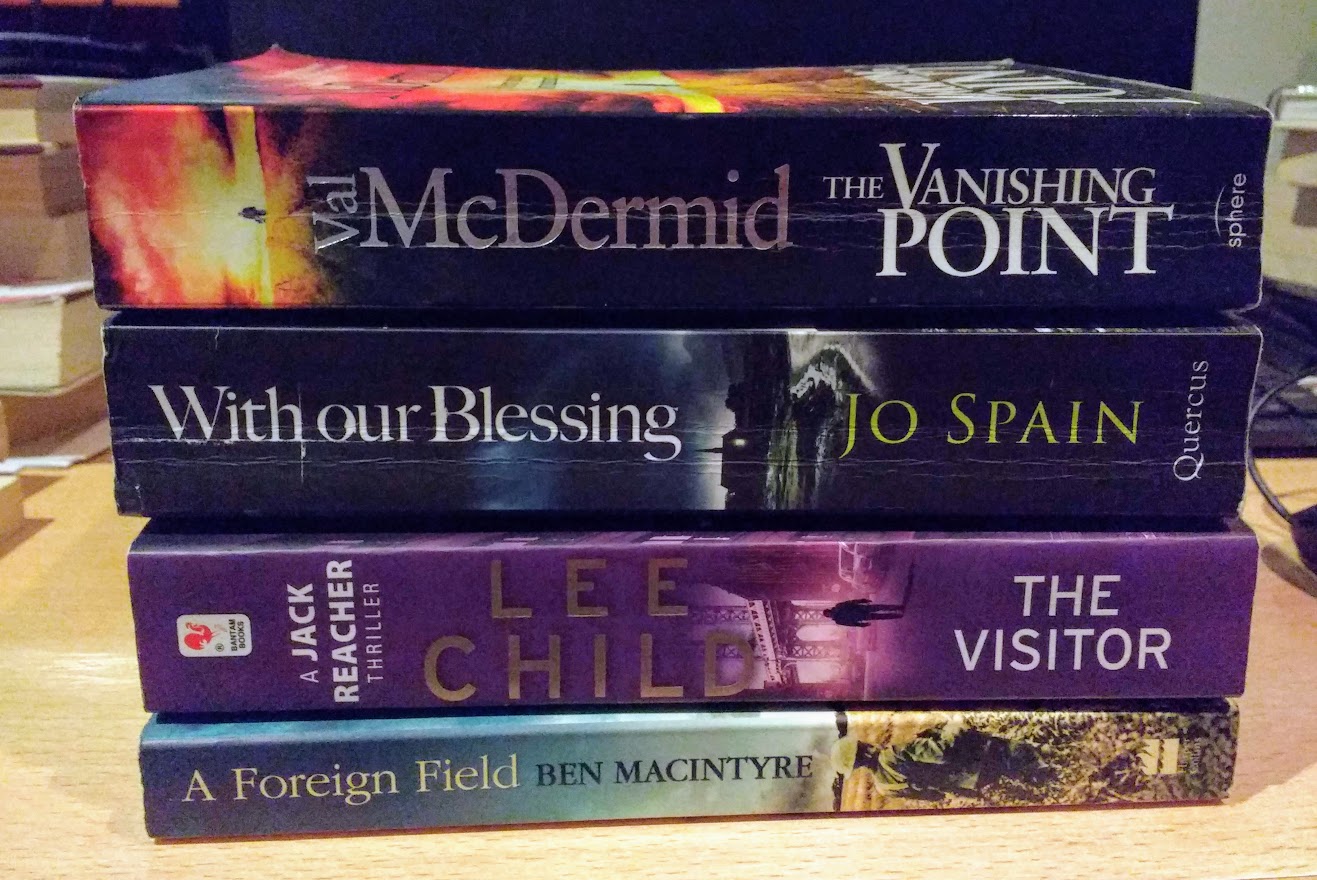
A visit to Barter Books  at Alnwick this week has added 4 books to my TBRs.

 I usually steer clear of books about kidnapped or missing babies/children, so I’m not sure about the first two books shown below. But I’ve read books by both authors before and enjoyed them so I’m hoping they’ll be OK – or at least not too heart-wrenching:

The Vanishing Point by Val McDermid – a standalone psychological thriller beginning with a nightmare scenario: a parent who loses her child in a bustling international airport.

Blurb

Stephanie Harker is travelling through security at O’Hare airport with five-year-old Jimmy. But in a moment, everything changes. In disbelief, Stephanie watches as a uniformed agent leads her boy away – and she’s stuck the other side of the gates, hysterical with worry.

The authorities, unaware of Jimmy’s existence, just see a woman behaving erratically; Stephanie is wrestled to the ground and blasted with a taser gun. By the time she can tell them what has happened, Jimmy is long gone.

But as Stephanie tells her story to the FBI, it becomes clear that everything is not as it seems. There are many potential suspects for this abduction. With time rapidly running out, how can Stephanie get him back?

A breathtakingly rich and gripping psychological thriller, The Vanishing Point is Val McDermid’s most accomplished standalone novel to date, a work of haunting brilliance.

With Our Blessing by Jo Spain – a murder mystery and another book about mothers and babies in the Magdalene Laundries in Ireland, also known as Magdalene asylums.

Blurb

1975
A baby, minutes old, is forcibly taken from its devastated mother.

2010
The body of an elderly woman is found in a Dublin public park in the depths of winter.

Detective Inspector Tom Reynolds is on the case. He’s convinced the murder is linked to historical events that took place in the notorious Magdalene Laundries. Reynolds and his team follow the trail to an isolated convent in the Irish countryside. But once inside, it becomes disturbingly clear that the killer is amongst them . . . and is determined to exact further vengeance for the sins of the past.

The Visitor by Lee Child – a Jack Reacher – I’ve read one of the Jack Reacher books and did enjoy it but looking at the reviews of this book it seems a lot of readers weren’t keen on it whilst many others were. A marmite book, maybe. 

Blurb

Sergeant Amy Callan and Lieutenant Caroline Cook have a lot in common. High-flying army career women, both are victims of sexual harassment from their superiors; both are force to resign from the service.

And now they’re both dead.

Their unmarked bodies are discovered in their homes, naked, in baths filled with army-issue camouflage paint. Expert FBI psychological profilers start to hunt for a serial murderer, a smart guy with a score to settle, a loner, an army man, a ruthless vigilante known to them both.

Jack Reacher, a former US military cop, is a smart guy, a loner and a drifter, as tough as they come. He knew both victims. For Agent-in-Charge Nelson Blake and his team, he’s the perfect match. They’re sure only Reacher has the answers to their burning questions: how did these women die? And why?

A Foreign Field: a True Story of Love and Betrayal in the Great War by Ben Macintyre – nonfiction – because I’m interested in reading about World War One in both fiction and nonfiction. I enjoyed reading his book Operation Mincemeat so I’m hoping I’ll like this one too.  

Blurb

A wartime romance, survival saga and murder mystery set in rural France during the First World War, from the bestselling author of ‘Operation Mincemeat’ and ‘Agent Zig-Zag’.

Four young British soldiers find themselves trapped behind enemy lines at the height of the fighting on the Western Front in August 1914. Unable to get back to their units, they shelter in the tiny French village of Villeret, where they are fed, clothed and protected by the villagers, including the local matriarch Madame Dessenne, the baker and his wife.

The self-styled leader of the band of fugitives, Private Robert Digby, falls in love with the 20-year-old-daughter of one of his protectors, and in November 1915 she gives birth to a baby girl. The child is just six months old when someone betrays the men to the Germans. They are captured, tried as spies and summarily condemned to death.

Using the testimonies of the daughter, the villagers, detailed town hall records and, most movingly, the soldiers’ last letters, Ben Macintyre reconstructs an extraordinary story of love, duplicity and shame – ultimately seeking to discover through decades of village rumour the answer to the question, ‘Who betrayed Private Digby and his men?’ In this new updated edition the mystery is finally solved.

Which one would you recommend I read first?

My Friday Post: Tombland by C J Sansom

Book Beginnings Button

Every Friday Book Beginnings on Friday is hosted by Gillion at Rose City Reader where you can share the first sentence (or so) of the book you are reading, along with your initial thoughts about the sentence, impressions of the book, or anything else the opener inspires.

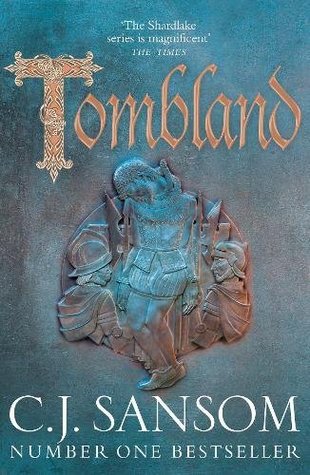
This week I’m featuring Tombland by C J Sansom, one of the books I’m currently reading.

Tombland (Matthew Shardlake, #7)

It begins with a Prologue:

January 1549

I had been in my chambers at Lincoln’s Inn when the messenger came from Master Parry, asking me to attend to him urgently. I wondered what might be afoot. He was the Lady Elizabeth’s Comptroller, head of the financial side of her household, and I had worked under him since I was recommended to Elizabeth by Queen Catherine Parr two years before, following King Henry’s death.

It continues with

Chapter One

June 1549

It rained throughout our journey to Hatfield Palace; hard, heavy rain that dripped from our caps and made our horses’ reins slippery and slick. Occasionally, a gust of cold wind drove it at us slantwise; as though even now, in early June, the chill of the hard winter and cold spring was reluctant to let go of the land.

Also every Friday there is The Friday 56, hosted by Freda at Freda’s Voice.

30879-friday2b56These are the rules:

  1. Grab a book, any book.
  2. Turn to page 56, or 56% on your eReader. If you have to improvise, that is okay.
  3. Find any sentence (or a few, just don’t spoil it) that grabs you.
  4. Post it.
  5. Add the URL to your post in the link on Freda’s most recent Friday 56 post.

Pages 56 – 57:

I turned to the young man. ‘I understand that you visited Master Boleyn in gaol.’

Lockswood turned to his master, who nodded his agreement, then said, ‘I visited him last week in the castle gaol, where he is held until trial. An unpleasant place, sir, and Master Boleyn was in a sorrowful state. He seemed shocked by what had happened to him, kept doddering -‘

~~~

About the Book (extracted from Amazon)

Tombland is the seventh novel in C. J. Sansom’s number one bestselling Shardlake series.

It’s set in the summer of 1549, two years after the death of Henry VIII, England is sliding into chaos . . .

The nominal king, Edward VI, is eleven years old. His uncle Edward Seymour, Duke of Somerset, rules as Protector. The extirpation of the old religion by radical Protestants is stirring discontent among the populace while the Protector’s prolonged war with Scotland is proving a disastrous failure and threatens to involve France. Worst of all, the economy is in collapse, inflation rages and rebellion is stirring among the peasantry.

Matthew Shardlake is asked to investigate the murder of Edith Boleyn, the wife of John Boleyn – a distant Norfolk relation of Elizabeth’s mother Anne Boleyn.  Then he and his assistants get caught up in the rebellion against the landowners’ enclosures of the common land as thousands of peasants led by Robert Kett establish a vast camp outside Norwich.

~~~

I am thoroughly absorbed by this book, reading it at a leisurely pace, enjoying all the details. I knew about the early enclosures of common land, but hadn’t heard of Kett’s Rebellion before. It’s a long book of 866 pages including an historical essay, Reimagining Kett’s Rebellion, notes and a bibliography.

What about you? Does it tempt you or would you stop reading? 

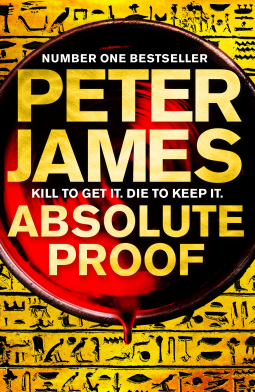
Absolute Proof by Peter James

3.5*

Pan Macmillan|4 October 2018|570 pages|Review copy Investigative reporter Ross Hunter nearly didn’t answer the phone call that would change his life – and possibly the world – for ever. ‘I’d just like to assure you I’m not a nutcase, Mr Hunter. My name is Dr Harry F. Cook. I know this is going to sound strange, but I’ve recently been given absolute proof of God’s existence – and I’ve been advised there is a writer, a respected journalist called Ross Hunter, who could help me to get taken seriously.’ What would it take to prove the existence of God? And what would be the consequences? This question and its answer lie at the heart of Absolute Proof, an international thriller from bestselling author Peter James. The false faith of a billionaire evangelist, the life’s work of a famous atheist, and the credibility of each of the world’s major religions are all under threat. If Ross Hunter can survive long enough to present the evidence . . . Absolute Proof is a long book and at times I struggled to carry on reading as, although for the most part it is fast-paced, it is slow going in parts. And it certainly tested my ability to suspend my disbelief several times. I’ve only read two of Peter James’ books previously, both crime fiction set in Brighton featuring Detective Superintendent Roy Grace. Absolute Proof is a standalone thriller and is very different from the Roy Grace books. It has similarities to Dan Brown’s The Da Vinci Code, as the search is on for proof of  God’s existence. Ross Hunter is married to Imogen and they are expecting their first child – however he has serious doubts about his marriage and suspects Imogen of cheating on him. The story of their marriage unfolds, underlying the main plotline.  Dr Harry  F Cook, a former RAF officer and  retired history of art professor, contacts Ross and drip feeds him information that Cook claims proves that God exists. The grid references Cook gives Hunter takes him to various places including Glastonbury, where he visits the Chalice Well in search of the Holy Grail, and Egypt in search of Queen Hatshepsut’s Temple. All the time he is in danger of death as he is pursued by those who do not want Cook’s claims to be made public. It’s a dramatic and hair-raising story that made me want to know what happened next at the same time as it made me question its credibility. It is certainly thought provoking and entertaining. One of the things that intrigued me was that in his Acknowledgements Peter James explains that the book began with a phone call he received in 1989 from someone who did indeed claim that he had been given absolute proof of God’s existence and that he had been given Peter James’s name as an author who would help him to get taken seriously. This started James’s ‘journey of exploration into what might be considered absolute proof – and just what the consequences might be.’ During the intervening years he has talked to many people from different faiths and had discussions with scientists, academics, theologians and clerics. He has certainly done his research and gives a long list of the people who have helped him, plus a list of his sources of reference, giving me yet more details of books I’d like to read. Thanks to Pan Macmillan and NetGalley for provided a review copy of this book.