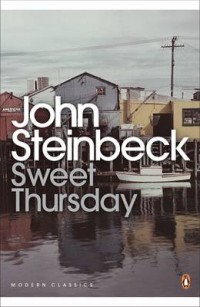
Sweet Thursday by John Steinbeck

Sweet thursdayI read John Steinbeck’s Cannery Row five years ago. At the time I didn’t know he’d written a sequel – Sweet Thursday. So when I discovered it, as I’d loved Cannery Row I wanted to read it. Published in 1954, I think it’s just as good, set in Monterey on the California coast in the 1950s after the Second World War when the cannery had closed down.

Sweet Thursday’ is what they call the day after Lousy Wednesday – one of those days that’s just bad from the start. But ‘Sweet Thursday’ is sunny and clear, a day when anything can happen.

I was delighted to find that there is just as much humour and generosity within its pages. Some of the same characters are still there, Mack, Hazel and friends who live in the Palace Flop-house (a dosshouse) and Doc too. There are some new characters, notably Suzy at the house called the Bear Flag, the local brothel. Dora who ran the Bear Flag had died and it has been taken over by her sister Fauna (previously known as Flora). Lee Chong had sold the grocery and it is now owned by a Mexican called Joseph and Mary Rivas.

I loved the opening of the Prologue:

One night Mack lay back on his bed in the Palace flop-house and he said, “I ain’t never been satisfied with that book Cannery Row, I would have went about it different.”

And after a while he rolled over and raised his head on his hand and he said, “I guess I’m just a critic. But if I ever come across the guy that wrote that book I could tell him a few things.”

Doc returned from the war to his laboratory, Western Biological Laboratories, now run down, covered in dust and mildew. He’d left Old Jingleballicks, in charge and he’d neglected it. But his heart is now longer in his work and the ‘worm of discontent‘ is gnawing at him – he feels a failure.

Whisky lost its sharp delight and the first long pull of beer from a frosty glass was not the joy it had been. He stopped listening in the middle of an extended story. He was not genuinely glad to see a friend …

What am I thinking? What do I want? Where do I want to go? There would be wonder in him, and a little impatience, as though he stood outside and looked in on himself through a glass shell …

Doc thought he was alone in his discontent, but he was not. Everyone on the Row observed him and worried about him. Mack and the boys worried about him. And Mack said to Fauna, “Doc acts like a guy that needs a dame.”

So they decide that Suzy is the answer. But Suzy, an independent spirit who isn’t much good as a hustler, doesn’t think she’s good enough for Doc. The schemes for getting the two of them together seem doomed from the start, ending in a disastrous party, when all Mack and Fauna’s good intentions seem to backfire. But this is not a tragedy, although at times it has touches of melancholy. Hazel, one of my favourite characters in the book, takes matters into his own hands. Although he appears to be slow and stupid, his problem is not that he lacks intelligence, but is that of inattention, as he just watches life go by. After the party he put his mind to thinking about what had gone wrong. And then he goes on a Quest …

Mack, in the Prologue, sums up for me what I like in a book. After saying that he likes to have a couple of words at the top of each chapter that tells what the chapter is about he says:

‘Well, I like a lot of talk in a book, and I don’t like nobody to tell me what the guy that’s talking looks like. I want to figure out what he looks like from the way he talks. and another thing – I kind of like to figure out what the guy’s thinking by what he says. I like some description too,’ he went on. ‘I like to know what colour a thing is, how it smells and how it looks, and maybe how a guy feels about it – but not too much of that.’

This is what you get in Sweet Thursday, great dialogue, great sense of location, eccentric and funny characters, wit, humour, irony and a touch of farce and surrealism, along with plenty of philosophy. I loved it.

This was my Classics Club Spin book for May, but I was late finishing it! It’s also one of my TBRs and a book that qualifies for the What’s In a Name challenge.
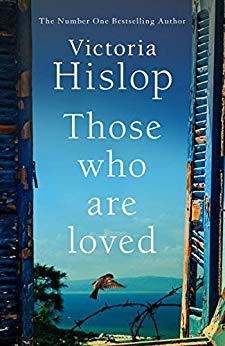
Those Who Are Loved by Victoria Hislop

Those who are loved

Headline Review|30 May 2019|496 pages|Review e-book copy|4.5*

Those Who Are Loved by Victoria Hislop is one of the most moving novels I’ve read for a long time. But it begins slowly and it was only at about the halfway stage that it really took off for me. And now I’ve come to write about it I’m finding it difficult to put into words just how exceptional I think it is. Whatever I write will not do it justice – it really is ‘an epic tale of an ordinary woman compelled to live an extraordinary life‘.

It is historical fiction ‘set against the backdrop of the German occupation of Greece, the subsequent civil war and a military dictatorship, all of which left deep scars.’

The main character is Themis Koralis/Stravidis (in Greek mythology Themis is the personification of fairness and natural law). In 2016 she is a great grandmother and realising that her grandchildren knew very little about Greek history she decided to tell them her life story, beginning from when she was a small child in the 1930s, through the German occupation of Greece during the Second World War, the civil war that followed, then the oppressive rule of the military junta and the abolition of the Greek monarchy, up to the present day.

As she grew up she and her brothers and sister had many disagreements, holding differing political opinions, which came to a head when the Germans invaded Athens in 1941.  Themis and her brother Panos joined the communist party in their fight against the Germans, whilst her other brother Thanasis and her sister Margarita opposed them, hating the communists’ views and believing that Germany was a friend of Greece, not a foe.

During the civil war Themis was imprisoned on the islands of exile, Makronisos and then Trikeri. Her experiences were horrific, but only strengthened her determination to survive. On Makronisos she met Aliki, also a member of the communist party, and when Aliki is condemned to death, Themis promises to find and raise Aliki’s son, Nikos as her own.

During the early part of the book I felt it was rather like reading a history book. But then, the book sprang to life, the pace increased, and I was totally gripped and moved as history and fiction came together dramatically in glorious technicolor, telling the story of the characters personal lives and their parts in the action.

I have only skimmed the surface of this book – there is so much more to the story than I can mention here. But after the slow start I loved it, even though it is not a book I can say I ‘enjoyed’. It is a powerful and shocking story of remarkable characters faced with brutal and traumatic events. It has a completely convincing and vivid sense of location. I knew next to nothing about this period in Greek history before and I was astounded by what I learnt. 

On a personal note, the earthquake in Athens on 7 September 1999 plays a part in the story. We were there then on holiday. We had been out at sea on that day and travelled back to our hotel through Athens, seeing some of the destruction and terror it caused. The earthquake had been felt at our hotel in Marathon – people had been thrown out of the swimming pool and later that evening we could still feel the aftershocks.

Many thanks to the publishers, Headline Review, for my review copy via NetGalley.

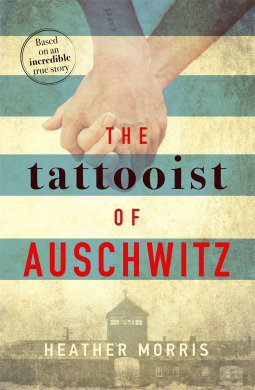
The Tattooist of Auschwitz by Heather Morris

‘a story of two ordinary people, living in an extraordinary time, deprived not only of their freedom but their dignity, their names and their identities.’

The Tattooist of Auschwitz

Zaffre|4 Oct. 2018|320 pages|Paperback|3*

Yesterday when I finished reading The Tattooist of Auschwitz, I didn’t want to write about it, but I kept thinking about it and in the end I decided I needed to record a few of my thoughts about it. It is not a book I can say that I ‘enjoyed’, because I didn’t – the subject matter is too painful, how can you enjoy a book that describes the horrors of one person’s experience of his time in the concentration camp of Auschwitz-Birkenau*!

It is ‘based on the true story of Lale Sokolov’.  He was born Ludwig Eisenberg on 28 October 1916 in Krompachy, Slovakia and transported to Auschwitz on 23 April 1942. He was given the job of tattooing the prisoners marked for survival. He met and fell in love with Gita, a fellow prisoner and he was determined that they would be survivors. The story Heather Morris tells is simply devastating and I could hardly bear to read the horrors of life in the concentration camps; it is appalling as it reveals the brutality, hatred and evil side of human nature. But is also about love, determination, compassion, and the strength of human nature. 

It is simply told in a straight forward, childlike style and in the present tense. It is certainly a most unsettling and depressing book, despite the fact that I knew that Lale and Gita would survive their horrific experience.

Heather Morris wrote the book after meeting Lale and hearing his story. In her Author’s Note she tells how she spent three years listening to him as

he told his story piecemeal, sometimes slowly, sometimes at bullet-pace and without clear connections between the many, many episodes. … Lale’s memories were on the whole, remarkably clear and precise.

The epilogue describes what happened to Lale and Gita after the end of the war. They married, moved to Bratislava, and, after travelling to Paris, eventually moved to Melbourne. There are photos at the end of the book of Lale and Gita in Australia with Gary their son and an Afterword by Gary about their family life and how their years in the camp affected them both.

But the line between fiction and fact can be blurred in a novel and there are claims that ‘the book contains numerous errors and information inconsistent with the facts, as well as exaggerations, misinterpretations and understatements‘. I have read the article pointing out the errors etc. It concludes that the book should be seen as an ‘impression devoid of documentary value on the topic of Auschwitz, only inspired by authentic events … Given the number of factual errors, therefore, this book cannot be recommended as a valuable title for persons who want to explore and understand the history of KL Auschwitz.’

It seems to me that it is a novel that clearly conveys what Lale experienced during the three years he spent in Auschwitz, as he remembered it many years later. Despite the errors that have been pointed out, I think it is a story of man’s inhumanity to man and a tribute to the strength of the human spirit for survival.

KL Auschwitz-Birkenau 

The first and oldest was the so-called “main camp,” later also known as “Auschwitz I” (the number of prisoners fluctuated around 15,000, sometimes rising above 20,000), which was established on the grounds and in the buildings of prewar Polish barracks;

The second part was the Birkenau camp (which held over 90,000 prisoners in 1944), also known as “Auschwitz II” This was the largest part of the Auschwitz complex. The Nazis began building it in 1941 on the site of the village of Brzezinka, three kilometers from Oswiecim. The Polish civilian population was evicted and their houses confiscated and demolished. The greater part of the apparatus of mass extermination was built in Birkenau and the majority of the victims were murdered here;’ (extract from the history page of the Auschwitz-Birkenau Memorial and Museum)

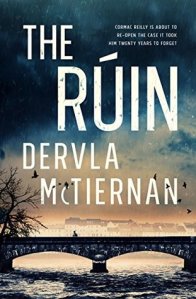
The Ruin by Dervla McTiernan

In Irish, Rúin means something hidden, a mystery, or a secret, but the word also has a long history as a term of endearment

Ruin

I liked The Rúin by Dervla McTiernan, the first in the detective Cormac Reilly series set in Ireland. It has a powerful opening in 1993 in Galway when Garda Cormac Reilly, new to the job, finds 15-year-old Maude and her little brother, Jack, who’s only five, alone in an old, decaying Georgian house, whilst their mother Hilaria Blake lies dead of an overdose.

Move forward twenty years and Cormac is now a DI. He has left an elite squad responsible for counter-terrorism and armed responses to serious incidents in Dublin and moved back to Galway, where Emma, his partner, has just started a new job. Although Galway is his home town he feels an outsider in the police department, largely shunned by the other officers, apart from Danny who had trained with him.  Despite his experience of running complex and high-profile cases he is assigned mainly to cold cases, which he thinks is an inappropriate use of his time. And he suspects the squad of corruption.

When Jack’s body is found in the River Corrib the police tell his girlfriend, Aisling Conroy, that he committed suicide. But when his sister, Maude arrives on the scene, having spent the last twenty years in Australia, she persuades Aisling to work with her to prove Jack’s death was murder. However, the police refuse to believe her and instead arrest her for the murder of her mother twenty years earlier. Meanwhile Cormac  realising there is a link between the deaths of Hilaria and Jack works to uncover the truth about both cases, despite the obstacles his fellow officers put in his way.

I found it rather confusing at first working out who was who and their relationships. There are quite a lot of minor characters who muddied the waters for me and I think the plot is over-complicated, needing the final chapters to explain the details. But I thought the main characters were convincing, in particular Cormac, and I was impressed by the description of Aisling grappling with her grief. There is also a strong sense of place. I was keen to find out the truth and once I had the characters clear in my head I just didn’t want to put it down until I finished it – it’s a real page-turner. I enjoyed it so much that I immediately reserved the next one in the series, The Scholar, at the library. I collected it on Thursday and will be reading it very soon.

  • Format: Kindle Edition
  • File Size: 1053 KB
  • Print Length: 402 pages
  • Publisher: Sphere (8 Mar. 2018)
  • Source: I bought it
  • My rating: 4*

My Friday Post: Anything You Do Say by Gillian McAllister

Book Beginnings Button

Every Friday Book Beginnings on Friday is hosted by Gillion at Rose City Reader where you can share the first sentence (or so) of the book you are reading, along with your initial thoughts about the sentence, impressions of the book, or anything else the opener inspires.

The book I’m featuring this week is Anything You Do Say by Gillian McAllister, a book I  started reading yesterday and one of the books on my 20 Books of Summer list.

Anything you do say


It starts with a selfie. He is a random; we are not even sure of his name. We are always meeting them whenever we go out. Laura says it’s because I look friendly. I think it’s because I am always daydreaming, making up lives for people as I stare at them, and they think I’m inviting them over to chat.

I’m thinking that Joanna (we learn the narrator’s name 2 pages later) should stop staring at people like she does – it’s obviously asking for trouble.

Also every Friday there is The Friday 56, hosted by Freda at Freda’s Voice.

30879-friday2b56These are the rules:

  1. Grab a book, any book.
  2. Turn to page 56, or 56% on your eReader. If you have to improvise, that is okay.
  3. Find any sentence (or a few, just don’t spoil it) that grabs you.
  4. Post it.
  5. Add the URL to your post in the link on Freda’s most recent Friday 56 post.

Page 54 and page 56:

I haven’t told him. I haven’t told him. I haven’t told him. I haven’t told him.

How could I tell him? He would stop looking at me that way. That tiny, knowing smile of his. I’m one of the only people he likes. And so how can I tell him, before anyone else?

Well, I said she should stop staring at people – something bad has happened.

What do you think? Would you keep reading?

Reading in May

I’ve been reading eight books in May, and have finished reading six of them, but only reviewed four of them:

  1. The Butterfly Room by Lucinda Riley 4* –  a family saga spanning generations  revealing the dark secret hidden behind the locked door of the Butterfly Room
  2. Mrs Whistler by Matthew Plampin 5* – not about his mother, but about him and his model and mistress, Maud Franklin
  3. Codename Villanelle by Luke Jennings 3* – the basis for the TV series Killing Eve 
  4. The Doll Factory by Elizabeth Macneal 5* –  the story of Iris who dreamed of being an artist and her involvement with the Pre-Raphaelites

The other two books I finished are:

Before the Fall by Noah Hawley, which I didn’t enjoy and I’m just writing a few notes here about it. It won the 2017 Edgar Award for Best Novel and was selected by The Sunday Times as one of the top page-turners of summer 2017, so I’m in the minority because I thought it was boring and tedious. The plot is simple – a plane crashes into the sea after taking off from Martha’s Vineyard, just two people survive and the mystery is why did the plane crash and who was responsible. The main part of the book is made up of the long backstories of the people on the plane. It’s not gripping or thrilling and definitely not a page-turner. 1*

However I thoroughly enjoyed The Ruin Dervla McTiernan’s debut novel and I’ll be writing more about it in the next few days. Now this is a page-turner, about a current murder linked to a cold case. It’s complex and compelling reading as DI Cormac Reilly unravels a web of secrets. 4*

I’m still reading two books:

D H Lawrence: the Life of an Outsider by John Worthen, from his childhood in Nottinghamshire to his death at the age of 44. I’m reading this slowly and it will be some time before I finish it. An ‘outsider’, he always felt he didn’t fit in or belong either with his family or his work colleagues or the literary elite of the times.

The other book I’ve been reading is Sweet Thursday by John Steinbeck, my Classics Club Spin book that I was hoping to finish by the end of May. I’ve only read half of it so far. It’s a follow up to Cannery Row, with some of the same characters and I’m enjoying its humour and view of life in Monterey in the 1950s.

And now it’s June! I’ll be concentrating on reading the books I’ve listed for the 20 Books of Summer challenge – and hoping I won’t be distracted by too many other books!