The Seagull by Ann Cleeves

Seagull

Macmillan| September 2017|print length 416 pages|e-book| 5*

The Seagull is Ann Cleeves’ eighth novel in her Vera Stanhope series, set in Northumberland. It begins as Vera visits the prison where ex-Superintendent John Brace is serving time for corruption and his involvement in the death of a gamekeeper. He had been one of the so-called ‘Gang of Four’ – Brace, Robbie Marshall, a man known simply as ‘The Prof’, and Vera’s father, Hector Stanhope. Brace tells Vera that Robbie, who had disappeared years ago, is dead and that he will tell her where his body is buried if she will visit his daughter Pattie, who has mental health problems.  She does so, but when the police investigate the location Brace gave her they find not one skeleton, but two. 

Opening up this cold case brings back memories for Vera of her past when she was living at home in a remote cottage in the Northumberland countryside, with Hector, after her mother had died.  The Gang of Four had met at Hector’s cottage when Vera was a teenager. They had traded in rare birds’ eggs and sold raptors from the wild for considerable sums. They were regulars at the (fictional) classy Seagull night club, a sleek Art Deco building built in the thirties in Whitley Bay,  during the town’s glory days. Brace and Marshall had also run a recruitment service providing muscle for hire. And Vera wonders just how much Hector had been involved in the Gang of Four’s illegal activities. 

And just as Vera and her team, Joe, Charlie and Holly – Vera’s own ‘gang of four’ – investigate Robbie’s murder they are faced with a present day murder that looks very much as though it links in with their cold case.

I enjoy watching Vera on TV, but I enjoy the books even more. Brenda Blethyn is very good in the role of Vera, but the Vera in the books is not the same as the TV Verashe is more down to earth, a large woman who wears tent-shaped dresses, has bare legs, wears size seven sandals with rubber soles and Velcro straps and she is none too fussy if her feet are dirty. She is a big woman with a big personality and she knows she is a brilliant detective:

‘Oh, I’m interested in everything, Joe. That’s why I’m a bloody brilliant detective’. She gave him her widest smile, ‘That’s why I’m in charge and you’re sitting there, doing as you’re told.’ (page 45)

She still lives in the cottage in the hills (not on Lindisfarne as in the TV series), which she had inherited from Hector along with a freezer full of animal corpses (Hector had done a bit of taxidermy), but most of the action takes place in Whitley Bay and at St Mary’s Island, a small rocky tidal island, linked to the mainland by a short, narrow causeway which is submerged at high tide.

I thoroughly enjoyed The Seagull and loved the way it reveals Vera’s past and her relationship with her father. At the same time the plot kept me guessing almost to the end and the location, well known to Ann Cleeves as it used to be her home town, is superbly described.

I see on Ann Cleeves’ website that ITV have confirmed that there will be a tenth series of VERA, based on Ann’s characters and settings and starring multi-award-winning Brenda Blethyn. The cast have been filming in the North East through the summer. Four new episodes will be broadcast in 2020.

And she has recently published a new  book, The Long Call, the first in a new series, Two Rivers. It is set in North Devon, where Ann grew up, and introduces the reserved and complex Detective Inspector Matthew Venn, estranged from the strict evangelical community in which he grew up, and from his own family, but drawn back by murder into the community he thought he had left behind.

The Long Call was published in Australia on 27th August, in the US on Tuesday 3rd September and in the UK on Thursday 5th September 2019.

Reading challenges: Mount TBR, Calendar of Crime
Six Degrees of Separation: from A Gentleman in Moscow to …

I love doing Six Degrees of Separation, a monthly link-up hosted by Kate at Books Are My Favourite and Best. Each month a book is chosen as a starting point and linked to six other books to form a chain. A book doesn’t need to be connected to all the other books on the list, only to the one next to it in the chain.

A Gentleman in Moscow

This month the chain begins with A Gentleman in Moscow by Amor Towles – a book I haven’t read, or even heard of before. It looks interesting from the description on Amazon:

On 21 June 1922, Count Alexander Rostov – recipient of the Order of Saint Andrew, member of the Jockey Club, Master of the Hunt – is escorted out of the Kremlin, across Red Square and through the elegant revolving doors of the Hotel Metropol.

Deemed an unrepentant aristocrat by a Bolshevik tribunal, the Count has been sentenced to house arrest indefinitely. But instead of his usual suite, he must now live in an attic room while Russia undergoes decades of tumultuous upheaval.

Can a life without luxury be the richest of all?

My first link is to another book set in Moscow Mrs Harris goes to Moscow by Paul Gallico This is a lovely little book. Mrs Harris is a London char lady who wins a trip to Moscow, where she wants to find her employer’s long-lost love. Mayhem ensues when she is thought to be Lady Char (the Russians not understanding what a ‘char lady’ is had converted it to ‘Lady Char’) and also a spy.

My second link is to a book about another visitor to Moscow: Archangel by Robert Harris. Set in present day Russia, it tells the story of Fluke Kelso, a former Oxford historian who is in Moscow for a conference on the newly opened Soviet archives. He learns of the existence of a secret notebook belonging to Josef Stalin and his search takes him to the vast forests near the White Sea port of Archangel.

Moving away from Moscow, but still in Russia my third link is Midnight in St Petersburg by Vanora Bennett. It begins in 1911 in pre-revolutionary Russia with Inna Feldman travelling by train to St Petersburg to escape the pogroms in Kiev. I liked the way Inna’s personal story is intermingled with the historical characters of the time, including Father Grigory (Rasputin), Prince Youssoupoff and Lenin.

The next book that came into my mind is another book set in St Petersburg and featuring Rasputin – Sashenka by Simon Sebag Montefiore. It begins in 1916 in St Petersburg. Sashenka’s mother parties with Rasputin whilst Sashenka is involved with conspiracy. It then moves forward to 1939 in Moscow under Stalin and ends in the 1990s when a young historian researches her life and discovers her fate. I haven’t read this book yet, even though I’ve had it for a long time.

My fifth link is a book I did read a long time ago, also set in Russia during the Russian Revolution – Doctor Zhivago by Boris Pasternak. At this distance in time my memories of it are a bit vague, but I remember more about the film of the book starring Julie Christie and Omar Sharif amongst others. I’d love to read it again sometime …

And so to the last link. It really should be to another book set in Russia to complete the chain with just one common theme. I wondered about a few – Anna Karenina, The Brothers Karamazov, or War and Peace, but eventually settled on a non fiction book, A People’s Tragedy: the Russian Revolution by Orlando Figes,  Unlike the other books in my chain I haven’t read this book, and it is not one of my TBRs – but it is now. It’s been described as the most vivid, moving and comprehensive history of the Russian Revolution available today. It’s long – 960 pages – and has won several awards.


My chain has one link throughout – Russia – passing from Moscow to St Petersburg and covering the modern day and the Russian Revolutionary period. Apart from the last book they are all fiction, beginning with the rather twee novel about Mrs Harris in Moscow. And for once I haven’t included any crime fiction!

Next month (October 5, 2019), we’ll begin with Three Women by Lisa Taddeo.

My Friday Post: Ruling Passion by Reginald Hill

Book Beginnings Button

Every Friday Book Beginnings on Friday is hosted by Gillion at Rose City Reader where you can share the first sentence (or so) of the book you are reading, along with your initial thoughts about the sentence, impressions of the book, or anything else the opener inspires.

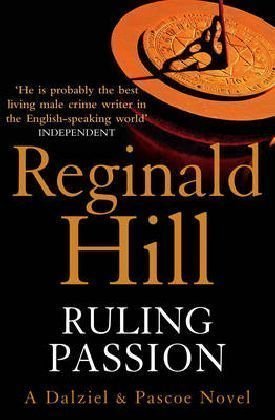
Ruling Passion by Reginald Hill is one of the books I’m reading at the moment.  It’s one of my TBRs, the third Dalziel and Pascoe book in which Pascoe finds his social life and work uncomfortably brought together by a terrible triple murder. Meanwhile, Dalziel is pressuring him about a string of unsolved burglaries, and as events unfold the two cases keep getting jumbled in his mind.

Ruling passion

Brookside Cottage,Thornton Lacey. September 4th.

Well hello, Peter Pascoe!

A voice from the grave! Or should I say the underworld? Out of which Ellie (who gave me the glad news of your existence when we met in town last month) hopes to lead you, for a while at least, back into the land of the living.

As soon as I finished reading the 2nd book in the series, An Advancement of Learning, I just had to start the third. I’ve read some of the later books but not the early ones, so I’m keen to know more about Dalziel and Pascoe. In An Advancement of Learning Pascoe and Ellie (his wife in the later books) had just renewed the relationship they’d had at university and so I’m pleased to see in the opening chapters of this book that they are together. In this first chapter a friend from their university days has invited them to stay for a weekend in the country.

Also every Friday there is The Friday 56, hosted by Freda at Freda’s Voice.

30879-friday2b56These are the rules:

  1. Grab a book, any book.
  2. Turn to page 56, or 56% on your eReader. If you have to improvise, that is okay.
  3. Find any sentence (or a few, just don’t spoil it) that grabs you.
  4. Post it.
  5. Add the URL to your post in the link on Freda’s most recent Friday 56 post.

Page 56:

‘We got on very well from the start. I’d only known her and Colin a couple of months, but we soon got on friendly terms. That’s why it came as such a shock … I still can’t believe it.’

The weekend in the country has turned into a nightmare!

Have read this book? What did you think about it? And if you haven’t, would you keep on reading?

An Advancement of Learning by Reginald Hill: Mini Review

An Advancement of learning

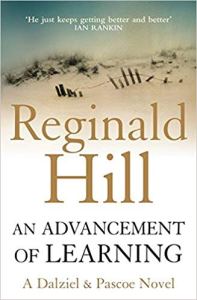
An Advancement of Learning is Reginald Hill’s second Dalziel and Pascoe novel, first published in 1971. It’s much better than the first one, A Clubbable Woman and I thoroughly enjoyed it. It’s set in a college, Holm Coultram College, where Dalziel and Pascoe investigate the discovery of a body found as an eight foot high bronze statue of Miss Girling, a former head of the College in the grounds is being moved. As the base of the statue is lifted earth falls away together with a shin bone followed by part of a rib cage and then a skull, still with a mop of dark red hair attached. Miss Girling had red hair – but she had died in an avalanche in Austria – so whose body was buried under the statue?

The plot is by no means straight forward and for most of the book continued to puzzle me, even though I thought the ending was rather weak. But the strength of this book is in the writing and the characterisation. It is a character-driven murder mystery, with a cast of characters including Girling, Halfdane, Fallowfield, Cockshut, and Disney, known as ‘Walt’, of course and I had no difficulty in keeping who was who clearly in my mind. It’s interesting to see the early relationship between Dalziel, shown as a rude, boorish character, and Pascoe, the university educated young DS. Dalziel is very much out of his comfort zone with the academic staff and looks to Pascoe to understand how the college operates, whilst mocking him. Pascoe renews his relationship with Ellie Soper, an ex-girlfriend from his university days – a feisty young woman, but a minor character in this book. 

Written in 1971 it is very much a book of its time. I read it quickly, as the two detectives uncover plenty of disagreements and power struggles in both the staff and student bodies – from rivalries to revelries on the beach, and more dead bodies turn up before the mystery is solved.

And reading it has made me keen to get on the next book in the series, Ruling Passion, which I’ve started almost straight away! I’ve been reading this series totally out of order, beginning with some of the later books – much more detailed and complex than the first books.

  • Paperback: 352 pages
  • Publisher: HarperCollins (25 Jun. 2009)
  • Language: English
  • ISBN-10: 9780007313037
  • ISBN-13: 978-0007313037
  • Source: I bought it
  • My Rating: 4.5*

Reading challenges: Mount TBR, Calendar of Crime, 20 Books of Summer

My Friday Post: The Seven Sisters by Lucinda Riley

Book Beginnings Button

Every Friday Book Beginnings on Friday is hosted by Gillion at Rose City Reader where you can share the first sentence (or so) of the book you are reading, along with your initial thoughts about the sentence, impressions of the book, or anything else the opener inspires.

The Seven Sisters by Lucinda Riley is one of the books on my 20 Books of Summer list and it’s also one of my TBRs. I recently finished reading it. It’s the first book in her Seven Sisters series of books based on the legends of the Seven Sisters of the Pleiades. 

seven sisters ebook

I will always remember exactly where I was and what I was doing when I heard that my father had died.

Also every Friday there is The Friday 56, hosted by Freda at Freda’s Voice.

30879-friday2b56These are the rules:

  1. Grab a book, any book.
  2. Turn to page 56, or 56% on your eReader. If you have to improvise, that is okay.
  3. Find any sentence (or a few, just don’t spoil it) that grabs you.
  4. Post it.
  5. Add the URL to your post in the link on Freda’s most recent Friday 56 post.

Page 56:

‘Presumably, you had a tough night last night, Maia, dealing with Electra’s usual histrionics? said Ce-Ce.

‘As a matter of fact, for Electra, she was relatively calm,’ I answered, knowing there was little love lost between my fourth and fifth sisters. Each was the antithesis of the other: Ce-Ce so practical and loath to show any emotion, and Electra so volatile.

Blurb:

Maia D’Aplièse and her five sisters gather together at their childhood home, ‘Atlantis’ – a fabulous, secluded castle situated on the shores of Lake Geneva – having been told that their beloved father, the elusive billionaire they call Pa Salt, has died. Maia and her sisters were all adopted by him as babies and, discovering he has already been buried at sea, each of them is handed a tantalising clue to their true heritage – a clue which takes Maia across the world to a crumbling mansion in Rio de Janeiro in Brazil. Once there, she begins to put together the pieces of where her story began . . .

Eighty years earlier, in the Belle Epoque of Rio, 1927, Izabela Bonifacio’s father has aspirations for his daughter to marry into aristocracy. Meanwhile, architect Heitor da Silva Costa is working on a statue, to be called Christ the Redeemer, and will soon travel to Paris to find the right sculptor to complete his vision. Izabela – passionate and longing to see the world – convinces her father to allow her to accompany him and his family to Europe before she is married. There, at Paul Landowski’s studio and in the heady, vibrant cafés of Montparnasse, she meets ambitious young sculptor Laurent Brouilly, and knows at once that her life will never be the same again.

My thoughts:

I knew very little about this series when I began reading the book, but I was soon caught up in this family saga. It’s not crime fiction but there is plenty of mystery – first of all why are there only six sisters, not seven? Who was Pa Salt and why did he adopt these  girls from the four corners of the globe when they were babies? He has died before the book begins and immediately buried and, as I read a lot of crime fiction, my first thought was –  why was he adamant that as soon as he died his body was to be buried at sea, with none of the girls present? And I wondered if he had really died? Please don’t tell me the answers to my questions – I intend to read all the Seven Sisters books, when I hope all will become clear.

Pa Salt has left clues for each girl so that if they want they can discover who their parents were and the circumstances of their birth. Having introduced all the sisters Maia’s story unfolds and it is an amazing story, taking her back to Brazil, the country of her birth. It’s beautifully written and completely convincing and I raced through it eager to find out the details of Maia’s family history.

I loved all the details about the building of the statue of Christ the Redeemer on Corcovado Mountain in the Carioca Range, overlooking the city of Rio de Janeiro and how Lucinda Riley incorporated it so seamlessly into Maia’s story.

Have read this book? What did you think about it? And if you haven’t, would you keep on reading?

For more about the series see Lucinda Riley’s website, where she explains why she based the books on the legends of The Seven Sisters of the Pleiades and about the details of her extensive research for each story.

I’ll be reading the next book – The Storm Sister as soon as possible. The six books in the series are:

1. The Seven Sisters (2014)
2. The Storm Sister (2015) – Ally (Alcyone)
3. The Shadow Sister (2016) – Star (Asterope)
4. The Pearl Sister (2017) – CeCe (Celaeno)
5. The Moon Sister (2018) – Tiggy (Taygete)
6. The Sun Sister (2019) – Electra

The seventh sister is Merope – in the cast of characters at the beginning of the first book she is described as ‘missing’ …

The Seven Sisters:

  • Format: Kindle Edition
  • File Size: 2822 KB
  • Print Length: 641 pages
  • Publisher: Pan; Main Market edition (6 Nov. 2014)
  • Source: I bought the book
  • My Rating: 5*

Latest Additions at BooksPlease

BB bks Aug 2019

Yesterday I brought this little pile of books home from Barter Books in Alnwick, my favourite bookshop.

From top to bottom they are:

Waverley by Sir Walter Scott, his first novel, first published anonymously in 1814. It is set in the Jacobite Rebellion of 1745 and tells the story of Edward Waverley, an idealistic daydreamer whose loyalty to his regiment is threatened when they are sent to the Scottish Highlands. I’m inspired to read this by a recent visit to Abbotsford, Scott’s home in the Scottish Borders.

The Locked Room by Maj Sjowall and Per Wahloo, the eighth in the Martin Beck series – once more I’ve plunged into a series without reading the earlier books. But it appears that shouldn’t matter as each book is focused on one particular case. I’m not sure what to expect as the blurb on the back says it transforms the police force into the police farce.

The Daughters of Cain by Colin Dexter, the eleventh Inspector Morse mystery. Morse must solve two related murders — a problem complicated by a plethora of suspects and by his attraction to one of the possible killers. I’ve read several of the Morse books, so far, so I was pleased to find another one I haven’t read.

Strangers on a Train by Patricia Highsmith, a book I’ve wanted to read for a long time. Hitchcock’s 1951 film is based on this book. Guy Haines and Charles Anthony Bruno meet on a train. Bruno manipulates Guy into swapping murders with him. “Some people are better off dead,” Bruno remarks, “like your wife and my father, for instance.” 

Sleeping Beauties by Jo Spain, the third Inspector Tom Reynolds novel set in Dublin and the surrounding areas. I’ve read the fourth book and have copies of the first two to read, so I was pleased to find this book on the shelves. Five bodies are found in woodland and a young woman is missing. A search is under way – can she be found before she too is killed?

The Headhunters by Peter Lovesey, second book DCI Hen Mallin Investigation (I haven’t read the first!)  Mallin and her team investigate the discovery of a dead body, found on the beach at Selsey. Gemma had joked about murdering her boss – and now her boss is missing.

The Vault by Peter Lovesey. I’ve read one of his Peter Diamond books before and enjoyed it. This book is the sixth book in the Peter Diamond series. A skeletal hand is unearthed in the vault under the Pump Room in Bath, England, near the site where Mary Shelley wrote Frankenstein. Then a skull is excavated. The bones came from different corpses, and one is modern.

Hotel on the Corner of Bitter and Sweet by Jamie Ford. I’d borrowed a copy of this from the library but hadn’t finished it when I had to return it. In 1986, The Panama Hotel in Seattle has been boarded up for decades, but now the new owner has made a startling discovery in the basement: personal belongings stored away by Japanese families sent to internment camps during the Second World War. The novel goes back and forth between 1986 and World War Two

The Music Shop by Rachel Joyce, a book I’ve often wondered about reading. As the title reveals it is about Frank’s music shop, full of records, vinyl, that is. It’s set in 1988 and is a story about love and about how important music is in our lives. When Ilse asks Frank to teach her about music she is not what she seems and for Frank it opens up old wounds from his past.