I read three crime fiction books in April:
- The Nine Tailors by Dorothy L Sayers
- The Cabinetmaker by Alan Jones
- Burial of Ghosts by Ann Cleeves
I’ve already reviewed The Cabinetmaker -based in Glasgow telling the story of a local cabinetmaker, Francis Hare, father of a murdered son, and John McDaid, a young detective on the investigation. It is an intricately plotted book which had me totally gripped.
 Burial of Ghosts by Ann Cleeves is a standalone book, not part of either her Vera or Shetland series. Lizzie Bartholomew, a social worker is on leave after a particular nasty episode which has left her traumatised. After a brief holiday affair with Philip Sansom in Morocco, she is surprised when he left her £15,000 in his will. But there are certain conditions she is required to fulfil, which plunges her into a terrifying situation. This is largely a psychological study, focussing on Lizzie, as she relives her past in flashbacks.
All three books are good reads, but my Crime Fiction Pick of the Month for April is The Nine Tailors by Dorothy L Sayers, one of the Golden Age crime fiction writers. It’s a Lord Peter Wimsey Mystery, first published in 1934, by far the most complicated book of the three crime fiction books I read in April and the most fascinating for a number of reasons. It had me completely baffled, first the bell-ringing, and then the twists and turns and all the red herrings.
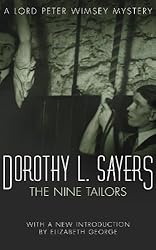 Wimsey driving through a snow storm ends up in a ditch near the village of Fenchurch St Paul in the Fens and is taken in for the night by the vicar. It’s New Year’s Eve (at some period in the early 1930s) and the vicar has arranged that the bell-ringers will ring in the New Year, involving 9 hours of bell-ringing. As one of the ringers is ill with influenza, Wimsey steps in at the last minute to take his place. I had never realised just how complicated bell-ringing is:
The art of ringing is peculiar to the English, and, like most English peculiarities, unintelligible to the rest of the world. To the musical Belgian, for example, it appears the proper thing to do with a carefully tuned ring of bells is to play a tune upon it. By the English campanologist, the playing of tunes is considered to be a childish game, only fit for foreigners; the proper use of bells is to work out mathematical permutations and combinations. (page 21)
A few weeks later Wimsey is asked back to Fenchurch St Paul to help solve the mystery of the dead man found by the sexton whilst he was opening up Lady Thorpe’s grave to bury her husband. The identity of the dead man is unknown, his face was mutilated and his hands had been cut off – who was he, who killed him and why? And what is the significance of the enigmatic note found in the bell-tower? It’s not an easy crime to solve and involves Wimsey in a trip to France as he tries to identify the victim. An added complication is the mystery of the missing necklace, stolen from the Thorpe family but never recovered.
I think one of the things that makes this such a good read is that it’s not just crime fiction, not just solving a puzzle, but it is also a fascinating portrait of the Fens, of their bleakness and isolation; of society in the 1930s with its rigid class divisions into gentry, clergy and villagers. The last part of the book is dominated by the floods as the sluice gates failed to keep back the water flooding all the low-lying ground, despite the new drainage works. It reminded me of the floods in the Somerset Levels this last winter, with various water authorities disputing responsibility for the disaster.
Above all, it is novel in which everything works well together, the characters are individuals, their behaviour is true to their beliefs and passions, and their conversations are realistic. It begins with a leisurely pace, with lots of detail about bell-ringing, which sometimes seemed a bit unnecessary to me, but as the plot unfolded I realised that I was wrong and I needed to pay more attention to the detail. It is essential to the plot. After this leisurely start the pace picks up as Wimsey and the police try to untangle the mystery.
It’s a book that you have to read with care, paying close attention as it is easy to get swept along with Dorothy Sayers’ beautifully descriptive prose and skilful story-telling. This is the sight that greets Wimsey from the top of the bell-tower:
An enormous stillness surrounded him. The moon had risen, and between the battlements the sullen face of the drowned fen showed like a picture in a shifting frame, like the sea seen through the porthole of a rolling ship, so widely did the tower swing to the relentless battery of the bells.
The whole world was now lost in one vast sheet of water. He hauled himself to his feet and gazed out from horizon to horizon. To the south-west St Stephen’s tower still brooded over a dark platform of land, like a broken mast upon a sinking ship. Every house in the village was lit up: St Stephen was riding out the storm. Westward, the thin line of the railway embankment stretched away to Little Dykesey, unvanquished as yet, but perilously besieged. Due south, Fenchurch St Peter, roofs and spire etched black against the silver, was the centre of a great mere. Close beneath the tower, the village of St Paul lay abandoned, waiting for its fate. Away to the east, a faint pencilling marked the course of the Potters Lode Bank, and while he watched it, it seemed to waver and vanish beneath the marching tide. (page 294)
The Nine Tailors is the first detective book by Dorothy L Sayers that I have read (previously I’d read The Descent into Hell, extracts from her translation of Dante’s Inferno). It’s her ninth Wimsey novel and I intend to read more.
 Ding Dong Bell, the Kitten in the Well goes back in time to Rhapsody Gershwin’s childhood in the early 1990s. Rhapsody is the vicar’s daughter first featured in The Cosy Knave. In this short story Rhapsody and her sisters are worried about the disappearance of the black kitten they have called Black Pete. The last time they had seen him was when they had played in old Ursula Abbot’s garden and they wondered if he had he got locked in her cottage. Ursula had died but as she was nearly ninety it wasn’t entirely an unexpected death … but she had been in good health. Is Ursula’s death connected to Black Pete’s disappearance?Rhapsody helps to solve the mystery.
 Green Acres* takes us to the latest in the Gershwin and Penrose Mysteries series. Green Acres, once a country mansion, has been converted into a home for the elderly. Rhapsody visits Rowan Dougal, a farmer who has broken his hip and is currently living at Green Acres. Lavinia Banbury staying in the room next to Rowan dies in her sleep. Nothing unusual in an old people’s home, but is her death really a natural one?
 With so many good books by both established and new authors to choose from, after much thought, my all-round Best Book of the Month for April is



 BooksPlease