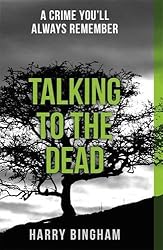
Talking to the Dead by Harry Bingham

I think DC Fiona Griffiths must be one of the most original fictional detectives I’ve come across. She is the creation of Harry Bingham in Talking to the Dead. She is Welsh, single and at the start of the book is aged 26, being interviewed for a job with the South Wales Police in Cardiff. She had a degree from Cambridge where she studied philosophy (a prize winning student). However, there is a problem as she has a two year gap in her CV around the time of her A Levels and she doesn’t want to talk about it. But as Human Resources have passed her OK, she gets a job.

But is she really OK? I soon began to have doubts about that. Four years later she is a detective constable, mainly working on routine details. However, Fiona does not play by the rules and when she is asked to help on the investigation of the brutal murders of Janet Mancini, a part-time prostitute, and April, Janet’s 6 year old daughter she doesn’t hesitate to use her initiative. Her colleagues and her boss think she is odd, although very smart and a quick worker. She is dedicated to her job and whereas DCI Jackson likes the ‘good DC Griffiths’, he’s not so keen on the other one:

The one I ask to do something and that something never seems to get done. Or done after fifteen reminders. Or done in a way that breaks the rules, causes complaints or pisses off your fellow officers. The Griffiths who decides that if something is boring her, she’s going to make a mess of it until she’s moved to something else. (page 52)

Even worse she gets obsessed, throws herself into finding out the truth with no regard for her own safety and without calling for backup, or referring to senior officers. And she’s clearly still suffering from whatever it was that caused the gap in her CV. But on the other hand she is a brilliant researcher and has great instincts and intuition. She focuses on the credit card found at the scene of the murders, fascinated by the fact that it had belonged to a millionaire who had been presumed dead after a plane crash over the sea (his body had never been recovered), convinced it is a vital clue.

There are two strands to the mystery, as alongside the Mancini murders Fiona is investigating ex policeman Brian Penry, a bursar at a Roman Catholic boys’ school, who had stolen money from the school. And there is also a mystery surrounding Fiona and her family, which is only partly revealed at the end of the book.

I really should not have liked this book as much as I did as it’s written in the present tense, solely from Fiona’s viewpoint. But I loved it and in this book was completely at ease with the present tense. It’s also quite strange in parts as we see further into Fiona’s mind; she has difficulty connecting with her feelings and with other people and some of her thoughts and actions are strange and disturbing. Whilst it is not an overtly violent book it is a dark book in places and there is an amount of gruesomeness involved (but I didn’t have to avert my eyes, as it were, or skim read any of the book). I had an idea about Fiona’s trauma, as I’d come across a similar case in another crime fiction novel, but I don’t want to spoil the book for others by saying what it is.

I will most certainly look out for the next book in the series – there are now 5 Fiona Griffiths books and I think these are books that should definitely be read in sequence. The locations are well grounded, there is a definite ‘Welsh’ feel and atmosphere and the characters are well defined. See Harry Bingham’s website for more information about him and his books – he’s written others as well as the Fiona Griffiths books.

  • Paperback: 384 pages
  • Publisher: Orion (28 Mar. 2013)
  • Language: English
  • ISBN-10: 1409137228
  • ISBN-13: 978-1409137221
  • Source: I bought the book

Talking to the Dead is my second book for the 20 Books of Summer Challenge and the 24th for the Mount TBR Reading Challenge, completing the second level.
My Week in Books: 8 June 2016

This Week in Books is a weekly round-up hosted by Lypsyy Lost & Found, about what I’ve been reading Now, Then & Next.

IMG_1384-0

A similar meme,  WWW Wednesday is run by Taking on a World of Words.


Now:
 I’ve just started Talking to the Dead by Harry Bingham, his first book featuring British detective Fiona Griffiths.

Blurb:

A young girl is found dead. A prostitute is murdered. And the strangest, youngest detective in the South Wales Major Crimes Unit is about to face the fiercest test of her short career.

A woman and her six-year-old daughter are killed with chilling brutality in a dingy flat. The only clue: the platinum bank card of a long-dead tycoon, found amidst the squalor.

DC Griffiths has already proved herself dedicated to the job, but there’s another side to her she is less keen to reveal. Something to do with a mysterious two-year gap in her CV, her strange inability to cry – and a disconcerting familiarity with corpses.

Fiona is desperate to put the past behind her but as more gruesome killings follow, the case leads her inexorably back into those dark places in her own mind where another dead girl is waiting to be found.

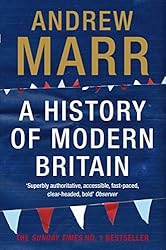
I’m still reading Andrew Marr’s A History of Modern Britain by Andrew Marr, basically Britain after the end of the Second World War up to 2006, with an added introduction in the paperback edition written in 2008. I’ve read up to page 152 so far out of 672 pages. It will be a while  before I finish this book – I don’t read non-fiction quickly!

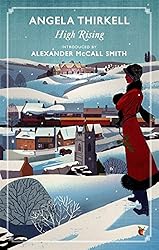
Then:The last book I read was High Rising by Angela Thirkell. See this post for my review.

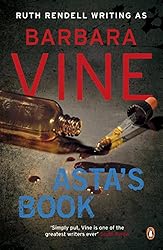
Next: It  will most likely be one of the books on my 20 Books of Summer list, probably Asta’s Book by Barbara Vine.

Blurb:

Asta and her husband Rasmus have come to east London from Denmark with their two sons. With Rasmus constantly away on business, Asta keeps loneliness and isolation at bay by writing her diary. These diaries reveal themselves to be more than a journal, for they seem to hold the key to an unsolved murder.

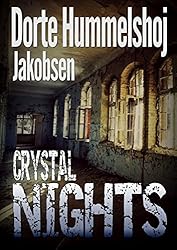
Crystal Nights by Dorte Hummelshoj Jakobsen

I recently read Crystal Nights: a Scandinavian mystery by Dorte Hummelshoj Jakobsen, who kindly sent me an e-version of the ARC of her book. The Danish edition of the book, Krystalnætter, won a national competition in 2013.

Once I started reading Crystal Nights I was hooked. It begins with an extract from Hans Christian Andersen’s The Snow Queen, a fairy tale about the struggle between good and evil, when a magic mirror was smashed into many pieces, which then entered the eyes, hearts and minds of people infecting them with evil.

Crystal Nights moves between events in Germany in 1938 to Kalum, a fictional village in Denmark, in the 1960s. In Berlin in 1938 Jewish families, including the Stein family, Simon, his wife Sara, and Miriam and Isaac, their two young children flee from the events of Krystallnacht, the “night of broken glass”.  Their journey doesn’t get them to safety though and ends with Sara desperate as her son becomes dangerously ill and Simon refuses to get medical help.

Moving on to the 1960s in Kalum, the story divides into the years 1963 and 1967. In 1963 a middle-aged smallholder from Brook Farm, north of Kalum is killed in a road accident. The relevance of this death only becomes apparent towards the end of the book. In 1967 a young boy, Lars-Ole disappears. His mother believes he had gone to stay with his father, but eventually everybody except for his friend Niels, assumes he is dead although his body has not been found. Niels finds Lars-Ole’s notebook, in which he had written some coded messages and sets out to discover what has happened to him, putting himself into great danger.

I particularly liked the comparison between Andersen’s fairy tale and the events of Krystallnicht and I think the characters of both Lars-Ole and Niels are well-drawn, with the village setting in the 1960s particularly convincing. I was carried away by the story, a story of how evil touched so many lives with such terrible consequences and how by patience and perseverance the truth was revealed.

You can see photos and maps showing the area in this picture companion to the book.

  • Format: Kindle Edition
  • File Size: 820 KB
  • Print Length: 187 pages
  • Publisher: Candied Crime; 1 edition (6 May 2015)
  • Source: Review copy from the author

Reading Challenges: Mount TBR Reading Challenge 2016

Adding to the TBRs

As usual I am behind with writing about the books I’ve read, with four to do. I’m in the middle of writing about The Voyage Out by Virginia Woolf, but it is taking me longer than I’d hoped and I haven’t finished my post yet.

So, here’s a post about the four books I’ve added to my TBRs this week:

STSmall

Stacking The Shelves is all about sharing the books you are adding to your shelves. This means you can include ‘˜real’ and ‘˜virtual’ books (ie physical and ebooks) you’ve bought, books you’ve borrowed from friends or the library, review books, and gifts.

I’ve added one paperback and three e-books:

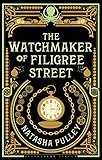
  • The Watchmaker of Filigree Street by Natasha Pulley. A friend recommended this book to me and I was delighted to see that it is one of the Kindle Daily Deals this morning. It’s steam-punk, a genre completely new to me! It is described as:

Utterly beguiling, The Watchmaker of Filigree Street blends historical events with dazzling flights of fancy to plunge readers into a strange and magical past, where time, destiny, genius ? and a clockwork octopus ? collide.

I hope I’ll like it as much as my friend did!

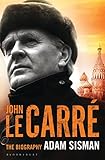
  • John Le Carré: the Biography by Adam Sisman, because I want to know more about the author of Tinker, Tailor, Soldier, Spy; The Night Manager and his other espionage books. During the 1950s and the 1960s, he worked for the Security Service and the Secret Intelligence Service, and began writing novels under a pen name. This is the definitive biography of a major writer, described by Ian McEwan as ‘perhaps the most significant novelist of the second half of the twentieth century in Britain’.
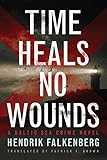
  • Time Heals No Wounds: a Baltic Sea crime novel by Hendrick Falkenberg. This is one of the free books for Amazon Prime members in May. German author Hendrik Falkenberg studied sports management and works in sports broadcasting. The magical allure that the sea holds for him comes alive in his stories, which are set on the north German coast. His first book, Die Zeit heilt keine Wunden (Time Heals No Wounds), was a #1 Kindle bestseller in Germany and has been translated for the first time into English.
  • And lastly, HeavenAli held a draw to give away some of Virginia Woolf’s books and I’m delighted that I won Orlando in the giveaway.

Orlando tells the tale of an extraordinary individual who lives through centuries of English history, first as a man, then as a woman; of his/her encounters with queens, kings, novelists, playwrights, and poets, and of his/her struggle to find fame and immortality not through actions, but through the written word. At its heart are the life and works of Woolf’s friend and lover, Vita Sackville-West, and Knole, the historic home of the Sackvilles. But as well as being a love letter to Vita, Orlando mocks the conventions of biography and history, teases the pretensions of contemporary men of letters, and wryly examines sexual double standards.

I’m looking forward to reading these books in the coming months!

First Chapter, First Paragraph: The Silver Pigs

Every Tuesday Diane at Bibliophile by the Sea hosts First Chapter First Paragraph Tuesday Intros, where you can share the first paragraph, or a few, of a book you are reading or thinking about reading soon.

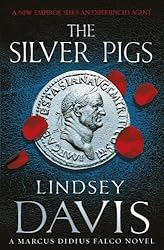
This week I’m featuring The Silver Pigs by Lindsay Davis, a book that I started reading last night. Whilst this is a new-to-me series, The Silver Pigs was first published in 1989 and there are now 20 books in the series. Lindsey Davis also writes the Favia Alba Mystery series. She has won many literary awards, and was honorary president of the Classical Association from 1997 to 1998.

It begins:

When the girl came rushing up the steps, I decided she was wearing far too many clothes.

It was late summer. Rome frizzled like a pancake on a griddleplate. People unlaced their shoes but had to keep them on; not even an elephant could cross the street unshod. People flopped on stools in shadowed doorways, bare knees apart, naked to the waist – and in the backstreets of Aventine Sector where I lived, that was just the women.

This is historical crime fiction, the first of the Marcus Didius Falco novels. Set in Rome in 70AD, Vespasian is the new Roman emperor and Falco is a private informer, or private eye. In this first book he and his partner Helena Justina rescue a young girl in trouble. He is then catapulted into a dangerous game involving stolen imperial ingots, a dark political plot and, most hazardous of all, a senator’s daughter connected to the traitors Falco has sworn to expose.

My copy has an introduction by Lindsey Davis in which she tells of how she began to write historical fiction, setting a typical private eye figure in Rome two thousand years ago. It has maps and a Dramatis Personae.

And I do like the cover.


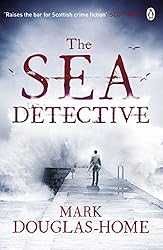
The Sea Detective by Mark Douglas-Home

Lovereading.co.uk  sent me a copy of  The Sea Detective by Mark Douglas-Home for review in advance of the publication of the third title in the series The Malice of Waves on 19 May and I’m glad to say that I thoroughly enjoyed it.

It’s one of those books that grabbed my attention right from the start when two young teenage girls from India are sold into the sex trafficking trade, completely unaware of the dangers and terror that awaits them. Then, Edinburgh-based oceanographer, Cal McGill is caught on camera planting a rare wild flower in the garden of the Scottish Environment Minister in a campaign to make politicians aware of the dangers of climate change. Detective Inspector Ryan wants to charge him with vandalism but the minister’s wife wants to keep the plant!

From then on the story gets complicated. It’s more of an investigative story than crime fiction, with several strands to the story, but it’s so well told that I had no difficulty in following all of them: a story of unsolved mysteries both from the present day and from the Second World War, and of two Indian girls, sold into the sex trafficking trade. It’s set mainly in Scotland with a strong sense of place throughout.

The main characters are all fully rounded and complex – Cal McGill works for environmental organisations tracking oil spills using wind speeds and data on ocean currents; DI David Ryan and DC Helen Jamieson are investigating the appearance of severed feet in trainers that had been washed on shore on islands miles apart – tests had revealed that they belonged to the same body; and Basanti, one of the Indian girls, whose resourcefulness saved her life. I especially liked Helen Jamieson, the overweight policewoman, whose boss, Ryan mistakenly thinks is stupid, and the way she deals with him.

The strand that interested me most concerns Cal’s grandfather, from the (fictional) island of Eilean Iasgaich. He had died during the Second World War, washed overboard during a storm, whilst their trawler was patrolling the sea around Norway, one of seven men who had died ‘“ and yet his name had not been included in the island’s war memorial. Cal eventually discovers the truth about what actually happened and how his grandfather met his death.

It’s a gripping and emotional story. I loved it.

The Sea Detective is Mark Douglas-Home’s first book. Before writing books he was the editor of Scotland’s leading daily newspaper, The Herald, and The Sunday Times Scotland. He is the nephew of the late Sir Alec Douglas-Home who was Prime Minister of the UK from October 1963 to October 1964. He lives in Edinburgh.

I’m looking forward to reading his second book, The Woman who Walked into the Sea as well as his third, The Malice of Waves.

Reading Challenges: Read Scotland 2016 – by a Scottish author and set in Scotland.