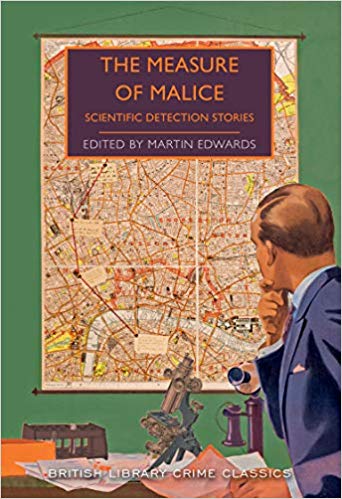
Measure of Malice: Scientific Detection Stories edited by Martin Edwards

The Measure of Malice edited by Martin Edwards is one of the more enjoyable short story collections that I’ve read. It contains 14 stories in which scientific/technological methods are used in the detection of crime. There is an excellent introduction by Martin Edwards with information about the authors, five of whom were doctors, two were engineers and one was an academic chemist.

As always with short story collections some stories are better than others. I’m highlighting a few of the better ones here:

The Boscombe Valley Mystery by A Conan Doyle was originally published in the Strand Magazine in October 1891, and is the first short story to feature Inspector Lestrade. It’s a solid story, solved by Sherlock Holmes by inspecting and analysing the footprints and signs at the scene of the crime.

The Horror of Studley Grange by L T Meade and Clifford Halifax (1894), from Stories for the Diary of a Doctor, originally published in the Strand Magazine. I enjoyed this one although it was pretty easy to predict. Ostensibly a ghost story, the solution involves the use of a laryngoscope.

After Death the Doctor by J J Connington, a Scottish professor of chemistry. This one was first published in 1934, involving a contemporary scientific gadget. The doctor in question is Doctor Shefford who together with Sergeant Longridge, investigate the murder of old Barnaby Leadburn, found dead with his throat cut.

The next two are the ones I enjoyed the most:

The Broken Toad by H C Bailey, first published in 1934, featuring the surgeon and Home Office Consultant, Reggie Fortune as he considers the death of a police constable from poisoning. I enjoyed all the detailed complications and Bailey’s literary mannered style of storytelling.

In the Teeth of the Evidence by Dorothy L Sayers, first published in 1939, about forensic dentistry, which starts as Lord Peter Wimsey is sitting in his dentist’s chair. The police had just visited the surgery, wanting to see his predecessor’s records to identify the victim of a burnt out garage. An upper right incisor crown and the filling in a molar provided the clues to his death. Gory if you actually visualise what is involved!

  • Publisher : Poisoned Pen Press (4 Feb. 2020)
  • Language: : English
  • Paperback : 336 pages
  • ISBN-10 : 1492699624
  • ISBN-13 : 978-1492699620
  • Source: The Poisoned Pen Press via NetGalley
  • My Rating: 3.5*

The Birdwatcher by William Shaw

I read The Birdwatcher by William Shaw in the summer and didn’t get round to reviewing it. So, this is a short post summarising what I thought about it.

I enjoyed this book, set in Dungeness on the Kent coast. Sergeant William South is a birdwatcher a methodical and quiet man. Very much a loner, South is not a detective and has always avoided investigating murder. But he does have one friend, a fellow birdwatcher, Bob Rayner and one morning he finds Bob has been brutally beaten to death. DS Alexandra Cupidi, a new CID officer, is leading the investigation and Shaw is reluctantly assigned to her team. Having recently moved from London she relies on William for his knowledge of the area.

Alternating with the present day story is the story of Billy, a thirteen year old living in Northern Ireland during the ‘Troubles’. And hidden within that story is the reason for South’s reluctance to investigate murders. Life becomes uncomfortable for South as Cupidi takes over his house for the base for their investigation and also lands him with the responsibility of entertaining her troubled teenage daughter, Zoe after school – he introduces her to birdwatching.

Shaw is an excellent storyteller and I liked his writing style. This is very much a character-driven mystery as the suspense builds to a climax and his description of Dungeness, with its wind-swept shingle beach close to the Nuclear Power Station and Romney Marsh provides an atmospheric and vivid backdrop. I liked William, and was irritated by Alexandra. So I’m pleased to discover that this is a prequel to Shaw’s DS Alexandra Cupidi series. Currently there are five books, with the sixth to be published next year, so I have plenty more to read.

  • File Size : 3045 KB
  • Print Length : 337 pages
  • Publisher : Riverrun (19 May 2016)
  • Source: I bought it
  • Rating: 5*

The Luminaries by Eleanor Catton

Sometimes I read books and have no desire to write about them, not because I didn’t enjoy them but because I just want to get on and read the next book. And this summer has been one of those times, so that now I’m finding difficult to remember all the details of the books I’ve read because I didn’t write about them soon after I finished reading. It’s been a strange time during this pandemic and it’s not been easy to concentrate. But I do want to keep a record of my reading and the only way now to catch up is to write some brief notes about each book, beginning with The Luminaries by Eleanor Catton, the winner of the 2013 Booker Prize,

Rating: 4 out of 5.

I downloaded The Luminaries by Eleanor Catton 3 years ago. I read it in July. It is a long and detailed book, written with such intricate plotting and numerous characters that it bewildered me at times. It’s historical fiction set in New Zealand in the 1860s, during its gold rush and it has everything – gold fever, murder, mystery and a ghost story too.

Blurb from Goodreads:

It is 1866, and young Walter Moody has come to make his fortune upon the New Zealand goldfields. On the stormy night of his arrival, he stumbles across a tense gathering of twelve local men who have met in secret to discuss a series of unexplained events: A wealthy man has vanished, a prostitute has tried to end her life, and an enormous fortune has been discovered in the home of a luckless drunk. Moody is soon drawn into the mystery: a network of fates and fortunes that is as complex and exquisitely ornate as the night sky. Richly evoking a mid-nineteenth-century world of shipping, banking, and gold rush boom and bust, The Luminaries is a brilliantly constructed, fiendishly clever ghost story and a gripping page-turner. 

I found the structure a bit of a stumbling block at first as the chapters halve in length from the very long opening chapter to the very short final chapter – so that from feeling overwhelmed by the length and detail of the opening chapters, by the time that I neared the ending I felt distinctly dissatisfied with the brevity of the concluding chapters – the early chapters are too long and the final ones are too short. And the significance of the astronomical headings completely bypassed me.

But if this sounds as though I didn’t enjoy this novel, that is wrong, because I did for the major part of the book. I loved the pictures it builds up of the setting in New Zealand, the frontier town and its residents from the prospectors to the prostitutes, and the obsessive nature of gold mining. And I did become fully absorbed in the story during the week it took me to read. it

These are the other books I read in July and August and have not yet reviewed:

  • Thin Air by Michelle Paver
  • The Birdwatcher by William Shaw
  • Still Life by Val McDermid
  • Dead Man’s Footsteps by Peter James

My Friday Post: Dead Man’s Footsteps

Every Friday Book Beginnings on Friday is hosted by Gillion at Rose City Reader where you can share the first sentence (or so) of the book you are reading. You can also share from a book you want to highlight just because it caught your fancy.

I’m currently reading Dead Man’s Footsteps by Peter James.

It begins:

If Ronnie Wilson had known, as he woke up, that in a couple of hours he would be dead, he would have planned his day, somewhat differently.

Also every Friday there is The Friday 56, hosted by Freda at Freda’s Voice. *Grab a book, any book. *Turn to Page 56 or 56% on your  ereader . If you have to improvise, that is okay. *Find a snippet, short and sweet, but no spoilers!

These are the rules:

  1. Grab a book, any book.
  2. Turn to page 56, or 56% on your eReader. If you have to improvise, that is okay.
  3. Find any sentence (or a few, just don’t spoil it) that grabs you.
  4. Post it.
  5. Add the URL to your post in the link on Freda’s most recent Friday 56 post.
  1. Grab a book, any book.
  2. Turn to page 56, or 56% on your eReader. If you have to improvise, that is okay.
  3. Find any sentence (or a few, just don’t spoil it) that grabs you.
  4. Post it.
  5. Add the URL to your post in the link on Freda’s most recent Friday 56 post.

Page 56:

And another part of his brain was telling him that while one plane hitting the Twin Towers was an accident, two was something else.

Dead Man’s Footsteps is the fourth Roy Grace novel, a fast paced police procedural. There’s a woman in hiding, a skeleton discovered in a storm drain, a man believed to have died in the 9/11 disaster, and a body found in the boot of a car submerged in a river in Australia. And there is the continuing story about Sandy, Grace’s wife, who had disappeared 9 years earlier.

The Killings at Kingfisher Hill by Sophie Hannah

HarperCollins/ 20 August 2020/ Print length 346 pages/ Kindle edition/ 3*

The Killings at Kingfisher Hill is Sophie Hannah’s fourth Hercules Poirot mystery novel and the first one I’ve read. I have read some of Hannah’s books previously. So, I know that she writes complicated and tricky plots. Whilst not attempting to reproduce Christie’s Poirot this book is loosely based on Christie’s books, as Hannah incorporates all the twists and turns, red herrings and misdirections that you find in them. There’s a country house setting, a number of suspects, and a gathering together at the end where Poirot reveals all.

Blurb:

Hercule Poirot is travelling by luxury passenger coach from London to the exclusive Kingfisher Hill estate, where Richard Devonport has summoned him to prove that his fiancée, Helen, is innocent of the murder of his brother, Frank. But there is a strange condition attached to this request: Poirot must conceal his true reason for being there.
 
The coach is forced to stop when a distressed woman demands to get off, insisting that if she stays in her seat, she will be murdered. Although the rest of the journey passes without anyone being harmed, Poirot’s curiosity is aroused, and his fears are later confirmed when a body is discovered with a macabre note attached…

Could this new murder and the peculiar incident on the coach be clues to solving the mystery of who killed Frank Devonport? And if Helen is innocent, can Poirot find the true culprit in time to save her from the gallows?

I wasn’t expecting a cloned Poirot and Hannah’s Poirot is not Christie’s Poirot. There’s no Captain Hastings in this book, Poirot’s faithful friend. Instead Poirot is accompanied by Inspector Catchpole from Scotland Yard. How on earth he got to be an inspector is beyond me – he comes across as rather dim and stupid and Poirot treats him as such, endlessly explaining things to him and telling him what to do in an officious manner.

There are three strands to the plot – who killed Frank Devonport; who is the hysterical woman with an ‘unfinished face’ who insists she will be murdered if she sits in a specific seat on the coach; and who is the mysterious woman who tells Poirot she is a murderer – what a stupid thing to do when she knows he is a ‘world-renowned detective’? And I wondered what makes Richard so sure that Helen didn’t kill Frank when she had immediately confessed that she had? And I’m still wondering why when he was invited to Kingfisher Hall, an exclusive and private country estate, he went by coach with 30 other passengers – even if it was a ‘luxury’ coach. I just can’t see Poirot travelling by coach!

This all makes the book extremely convoluted, confusing and tangled as well as long-winded. Poirot though works his way methodically through the mess and gets to the truth. However, I found it quite dull and repetitive and rather contrived. So, my rating for this book is 2.5 stars, rounded up to 3.

My thanks to HarperCollins for a review copy via NetGalley.

A Thousand Moons by Sebastian Barry

Faber and Faber Ltd/ 19 March 2020/ 256 pages/ Kindle edition/ 5*

Three years ago I read Sebastian Barry’s Days Without End which has to be one of the best books I’ve read, so I began reading A Thousand Moons with great anticipation of a good read. I wasn’t disappointed and I loved it. It continues the story of Thomas McNulty and John Cole, and Winona, the young Indian girl they had adopted. It really helps if you have read Days Without End first to understand the characters’ history and relationships and how they got to this stage in their lives.

Winona is a young Lakota orphan adopted by former soldiers Thomas McNulty and John Cole.
Living with Thomas and John on the farm they work in 1870s Tennessee, she is educated and loved, forging a life for herself beyond the violence and dispossession of her past. But the fragile harmony of her unlikely family unit, in the aftermath of the Civil War, is soon threatened by a further traumatic event, one which Winona struggles to confront, let alone understand.

They are living and working on a farm owned by Lige Magan in Tennessee, about seven miles from a little town called Paris. It is now the 1870s, some years after the end of the Civil War, but the town was still full of rough Union soldiers and vagabonds on every little byway. Dark skin and black hair were enough to get you beaten up – and it wasn’t a crime to beat an Indian. Life wasn’t any better for the other two workers on the farm, black ex-slaves, Rosalee Bouguereau and her brother, Tennyson. These are dangerous times not just in the town but also in the woods outside the town from Zach Petrie’s gang of ‘nightriders’.

Winona remembers little of her early life, beyond seeing in the back of her mind a ‘blackened painting’ of blood and screaming, bayonets, bullets, fire and death. But their lives are full of love at the farm; Winona is loved as a daughter by Thomas and John, who are themselves lovers. She works for lawyer Briscoe as his clerk and ventures into town for supplies, which was where she met Jas Jonski, a young man who declares he wants to marry her. At first she hopes that she might very much like to marry Jas. But, then things go disastrously wrong. First racism rears its ugly head as Jas is white and the Paris townspeople began to talk. As his employer said he thought Jas had gone mad or wicked in some way – ‘to want to go marrying something closer to a monkey than a man’ was how he put it.

And then came the dreadful day when Winona was brutally attacked so badly that she shook for two weeks and something deep within her was shaking a long time after. She can’t remember at first what had actually happened to her, except that she was plied with ‘distillery whiskey’, nor who had carried out the assault. But all the signs pointed to Jas Jonski. Then Tennyson Bouguereau was also attacked, and their peaceful happy life was shattered. Winona set out for revenge. And in so doing she began to remember more about her early life and about her mother, a strong Lakota woman, full of courage and pride.

‘A thousand moons’ was her mother’s deepest measure of time. To her time was ‘a kind of hoop or a circle not a long string and if you walked far enough she said you could find the people still living in the long ago’ – ‘a thousand years all at once’. As she sets off on her quest it is the thought of her mother’s courage that enabled Winona to find her own courage – the ‘courage of a thousand years’.

I just love everything about this book, so beautifully written, rendering the way the characters speak so that I could hear them, and describing the landscape so poetically and lyrically that the scenes unfolded before my eyes; and the characters too, all real people from the American West of the 1870s, as though I was there in their midst. It would make a superb film.

Sebastian Barry

Photo credit: ©Alan Betson, The Irish Times

Sebastian Barry was born in Dublin in 1955. His novels and plays have won, among other awards, the Kerry Group Irish Fiction Prize, the Costa Book of the Year award, the Irish Book Awards Best Novel, the Independent Booksellers Prize and the James Tait Black Memorial Prize. He also had two consecutive novels, A Long Long Way (2005) and The Secret Scripture (2008), shortlisted for the MAN Booker Prize. He lives in Wicklow with his wife and three children.

My thanks to Faber and Faber Ltd for my copy of this book, via NetGalley.