Nonfiction November: Week 2 Book Pairings

Week 2: (November 8-12) – Book Pairing with Katie at Doing DeweyThis week, pair up a nonfiction book with a fiction title. It can be a “If you loved this book, read this!” or just two titles that you think would go well together. Maybe it’s a historical novel and you’d like to get the real history by reading a nonfiction version of the story. 

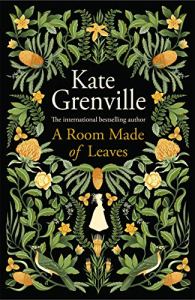
Earlier this year I read the novel A Room Made of Leaves by Kate Grenville and I’m pairing it with Elizabeth Macarthur: A Life at the Edge by Michelle Scott Tucker, which I haven’t read yet.

Kate Grenville is one of my favourite authors, so I was very keen to read A Room Made of Leaves. It’s historical fiction telling the story of the Macarthurs, Elizabeth and John Macarthur, who settled in Australia at the end of the eighteenth century. It’s based on the real lives of the Macarthurs using letters, journals and official documents of the early years of the New South Wales colony. Her writing suits me – historical fiction, with good descriptive writing setting the scenes vividly in their locations. I find her books difficult to put down and they stay in my mind long after I’ve finished reading. This one is no exception.

Whenever I read historical fiction I always want to know how much is fact and how much is fiction, how accurate it is. And so this novel intrigued me because Kate Grenville’s book begins with an editor’s note about ‘the ‘incredible discovery of Elizabeth Macarthur’s secret memoirs’ in a tin box containing old papers, revealing the real person behind the few letters she wrote home to her family and friends and a lot of ‘dull correspondence with her adult children’. Was this true, I wondered. So I turned to the back of the book to read Grenville’s Author’s Note and in that she clarifies that this is not history and, although the extracts from Elizabeth’s letters are from the letters of the real Elizabeth Macarthur, she has ‘taken some liberties in order to shape this work of fiction’. The old documents were Grenville’s ‘inspiration and guide’. In other words you have to bear in mind the epigraph, an actual quotation from one of Elizabeth’s letters: Believe not too quickly, a reminder that this is fiction.

It made me want to know more about the Macarthurs, and what was indeed their history, so I was delighted to find out that Kate Grenville references Michelle Scott Tucker’s biography: Elizabeth Macarthur: A Life at the Edge of the World as the standard biography in her Acknowledgements and I was even more delighted to see that it’s available as a ebook. So it is now in my Kindle and I’m keen to read it as soon as possible. I want to see what Michelle Scott Tucker has made of the same historical sources – history, after all, is an interpretation of the facts from the records, trying to explain what happened and why, dependent on available evidence. Fiction is more flexible and can fill in the gaps where the documentary evidence is lacking.

A Z of TBRs: E-Books – J, K and L

It’s been a long time since I last looked at the forgotten e-books on my Kindle, so it’s time to dip into it again. I have a bad habit of downloading books and then forgetting all about them – it’s as though they’ve gone into a black hole.

Today I’m looking at books with titles beginning with the letters J, K and L, with a little ‘taster’ from each. The summaries are from Goodreads.

Jeremy Hutchinson’s Case Histories by Thomas Grant – I bought this in February 2020 after watching the BBC series,The Trial of Christine Keeler, the story of the Profumo affair in 1962 as seen from her perspective. Hutchinson was Keeler’s defence barrister.

Summary: Born in 1915 into the fringes of the Bloomsbury Group, Jeremy Hutchinson went on to become the greatest criminal barrister of the 1960s, ’70s and ’80s. The cases of that period changed society for ever and Hutchinson’s role in them was second to none. In Case Histories, Jeremy Hutchinson’s most remarkable trials are examined, each one providing a fascinating look into Britain’s post-war social, political and cultural history.

A cartoon by Cummings appeared in the Daily Express on 10 July 1963 headed ‘The adventures of James Macbond’. It showed the beleaguered figure of Harold Mavmillan fleeing from three assailants. Kim Philby and his fellow spy John Vassall are both dressed as shady hoodlums, one wielding a knife, the other a pistol both aimed at Macmillan. Christine Keeler is the third, incarnated on the page as a sort of vampiric harpy, her long-nailed hand outstretched trying to clutch the Prime Minister’s coat tails.

That year was a kind of horror show for Macmillan, and he was not to see out 1963 as Prime Minister. His resignation was accepted by the Queen in October.(page 95)

The Keeper of Lost Things by Ruth Hogan – I bought this in May 2017 and can’t remember how I first came across it.

Summary: Anthony Peardew is the keeper of lost things. Forty years ago, he carelessly lost a keepsake from his beloved fiancée, Therese. That very same day, she died unexpectedly. Brokenhearted, Anthony sought consolation in rescuing lost objects—the things others have dropped, misplaced, or accidentally left behind—and writing stories about them.

He took a sip from his drink and lovingly kissed the cold glass of the photograph before replacing it on the table next to his chair. She was not a classic beauty; a young woman with wavy hair and large dark eyes that shone, even in an old black and white photograph. But she was wonderfully striking, with a preserve that still reached out from all those years ago and captivated him. She had been dead for forty years, but she was still his life, and her death had given him his purpose. It had made Andrew Peardew the Keeper of Lost Things. (page 4)

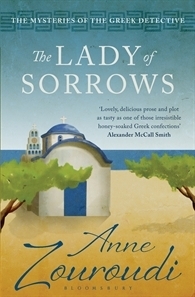
The Lady of Sorrows by Anne Zouroudi – I bought this in April 2013! It is the fourth in Anne Zouroudi’s Mysteries of the  Greek Detective series featuring Hermes Diaktoros. Hermes is a detective with a difference. Just who he is and who he works for is never explained. I have read three of the books in the series. Each one features one of the Seven Deadly Sins.

Summary: A painter is found dead at sea off the coast of a remote Greek island. For our enigmatic detective Hermes Diaktoros, the plot can only thicken: the painter’s work, an icon of the Virgin long famed for its miraculous powers, has just been uncovered as a fake. But has the painter died of natural causes or by a wrathful hand? What secret is a dishonest gypsy keeping? And what haunts the ancient catacombs beneath the bishop’s house?

‘Allow me to introduce myself. I am Hermes Diaktoros, of Athens. Diaktoros being, as you may know, an ancient word for messenger. My father has a strange idea of humour. He’s something of a scholar of the classical world.’

Politely, the priest took the fat man’s hand, which was, in spite of the day’s heat was quite cool to touch.

‘Father Linos Egiotis,’ said the priest.

‘A pleasure,’ said the fat man. ‘Now, I know you must be anxious to close up for siesta, and I won’t keep you.’ He turned back to the icon. ‘She’s very lovely, isn’t she?’ he said. ‘I have been wanting to make her acquaintance for many years. Quite by chance we were passing within a few miles, and had time enough before my next engagement to make the detour. She has quite a reputation, I believe, for performing magic tricks. Magic tricks are a paerticular interest of mine.’

‘Magic tricks?’ queried the priest, with annoyance. ‘The Lady occasionally sees fit to grant miracles. They are acts of divine grace, not magic tricks.’ (page 31)

So, three very different books from the depths of my Kindle. I’m not sure which one to read first. If you’ve read any of these books please let me know what you think. Or if you haven’t read them do they tempt you?

A Line to Kill by Anthony Horowitz

Random House UK, Cornerstone Digital| 19 August 2021| 368 pages| Review copy| 4*

Synopsis:

There has never been a murder on Alderney.

It’s a tiny island, just three miles long and a mile and a half wide. The perfect location for a brand new literary festival. Private Investigator Daniel Hawthorne has been invited to talk about his new book. The writer, Anthony Horowitz, travels with him.

Very soon they discover that not all is as it should be. Alderney is in turmoil over a planned power line that will cut through it, desecrating a war cemetery and turning neighbour against neighbour.

The visiting authors – including a blind medium, a French performance poet and a celebrity chef – seem to be harbouring any number of unpleasant secrets. When the festival’s wealthy sponsor is found brutally killed, Alderney goes into lockdown and Hawthorne knows that he doesn’t have to look too far for suspects.

There’s no escape. The killer is still on the island. And there’s about to be a second death…

A Line to Kill is the third in Anthony Horowitz’s Hawthorne and Horowitz Mystery series. I have read the earlier books, The Word is Murder and The Sentence is Death and I think it really it best if you read these books in order to fully understand the main characters and their relationship. Daniel Hawthorne, an ex-policeman, is now a private investigator, who the police call in to help with their more complicated cases. Anthony Horowitz himself plays a major role as one of the main characters, recruited by Hawthorne to write a book about him and the cases he investigates and he’d agreed to a three-book contract with Hawthorne.

This third book is about the third case they investigate. I loved the setting on the island of Alderney where the literary festival is being held. I enjoyed the interplay between Hawthorne and the fictional Horowitz, a somewhat difficult relationship as Hawthorne is particularly secretive about his personal life and about the reason he left the police force. In a way he is a Sherlock Holmes type of character keeping Horowitz very much in the dark about what he thinks about the identity of the murder. He is not an easy person to like, single minded with a somewhat superior air about him, but he does get results.

Like the two earlier books this is a complicated murder mystery, with a type of ‘locked room’ puzzle to be solved. As you would expect it is full of red herrings and multiple twists and turns. I was soon totally immersed in this fascinating novel. The characters are fully formed, all with secrets they want to keep hidden and clues are all there, but so well hidden that I was once again totally bemused by it all.

The fictional Horowitz is by now, thoroughly intrigued by Hawthorne himself – just what is he keeping hidden about himself, why did he really leave the police force? Will the writer Horowitz reveal the secret is his next book – if there is to be one? I do hope so.

Thank you to Anthony Horowitz, Random House and NetGalley for an ARC of A Line to Kill.

Coming Up For Air by Sarah Leipciger

A remarkable true story richly re-imagined

On the banks of the River Seine in 1899, a young woman takes her final breath before plunging into the icy water. Although she does not know it, her decision will set in motion an astonishing chain of events. It will lead to 1950s Norway, where a grieving toy-maker is on the cusp of a transformative invention, all the way to present-day Canada where a journalist, battling a terrible disease, risks everything for one last chance to live.

Taking inspiration from a remarkable true story, Coming Up for Air is a bold, richly imagined novel about the transcendent power of storytelling and the immeasurable impact of every human life.

Coming Up For Air is Sarah Leipciger’s second novel. It is a beautiful novel, a story of three people living in different countries and in different times. How their stories connect is gradually revealed as the novel progresses. As the author explains at the end of the novel is is a mix of fact and fiction and has its basis in truth. There is grief and loss and despair in each story, but above all, it is about love, and the desire to live.

Each story was compelling and, for once in a book that alternates between the characters, I thought the changes were just at the right moment in each one.

It begins with the unknown young woman in Paris, L’Inconnue, telling the story of her life that led to her suicide. Her death in the Seine is vividly described. As she fell in the cold water, initially she discovered the desire to live, as her body thrashed about not wanting to drown, her lungs fighting for air, for oxygen. It’s poignant and moving, set at the end of the 19th century bringing the city to life, where she lives as a lady’s companion to an old friend of her grandmother’s.

The second story is that of Norwegian, Pieter Akkrehamn, beginning in 1921, when he used to spend his summers with his grandparents on Karmoy Island. He went swimming in the North Sea, diving down several metres, holding his breath for over a minute in the freezing cold water, as the cold reached his chest, squeezing his lungs. His story is revealed, as he grieves for his little son. He is a toymaker, bored with making wooden toys, who turned to soft plastics and began making dolls with soft faces and bendable knees. What he eventually developed was truly remarkable.

The vital importance of being able to breathe comes to the fore in the third story – that of Anouk, a journalist in Canada. Anouk has cystic fibrosis and is on the list for a lung transplant. Her story is one of how she and her parents dealt with her illness, enabling her to combine her love for water and swimming with managing her cystic fibrosis, all the time struggling to breathe.

I think Sarah Leipciger is a great storyteller. It is an inspiring book, beautifully written, which emphasises the importance of the air we breathe and the desire to live. I loved it so much that I hope to read her first novel, The Mountain Can Wait.

With my thanks to NetGalley and to Random House for my review copy.

  • Publisher ‏ : ‎ Random House UK Transworld Digital (19 Mar. 2020)
  • Language ‏ : ‎ English
  • Print length ‏ : ‎ 320 pages

My Friday Post: Checkmate to Murder by E C R Lorac

Every Friday Book Beginnings on Friday is hosted by Gillion at Rose City Reader where you can share the first sentence (or so) of the book you are reading. You can also share from a book you want to highlight just because it caught your fancy.

This week I’m featuring one of the books I’m currently reading, Checkmate to Murder: a Second World War Mystery by E C R Lorac, first published in 1944. One of the things I like about this book is the setting and atmosphere of wartime London, when details such as blackouts, fire-watching and air raid precautions were everyday events.

It begins:

The vast studio had two focus points of light; between two pools of radiance was a stretch of shadows, colourless, formless, empty. At one end of the long, barn-like structure, where the light was most strongly concentrated, was a model’s platform. A high-backed Spanish chair stood upon it, with a dark leather screen as background. On the chair sat a man arrayed in the superb scarlet of a Cardinal’s robe, the broad-brimmed Cardinal’s hat upon his head.

Also every Friday there is The Friday 56, hosted by Freda at Freda’s Voice. *Grab a book, any book. *Turn to Page 56 or 56% on your  ereader . If you have to improvise, that is okay. *Find a snippet, short and sweet, but no spoilers!

These are the rules:

  1. Grab a book, any book.
  2. Turn to page 56, or 56% on your eReader. If you have to improvise, that is okay.
  3. Find any sentence (or a few, just don’t spoil it) that grabs you.
  4. Post it.
  5. Add the URL to your post in the link on Freda’s most recent Friday 56 post.
  1. Grab a book, any book.
  2. Turn to page 56, or 56% on your eReader. If you have to improvise, that is okay.
  3. Find any sentence (or a few, just don’t spoil it) that grabs you.
  4. Post it.
  5. Add the URL to your post in the link on Freda’s most recent Friday 56 post.

Page 56:

“Deceased was a miser, one of the real old-fashioned storybook misers. I won’t say I haven’t met one before – I have, though they are getting less common than they used to be. D’you remember old Simple Simon, who was always getting run-in for begging on the Embankment – £525 we found under the boards in his bedroom when he died, and another fifteen pounds odd in his filthy bedding. He died of starvation at last.”

~~~

About the book:

On a dismally foggy night in Hampstead, London, a curious party has gathered in an artist’s studio to weather the wartime blackout. A civil servant and a government scientist match wits in a game of chess, while Bruce Manaton paints the portrait of his characterful sitter, bedecked in Cardinal’s robes at the other end of the room. In the kitchen, Rosanne Manaton prepares tea for the charlady of Mr. Folliner, the secretive miser next door.

When the brutal murder of ‘Old Mr. F’ is discovered by his Canadian infantryman nephew, it’s not long before Inspector Macdonald of Scotland Yard is called to the scene to take the young soldier away. But even at first glance the case looks far from black-and-white. Faced with a bevy of perplexing alibis and suspicious circumstances, Macdonald and the C.I.D. set to work separating the players from the pawns to shed light on this toppling of a lonely king in the dead of night.

What do you think – would you read this book?

Cruel Acts and The Cutting Place by Jane Casey

This month I have caught up with reading two of Jane Casey’s Maeve Kerrigan books, and having read these two in quick succession I’m feeling as though I’ve overdosed on crime fiction. Too many murders in quick succession. I need to space them out.

Maeve is a Detective Sergeant with the Metropolitan Police – in the first six books she was a detective constable – and her boss Detective Inspector Josh Derwent are the two main characters. They have a confrontational working relationship and their spiky relationship is a recurring theme in the books. In fact they are both strong characters described in depth and completely believable. They’ve both changed as the series has grown, which is why it’s better to read the books in sequence to see how have they’ve developed.

The first book in Jane Casey’s Maeve Kerrigan series was The Burning, published in 2010, but I didn’t get round to reading it until February 2015. I was hooked immediately and read the next five books in quick succession by the end of August 2015. These are all police procedurals, fast-paced novels, with intriguing and complex plots and developing the relationships between the main characters. So, I think that although the books read well as stand-alones, it helps enormously to read them in order, especially to follow the relationship between Maeve and DI Josh Derwent.

Cruel Acts is the 8th book in the series and I enjoyed it more than The Cutting Place, the 9th book.

Blurb:
A year ago, Leo Stone was convicted of murdering two women and sentenced to life in prison. Now he’s been freed on a technicality, and he’s protesting his innocence. DS Maeve Kerrigan and DI Josh Derwent are determined to put Stone back behind bars where he belongs, but the more Maeve digs, the less convinced she is that he did it. Then another woman disappears in similar circumstances. Is there a copycat killer, or have they been wrong about Stone from the start?

The Cutting Place

Blurb
Everyone’s heard the rumours about elite gentlemen’s clubs, where the champagne flows freely, the parties are the height of decadence . . . and the secrets are darker than you could possibly imagine.

DS Maeve Kerrigan finds herself in an unfamiliar world of wealth, luxury and ruthless behaviour when she investigates the murder of a young journalist, Paige Hargreaves. Paige was working on a story about the Chiron Club, a private society for the richest and most privileged men in London. Then she disappeared. 

It’s clear to Maeve that the members have many secrets. But Maeve is hiding secrets of her own – even from her partner DI Josh Derwent. Will she uncover the truth about Paige’s death? Or will time run out for Maeve first?

~~~

I enjoy crime fiction because I like trying to work out happened and why. But I don’t like reading about horrific murders that are described in gory technicolour detail. Whilst there are brutal murders in these books they’ve not been too much for me to read. They are gritty stories but in The Cutting Place the murders and abuse of women and the violence involved is just a step too far for me. One of the changes in Maeve’s life came about in that book was when she acquired a new boy friend – the lawyer Seth Taylor – I didn’t like him straight away and I was right. Now I would like to know what happens next between Maeve and Josh as it seems to me that their relationship took a significant turn in The Cutting Place! So, I am hoping there will be a 10th book.

Jane Casey’s writing makes compelling reading, always satisfying even if her books take me to places and situations that appal and terrify me. Her books are down to earth and based on real life. As she explains at the end of the book, she is married to a criminal barrister ‘who makes sure her writing is realistic and as accurate as possible.’

Her next book is a standalone thriller, The Killing Kind, to be published 27 May 2021, featuring barrister Ingrid Lewis – one to look out for.