Lustrum and Dictator by Robert Harris

I’d enjoyed the first book in Robert Harris’ Cicero Trilogy, Imperium. So I’d been looking forward to reading Lustrum, the second in the trilogy (published as Conspirata in the US and Italy) . It didn’t fail to live up to my expectations – it surpassed them. I think it’s historical fiction at its best. I immediately went on to read Dictator, the third book in the trilogy, which I also enjoyed very much, but I think Lustrum is the outstanding book of the three.

I had intended to write a more detailed post about Lustrum and Dictator but life and medical issues decided otherwise, so this is just a short post on both books.

Lustrum begins where Imperium finished in 63 BC with a dramatic scene, as the body of a child is pulled from the River Tiber, a child who had been killed as a human sacrifice, grotesquely mutilated. What follows is an account of the five year period (a lustrum) of Cicero’s consulship and the battle for power between him, Julius Caesar, Pompey the republic’s greatest general, Crassus its richest man, Cato a political fanatic, Catilina a psychopath, and Clodius an ambitious playboy. It ends with his exile from Rome.

Once I began reading I was immediately drawn into the world of Cicero. The story is once again narrated by his secretary, the slave Tiro, giving access to Cicero’s thoughts and feelings. Tiro is an interesting character in his own right – he is reported to be the first man to record a speech in the senate verbatim and some of the symbols in his shorthand system are still in use today, such as &, etc, ie, and eg. As in Imperium and in the third book, Dictator, Harris has used Cicero’s actual words, adding to the books’ authenticity. Harris states that he hopes it is not necessary to read the books in order but I think it adds much to the enjoyment if you do.
Dictator covers the last 15 years of Cicero’s life when he was no longer a dominant political figure in Rome. The book begins with Cicero in exile, separated from his wife and children and in constant danger of losing his life. Apart from the first part of the book when Cicero is working towards returning to Rome, I didn’t find it as exciting or as compelling as the first two books. This is mainly because there is so much happening such as the civil war and the downfall of the republic from which Cicero is excluded first because on his return to Rome he is sidelined, and then retired.

All three books are based on extensive research but Harris is such a good story teller that they don’t read like text books. Roman history has always fascinated me and reading this trilogy has revived my interest, so much so that I am now reading Mary Beard’s book, SPQR: a History of Ancient Rome, that goes right back to the beginning describing how Rome grew and became such a dominant power.

When I saw Catilina’s Riddle by Steven Saylor sitting in the mobile library shelves I just had to borrow it. It’s historical crime fiction in which Gordianius the Finder gets involved in the Catilina conspiracy to overthrow the republic.

And I would also like to re-read Colleen McCullough’s Masters of Rome series to compare with Harris’ trilogy, or at least some of the books involving Cicero and Caesar. Oh for more time to read!

Lustrum is one of my Mount TBR Mountain Challenge 2016 books (ie books I’ve owned before 1 January 2016) .
The Murder at the Vicarage by Agatha Christie

Ingenious! That’s what I thought when I’d finished reading The Murder at the Vicarage. Although Agatha Christie had written short stories featuring Miss Marple this is the first full length Miss Marple story, published in 1930.
I’ve been reading my way through Agatha Christie’s crime fiction for a few years now, totally out of order, which is why I’ve only just got round to reading The Murder at the Vicarage. I’d picked up along the way on the fact that Miss Marple uses her knowledge of people to help her solve the mysteries she investigates. And it is in this book that her use of analogy is made absolutely explicit, as she considers who could have killed Colonel Prothero, the unpopular churchwarden, found in the vicar’s study shot through the head. She comes up with seven suspects, all based on examples of human behaviour she has observed in the past.

Miss Marple is not the popular figure she appears in the later books as not everybody likes her. The vicar does, liking her sense of humour, and describing her as ‘a white-haired old lady with a gentle appealing manner’, whereas his wife describes her as ‘the worst cat in the village. And she always knows everything that happens – and draws the worst inference from it.

But it is very helpful to know what is going on in St Mary Mead, about Dr Stone, a well-known archaeologist superintending the excavation of a barrow on Colonel Protheroe’s land and about Mrs Lestrange, a mysterious woman who has recently moved to the village and also about who was coming and going to the vicarage and when.

It’s also helpful to have a a plan of St Mary Mead, showing where the main characters live, and plans of the layout of the vicarage and the vicar’s study, where the murder occurred.

After one of the suspects confesses to the murder Inspector Slack, who shows his contempt for Miss Marple, thinks the case is closed, but Miss Marple is puzzled – the facts seem to her to be wrong. The Murder at the Vicarage has an intricate plot, is full of red herrings and was impossible for me to unravel, but Miss Marple with her knowledge of ‘Human Nature’ solves the mystery.

I enjoyed this book very much, but Agatha Christie writing her Autobiography years later, wasn’t all that pleased with it. She thought it had too many characters and too many sub-plots; she is probably right. But she thought that the main plot was sound and that the village was as real to her as it could be. It’s real to me too.

Silver Lies by Ann Parker

From out of the black hole that is my Kindle came Silver Lies by Ann Parker, a new-to-me author. Books have been known to disappear for ever in there and this one had been languishing down in the depths for three years, so I thought it was time to read it. It looked as though it would be a bit different from other books I’ve been reading this year. Apart from True Grit I don’t think I’ve read any westerns for years and actually this one is not a typical western. It’s not a Cowboys and Indians type western at all but is set in 1879/80 in the silver-mining town of Leadville, Colarado in the heart of the Rocky Mountains. It probably fits in more with the crime fiction genre than with westerns, but it was the setting  that attracted me to it.

It’s a really good story beginning when Joe Rose, a silver assayer, facing a bleak future as the last of his money has gone and the hope of making his fortune in silver has disappeared, is found dead in Tiger Alley propped up behind the Silver Queen saloon. Inez Stannert’s husband Mark had won the saloon in a poker game and eight months before the story begins he had left her and their friend and business partner, Abe Jackson to run it on their own. Inez has no idea where he is and whether he’ll ever return.

Joe’s death is just the start of the mystery – was his death an accident or was he murdered and if so why?  Inez sets out to discover the truth and although his wife Emma has asked her to settle his affairs for her what is she keeping from Inez? Where is Mark and why did he leave? There is a new Reverend in town. Inez falls for his charms but is he to be trusted? She had him pegged as a gambler rather than a man of the cloth. And she doesn’t trust the new marshall either – ‘a thin man with the look of a hungry rattlesnake’. Inez knows he is ‘just a two-bit gunslinger from Texas’ hired by the ‘silver barons to keep the peace after last month’s lynching’. So it’s no wonder that she uncovers a web of deceit, counterfeit, blackmail and murder.

With plenty of memorable characters I could easily imagine I was in the silver rush town, a town where:

People rush in – from the East, from the West – and collide at the top of the Rockies. They’re looking for riches or looking to escape. And running. Everyone’s either from their past or running toward some elusive vision of the future. (location 5896)

Leadville was a colourful place, a boom-town, bustling with life -everything is there – the Silver Queen saloon and the Crystal Belle Saloon, Leadville’s leading parlor house, a brick built opera house, whose patrons ‘swelled the after-midnight crowds’ in the Silver Queen saloon, five banks and a small white church with a steeple.

Silver Lies won the Willa Award for Historical Fiction and the Colorado Gold Award and was chosen as best mystery of the year by Publishers Weekly and The Chicago Tribune.  For more information about Ann Parker and her books see her website.

I was completely engrossed in this book with its multi-layered and intricate plot that kept me guessing all the way through.  I hope to read more of this series:
  1. Silver Lies (2003)
  2. Iron Ties (2006)
  3. Leaden Skies (2009)
  4. Mercury’s Rise (2011)

Reading challenges: Mount TBR Reading Challenge 2015Historical Fiction Reading ChallengeColor Coded Challenge

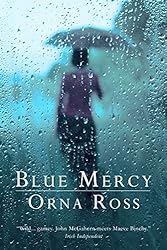
Blue Mercy by Orna Ross

This is a short post giving the synopsis of Blue Mercy by Orna Ross and my thoughts about the book.

Synopsis from Amazon:

A literary family drama, with a murder at its heart, full of emotional twists and surprises
~~~
Will you side with mother or daughter? When Mercy Mulcahy was 40 years old, she was accused of killing her elderly and tyrannical father. Now, at the end of her life, she has written a book about what really happened on that fateful night of Christmas Eve, 1989. The tragic and beautiful Mercy has devoted her life to protecting Star, especially from the father whose behavior so blighted her own life. Yet Star vehemently resists reading her manuscript. Why? What is Mercy hiding? Was her father’s death, as many believe, an assisted suicide? Or something even more sinister?

In this book, nothing is what it seems on the surface and everywhere there are emotional twists and surprises. (“Breathtaking, and I mean literally — actual gasps will happen” said one reader review).

Set in Ireland and California, Blue Mercy is a compelling novel that combines lyrical description with a page-turning style to create an enthralling tale of love, loss and the ever-present possibility of redemption.

My thoughts:

Blue Mercy has had a lot of 4 and 5 star reviews on Amazon and on Goodreads, so I am definitely in the minority in not being swept away by it. I enjoyed some of it, thought some parts were OK and didn’t like other parts, but I didn’t find it compelling or enthralling and I certainly did not gasp at the revelation that Mercy had been lying to her daughter and to the reader. It confirmed my suspicion that she was not a reliable narrator in writing about her life.

I thought the setting in Ireland was vivid and came to life. However, although there is a mystery about how Mercy’s father died and what had happened to Star’s father, the plot is definitely secondary to the various themes running through this book – such as family relationships, particularly but not solely the mother/daughter relationship, abuse and assisted dying. But there is also so much detail about feelings, personal development, women’s studies, childhood and teenage problems, eating disorders, and exploration of Mercy and Star’s psyches and perceptions, that the characters and plot were almost drowned in emotion, pain and angst.

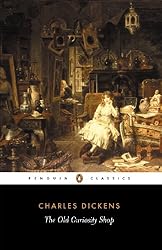
The Old Curiosity Shop by Charles Dickens

Note: I’ve found this hard to write about without giving away some spoilers.

I’d listed The Old Curiosity Shop in my Classics Club Spin,  but was really hoping to get one of Thomas Hardy’s books. Without this push from the Classics Club this book would have stayed on my TBR list for a long time because all I knew about it was that it’s the book in which Little Nell suffers a melodramatic death and I feared it would be too sentimental for my liking. And much to my surprise I have finished it in time for the deadline for reading our Spin book this Friday, even though it’s such a long book.

Well, it was and it wasn’t. It’s not just a sentimental, melodramatic story. It’s also full of weird, grotesque and comic characters, a mix of everyday people and characters of fantasy. It has elements of folklore and myth, as Nell and her grandfather, go on an epic journey, fleeing from the terrifying dwarf, Daniel Quilp and travelling through a variety of scenes, meeting different groups of people on their journey. There are numerous allusions to the Bible, Shakespeare and popular songs of the day. There are long passages where Nell doesn’t feature and is hardly mentioned, so it’s by no means a totally sentimental tale.

Several of the characters stand out for me, Quilp is an obvious choice. He takes delight in inflicting pain and suffering on others. He’s scarcely human, grossly wicked, hideous in appearance, full of lust, ferocious, cunning, and malicious. A fiend who

… ate hard eggs, shell and all, devoured gigantic prawns with heads and tails  on, chewed tobacco and water-cresses at the same time and with extraordinary greediness, drank boiling tea without winking, bit his fork and spoon until they bent again, and in short performed so many horrifying and uncommon acts that the women were nearly frightened out of their wits, and began to doubt if he were really a human creature. (page 47)

Other characters who stood out are Dick Swiveller and the Marchioness. Dick at first appears as a profligate friend of Nell’s brother, Fred but takes on a larger role later in the book. Working in a law office for Mr Brass and his sister, Sally Brass, he befriends the small, half-starved girl who is a servant locked in the basement, calling her the Marchioness. He rescues her and also Kit, Nell’s friend, when he is wrongly accused of robbery.

There are many more I could mention, including the people Nell and her grandfather meet on their travels – wonderful scenes  of the travelling Punch and Judy show; Mrs Jarley’s wax-work figures, over a hundred of them that she takes around the countryside in a caravan; the gypsies who take advantage of Nell’s grandfather’s addiction to gambling; the poor schoolteacher who take in Nell and her grandfather; and the Bachelor who they meet at the end of their journey.

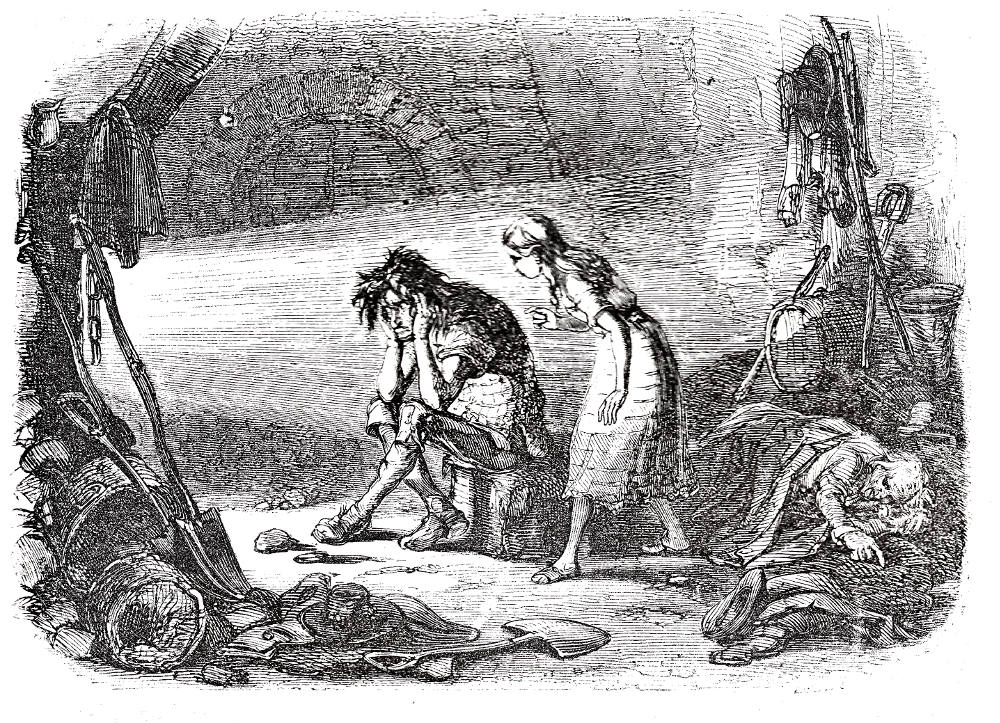
I also liked the description of the landscape as Nell leaves London, the change from town to countryside, then later through the industrial Midlands with its factories, furnaces and roaring steam-engines where people worked in terrible conditions. Nell and her grandfather spend a night in one of the furnaces, sleeping on a heap of ashes.

In a large and lofty building, supported by pillars of iron, with great black apertures in the upper walls, open to the external air; echoing to the roof with the beating of hammers and roar of furnaces, mingled with the hissing of red-hot metal plunged in water, and a hundred strange unearthly noises never heard elsewhere; in this gloomy place, moving like demons among the flame and smoke, dimly and fitfully seen, flushed and tormented by the burning fires, and wielding great weapons, a faulty blow from any one of which must have crushed some workman’s skull, a number of men laboured like giants. (pages 334-5)

Nell, herself, is a sweet, self-effacing and innocent character, who is left to look after her grandfather as he fails to overcome his gambling addiction. She goes into a decline and her slow death is, I suppose inevitable, although thankfully it is not described by Dickens. Child death is one of the themes of The Old Curiosity Shop as Nell’s death is not the only one.

The Old Curiosity Shop was written in 1840 – 1841 and serialised weekly in Master Humphrey’s Clock beginning on 4 April 1840 and ending on 6 February 1841. During this period the circulation of the periodical rose to a staggering figure of 100,000. It was Dickens’ fourth novel, influenced by the early death of his sister-in-law, Mary Hogarth, in 1837, which had profoundly shocked him. His work on The Old Curiosity Shop, particularly as he came to writing the end, revived the anguish he had experienced on her death.

The Old Curiosity Shop

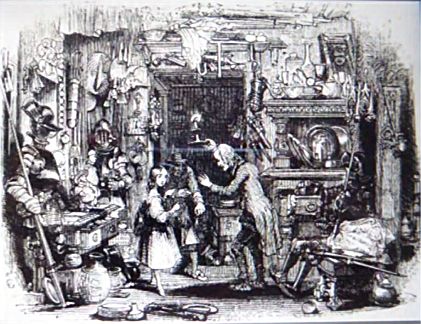
I read the Penguin Classics e-book which has the original illustrations by George Cattermole, Hablot K Browne (‘Phiz’), Daniel
Maclise and Samuel Williams.

The furnace

Despite the sentimentality I did enjoy reading The Old Curiosity Shop and it has made me keen to read more of Dickens’ books.

As well as being my Classics Club Spin, this book also qualifies for the Mount To Be Read Challenge and the Victorian Bingo Challenge.

Little Black Lies by Sharon Bolton

You can tell from the title what to expect from this book – lies, black lies, but they’re not little lies, they are whopping great big lies. The story is narrated by three of the main characters, Catrin, Callum and Rachel, all unreliable narrators either self deceptive, delusional or manipulative. They are all damaged characters.

Three years before the story begins Catrin’s two sons died in an accident caused by her then best friend Rachel. She has never got over it; they have haunted her ever since and she has not spoken to Rachel since then, determined to take revenge as the third anniversary of their death approaches. A year after their deaths Fred Harper went missing and was never found, then another boy, Jimmy Brown disappeared. As the story begins yet another boy, Archie West is missing. The nightmare continues with the disappearance of Peter, Rachel’s third and youngest son.

Little Black Lies is set in the Falkland Islands in 1994, twelve years after the war and Sharon Bolton’s descriptions of the islands paint a vivid picture of the isolation, the close knit community and war scarred landscape.

But there are a few things about this book that mean whilst I enjoyed the descriptive writing, the sense of place and the opening section very much I didn’t really like it. I began reading it with high expectations as it has received much praise and I’ve enjoyed everything else by Sharon Bolton that I’ve read. And although I was dismayed when I found it was written in the present tense (which is not my favourite style) I thought it was very promising and read on eagerly.

But when I finished it I gave it 3 stars on Goodreads, rounded up from 2.5 (Goodreads doesn’t have half marks!). I wasn’t keen on the focus on missing/dead children which so many books seem to have had recently. And it was a combination of the present tense and the way the plot descended into more of a farce with several twists and turns, particularly as the book draws to an end, one after the other that I just didn’t think was credible. The final  twist at the end came out of the blue for me, although thinking back it shouldn’t have been such a surprise. But I felt a bit cheated. In fact I’m rather annoyed with myself as I’d totally forgotten FictionFan had reviewed this book and I’d thought then that it was one that didn’t appeal to me – at least I was right!