The Good People by Hannah Kent

A heart-wrenching and beautiful novel.

I loved The Good People by Hannah Kent. It’s an intensely moving and beautifully written tale of Irish rural life in the early 19th century.

The Good People

Blurb:

County Kerry, Ireland, 1825.

Nóra bereft after the sudden death of her beloved husband, finds herself alone and caring for her young grandson Micheál. Micheál cannot speak and cannot walk and Nóra is desperate to know what is wrong with him. What happened to the healthy, happy grandson she met when her daughter was still alive?

MARY arrives in the valley to help Nóra just as the whispers are spreading: the stories of unexplained misfortunes, of illnesses, and the rumours that Micheál is a changeling child who is bringing bad luck to the valley.

NANCE’s knowledge keeps her apart. To the new priest, she is a threat, but to the valley people she is a wanderer, a healer. Nance knows how to use the plants and berries of the woodland; she understands the magic in the old ways. And she might be able to help Micheál.

As these three women are drawn together in the hope of restoring Micheál, their world of folklore and belief, of ritual and stories, tightens around them. It will lead them down a dangerous path, and force them to question everything they have ever known.

Based on true events and set in a lost world bound by its own laws, The Good People is Hannah Kent’s startling new novel about absolute belief and devoted love. Terrifying, thrilling and moving in equal measure, this long-awaited follow-up to Burial Rites shows an author at the height of her powers.

My thoughts:

I grew up reading fairy stories but The Good People gives a frighteningly realistic view of what belief in fairies meant to people dealing with sickness, disease, evil and all the things that go wrong in our lives. It’s set in 1825/6, a long gone world of people living in an isolated community, a place where superstition and a belief in fairies held sway. People talk of others being ‘fairy-swept’ or ‘away with the fairies’, and kept with the music and lights, dancing under the fairy hill.

Nóra is overcome with grief when her husband, Martin, died, feeling as though she was drowning and abandoned, completely unable to cope with Micheál, her four-year old grandson. There is talk that he is ‘fairy-struck’, unable to walk or talk and screaming uncontrollably when he is in pain or upset. She needed someone else to help her and so she hired Mary to look after Micheál. But Micheál did not improve and soon she comes to believe that he is a changeling. After both the doctor and the priest are unable to cure Micheál, Nóra appeals to Nance, the valley’s ‘handy woman’ for help.

This is a beautifully written book. It is not a fairy story, but one in which their existence is terrifyingly real to the people of the valley. The villagers believe that the fairies live in Piper’s Grave, ‘the lurking fairy fort’, at the end of the valley, a place where few people went, a neglected and wild place. People see lights there, glowing near a crooked whitethorn tree that stood in a circle of stone. Nance lives in a cabin in front of the wood a short distance from Piper’s Grave and not far from the river. She was the woman they wanted to help them bring their babies into the world, and who was the ‘gatekeeper’ at the end of their lives, the ‘keener’ when they died. She is the person Nance went to believing she could help bring back the little boy she loved.

I loved everything about The Good People, Hannah Kent is an excellent storyteller. The characters all spring to life, Nóra, Nance and Mary in particular. It’s not a world I know and yet I felt I did, with its mix of characters, old Peg O’Shea, Nóra’s nearest neighbour who helps when she can and the younger men and women who gossip and are quick to blame Micheál for bringing bad luck to the valley and to condemn Nance, who whilst they go to her for cures, also frightens them.

It is a heart breaking story and as it drew to its inevitable end I was really moved by the effect of fear, ignorance and superstition that brought about such a tragedy. The Author’s Note at the end of the book  explains that she drew on a real event from 1826 in writing The Good People. She has researched and listed many works of both fiction and non-fiction and also consulted many historians, curators and academics whilst writing the book.

Many thanks to the publishers and NetGalley for a review copy.

  • Format: Kindle Edition
  • File Size: 3007 KB
  • Print Length: 400 pages
  • Publisher: Picador; Main Market Ed. edition (9 Feb. 2017)
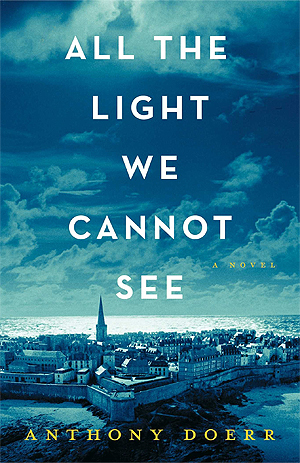
All the Light We Cannot See by Anthony Doerr

All the Light We Cannot See

Synopsis:

A beautiful, stunningly ambitious novel about a blind French girl and a German boy whose paths collide in occupied France as both try to survive the devastation of World War II

Marie-Laure has been blind since the age of six. Her father builds a perfect miniature of their Paris neighbourhood so she can memorize it by touch and navigate her way home. But when the Nazis invade, father and daughter flee with a dangerous secret.

Werner is a German orphan, destined to labour in the same mine that claimed his father’s life, until he discovers a knack for engineering. His talent wins him a place at a brutal military academy, but his way out of obscurity is built on suffering.

At the same time, far away in a walled city by the sea, an old man discovers new worlds without ever setting foot outside his home. But all around him, impending danger closes in.

Doerr’s combination of soaring imagination and meticulous observation is electric. As Europe is engulfed by war and lives collide unpredictably, ‘˜All The Light We Cannot See’ is a captivating and devastating elegy for innocence.

I have just finished reading All the Light We Cannot See by Anthony Doerr. I’m not going to write a review but want to jot down some thoughts:

  • It began well and I liked it straight away – see this Friday post.
  • There are three story lines – that of Marie-Laure, of Werner, and of a diamond that has magical powers.
  • But my overall picture of the book is of a blur, of confusion as it moved not only between characters but also backwards and forwards in time and I couldn’t work out the time sequence. I kept going back to the contents list to try to work it out was I in 1944 when the book began or in 1942, or 43. Had I met this character before in the future, or in the past and where was I -in France, Germany, Vienna or Russia? How did the characters relate to each other? I was hopelessly puzzled for quite a large portion of this book. For a while the fog in my mind cleared and I thought I’d got it, only to find a few chapters later I was lost again.
  • So I gave up trying to work out dates; places and people became clearer to me and I did (I think) follow the story, but it wasn’t easy as Marie-Laure’s and Werner’s time-lines were so fragmented.
  • The writing in parts is beautiful, great descriptions giving me some insight into what it was liked for ordinary people from both sides during the 2nd World War and what it must be like to be blind.
  • I liked all the detail of the model of Saint-Malo that Marie-Laure’s father made to help her find her way around, models of the buildings and roads.
  • The title refers (I think) to the how the brain, which is enclosed within the scull – ie in darkness – is yet full of light, brimming with colour and movement. And also to the light transmitted by radio wavelengths; light caught from the sun within plants and within gem stones such a diamonds; light beyond our ability to see it within the electromagnetic spectrum.
  • I was glad to get to the end. I think it is over-long, and very slow. But overall, mainly because of its descriptive prose; the way it conveys what being involved in war is like; and the character of Marie-Laure, I liked it and gave it 3 stars on Goodreads.

A book for Bev’s Mount TBR Reading Challenge, a book I’ve owned since 2016.

Two Inspector Morse Mysteries

I’ve got rather behind with writing about the books I’ve been reading so this post is on two of Colin Dexter’s Inspector Morse books, both are books from my TBR list. Colin Dexter wrote 13 novels in the series and I’ve been reading them out of order – just as I come across them.

22747030

The second book in the series is Last Seen Wearing, first published in 1976, in which Morse investigates a cold case. Two years previously schoolgirl Valerie Taylor had disappeared during her lunch hour from the Roger Bacon Comprehensive school. Her body had never been found and the case had been shelved but recently her parents had received a letter telling them she was ‘alright’ and they were not to worry.

Morse isn’t please when he was instructed to investigate Valerie’s disappearance but then is interested when he guesses that she is dead.  In fact he is convinced that she is dead. But throughout the novel he keeps changing his mind, coming up with theory after theory about what happened to her. Lewis meanwhile, who is assisting Morse, is sure that Valerie is still alive.

There are plenty of suspects, the headmaster of the school, the second master, the French teacher, one of her boyfriends, her mother and her stepfather all come under Morse’s scrutiny. It is a complicated investigation made even more so when the second master is found stabbed with a nine-inch kitchen knife.

I haven’t read the first book in the series, Last Bus to Woodstock, in which Morse and Lewis first work together, but this second book shows their working relationship is a good one and they have several lively discussions. Lewis whilst admiring Morse sees him clearly, noting that he always had to find a complex solution.

I was puzzled throughout and like Morse I kept changing my mind about it all and at one point I had the solution – as had Morse – but had then changed my mind. Of course, by the end of the novel Morse had it all worked out correctly.

The Dead of Jericho: An Inspector Morse Mystery 5

The Dead of Jericho is the 5th Inspector Morse book, first published in 1981. Colin Dexter wrote 13 novels in the series and I’ve been reading them out of order – just as I come across them. Years ago I watched the TV series of Morse. The Dead of Jericho was broadcast in January 1987, the first of Dexter’s books to be televised. I must have watched it but as it was so long ago I had completely forgotten the details.

Jericho is an area of Oxford, described in the book as a largely residential district consisting mainly of two-storey terraced mid nineteenth century houses and bounded by the Oxford Canal.

Morse met Anne Scott at a party and was immediately attracted to her. She gave him her address but thinking she was married he didn’t contact her until six months later when, being near where she lived, he impulsively called at her house at Canal Reach in Jericho. There was no reply, but the front door wasn’t locked and he stepped inside and after calling out Anne’s name and getting no reply, he closed the door behind him as he stepped out onto the pavement and left. Later that evening an anonymous phone call directed the police to Anne’s house where she was found dead. Apparently she had hanged herself.

Morse is assigned to the case and has to decide whether her death was suicide or murder. And when the police realise that Morse had been in the house that day he comes under suspicion for a while. There are various suspects and Morse as usual constructs theories which fit all of them, leaving Lewis to put him on the right track.

In both books Morse shows various aspects of his personality. He is clever, loves the opera,  and solving puzzles, particularly crosswords – he can do The Times crossword in under ten minutes. He is not a happy man; he is sensitive, melancholy, a loner and a pedant. His meanness comes out in the pub where he gets Lewis, on a much lower salary, to buy all their drinks. And in both books he is attracted  sexually to women.

Both books qualify for Bev’s Mount TBR Reading Challenge, being e-books I’ve had for over two years.

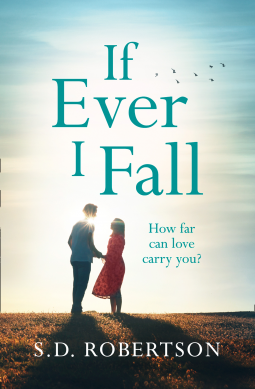
If Ever I Fall by S D Robertson

It’s always a bit of a gamble reading a book by an author you’ve never heard of before, but I thought If Ever I Fall by S D Robertson looked as though it would be a book I would like. It’s a story about a family in crisis, struggling to come to terms with a terrible tragedy. It is his second book, due to be published on 9 February 2017.

And reading the Prologue it seemed as though I was right. It begins mysteriously as a man surfaces from his dreams only to discover that he doesn’t know who he is. It appears that Miles has rescued him and tells him he had suffered a head trauma. He calls him Jack. But as I read on I became confused and struggled a bit to follow the narrative.
It’s difficult to write about this book without giving away spoilers. The structure of the novel confused me at first because the story moves between three characters’ perspectives – Maria, Dan, her husband and Jack- and between different time periods.

Maria’s side of things is told in letters to Sam moving forwards in time, whereas Dan’s story begins in the present and moves backwards in time, and Jack’s is timeless. At first I had to keep checking the chapter titles to find out what time period I was reading until I got the hang of it. It shouldn’t really have been that difficult as the style of each is different but it did take me a while to get into the story.

Maria’s letters are quite stilted – maybe that’s what they were meant to be as she is struggling to sort out and write her thoughts so that Sam will understand. Her letters are full of grief. But they are long-winded explanations of what she was thinking and feeling and they slowed down the narrative too much for me. She obsessed about her OCD, but maybe I’m being over critical and insensitive here because being obsessive is the essence of the condition after all, but it became quite dull to read. I was more interested in Dan’s story and especially in Jack’s.

It is Jack’s story that captivated me the most and each time the narrative went to Maria or Dan I wanted to get back to Jack to find out what was happening to him – because some very strange things were going on around him. He can’t work out if he can trust Miles who tells him that he is helping him to renovate a house by the sea. But Jack keeps finding that he is in other places, as a fog descends upon him, or he finds himself trapped in a tunnel unable to move, and he sees people who Miles tells him aren’t there. Whereas, Maria’s and Dan’s stories show them dealing with the same events in different ways, culminating in one tremendous tragedy  and growing increasingly apart. All three narratives are full of emotional and psychological tension.

About half way into the book I began to work out the storyline and how the three narratives linked together and was able to settle into enjoying the book, which did work out as I had anticipated.

It’s about what happens to family relationships hit by the most terrible tragedy, how grief affects us in different ways, and the psychological and emotional impact of amnesia and obsessive compulsive disorder. I think if the novel had followed the story in a straight forward chronological order it would not have had as much impact on me. It certainly gave me much to think about as I was reading it and afterwards.

My thanks to Avon Books UK and NetGalley for a review copy.

  • Format: Kindle Edition
  • File Size: 1149 KB
  • Print Length: 432 pages
  • Publisher: Avon (9 Feb. 2017)

4 *

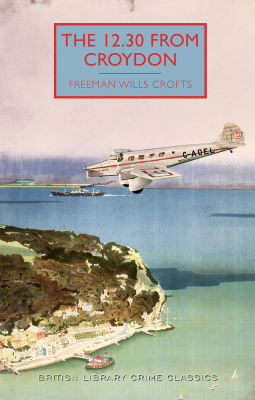
The 12.30 from Croydon by Freeman Wills Crofts

This is the second book by Freeman Wills Crofts that I’ve read. The first was Mystery in the Channel, which is a complicated murder mystery with plenty of red herrings and I had no idea about the identity of the killer. The 12.30 from Croydon couldn’t be more different – it begins with a murder but the identity of the murderer is known before he even thought of committing the crime.

The result is there is little mystery, as Charles Swinburne sets about murdering his uncle, Andrew Crowther, in order to inherit his fortune. It’s set in the early 1930s when the country is suffering the effects of the ‘slump’ and Charles’ business is on the edge of bankruptcy, and he is unable to raise the money to keep it going.

The major part of the book is taken up with describing how Charles became convinced that the only way out of his dilemma and the only way he could convince Una, a mercenary rich young woman, to marry him, was to kill Andrew. Consequently Andrew died on the 12.30 plane from Croydon. From that point onwards we see how Charles devised a plan and created an alibi that he thought would be perfect – and how it went wrong and how he was drawn into committing yet another murder.

Inspector French appears later on in the book to explain Charles’ thoughts and actions, and how he broke his alibi, just as Poirot sums up his thoughts and methods of deduction in Agatha Christie’s books.

The 12.30 from Croydon focuses on the psychology of the murderer and from that point of view I think it works well.  Charles’ personality is thoroughly explored, showing his ingenuity, efficiency, and the ways he overcame his scruples about murder were in the main convincing. But the in-depth detail of the planning means that it is hardly riveting reading. So whilst the plotting is clever my interest in the outcome flagged as the only thing to work out is would Charles get caught out, and would Inspector French break his alibi. But I did want to know how it would end.

What I found more interesting is the description of the thrill of the early passenger flights. In the opening chapter Rose Morley, Andrew’s young granddaughter flies to France with him and her father, Peter, because her mother had been knocked down and seriously injured by a taxi in Paris. Rose thinks the plane looks like a huge dragonfly. From her seat her view through the window was of the lower wing with its criss-cross struts connecting it to the upper wing. She was delighted by the whole process the increasing speed and the roar of the motors as the plane miraculously left the ground. Peter remarks that it was a wonderful improvement on the early machines when you had to stuff cotton wool in your ears. Rose loved the whole experience.

I also like the setting Crofts created for the novel – the enormous pressure that drove Charles to take such drastic action due to the financial disasters of the period in the 1930s is well presented. I liked the book but as I enjoy trying to work out the why and the how for me it needed more mystery, and more red herrings.

 My thanks to Netgalley and Poisoned Pen Press for a review copy of The 12.30 From Croydon. It was first published in 1934; this edition with an introduction by Martin Edwards was published in 2016 by Poisoned Pen Press in association with the British Library.

Amazon UK link

Amazon US link

This is my first book for the What’s in a Name 2017 in the category of ‘a number in numbers’.

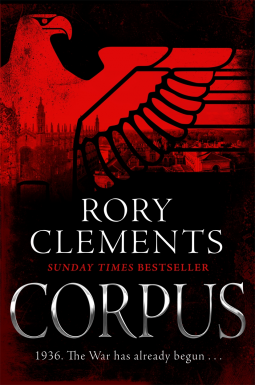
Corpus by Rory Clements

Rory Clements is best known for his John Shakespeare series, but Corpus is the first of his books I’ve read, so I was unsure that I would like it when I received an ARC from NetGalley. It is due to be published on 26 January 2017. (I read Corpus in December 2016.)

Blurb

1936.

Europe is in turmoil.

The Nazis have marched into the Rhineland.

In Russia, Stalin has unleashed his Great Terror.

Spain has erupted in civil war.

In Berlin, a young Englishwoman evades the Gestapo to deliver vital papers to a Jewish scientist. Within weeks, she is found dead in her Cambridge bedroom, a silver syringe clutched in her fingers.

In a London club, three senior members of the British establishment light the touch paper on a conspiracy that will threaten the very heart of government. Even the ancient colleges of Cambridge are not immune to political division. Dons and students must choose a side: right or left, where do you stand?

When a renowned member of the county set and his wife are found horribly murdered, a maverick history professor finds himself dragged into a world of espionage which, until now, he has only read about in books. But the deeper Thomas Wilde delves, the more he wonders whether the murders are linked to the death of the girl with the silver syringe – and, just as worryingly, to the scandal surrounding King Edward VIII and his mistress Wallis Simpson…

Set against the drumbeat of war and moving from Berlin to Cambridge, from Whitehall to the Kent countryside, and from the Fens to the Aragon Front in Spain, this big canvas international thriller marks the beginning of a major new series from bestselling author Rory Clements.

My thoughts:

The setting in 1936 is well done, a time when Europe was once more on the brink of war. Civil war has broken out in Spain, in Britain some people are openly supporting the Nazis in Germany and politicians are torn between wanting Edward VIII to abdicate the throne or give up his relationship with Wallis Simpson. Against this background Corpus focusses on Tom Wilde’s investigations first into Nancy’s death, aided by her friend Lydia, who is convinced that Nancy was murdered, and then into yet more murders.

I was totally convinced by the characters, in particular Tom Wilde, a professor of history who is writing a biography of Sir Robert Cecil, the Elizabethan and Jacobean statesman, the successor to Sir Francis Walsingham as the Queen’s spymaster (a nod to his earlier series, I thought). And I was immersed in the mysteries, with spies, communists and Nazis, Spanish Gold, Soviet conspirators, politicians and academics all intricately woven into the plot. It’s pacy, full of action, violence and double-cross – a most satisfying and compelling thriller.

I loved Corpus and I shall certainly look out for Rory Clements’ other books.

  • Hardcover: 384 pages
  • Publisher: Zaffre (26 Jan. 2017)
  • Language: English
  • ISBN-10: 1785762613
  • ISBN-13: 978-1785762611
  • Source: review copy via NetGalley