The Confession by Jo Spain

Publication date: 25 January 2018, Quercus Books

Review copy from the publishers, via NetGalley

My rating:  4 stars 

The Confession is the first book by Jo Spain that I’ve read, so I didn’t know what to expect. But the blurb interested me and I’m delighted to say that I enjoyed this book and as this is Jo Spain’s fifth book I’ll be able to read more of her work. She is the author of the Inspector Tom Reynolds Mystery books, police procedurals based on the investigations of a Dublin-based detective team. The Confession is a standalone book.

Set in Ireland, it begins as Harry McNamara, a banker, recently cleared of multiple accounts of fraud, is brutally attacked in his own home in front of his wife, Julie. The attacker, JP Carney immediately goes to the police and confesses that he had killed Harry.  JP insists he doesn’t know the identity of the man he attacked and that he didn’t know what had come over him – it was as though he’d been possessed.

It’s narrated from three different perspectives – that of Julie, JP and DS Alice Moody, leading the investigation. So, was JP telling the truth, did he really know who Harry was and why did he attack him so viciously that he died after being in a coma for several days? What did he whisper in Harry’s ear as he left him at the end of the attack? And why did Julie just sit there watching?

These questions form the focus of the book, as Julie and JP go back over their lives, leading up to that fatal attack. At first it isn’t at all clear what had actually led up to JP’s attack on Harry, but it is clear that he hadn’t had an easy life, growing up with a mother suffering from mental health issues who left him with his shiftless father. Julie and Harry’s marriage was in difficulties, despite his wealth – he was unfaithful and she resorted to alcohol to compensate for his neglect. They’re all flawed characters and not very likeable. Alice Moody is, however, a likeable character, astute and suspicious of JP’s account right from the start.

There are several twists and turns before I began to see the light, after changing my mind about the truth of the matter, first leaning one way then another. But I hadn’t foreseen the final twist. The characters are well-drawn and the book is well paced. I didn’t find it thrilling or chilling after the opening chapter, but I was gripped by the story and I had to read it quickly to find out what really happened.

My thanks to the publishers for a review copy via NetGalley.

Turning for Home by Barney Norris

Love and loss, grief and guilt

Publication date 11 January 2018, Random House UK

Review copy from the publishers, via NetGalley

My rating:  4.5 stars (I’ve rounded this up to 5 on Goodreads)

Blurb:

Isn’t the life of any person made up out of the telling of two tales, after all? People live in the space between the realities of their lives and the hopes they have for them. The whole world makes more sense if you remember that everyone has two lives, their real lives and their dreams, both stories only a tape’s breadth apart from each other, impossibly divided, indivisibly close.’

Every year, Robert’s family come together at a rambling old house to celebrate his birthday. Aunts, uncles, distant cousins – it has been a milestone in their lives for decades. But this year Robert doesn’t want to be reminded of what has happened since they last met – and neither, for quite different reasons, does his granddaughter Kate. Neither of them is sure they can face the party. But for both Robert and Kate, it may become the most important gathering of all.

My thoughts:

Beautifully and lyrically written, I was soon totally absorbed in this book, alternating between Robert’s and Kate’s stories, as they reveal their thoughts and emotions, reflecting on their lives. It’s set on the day of Robert’s 80th birthday celebration. Still grieving after his wife’s recent death, he is finding it a sad, rather than a joyful occasion as the family gather together. His granddaughter, Kate is troubled at the thought of meeting her mother again after a three year estrangement. Then Robert’s day is interrupted by a phone call from Frank, a retired Oxford professor, whom he had known from his days as a civil servant working in Ireland, particularly at the time of the Remembrance Day bombing in Enniskillen in 1987.

The narration is split between Robert and Kate interspersed with extracts from the Boston Tapes, an oral history of the Troubles in Northern Ireland recording the recollections of combatants on both sides. What Frank reveals to Robert shocks him and he struggles to come to terms with it. In parts it moves slowly, particularly as Kate reflects on her life, revealing what caused the break-up with her mother and recounting the pain she had gone through with her anorexia and the guilt she feels over her boyfriend’s  car accident. I found it a moving book with emotional depth.

My thanks to the publishers for a review copy via NetGalley.
Amazon UK link
Amazon US link

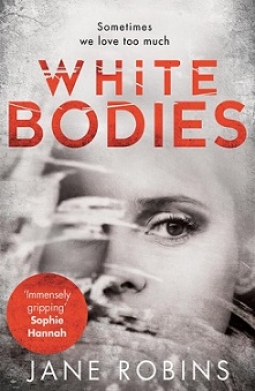
White Bodies by Jane Robins

A Tale of Obsession and Manipulation

Publication date 28 December 2017, HQ

Review copy from the publishers, via NetGalley

My rating:  2.5 stars (I’ve rounded this up to 3 on Goodreads)

Blurb:

‘He’s so handsome and clever and romantic. I just wished he hadn’t forced Tilda under the water and held her there so long.’

Callie loves Tilda. She’s her sister, after all. And she’s beautiful and successful.

Tilda loves Felix. He’s her husband. Successful and charismatic, he is also controlling, suspicious and, possibly, dangerous. Still, Tilda loves Felix.

And Callie loves Tilda. Very, very much.

So she’s determined to save her. But the cost could destroy them all…

Sometimes we love too much.

My thoughts:

Twins, Callie and Tilda are two very different people, both in appearance and personality. The blurb doesn’t give away much of the book but the idea interested me. It begins with Felix’s death and then goes back over the events that led to his death. So far, so good and I thought this was an interesting opening and that I was going to enjoy this book, even though it’s written in the present tense (not my preferred style). But very early on I realised what the eventual outcome would be when a certain film was mentioned and I know this is not unique – many other books are based on earlier books or plays and it is said that there are just seven basic plots in literature – but it really irritated and disappointed me. So it has left me in two minds about this book.

Parts of it fascinated me (I wanted to know how Felix died for example), the characters are certainly interesting/weird – not likeable, except for Wilf, Callie’s boyfriend. It’s really a story of obsession in various forms, manipulation and the dangers of the internet. Callie’s obsession with Tilda (eating her hair, teeth etc), Tilda’s obsession with herself and Felix’s obsession with OCD, control (re-organising Tilda’s flat), tidiness and neatness (aligning cutlery and wrapping crockery etc in clingfilm). The events are seen through Callie’s perspective and at times I felt sympathy for her in her desire to protect Tilda from the dangers she could see she was in from Felix. But is her view skewed? And her foray into an internet forum is the beginning of the end for her.  But overall, I wasn’t convinced by the book and I didn’t find it particularly tense or chilling, just rather strange. Maybe I’ve been reading too many books in this genre to be convinced.

My thanks to the publishers for a review copy via NetGalley.

Other people, however, have enjoyed this book far more than me – for example see Fanfiction’s review and this one from Cleo.

Amazon UK link
Amazon US link

A Maigret Christmas by Georges Simenon

A Christmas Mystery

Publication date 2 November 2017, Penguin Books (UK). Newly translated by David Coward

Review copy from the publishers, via NetGalley

My rating: 4 stars

The review copy of A Maigret Christmas and Other Stories by Georges Simenon I received contains just one of the three stories in this collection, A Maigret Christmas which was first published in 1950 as Un Noël de Maigret.

It’s set in Paris on Christmas Day. Inspector Maigret has the day off and Madame Maigret, hoping to bring him croissants for his breakfast in bed, as she usually does on Sundays and public holidays, is disappointed to find that he had got up before she returned from the corner shop. Both Maigret and his wife are feeling not exactly depressed but rather melancholy, with no family to visit at Christmas.

Their plan to spend a quiet morning cocooned in their apartment is disrupted by the arrival of two ladies, Madame Martin and Mademoiselle Doncoeur, who live in the apartment opposite in the Boulevard Richard-Lenoir. Colette, a little girl staying with her aunt and uncle, Madame Martin and her husband, had woken in the night and seen Father Christmas in her room, making a hole in the floor. He gave her a present, a big doll and then held up his finger to his lips as he left. But who was he and why was he trying to take up the floorboards?

Maigret, concerned about Colette, decides to help and, phoning his colleagues at the Quai des Orfevres for information, he spends the rest of the day solving the mystery. As the mystery is unravelled it turns out to be anything but simple. I enjoyed this story for the mystery itself, but I also liked the light it throws on Maigret and his wife, their relationship and the sadness they feel at being childless, particularly so at Christmas.

My thanks to the publishers for a review copy via NetGalley.

Amazon UK link

Catching Up with Inspector Banks

Last month I read A Necessary End and Past Reason Hated by Peter Robinson, books 3 and 5 in his Inspector Banks series. I’ve read a few of his books out of order and I’m now filling in the gaps in my reading.

In A Necessary End a policeman is killed at an anti-nuclear demonstration in Eastvale. With over a hundred people at the demonstration at first there are plenty of suspects, but it soon becomes apparent that the main suspects are the organisers of the demonstration and the people living at Maggie’s Farm, an old Dales farmhouse set on the moors above the dales, the home of Seth Cotton.

To complicate matters Banks’ friend, Jenny Fuller is in a relationship with Dennis Osmond, a social worker and one of the main organisers of the demonstration. Jenny can’t believe that Dennis could be the culprit as he’d told he the last thing they had wanted was a violent confrontation.

This is the first book to introduce Detective Superintendent Richard ‘Dirty Dick’ Burgess, a troubleshooter from London called in to help with the investigations. Banks had worked with him a couple of times when was working in London and is not happy to see him. Because of this Banks works independently of Burgess and eventually gets to the bottom of the mystery.

Past Reason Hated is set just before Christmas when Caroline Hartley is found brutally murdered in her home she shared with Veronica Shildon. Three people had been seen visiting the house separately that evening. Nobody could describe them clearly – it had been dark and snowing and the street was not well lit and the investigation into her death centres on identifying them.

There are a number of suspects, among them is Charles Ivers, Caroline’s ex-husband, whom she had left to live with Veronica. There are also the members of the Eastvale amateur dramatic society who are rehearsing for a performance of Twelfth Night at the community centre. Caroline had a small part. But Banks is also interested in the music that was playing  when Caroline was found – the Laudate pueri – and in identifying the woman whose photo was found in Caroline’s belongings.

Both of these books are enjoyable but I preferred Past Reason Hated, because it has so many strands, which of course all interlinked and because of Robinson’s descriptions of the scenery in a snowy December. I also liked the focus on Susan Gay, newly promoted to Detective Constable as she stumbles to find her way in the team.

I am now addicted to the Banks books, which I enjoy more than the TV series. Both these books are from my TBRs.

Of Women by Shami Chakrabarti

A global perspective on gender injustice

Publication date 26 October 2017, Penguin, 229p. 

Review copy from the publishers via NetGalley

My rating: 3 stars

Shami Chakrabarti is passionate, and indeed angry, about the need for gender equality in her book Of Women: in the 21 Century.  She examines the effects of gender injustice on a wide variety of issues in many parts of the world. In parts it reads like a dry academic textbook, packed full of statistics and wide ranging examples of gender injustice on a global scale. It becomes more personal however, when she writes about her own experiences her family and her background.

She covers a broad overview of many issues, rather than an in depth study, including violence against women, abortion, sanitary products, childcare and sex education and topics such as faith, the concept of home and displaced persons, health, wealth, education, representation, opportunity and insecurity in the 21st century. There are so many issues for just one book of just 229 pages and it is depressing reading for the most part, even though she suggests a number of initiatives to improve matters.

However, she remains optimistic, concluding that she believes that ‘far greater equality for women and men is realistically within our reach and well worth the stretch.’ I don’t think it is that easy and will need more than a ‘stretch’.

There is an extensive list (for each chapter heading) of ‘Further Reading and Viewing’ at the end of the book, but I think it would also be helpful to have an index to the wide ranging issues covered in this book.

Shami Chakrabarti is a former director of Liberty (2003-16), is Labour’s Shadow Attorney General, a member of the House of Lords, and the author of On Liberty, a book about human rights violations published in 2014.

My thanks to the publishers for a review copy via NetGalley.

Amazon UK