Wakenhyrst by Michelle Paver

A tale of mystery and imagination laced with terror. 

Wakenhyrst

Head of Zeus|4 April 2019|e-book 5683 KB|Review copy|4*

Wakenhyrst by Michelle Paver is a dark and sinister tale, full of menace and suspense. It’s a slow-burner, told through different points of view, that builds to a climax with a sad twist in the story right at the end – one I hadn’t seen coming. It’s set in a remote hamlet in the Suffolk Fens, an eerie waterlogged landscape where Edmund Stearn, a historian, and his family live in a large manor house, Wake’s End, on the edge of the Fens, said to be the oldest and most rotten of fens. It was a place of dread, haunted by spirits and the home of eels and other foul creatures.

The novel begins with a magazine report in 1966 on the events that took place at Wake’s End in 1913 when sixteen-year old Maud Stearne watched her father, Edmund, leave the house, armed with an ice-pick and a geological hammer and murder the first person he came across in the orchard. Maud was the only witness. She is now a recluse and in 1913 she had only spoken briefly at his trial. But now she needs money to repair the ancient manor house that is her home and has invited the journalist to Wake’s End. He believes Edmund was innocent and hopes to discover the truth – was Edmund mad and what did he write in his notebook that Maud has never confirmed even existed? Maud’s evidence was full of holes – did she commit the murder and frame her father, who took the blame?

 Edmund never explained why he did it, or how he ended up in the well, screaming with terror as he fought off a mass of eels. He spent the rest of his life in an asylum, where he created three paintings that astonished the world – grotesque paintings full of colour and tiny malevolent faces leering out of the canvas, the stuff of nightmares. 

What follows is a story of disintegrating madness, revealed in Edmund Stearne’s notebook as the reporter persuades Maud to tell her story, going back to her childhood, when her mother was still alive. Her mother got the same illness every year, or so Maud believed – an illness where her middle swelled, resulting in a period of ‘groaning’, as her middle would burst and ending with either ‘a bloody chamberpot’, or a dead baby. When she died Maud blamed her father and believed he was insane when he became obsessed with the medieval painting  of the Last Judgement, known as the Doom, that he found in the churchyard. He connects the Doom with the writings of Alice Pyett, a medieval mystic whose book he was transcribing.

There is a sense of impending disaster as the tale unfolds. Whilst the fens are a source of dread and fear for Edmund, they are a place of solace and beauty for Maud. The book is full of the folklore and customs of the local people and their belief in the spirits that haunt the fen – ferishes, Jack-o’-Lanterns and Black Shuck – Michelle Paver notes in her Author’s Note that she has not invented these. Maud’s childhood, her fear of her father and his violence towards her and her mother, are scenes that are based on the misogynist attitudes of the period.

Maud’s life was run by her father’s rules. She had no friends or companions apart from the servants, whose lives were ruled by superstitions, until she met Jubal Rede, the wild man who lived in the fen. He was kind to her and taught her the ways of the fen. But there is also Chatterpie, the magpie she rescued from the well and grew to love, and then Clem, the young under-gardener who she also grew to love.

It’s a compelling story, steeped in atmosphere, with characters typical of an earlier age whose lives were oppressed and isolated from the wider world. I loved the setting, the mysterious fenland, the horrific gothic and dark nature of the story, the mystery of the murder and most of all I loved Maud and her independent spirit that brought her through the nightmare.

My thanks to the publishers, Head of Zeus for my review copy via NetGalley.
Dear Mrs Bird by A J Pearce

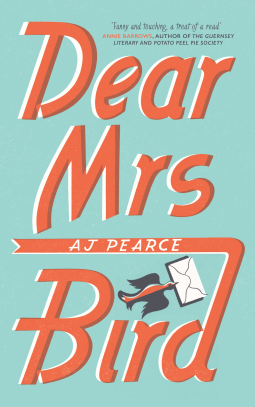
Picador|5 April 2018 |288 pages|Kindle edition |Review copy|3* I wasn’t sure I would like Dear Mrs Bird by A J Pearce because, although it’s historical fiction and one of my favourite genres, it has received so much hype that made me wonder if it was over-hyped and whether I’d find it a bit of a disappointment. 

The Frank Business by Olivia Glazebrook

The Frank Business John Murray Press|7 March 2019 |288 pages|e-book |Review copy|4* I enjoyed The Frank Business by Olivia Glazebook very much. It’s about a rather dysfunctional family in crisis and it begins dramatically:

The Man on a Donkey by H F M Prescott

The Man on a Donkey

Apollo|2016|756 pages|e-book|3.5*

This was first published in 1952.

Description:

In 1536, Henry VIII was almost toppled when Northern England rose to oppose the Dissolution of the Monasteries. For a few weeks Robert Aske, the leader of the rebels, held the fate of the entire nation in his hand … An enthralling novel about a moment in history when England’s Catholic heritage was scattered to the four winds by a powerful and arrogant king.

Opening paragraph:

Sir John Uvedale had business at Coverham Abbey in Wensleydale, lately suppressed, so he sent his people on before him to Marrick, to make ready for him, and to take over possession of the Priory of St. Andrew from the Nuns, who should all be gone by noon or thereabouts. Sir John’s steward had been there for a week already, making sure that the Ladies carried away nothing but what was their own, and having the best of the silver and gold ornaments of the Church packed up in canvas, then in barrels, ready to be sent to the King. The lesser stuff was pushed, all anyhow, into big wicker baskets; since it would be melted down, scratches and dints did not matter.

My thoughts:

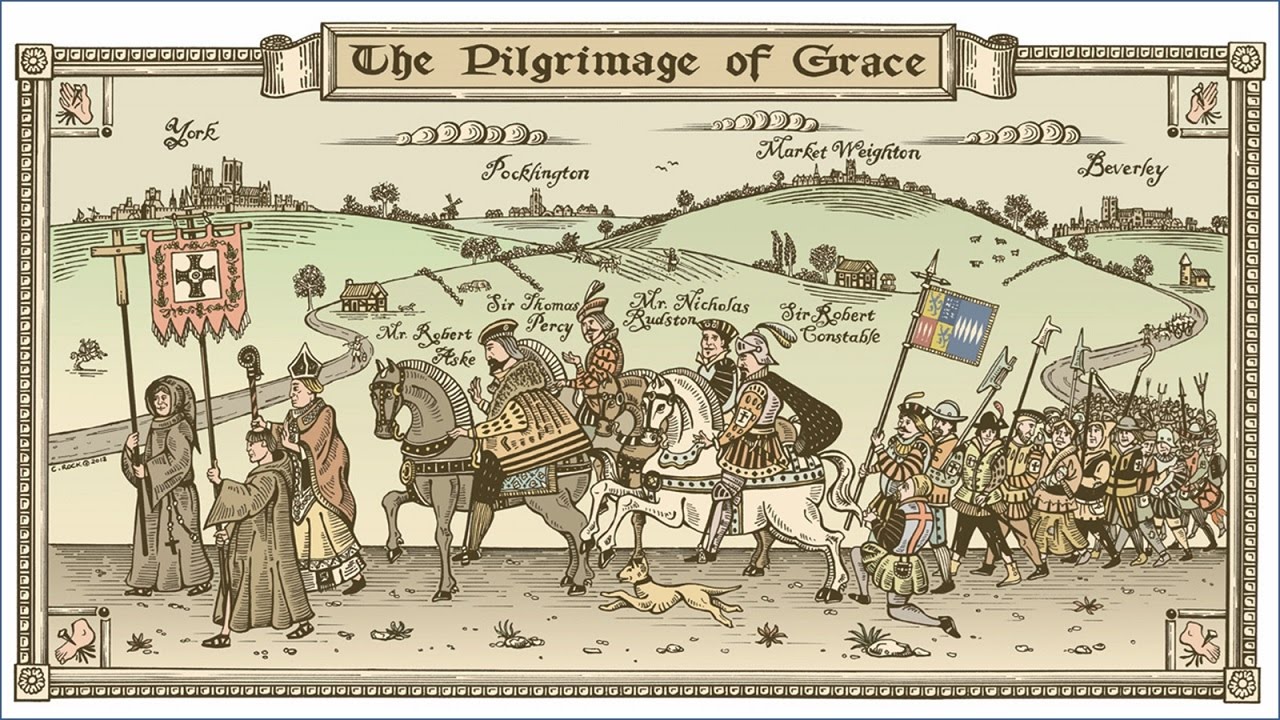
The Man on a Donkey is the longest book I’ve read this year and at times I thought it was overlong. It certainly is not a book to read quickly, as John Cooper writes in his Introduction it ‘requires persistence from the reader.’ Hilda Prescott (1896 – 1972) was a historian and biographer as well as a novelist and based this novel on documentary evidence relating to the Pilgrimage of Grace in 1536 led by Robert Aske, a lawyer. It was a protest against Henry VIII‘s break with the Roman Catholic Church, the Dissolution of the Monasteries, and the policies of the King’s chief minister, Thomas Cromwell.

Related image

It’s written in the form of a chronicle, written from the various characters’ viewpoints. It’s as much about the ordinary people as the rich and powerful. There are many characters including many real historical people, such as Henry VIII, Katherine of Aragon, Anne Boleyn, Thomas Cromwell, Princess Mary and Thomas More amongst others. The two main characters are historical figures too – Robert (Robin) Aske and Christabel Cowper, the last Prioress of the Benedictine nunnery at Marrick in Yorkshire. They and the fictional characters came to life as I got used to their individual voices – some instantly likeable, such as Robin and Christabel despite their flaws and others so despicable. Henry VIII, a tyrant and Thomas Cromwell, a real villain, for example were much reviled as between them they created fear and terror in a totalitarian regime.

In fact this book is in line with much of what I had learnt of the period from history lessons at school, films, books and TV series up until I read Hilary Mantel’s books that portray a much kinder view of Cromwell. But just like Mantel’s books, this book transported me back to that time, with lyrical descriptions of the settings, both of the countryside and of the towns, of Marrick Priory and of the king’s court, of the people, and the mood of the times, both religious and political

The Pilgrimage of Grace was not a revolution against Henry but an attempt to get him to change his mind and to understand how people felt. They wanted Henry to stop the dissolution and his attacks on the monks and nuns and to return the country to following the Pope. There were several uprisings and thousands of people were involved, nobles as well as the ‘commons’. But it cost many people their lives in excruciating pain as they were hanged, drawn and quartered.

The source of the book’s title comes from the mystic, Malle, a  simple-minded young woman who the nuns had bought at a York market in the belief that she was a mermaid. She is a strange character who sees a vision of Christ riding on a donkey over a bridge across a stream in the Yorkshire countryside. Her visions and strange sayings continue to puzzle and frighten people throughout the book.

Reading A Man on a Donkey has reminded me that I have Tracy Borman’s biography of Thomas Cromwell still to read. It’s a detailed account of his life, subtitled ‘the untold story of Henry VIII’s most faithful servant’. I wonder what this will reveal about Cromwell’s controversial  character?

The Wych Elm by Tana French

The Wych Elm Penguin UK Viking|21 February 2019 |517 pages|e-book |Review copy|4*

Excellent Intentions by Richard Hull

Excellent Intentions

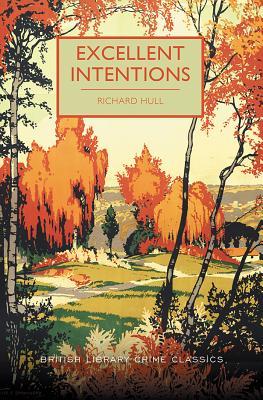
Poisoned Pen Press|2 October 2018 |227 pages|e-book |Review copy|2.5* This edition, published in association with the British Library, has an introduction by Martin Edwards. It was first published in 1938 by Faber and Faber. It’s the second book by Richard  Hull that I’ve read. However, I didn’t think Excellent Intentions was as enjoyable as the first one, The Murder of My Aunt. Henry Cargate, of Scotney End Hall, died on a train for London, from a heart attack brought on when he inhaled snuff laced with potassium cyanide. He was an unpleasant man, the most disliked person in the village of Scotney End and several people were suspected of murdering him. One of those suspects (who is not named until near the end of the book) was arrested and is on trial for his murder. The potassium cyanide crystals, mixed into Cargate’s snuff had been bought to destroy a wasps’ nest. So, Inspector Fenby’s investigation concentrates on the limited opportunities available for the murderer to add the poison to Cargate’s snuffbox, which he kept in his study. The book begins as the counsel for the prosecution makes his opening speech and makes his case for the judge and jury. It then follows the trial through its various stages to the verdict and subsequent appeal. My problem with this book is that it is so very factual and focused on the times that no one was in Cargate’s study, concentrating on four people that Fenby suspected had an opportunity to tamper with the snuff, and on the position of the bottle of potassium cyanide – whether it was on the desk or on the window sill. It’s clever, but it’s also repetitive and very long-winded. But, I liked the twist in the conclusion. My thanks to the publishers, Poisoned Pen Press, for my review copy via NetGalley. This is qualifies for the Mount TBR Challenge and for the Calendar of Crime Challenge for September in the category of the author’s birth month.