How to Disappear by Gillian McAllister

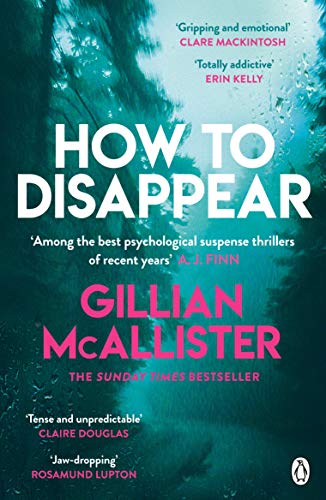
I’ve read three books by Gillian McAllister and enjoyed each one so I was delighted when I saw that she has a new book, How To Disappear published today. But, I have mixed feelings about this book, because although it is so tense in parts and is compulsive reading – I really wanted to know what happens next – I did have difficulty in suspending my disbelief for a large part of it. I liked the originality of the story – a murder mystery that is not a police procedural or an amateur detective story, but the story of a family devastated by their experience of being in witness protection. Although I’ve seen TV dramas about witness protection I’ve never read a novel before about it.

Blurb:

What do you do when you can’t run, and you can’t hide?

Lauren’s daughter Zara witnessed a terrible crime. But speaking up comes with a price, and when Zara’s identity is revealed online, it puts a target on her back. The only choice is to disappear. To keep Zara safe Lauren will give up everything and everyone she loves, even her husband. There will be no goodbyes. Their pasts will be rewritten. New names, new home, new lives. The rules are strict for a reason. They are being hunted. One mistake – a text, an Instagram like – could bring their old lives crashing into the new. They can never assume someone isn’t watching, waiting.

As Lauren will learn, disappearing is easy. Staying hidden is harder…

I thought it began well, although, it’s written in the present tense, often a stumbling block for me, setting the scene and establishing the characters. Zara is fourteen when she witnesses the murder of a homeless man by two teenagers. A year later she gives evidence as Girl A, to protect her identity, at the trial of two teenage footballers. But it all goes wrong, the boys are freed and after the trial a search is on to discover her identity and make her pay for what she did. As the situation escalates she is forced to go into witness protection.

This is a dark, intense story about what happened next, and going into more detail about what led up to the murder. It’s told from the four main characters’ viewpoints – Zara, Lauren her mother, Aidan her stepfather and his daughter Ruby. It moves along at quite a good pace, although sometimes I thought it was a bit repetitive about long hot baths or lack of a long hot bath, comfort eating cakes, and compulsive shopping.

The main themes of the book are about witness protection, parenting and family relationships. Gillian McAllister explains in her Author’s Note that there are many blanks she was unable to fill in, ‘due to the UK’s protection service not wishing to reveal their secrets’ to her. She hopes it is ‘believable despite basically having … made it up.’ I found it believable up to a point, but it was the characters’ behaviour that I found so far-fetched. However, it certainly made me wonder how I would cope in witness protection, faced with being unable to contact the family I’d left behind in anyway for fear of the consequences. But, most of all, I didn’t enjoy reading it, and for me that is important when I’m reading a novel. It left me drained – and the ending felt so contrived that it really spoiled the whole book for me.

This was not an easy book for me to review, especially as I was expecting to enjoy it as much as her earlier books!

  • Format: Kindle Edition
  • File Size: 1560 KB
  • Print Length: 480 pages
  • Publisher: Penguin (9 July 2020)
  • Source: Review copy
  • My rating: 2

My thanks to the publishers, Penguin for my review copy via NetGalley.
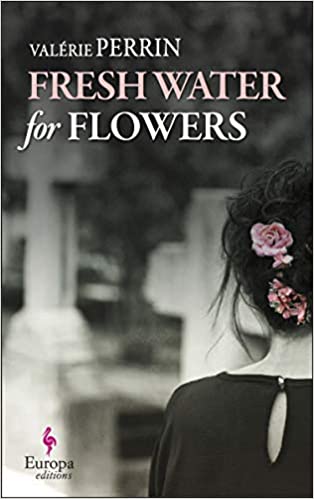
Fresh Water for Flowers by Valerie Perrin

I finished reading  Fresh Water for Flowers by Valérie Perrin a while ago, so this is just a brief post which really doesn’t do justice to this beautifully written book, translated from the French by Hildegarde Serle. It will be published by Europa Editions on 7 July 2020. My copy is an uncorrected proof from NetGalley.

This is a story of love and loss – and hope. Violette, the caretaker at a cemetery in a small town in Bourgogne, is a character I really warmed to; she is optimistic, brave, creative and caring. This is very much a character driven story, and full of original and quirky characters, such as the three gravediggers – Nono, Gaston and Elvis. But it is also a story with a mystery at the heart of it – as Julien Seul, the policeman is delving into his mother’s past, intrigued by her wish to have her ashes scattered far from her home and on the grave of a stranger.

It is also an emotional and moving story about Violette, her estranged husband, Phillippe, his miserable parents and their young daughter, Leonine. What happened to Leonine is especially tragic. But this a story full of warmth and happiness and life in the cemetery is full of surprises and joy. It is not what I expected to be and I am so pleased I’ve read it.

I haven’t said very much about the plot – so here is the publishers’ description:

A POIGNANT RUNAWAY BESTSELLER full of French charm and memorable characters, Fresh Water for Flowers is Valérie Perrin’s English debut.

Violette Toussaint is the caretaker at a cemetery in a small town in Bourgogne. Casual mourners, regular visitors, and sundry colleagues—gravediggers, groundskeepers, and a priest—visit her to warm themselves in her lodge, where laughter, companionship, and occasional tears mix with the coffee she offers them. Her life is lived to the rhythms of their funny, moving confidences.

Violette’s routine is disrupted one day by the arrival of Julien Sole—local police chief—who insists on scattering the ashes of his recently deceased mother on the gravesite of a complete stranger. It soon becomes clear that Julien’s inexplicable gesture is intertwined with Violette’s own difficult past.

With Fresh Water for Flowers, Valérie Perrin has given readers an intimately told story that tugs on the heartstrings about a woman who believes obstinately in happiness, despite it all. A number one bestseller in France, Fresh Water for Flowers is a heartwarming and tender story that will stay will readers for years after the final page is turned.

My thanks to the publishers and NetGalley for an uncorrected proof copy.


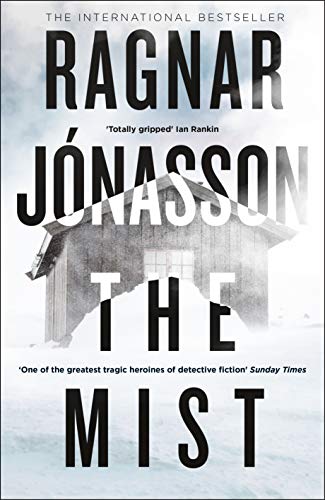
The Mist by Ragnar Jonasson

Nordic noir, as bleak, cold, snowy and empty as Iceland.

Penguin UK – Michael Joseph/ 30 April 2020/ 320 pages/ review copy/ 4*

About the book

1987. An isolated farm house in the east of Iceland.

The snowstorm should have shut everybody out. But it didn’t.

The couple should never have let him in. But they did.

An unexpected guest, a liar, a killer. Not all will survive the night. And Detective Hulda will be haunted forever.

My thoughts

The Mist is the third novel in Ragnar Jonasson’s Hidden Iceland series, translated from the Icelandic by Victoria Cribb. The trilogy began with The Darkness in which Detective Inspector Hulda Hermannsdottir was on the verge of retirement. The second book, The Island goes backwards in time with an investigation in 1997. The Mist featuring Hulda goes back yet again to 1987 as Hulda is worrying about her daughter, Dimma and her relationship with her husband, Jon. Alongside the story of what is happening in her personal life, she is also investigating the disappearance of a young woman and a suspected murder case, a particularly horrific one in an isolated farmhouse in the east.

I thought the first part of this book, about Erla and her husband, Einar, who live in the furthest reaches of eastern Iceland was completely gripping, especially with the arrival of a stranger lost in a snowstorm. Erla invites him in and the nightmare begins. This is one of those books where to know too much about the plot would really spoil it. All I’m going to say is that it starts slowly, and the tension and suspense gradually rise throughout, with an increasing sense of dread.

I loved the setting, Jonasson’s writing bringing the scenery and the weather to life – you can feel the isolation and experience what it is like to be lost in a howling snowstorm. The emotional tension is brilliantly done too, the sense of despair, confusion and dread is almost unbearable. My only criticism, a small one, is that when I reached a certain point in the novel, quite a bit before the end, it seemed obvious to me what the outcome would be. It didn’t spoil my enjoyment, but I would have preferred not to have known and is the reason I’ve given this 4 stars instead of 5.

My thanks to the publishers for my copy via Netgalley.

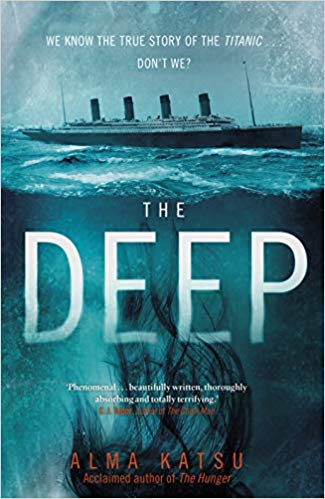
The Deep by Alma Katsu

Random House Bantam Press| 5 March 2020| 391 pages|e-book| Review copy| 3*

About the Book

Deaths and disappearances have plagued the vast liner from the moment she began her maiden voyage on 10 April 1912. Four days later, caught in what feels like an eerie, unsettling twilight zone, some passengers – including millionaire Madeleine Astor and maid Annie Hebbley – are convinced that something sinister is afoot. And then disaster strikes.

Four years later and the world is at war. Having survived that fateful night, Annie is now a nurse on board the Titanic’s sister ship, the Britannic, refitted as a hospital ship. And she is about to realise that those demons from her past and the terrors of that doomed voyage have not finished with her yet . . .

Bringing together Faustian pacts, the occult, tales of sirens and selkies, guilt and revenge, desire and destiny, The Deep offers a thrilling, tantalizing twist on one of the world’s most famous tragedies.

My thoughts

I loved The Hunger by Alma Katsu, so I was looking forward to reading The Deep. It began really well and it’s beautifully written. It’s a mix of fact and fiction. It moves between 1912 as the Titanic sets sail on its maiden voyage and 1916, as its sister ship the Britannic, converted to a hospital picks up soldiers injured in the battlefields to take them back to England. There is a large cast of characters, some are real people and others are fictional; the stories on the two ships are told from their different perspectives.

The story revolves around Annie Hebbley, a stewardess on the Titanic and a nurse on the Britannic. It begins in 1916 when she is in an asylum and receives a letter from a friend, Violet Jessop (a real person) who had been on the Titanic with her, asking her to join her as nurse on the Britannic. Annie, however, has a dark secret in her past, which is slowly revealed – most of the time I was reading I couldn’t decide how much was real and how much imaginary. She grew up in Ireland and her mind is full of the fairy stories and superstitions her grandmother had told her. And things start to go wrong as soon as she boards the Titanic.

It didn’t grip me as much as The Hunger, although it’s a very atmospheric novel and I loved the way Alma Katsu has combined fact and fiction. The scenes on the Titanic convey the splendour of the ship, the wealth of the passengers and the contrasting conditions between the different classes of passengers, and the crew. Similarly, the stark conditions on The Britannic and the suffering of its passengers are vividly portrayed. Some of the passengers are convinced that the ship is haunted and there is a genuine sense of menace, of something sinister and supernatural waiting to strike them all. However, I didn’t think the supernatural elements were as convincing later on in the novel and I found the ending confusing.

It’s not a quick read, beginning slowly and, although at first I thought this was going to be a really engrossing novel, my interest began to flag later on. I was actually relieved when I finished it. That maybe because I knew the fate of the Titanic and I didn’t empathise with Annie, the main character. As historical fiction I think it works quite well, but the main focus of the book is not the sinking of the Titanic or of the Britannic – it’s the story of the passengers and crew of both ships. The supernatural elements just confused me – especially the ending, which is so ambiguous – just who was Annie Hebbley? It’s surreal and I suppose you just have to make your own mind up. It’s been in my mind ever since I finished reading.

My thanks to the publishers and NetGalley for providing me with a review copy.

This is my first book for Cathy’s 20 Books of Summer, and my eighth book for the Historical Fiction Challenge.

Sword by Bogdan Teodorescu

I haven’t read anything set in Romania before and so when fellow blogger Marina Sofia, who has translated Sword from Romanian, told me about this book by Bogdan Teodorescu, a journalist and political analyst, I was keen to read it. Unusually it is crime fiction in which a serial killer is on the loose, but with a difference – it’s a complex novel, a political thriller focusing on the political and social dimensions of the racial conflict between the Romanians and the Roma or ‘gypsies’. The killer is hunting down his victims from the minority Roma community. As the racial conflict continues the ethnic tension rises highlighting the corruption and manipulation by the politicians and by the mass media in particular.

The book opens with a scene in Bucharest’s Obor Market as The Fly, a con man, playing his card and shell games, is killed by a person who suddenly appeared, brandishing a sword which he then plunged into his throat. This is followed by more killings – all of them of gypsies. Despite the number and method of the murders it is not gory or too graphic.

Written in a clear, journalistic style, there is a large cast of characters, listed at the end of the book including politicians and their advisors, journalists and media moguls, victims and police. The narrative moves between them as they give speeches, discuss the situation in numerous meetings, phone calls and media broadcasts. It reveals how Romania had moved on since Ceaușescu‘s Communist reign overthrown by the 1989 Revolution. In places I found the amount of dialogue and speeches slowed the narrative down more than I preferred.

At 272 pages it is not long, but it is not a quick read, partly because of the large cast and partly because it took me a while to sort out the unfamiliar names and partly because of the number of speeches. That said, I throughly enjoyed Sword, especially the setting and the unique (for me at least) focus on the political and cultural scene in Romania – and the murder mystery.

  • Format: Kindle Edition
  • File Size: 908 KB
  • Print Length: 272 pages
  • Publisher: Corylus Books Ltd (8 May 2020)
  • Source: I bought my copy
  • My Rating: 4*

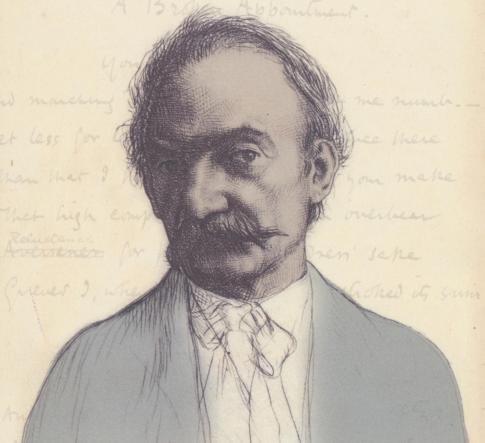
The Return of the Native by Thomas Hardy

Blurb from Amazon:

First published serially between January and December of 1878 in the sensationalistic monthly London magazine “Belgravia”, Thomas Hardy’s “The Return of the Native” is the author’s sixth published novel. Set in Egdon Heath, an area of Thomas Hardy’s fictionalized Wessex known for the thorny evergreen shrubs, called furze or gorse, which are cut there by its residents for fuel.

When the story begins, on Guy Fawkes Night, we find Diggory Venn, a merchant of the red mineral called reddle which farmers use to mark their sheep, giving aid to Thomasin Yeobright, whom he is in love with but has unsuccessfully wooed over the preceding two years. Diggory is helping Thomasin, who is in distress having left town with Damon Wildeve under the false promise of matrimony, return home to her aunt, Mrs. Yeobright. Damon has rebuffed Thomasin in favor of the beautiful young Eustacia Vye.

However when Mrs. Yeobright’s son Clym, a successful diamond merchant, returns from Paris, Eustacia loses interest in Damon, seeing a relationship with Clym as an opportunity to escape the Heath in favor of a more glamorous and exciting locale. A classically modern novel, “The Return of the Native” presents a world of people struggling between their unfulfilled desires and the expectations of society. 

My thoughts:

Thomas Hardy is one of my favourite authors and I throughly enjoyed The Return of the Nativewhich I think is one of his best books. I loved the setting on Eldon Heath, which is based on the small heath by Hardy’s childhood home, but is much larger. The ancient round barrows named Rainbarrows, and Rushy Pond, which lie immediately behind Hardy’s childhood home, form the centre of the fictional heath. Hardy’s description of it is detailed, poetically lyrical and beautiful. 

It’s a dramatic and tragic love story. It has a large cast of characters, with lovers who change their affections throughout the novel and it’s full of intrigue with striking moonlit scenes, disputes, heated quarrels and misunderstandings, along with rustic characters and traditional celebrations, for example Guy Fawkes night, May Day and a Mummers’ play at Christmas.

It was first published in 1878 in three volumes with revisions at later dates. The revision I read was published in 1912. Hardy’s Preface establishes that the events described took place between 1840 and 1850. ‘Egdon Heath’ is a combination of various heaths that were later ploughed or planted to woodland. He liked to think of it as the ‘heath of that traditionary King of Wessex – Lear’. The Return of the Native is a complex novel, shocking to its contemporary public because of its depiction of passionate and illicit sexual relationships (tame by today’s standards).

It begins with a description of Egdon Heath, a sombre isolated place, loved by some and hated by others, some regarding it as a prison. Along the ancient highway that crossed the heath the solitary figure of an old man sees a cart ahead of him in the long dry road. Both the driver, who walked beside it, and the cart, were completely red – he was a reddleman, who supplied  farmers with redding for their sheep. He plays an important part in the novel, appearing at significant times and places to great effect on the course of events. 

It’s not a book to read quickly and it transported me back to a time that ceased to exist before I was born, where time moved more slowly, ruled by the seasons and the weather, and with a clearly defined social hierarchy. And yet, I was surprised to find that youngsters were scribbling graffiti on ‘every gatepost and barn’s doors’, writing ‘some bad word or other’ so that a woman can hardly pass for shame some time.’ Learning to write and sending children to school was blamed:

’Ah, there’s too much of that sending to school these days! It only does harm. … If they’d never been taught how to write they wouldn’t have been able to scribble such villainy. Their fathers couldn’t do it, and the country was all the better for it.’ (Page 108)8

Quite simply – I loved it. It’s a love story full of depth, atmosphere and passion, but also of tragedy  and a mix of darkness and light.