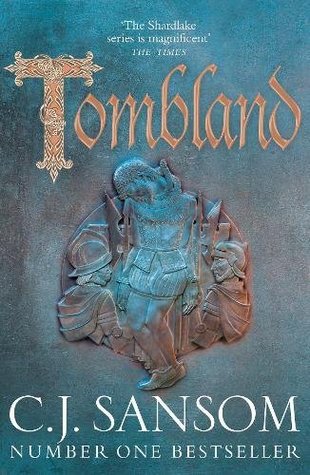
Tombland by C J Sansom

Tombland (Matthew Shardlake, #7)

5*

It’s been a few weeks now since I finished reading Tombland, the seventh novel in C. J. Sansom’s Shardlake series. I wrote a Friday post, quoting the first paragraph and a teaser from page 56 and have been wondering what to write about the book as a whole. It is very long, is based on primary and secondary sources with notes and a bibliography. ‘Tombland‘ is an area within the city of Norwich and there’s a street plan on the endpapers of my hardback edition, showing the layout of Norwich and the position of Mousehole Heath in 1549. It is a most impressive book full of detail with a large cast of characters, and whatever I write will not do justice to it.

It’s 1549, Edward VI is king, a minor and England is ruled by the Duke of Somerset as Lord Protector. Rebellion is spreading in protest against the landowners’ enclosures of the common land. Edward’s sister, the Lady Elizabeth has asked Matthew Shardlake to make discrete investigations into the murder of Edith Boleyn, the wife of John Boleyn – a distant Norfolk relation of Elizabeth’s mother, Anne Boleyn. John Boleyn has been arrested and will be on trial at the Norfolk Assizes.

The murder mystery, however, is not the main focus of Tombland. Shardlake and his assistant, Nicholas Overton leave London for Norwich, begin their investigation, but as they leave Norwich they get caught up in a rebellion as thousands of peasants led by Robert Kett march on Norwich and establish a vast camp on Mousehole Heath on the land overlooking the city.

I knew about the early enclosures of common land, but hadn’t heard of Kett’s Rebellion before. A large part of the book follows the sequence of events that made up the Rebellion (with more detail given in the Historical Essay at the end of the book). Shardlake is forced to join the rebels. He then has little control over events in the rebel camp and has to search his conscience to decide whether to help them and where his loyalties actually lie. His sympathies lie with the common people ousted from the land they had previously used and so, when Robert Kett asks for his advice at the trials held at the ancient oak, they called the ‘Oak of Reformation’ to ensure that the proper legal procedures are followed he agrees.

Meanwhile Shardlake has not forgotten about Edith’s murder and as the rebels take over the city of Norwich for a while he is allowed to visit John Boleyn, held a prisoner in Norwich Castle, and convinced of John’s innocence he is determined to discover who really had murdered her. Surprisingly, he finds the key to the mystery back at the rebel camp.

Of course, it is far more complicated than I have outlined. Sansom’s research is thorough, so much so that reading his book takes you back in time evoking the sights, smells and atmosphere of the mid 16th century. The characters become real people, with their place in society clearly defined, and the changes in their economic conditions explained as a new ‘rural’ gentry class came into existence and the enclosures deprived the common people of the land they had traditionally used. It’s not just economic changes but also religious changes as the new Book of Common Prayer has been introduced and people are upset by the changes and religious intolerance. It’s a time of great unrest:

Our misery is a laughing stock to those proud insolent men! We are like slaves, and farm our land only at the pleasure and will of the lords. For as soon as any man offends any of these gentlemen he is put out! The common pastures which have been our predecessors’ time out of mind are taken away; they are ditched and hedged in, the pastures enclosed …

We can no longer bear such great and cruel injury! We will rather take up arms than endure it! (page 394)

There is so much more to this book, skilfully written combining the historical facts and fiction. But it works well as a standalone book as enough information is given to understand the relationships of the characters from the earlier books. I was rather sad to see that Guy Malton (previously a monk and now licensed as a doctor), one of my favourite characters is now old and ill, but I was pleased to learn more about Jack Barak, Shardlake’s former assistant, and his on-off relationship with his wife Tamsin. Shardlake’s former servant, Josephine lives in Norwich and he is pleased to meet  up with her, her husband and young baby.

Tombland is a book with an emphasis on the people of the Tudor period – not just about royalty and national events. Protector Somerset is waging war against Scotland but that is only mentioned, Edward VI doesn’t appear, Mary, his sister is referred to, and Elizabeth, his other sister has a cameo role at her household in Hatfield Palace in Hertfordshire. With so much detail it has a slower pace than other books I’ve read recently but I loved the attention to detail and the descriptive writing which placed me precisely at the scenes.

  • Hardcover: 880 pages
  • Publisher: Mantle; Main Market edition (18 Oct. 2018)
  • Language: English
  • ISBN-10: 1447284488
  • ISBN-13: 978-1447284482
  • Source: I bought the book
  • My rating: 5*


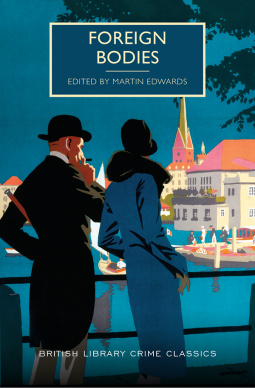
Foreign Bodies (British Library Crime Classics) edited by Martin Edwards

Poisoned Pen Press|6 March  2018 |288 pages|e-book |Review copy|3*

This edition, published in association with the British Library, has an introduction by Martin Edwards.

There are fifteen stories in this collection of vintage crime fiction in translation,  written by authors from Hungary, Japan, Denmark, India, Germany, Mexico, Belgium, the Netherlands, Russia and France. Some are detective stories in the same tradition of  Conan Doyle’s Sherlock Holmes stories, or in the same style as Agatha Christie; there are ‘locked room’ mysteries and stories mixing mystery and horror. Martin Edwards has prefaced each one with a brief biographical note, which I found useful as, unsurprisingly, the authors were all new to me, with the exception of Anton Chekhov (although I haven’t read any of his works).

Edwards presents the stories in approximately the chronological order of their publication from 1883 to 1960 and notes that these authors were writing in the same styles at much the same time as Agatha Christie and other Golden Age crime fiction writers.

When I began reading I was disappointed as I didn’t enjoy the first few stories. Short story collections are often a mixed bag and some stories are better than others, so after putting the book aside for a while I carried on reading. Some are very short and are predictable and really easy to see where they will end, but others are much more satisfying.

The ones that appealed to me the most are (in the order I read them):

The Spider (1930) by Koga Saburo who founded the Mystery Writers of Japan in 1947. His work was very popular in Japan and he wrote in the traditionalist style, favouring the puzzle element of a mystery. Edwards writes that it ‘is a pleasing fusion of macabre fiction and the classic detective puzzle‘, which explains why I like it. It’s set in a bizarre laboratory in a nine metre high round tower in which a professor is carrying out research on spiders. One night another professor visited him and fell to his death from the tower having been bitten by a poisonous spider. The circumstances of his death, however are not at all straightforward and are most ingenious. Probably my favourite story.

Murder a la Carte (1931) by Jean-Toussaint Samat, born in the Camargue, a journalist and writer of crime and adventure novels. This story is about a case of poisoning, but poisoning with a difference. A guest at a dinner party explains how to get away with murder – by using a non-poisonous substance. It’s one of the shorter stories that I did find satisfying.

The Venom of the Tarantula (1933) by Sharadindu Bandyopadhya from Bengal, educated in Calcutta, whose crime writing is similar to that of Arthur Conan Doyle. A writer called Ajit  and detective Byomkesh Bakshi join forces to investigate what is an apparently ‘impossible crime’ featuring an ingenious poisoning.  Nandadulalbabu is a hypochondriac who is writing fiction using black and red ink. He is addicted to venomous ‘spider juice’, extracted from tarantulas. His family have prevented him from getting the juice but somehow he is able to trick them and is still  getting his fix. Although I was able to work out the solution it’s still a satisfying and interesting story.

The Mystery of the Green Room (1936) by Pierre Véry from France. This story is dedicated to the memory of Gaston Leroux, and plays on the events in his story, The Mystery of the Yellow Room (1907), which I haven’t readanother ‘locked room’ whodunnit.  I enjoyed this one , particularly where the private investigator points out to the detective the similarities between the yellow room mystery to this one, the green room mystery – this is an ‘open-room’ mystery as opposed to a ‘locked-room’ puzzle.

John Flanders, born in Ghent was one of the pen-names of Jean-Raymond-Marie De Kremer. He wrote imaginative and fantastical stories and Kippers, originally written in Flemish is one of his many short stories. It’s one of the shortest stories in the book and entertained me in a very different way – it is not a puzzle or even really a mystery story, but is focused on one of Flanders’ fictional preoccupations with food and drink and as the title indicates it is a story about

Kippers, delectable, salmony kippers, smoky as a chimney, dripping with fat, one for each of us, of course, the real thing.

Even Bertie the cabin boy got one.

A sinister tale about a shipwrecked crew on a desert island that ends in horror.

My thanks to the publishers, Poisoned Pen Press, for my review copy via NetGalley.

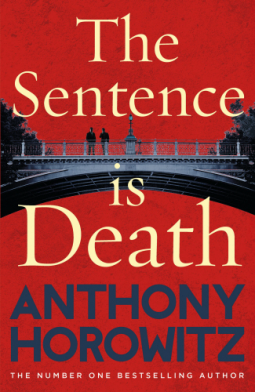
The Sentence is Death by Anthony Horowitz

5*

Random House UK Cornerstone|1 November 2018|384 pages|Review copy Last year when I read The Word is Murder I thought it was a very clever and different type of murder mystery. It features Daniel Hawthorne, an ex-policeman, now a private investigator, who the police call in to help when they have a case they call a ‘sticker’. What I found particularly interesting was the way that Anthony Horowitz inserted himself into the fiction, recruited by Hawthorne to write a book about him and the cases he investigates. In The Sentence is Death, Anthony appears again as a character, reluctantly, as he had agreed to a three-book contract with Hawthorne. At the start of the book Anthony, who wrote the script for the TV series of Foyles War, is on the set as the opening scenes in the seventh series were being shot. The rehearsal was disastrous, but it came to an abrupt end when Hawthorne interrupted the scenes by driving straight into the middle of the set to tell Anthony there had been another murder and that the police had asked for his help. Divorce lawyer Richard Pryce was found dead in his home, having been hit on the head by a wine bottle, a 1982 Chateau Lafite worth £3,000, and then stabbed to death with the broken bottle. There are several clues – there’s the number 182 written in green paint on the wall, the incredibly expensive bottle of wine when Pryce was a teetotaller, a public threat from a well known feminist writer, an unknown visitor the evening he was killed and plenty of other enemies as suspects.  There’s no doubt that Daniel is a brilliant detective, but Anthony finds him trying as he’s uncommunicative, keeping Anthony in the dark most of the time, he swears and he calls him ‘Tony’. I found it all most entertaining and perplexing, completely foxed by all the red herrings and twists and turns in the plot. But, mainly because I’d read the first book, I loved the interaction between Anthony and Daniel and had no difficulty with the mix of fact and fiction, enjoying the details about Anthony’s life as a scriptwriter as much as the mystery about the murder. I don’t think, however that you need to read The Word is Murder first because as a murder mystery The Sentence is Death works well as a standalone. But to  see how their relationship began and develops it would help to read the books in order. I loved this book as much or maybe even more than the first one and am delighted that I received a copy of this book from the publisher, via NetGalley, for review.

Six Degrees of Separation: from A Christmas Carol to No Further Questions

I love doing Six Degrees of Separation, a monthly link-up hosted by Kate at Books Are My Favourite and Best. Each month a book is chosen as a starting point and linked to six other books to form a chain. A book doesn’t need to be connected to all the other books on the list, only to the one next to it in the chain.

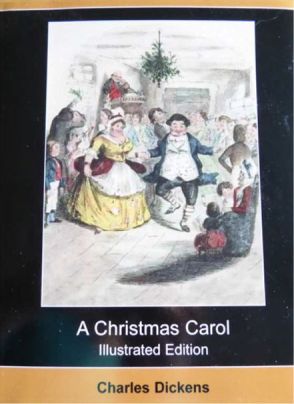
This month the chain begins with A Christmas Carol by Charles Dickens.

A Christmas Carol cover

I love A Christmas Carol and when I sat down to think about this Six Degrees post I thought I’d be linking up to more books with a Christmas theme, but it didn’t work out like that. Instead what came to mind after the first link to another Dickens’ book is a series of mystery/crime fiction books! These are all books I’ve read, so the links are to my review posts.

The MoonstoneDiamonds Are Forever

  • The Holly Tree Inn by Charles Dickens. This was originally published in 1855, being the Christmas number of Dickens’s periodical Household Words. It was so popular that it was then adapted for the stage. It’s a collection of short stories by Dickens, Wilkie Collins, William Howitt, Adelaide Anne Procter and Harriet Parr, around the theme of travellers and inns.
  • The Moonstone by Wilkie Collins – The ‘Moonstone’, a large diamond, originally stolen from a statue of an Indian God and said to be cursed is left to Rachel Verinder. She receives it on her 18th birthday and that night it is stolen from her bedroom.
  • Diamonds are Forever by Ian Fleming in which James Bond is assigned to infiltrate and close down a diamond smuggling operation, run by the Spangled Mob, operating from Africa to the UK and the USA. It’s run by a couple of American gangsters, the Spang brothers, and the mysterious character known as ‘ABC‘.

The ABC Murders (Hercule Poirot, #13)The House at Sea's End (Ruth Galloway, #3)No Further Questions

  • ABC leads me to The ABC Murders by Agatha Christie – one of her best books, I think, in which there’s another mysterious character known as ‘ABC’. Poirot and Captain Hastings investigate a series of murders. An ABC Railway Guide is left next to each of the bodies.
  • The House at Seas End by Elly Griffiths – The bones of six people are found in a gap in the cliff, a sort of ravine, where there had been a rock fall at Broughton Seas End. Seas End House, which stands perilously close to the cliff edge above the beach is owned by Jack Hastings. I really, really do wish these books weren’t written in the present tense!
  • No Further Questions by Gillian McAllister – also written in the present tense, but in this book it didn’t irritate me. I was totally gripped by it. It plunges straight into a trial as Martha sits in the courtroom listening to expert witnesses being questioned  and cross-examined about the death of her baby, Layla, just eight weeks old. I didn’t want to stop reading it and when I wasn’t reading it I was thinking about it, about the characters and their relationships, about how they had got themselves into such a terrible situation. An excellent book, and it is without doubt one of the best books I’ve read this year.

From tales told in an inn, to diamond smugglers, murders connected to a mysterious character, characters called Hastings and books written in the present tense, this chain has once again surprised me at where it has ended up!

Next month (January 5, 2019) the chain begins with another of my favourite books – The French Lieutenant’s Woman by John Fowles.


Books Read in November 2018

This month I read seven books, made up of one review copy that came to me via  NetGalley, two library books and four of my own books (two of these on Kindle). Two of the seven books are non-fiction and the rest are fiction. My ratings range from 5 to 2.5 stars and are based solely on my reactions to the books.

I’ve written about three of these books (click on the links to read my reviews):

Jacob's Room is Full of Books: A Year of ReadingAbsolute ProofIn a Dark, Dark Wood

  1. Jacob’s Room is Full of Books by Susan Hill 5*  – in which Susan Hill describes a year of her reading.
  2. Absolute Proof by Peter James 3.5* –  a standalone thriller that is very different from his Roy Grace books. It has similarities to Dan Brown’s The Da Vinci Code, as the search is on for proof of  God’s existence.
  3. In a Dark, Dark Wood by Ruth Ware 2.5* – I was disappointed as this book promised to be a psychological thriller but it neither thrilled nor scared me, although it is a page-tuner. Leonora and Clare haven’t seen  or even spoken to each other since they were 16, ten years ago. So why has Clare invited Leonora to her hen party held in a glass house in the middle of a wood?

Here are some brief notes about the remaining four books:

I Am, I Am, I Am: Seventeen Brushes With DeathThe ReckoningThe New Mrs CliftonTombland (Matthew Shardlake, #7)

I Am, I Am, I Am by Maggie O’Farrell 5* – I wrote this Friday post about this book, with two quotations and a summary of the book. It’s a memoir with a difference: seventeen encounters of near-death experiences, with Maggie at different ages, in different locations, revealing a whole life in a series of tense, visceral snapshots. It’s a beautifully written book that I loved.

The Reckoning by John Grisham 5*, about Pete Banning, Clanton’s favourite son, a returning war hero, the patriarch of a prominent family, a farmer, father, neighbour, and a faithful member of the Methodist Church. Why did he shoot and kill the Reverend Dexter Bell? And then refuse to say why he killed him? I was intrigued and fascinated by the whole book that went back into Pete’s wartime experiences during world War Two during the Bataan Death March in the Philippines.

The New Mrs Clifton by Elizabeth Buchan 4* this begins in 1974 with the discovery of a skeleton, the remains of a woman, between twenty-five and thirty, buried beneath a tree in the garden of house in Clapham, facing the Common. Her identity and why and how she was killed is not revealed until very nearly the end of the book.

It then moves back in time to 1945 when Intelligence Officer Gus Clifton returns to London with Krista, the German wife he married secretly in Berlin. For his sisters, Julia and Tilly, this broken woman is nothing more than the enemy. For Nella, Gus’s loyal fiancée, it is a terrible betrayal. Elizabeth Buchan paints a convincing and moving picture of life in both London and Berlin post-war, highlighting the devastation of the bombing and showing how people have to come to terms with the changes in their lives. All the way through the book I wondered who the killer was and which woman had been murdered.

Tombland by C J Sansom 5* – I wrote this Friday post this book, giving two quotations and a summary of the book. Set in 1549 this is a remarkable and detailed book about the situation as Edward VI is on the throne following the death of his father Henry VIII and his uncle Edward Seymour, Duke of Somerset, rules as Protector.

Matthew Shardlake has been working as a lawyer in the service of Edward’s sister, the Lady Elizabeth. He is employed to investigate the gruesome murder of Edith Boleyn, the wife of John Boleyn – a distant Norfolk relation of Elizabeth’s mother. But the main part of the book is about Kett’s Rebellion – as thousands of peasants, in protest about the enclosures of common land, gather together on Mousehold Heath outside Norwich and battle ensues.

It’s an enormous book and I’m planning to write a longer post about it.


The Classics Club Spin Result

Classics Club

The spin number in The Classics Club Spin was announced today. It’s number …

1

which for me is Greenmantle by John Buchan. The rules of the Spin are that this is the book for me to read by January 31, 2019.

Greenmantle

Greenmantle is the second of five novels by John Buchan featuring the character of Richard Hannay, first published in 1916. I’ve read the first, The Thirty-Nine Steps.

Here’s the blurb from Amazon:

Richard Hannay is tasked to investigate rumours of an uprising in the Muslim world and takes off on a hair-raising journey through German-occupied Europe to meet up with his old friend Sandy Arbuthnot in Constantinople, where they must thwart the Germans’ plans to use religion to help them win the war. Set during World War I, Greenmantle is a contraversial meditation on the power of political Islam (it was pulled from Radio 4’s schedule at the time of the 7 July bombings).

I’m really pleased this book came up in the Spin for me as it will fit in with my reading about World War I.

Did you take part in the Classics Spin? What will you be reading?