Six Degrees of Separation: from How To Be Both to The Prime of Miss Jean Brodie

I love doing Six Degrees of Separation, a monthly link-up hosted by Kate at Books Are My Favourite and Best. Each month a book is chosen as a starting point and linked to six other books to form a chain. A book doesn’t need to be connected to all the other books on the list, only to the one next to it in the chain.

This month (April 6, 2019), the chain begins with Ali Smith’s award-winning novel, How to be Both.

How to be both

How to be Both is a novel all about art’s versatility. Borrowing from painting’s fresco technique to make an original literary double-take, it’s a fast-moving genre-bending conversation between forms, times, truths and fictions. There’s a Renaissance artist of the 1460s. There’s the child of a child of the 1960s. Two tales of love and injustice twist into a singular yarn where time gets timeless, structural gets playful, knowing gets mysterious, fictional gets real—and all life’s givens get given a second chance.’ (Goodreads)

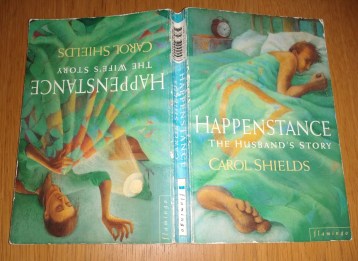
I haven’t read this book but I’d like to sometime. I see that there are two versions: one begins with the contemporary story, the other with the 15th-century story. This reminded me of Carol Shields’ book Happenstance, two stories about the same five-day period – one from Jack Bowman’s point of view, and the other from his wife, Brenda’s. They’re printed in the same book in an unusual format of containing two books in one, either can be read first – then turn the book upside down and read the other story.

Happenstance

My next link is a bit of a jump – from the character Brenda in Happenstance I immediately thought of Brenda Blethyn, who plays Vera in Ann Cleeves’s books. One of these books is Silent Voices in which D I Vera Stanhope finds a dead body in the sauna room of her local gym. The victim, a woman had worked in social services – and was involved in a shocking case involving a young child.

Social Services also feature in Fair of Face by Christina James. Ten year old Grace is being fostered when her foster mother and her baby are found dead in their beds. Social Services are asked to work with the police, in order to question Grace and her friend Chloe, a child from a troubled family.

Another author with the name James, is P D James, also a crime writer. An Unsuitable Job for a Woman is a Cordelia Gray detective story in which she takes on an assignment from Sir Ronald Callander, a famous scientist, to investigate the death of his son, Mark who had been found hanged in suspicious circumstances. Mark had left Cambridge University without completing his degree and had taken a job as a gardener.

My next link is to Agatha Christie’s Cat Among the Pigeons, set mainly in an exclusive and expensive girls’ school, Meadowbank, in England. Some new staff members have been appointed, including Adam Goodman, a handsome young gardener.

My final link is to another school, the Marcia Blaine School for Girls in Muriel Spark’s novel, The Prime of Miss Jean Brodie. Marcia Blaine is a traditional school where Miss Brodie’s ideas and methods of teaching are viewed with dislike and distrust. The Head Teacher is looking for ways to discredit and get rid of her. The girls in her ‘set’ fall under her spell, but one of them betrays her, ruining her teaching career.

Different formats, the name ‘Brenda’, Social Services, authors’ surname ‘James’, gardeners,  and girls’ schools all link How To Be Both to The Prime of Miss Jean Brodie.

Except for The Prime of Miss Jean Brodie the books in my chain are all crime fiction and apart from How To Be Both I’ve read all the books in the chain – clicking on the titles takes you to my posts, where they exist.

Next month (May 4, 2019), the chain will begin with Jane Harper’s debut best-seller, The Dry.

The King’s Evil by Andrew Taylor

London, 1667 – a royal scandal that could change the face of England forever…

The King's Evil HarperCollins|4 April 2019|464 pages|Hardback |Review copy|5* This is the third book in Andrew Taylor’s series following James Marwood and Cat (Catherine) Lovett. I loved the first two – The Ashes of London (set in 1666) and The Fire Court (set in 1667, eight months after the Great Fire of London), so I was delighted when Felicity Denham at HarperCollins asked me if I’d like a proof copy of The King’s Evil to review. It is not necessary to read the earlier books as I think they all work well as standalones, but I think it helps if you do. The King’s Evil carries on from where The Fire Court ended. Seven years after the restoration of the monarchy it’s still a time of political and social change. Whilst Charles II still had immense power as the King a new middle class, both professional and administrative, was evolving. James Marwood is a government agent in Whitehall, working as a clerk for William Chiffinch, one of the commissioners of the Board of Red Cloth. Chiffinch was also Keeper of the King’s Private Closet and Page of the Backstairs, an important position as he controlled private access to the King. In addition Marwood also works under Joseph Williamson, the Undersecretary to the Secretary of State for the South, one of Charles’s most powerful ministers. Charles had reinstated the ceremony of ‘touching for the King’s Evil’ as a demonstration of his divine right to rule – a ceremony in which the monarch touched those people suffering from scrofula, a disease, now known as  tuberculosis, that caused the swelling of the bones and lymphatic glands in the neck (the book cover illustrates the ceremony). It was believed that the King’s touch cured the disease. The novel begins as Marwood is in the Banqueting Hall at Whitehall watching the ceremony. Chiffinch had told him to attend on the orders of the King to meet Lady Quincy and do whatever she commanded. Lady Quincy, accompanied by a small African child, her footboy suffering from scrofula, tells Marwood to meet her outside the church near the Tower of London. She also warns him that Edward Alderley, her step-son, is out for revenge on Cat Lovett because of what she had done to him. (This refers to events in The Fire Court).  In order to keep her identity secret Cat, whose father had been one of the Regicides, is going by the name of Jane Hakesby. She had been working for Simon Hakesby, a surveyor and architect, on a garden pavilion project in the grounds of Clarendon House. Then Alderley is found dead in the well in the garden pavilion. Marwood is asked to look into the circumstances of Alderley’s death, under the King’s authority. He decides to keep his connection with Cat to himself, whilst he tries to find out where she has gone and who was responsible for Adderley’s death. Was it an accident, was it suicide, or was it murder? After Chiffinch received an anonymous letter naming Cat as the murdererhe sent officers to arrest her, but she had disappeared. So this was taken as a confession of her guilt. Marwood was afraid that this could implicate him too if it became known that he had told her that Alderley knew her whereabouts. In addition, Lord Clarendon is convinced that Alderley was involved in a conspiracy against him and also suspects that someone in his household is involved in the plot. He is out of favour with Charles, and had recently been removed from the office of Lord Chancellor.  But he’s still potentially politically powerful as his daughter is married to Charles’s brother, James, the Duke of York. His grandchildren, the Princesses Mary and Anne, are the next heirs in the line of succession if Charles remained childless. Marwood tries to find Cat, and also escorts Lady Quincy to Cambridge on a secret mission. Eventually his investigation into Alderley’s death leads him to discover who is behind the plot against Clarendon, and also to uncover a potential royal scandal in which Lady Quincy and the Duke of Buckingham, one of Charles’s favourites who had supplanted Clarendon, play important roles.  I loved the characterisation and all the details of the setting, bringing to life scenes at the royal court as well as in the refugee camps that housed the homeless as the work of rebuilding London continued. Andrew Taylor is a supreme storyteller, combining fact and fiction – his novels are full of historical details that slot seamlessly into his stories. The King’s Evil is historical fiction at its best, full of suspense and tension, an intricate and tightly plotted murder mystery, enhanced by the intrigue of a royal scandal.  I loved it. Many thanks to the publishers, HarperCollins for my review copy.

WWW Wednesday: 27 March 2019

IMG_1384-0

WWW Wednesday is run by Taking on a World of Words.

The Three Ws are:

What are you currently reading?
What did you recently finish reading?
What do you think you’ll read next?


I’m currently reading:

A Life of My Own: A Biographer’s Life by Claire Tomalin – a book that Marina @ Finding Time To Write, so kindly sent to me. I’ve been reading this a few chapters at a time for some while and am getting to the end of this book. This morning I read about the death of her second daughter, Susanna – such a moving tribute.

Moriarty by Anthony Horowitz – I’ve only read a few chapters so far. This is a Sherlock Holmes novel but without both Holmes and Watson – Sherlock Holmes and Moriarty have fallen to their deaths at the Reichenbach Falls. The discovery of a brutally murdered body in a leafy suburb is investigated by Pinkerton agent Frederick Chase  and Inspector Athelney Jones, a devoted student of Holmes’s methods of investigation and deduction.

Here Be Dragons by Sharon Penman, historical fiction, the first of her trilogy about the medieval princes of Gwynedd and the monarchs of England. I’m reading this on my Kindle and finding it just as compelling reading as her wonderful book The Sunne in Splendour. It tells the story of Llewelyn, the Prince of North Wales, and his rise to power and fame. So far, I’m reading about his childhood and teenage years.

I’ve recently finished:

Fingers in the Sparkle Jar by Chris Packham, which I first read two years ago. A very special book that is just as amazing to read as it was for the first time.

Wakenhyrst by Michelle Paver, a gothic novel due to be published on 4 April 2019. I loved her Dark Matter, a ghost story in the form of a diary set in the Arctic and so expected to love this one too. It’s not as chilling, but is just as atmospheric and full of mystery. I’ll be writing my review very soon.

In Edwardian Suffolk, a manor house stands alone in a lost corner of the Fens: a glinting wilderness of water whose whispering reeds guard ancient secrets. Maud is a lonely child growing up without a mother, ruled by her repressive father.

When he finds a painted medieval devil in a graveyard, unhallowed forces are awakened. Maud’s battle has begun. She must survive a world haunted by witchcraft, the age-old legends of her beloved fen – and the even more nightmarish demons of her father’s past.

My next book could be:

At the moment I don’t know. But it could be The Evidence Against You by Gillian Mcallister, due to be published on 18 April 2019.

The Evidence Against You

It’s the day Izzy’s father will be released from jail.

She has every reason to feel conflicted – he’s the man who gave her a childhood filled with happy memories.

But he has also just served seventeen years for the murder of her mother.

Now, Izzy’s father sends her a letter. He wants to talk, to defend himself against each piece of evidence from his trial.

But should she give him the benefit of the doubt?

Or is her father guilty as charged, and luring her into a trap?

Have you read any of these books?  Do any of them tempt you? 

Top Ten Tuesday: Books On My Spring 2019 TBR

top-ten-tuesday-new

Top Ten Tuesday is a weekly meme created by The Broke and the Bookish and now hosted by Jana at That Artsy Reader Girl. For the rules see her blog.

This week’s topic is Books On My Spring 2019 TBR. Some of these books have been on my shelves unread for a long time, some are new additions and others are e-books from NetGalley that will be published soon. I’d like to think I’ll read all these books soon but realistically I know that I’ll only read a few of them this Spring!

Broken Ground by Val McDermid – DCI Karen Pirie investigates the discovery of a body in the remote depths of the Scottish Highlands.

In Cold Blood by Truman Capote – Capote reconstructs the crime and the investigation into the murders of the four members of the Clutter family on November 15, 1959, in the small town of Holcomb, Kansas.

How Green Was My Valley by Richard Llewellyn – a story of life in a mining community in rural South Wales as Huw Morgan is preparing to leave the valley where he had grown up. He tells of life before the First World War.

On the Beach by Neville Shute – set in Melbourne, Australia this is a novel about the survivors of an atomic war as radiation poisoning moves toward Australia from the North.

Iris and Ruby by Rosie Thomas – the story of a teenage girl, Ruby, who runs away from home to live with her grandmother, Iris in Cairo.

Here Be Dragons by Sharon Penman – set in 13th century Wales this is the story of Llewelyn, the Prince of North Wales, and his rise to power and fame and his love for Joanna, the illegitimate daughter of King John. 

A Beautiful Corpse by Christi Daugherty – crime reporter Harper McClain unravels a tangled story of obsession and jealousy after a beautiful law student is shot in Savannah, Georgia.

A Snapshot of Murder by Frances Brody – set in Yorkshire in 1928, when  amateur detective, Kate Shackleton investigates a crime in Brontë country.

Gone Girl by Gillian Flynn – on the day of Nick and Amy’s fifth wedding anniversary, Amy suddenly disappears. The police suspect Nick. Amy’s friends reveal that she was afraid of him, that she kept secrets from him. He swears it isn’t true.

The Island by Ragnor Jonasson – Nordic noir, set on the island of Elliðaey,  off the Icelandic coast. Four friends visit the island during a long, hot summer but only three return. Detective Inspector Hulda Hermannsdóttir is sent to investigate.

My Friday Post: Moriarty by Anthony Horowitz

Book Beginnings Button

Every Friday Book Beginnings on Friday is hosted by Gillion at Rose City Reader where you can share the first sentence (or so) of the book you are reading, along with your initial thoughts about the sentence, impressions of the book, or anything else the opener inspires.

This week I’m featuring Moriarty by Anthony Horowitz, one of my TBRs that I’ll be reading next.

Moriarty

The Reichenbach Falls

Does anyone really believe what happened at the Reichenbach Falls? A great many accounts have been written but it seems to me that all of them have left something to be desired – which is to say, the truth.

Also every Friday there is The Friday 56, hosted by Freda at Freda’s Voice.

30879-friday2b56These are the rules:

  1. Grab a book, any book.
  2. Turn to page 56, or 56% on your eReader. If you have to improvise, that is okay.
  3. Find any sentence (or a few, just don’t spoil it) that grabs you.
  4. Post it.
  5. Add the URL to your post in the link on Freda’s most recent Friday 56 post.

Page 56:

‘It is a deliberate attempt to communicate something to Moriarty that will remain secret should it fall into the wrong hands.’
‘So there is a code!’
‘Exactly.’
‘And you were able to crack it!’
‘Through trial and error, yes.’ Jones nodded. ‘I take no credit for it, mind. Where Holmes has gone, I have merely followed.’

Blurb (Goodreads)

Sherlock Holmes is dead.

Days after Holmes and his arch-enemy Moriarty fall to their doom at the Reichenbach Falls, Pinkerton agent Frederick Chase arrives in Europe from New York. The death of Moriarty has created a poisonous vacuum which has been swiftly filled by a fiendish new criminal mastermind who has risen to take his place.

Ably assisted by Inspector Athelney Jones of Scotland Yard, a devoted student of Holmes’s methods of investigation and deduction, Frederick Chase must forge a path through the darkest corners of the capital to shine light on this shadowy figure, a man much feared but seldom seen, a man determined to engulf London in a tide of murder and menace.

~~~

Anthony Horowitz is one of my favourite authors. This is his second Sherlock Holmes novel and I’m hoping, no I’m expecting it to be as good as his first, The House of Silk.

Years ago I read Arthur Conan Doyle’s short story The Final Problem, in which he meant to end Sherlock Holmes’ life as he wanted to write more literary works, but needless to say really, I have forgotten most of the details. 

What do you think? Would you keep reading?

New Additions

We went to Barter Books in Alnwick yesterday and I came home with this pile. I didn’t realise until I took this photo that they’re all a variation on a black/white colour scheme! It wasn’t intentional.

I go armed with a notebook listing books and authors to look for and so I was delighted to find two books by Truman Capote as I enjoyed reading Breakfast at Tiffany’s recently and am keen to read more of his books – and two more of Reginald Hill’s books that are on my list of his books to find.

BB bks March19

From the bottom up they are:

  • The Collaborators by Reginald Hill, a standalone novel of wartime passion, loyalty – and betrayal. Set in Paris from 1940 to 1945, when Janine Simonian stands accused of passing secret information to the Nazis that led to the arrest and torture of several members of the French Resistance.
  • A Pinch of Snuff by Reginald Hill – the 5th of his Dalziel and Pascoe novels, this was first published in 1978. When Peter Pascoe’s dentist suggests that one film in particular shown in the Calliope Club is more than just good clean dirty fun, the inspector begins to make a few discreet inquiries and ends up with a homicide to investigate.
  • Beneath the Surface by Jo Spain, the second novel in the Inspector Tom Reynolds series. I’ve read three of her books and am always on the lookout for more of hers. Set in Dublin, DI Tom Reynolds and his team investigate the murder of Ryan Finnegan, a high-ranking government official in Leinster House, the seat of the Irish parliament.
  • Local Girl Missing by Claire Douglas. I’ve read two of her books previously and loved them. This one is about the disappearance of twenty-one year old Sophie Collier. Twenty years later a body has been found and her friend Francesca goes back to her home town to discover the truth about what had happened to Sophie.
  • The Weight of Angels by Catriona McPherson. I’ve read several of her Dandy Gilver books and enjoyed them. This book is a standalone psychological thriller, in which Alison McGovern takes a job as a beautician in a private psychiatric facility near her rented cottage and the ruins of Dundrennan Abbey.  A body is discovered in a shallow grave by the abbey on Ali’s first day at work.
  • Music for Chameleons by Truman Capote, a collection of his writings, both fiction and nonfiction – a book of reminiscences, portraits and stories, including ‘A Beautiful Child’ an account of a day with Marilyn Monroe and ‘Handcarved Coffins: a Nonfiction Account of an American Crime’.
  • In Cold Blood: A True Account of a Multiple Murder and its Consequences by Truman Capote, probably one of the best known ‘true crime’ books. Capote reconstructs the murder and the investigation that led to the capture, trial, and execution of the killers of four members of the Clutter family on November 15, 1959, in the small town of Holcomb, Kansas.

~~~

So, seven more books added to my TBRs and I’d love to start reading them all – now!

Have you read any of these? Do they tempt you too?