Book Beginnings & The Friday 56: Death in Berlin by M M Kaye

Every Friday Book Beginnings on Friday is hosted by Gillion at Rose City Reader where you can share the first sentence (or so) of the book you are reading. You can also share from a book you want to highlight just because it caught your fancy.

Death in Berlin by M M Kaye is one of the 20 Books of Summer that I’m aiming to read this summer. It is crime fiction set in war-scarred Berlin in the early 1950s. Miranda is on the night train when she discovers a dead body. Years ago I read The Far Pavilions and it is only in recent years that I discovered she wrote the Death in … series. This is the 2nd book in the series first published in 1955.

It begins with a Prologue:

With nightfall the uneasy wind that had sighed all day through the grass and the gorse bushes at the cliff edge died away, and a cold fog crawls in from the sea, obliterating the darkening coastline and muting the drag of waves on shingle to a rhythmic murmur barely louder than the unrelenting and monotomous mutter of gunfire to the east.

followed by Chapter 1

Miranda Brand knelt on the floor of a bedroom in the Families’ Hostel in Bad Oeynhausen in Berlin, searching her suitcase for a cake of soap, and regretting that she had ever accepted her cousin Robert Melville’s invitation to spend a month with him and his family in Berlin.

Also every Friday there is The Friday 56, hosted by Freda at Freda’s Voice, where you grab a book and turn to page 56 (or 56% of an eBook), find one or more interesting sentences (no spoilers), and post them.

Page 56:

Miranda’s eyes widened suddenly and she caught her breath in a little gasp. ‘Yes. There was something else. I heard a door being opened and then I heard someone moving about in there. I thought it was funny – “funny peculiar”, I mean.’

Synopsis from Amazon

Miranda Brand is visiting Germany for what is supposed to be a month’s vacation. But from the moment that Brigadier Brindley relates the story about a fortune in lost diamonds–a story in which Miranda herself figures in an unusual way–the vacation atmosphere becomes transformed into something more ominous. And when murder strikes on the night train to Berlin, Miranda finds herself unwillingly involved in a complex chain of events that will soon throw her own life into peril.

What are you planning to read this summer?

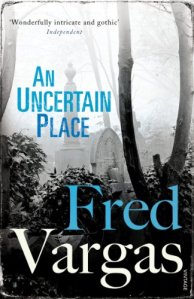
Throwback Thursday: An Uncertain Place by Fred Vargas

Today I’m looking back at my post on An Uncertain Place by Fred Vargas. I first reviewed it on June 10, 2017.

My review begins:

I loved An Uncertain Place, a clever and also a confusing book. It’s the sixth in Fred Vargas’ Commissaire Adamsberg series in which he investigates a macabre murder. I say confusing because I got a bit lost in the middle of the book, and looking back I think it’s because Adamsberg is not your normal detective – he works by intuition and I simply hadn’t followed his train of thought. With a bit of concentration I was back on track and caught up with him.

Click here to read my full review

~~~

Fred Vargas was born in Paris in 1957. As well as being a best-selling author in France, she is an historian and archaeologist.

She worked at the French National Centre for Scientific Research (CNRS), which she joined in 1988. She later joined the Institut Pasteur, as a eukaryotic archaeologist.

She mostly writes police thrillers (policiers). They take place in Paris and feature the adventures of Chief Inspector Adamsberg and his team. Her interest in the Middle Ages is manifest in many of her novels, especially through the person of Marc Vandoosler, a young specialist in the period. Seeking Whom He May Devour was shortlisted by the British Crime Writers’ Association for the last Gold Dagger award for best crime novel of the year, and the following year The Three Evangelists won the inaugural Duncan Lawrie International Dagger. She also won the award for the second year-running with Wash This Blood Clean From My Hand.

~~~

The next Throwback Thursday post is scheduled for June 30, 2022.

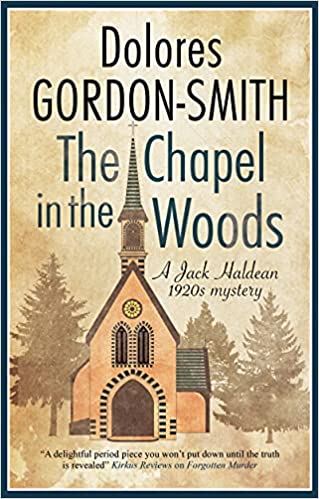
The Chapel in the Woods by Dolores Gordon-Smith

Severn House| 1 March 2022| 256 pages| e-book| Review copy| 3*

The Chapel in the Woods is the 11th Jack Haldean Murder Mystery, set in the 1920s.

Major Jack Haldean, a former World War I pilot, is a detective story writer. He and his wife Betty are visiting his cousin Isabelle and her husband Arthur in the hamlet of Croxton Abbas in Sussex. The neighbouring estate, Birchen Bower, had recently been bought by Canadian Tom Jago and his wife Rosalind. A fortnight earlier he had sent Derek Martin and his wife, Jean, in advance to open up the house and unpack their belongings, but when the Jagos arrive they discover the house open and that most of their things including Rosalind’s diamonds had been stolen. And the Martins have disappeared. But Jago can’t believe that Martin is the thief, maintaining he is perfectly honest. Jack has formerly helped his friend Detective Superintendent Ashley of the Sussex Police with a number of cases and as he is staying locally he gets involved in the police investigations.

Jago is renovating the 17th century house, built around 1620, by William Cayden, set in woodland. The chapel in the woods contains the tomb of Anna, Cayden’s wife who was a native of Peru. Her tomb, a box tomb, is decorated with an elaborately carved leaping jaguar – hence the legend of the Jaguar Princess who haunts the chapel and grounds taking the form of a jaguar.

It gets more and more complicated. In the Victorian period Josiah Cayden, an explorer and big game hunter had imported wild animals from South America, wanting to recreate a piece of the Amazon in the grounds. And now the locals are convinced that there is something in the woods that shouldn’t be there. There have been stories about dead and mutilated animals being found around Birchen Bower woods, and every so often dogs and ponies go missing. So, when Jago hosts the village fete, the local residents throng to the estate, some keen to follow the path into the woods to visit the chapel, only to find a dead body, apparently mauled by a jaguar.

And then there is another body … Is there really a jaguar roaming the woods, or is something supernatural going on? And who stole the diamonds, was it Derek Martin or someone else? Where is Derek Martin? What is the truth about the legend of the Jaguar Princess?

It is entertaining, with a mysterious, even supernatural atmosphere in parts, but it all seems to me too unlikely and fanciful and too convoluted. I liked the setting, the scenes in the woodlands and the historical aspects. But, there is too much repetition of the events and too much discussion about the various possibilities. I lost interest and just wanted to know how the mystery was resolved. It all gets sorted out and ends as Jack explains how he uncovered what had really happened.

My thanks to Severn House for a review copy via NetGalley.

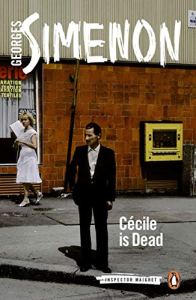
Cécile is Dead by Georges Simenon

Cécile is Dead by Georges Simenon, translated by Anthea Bell, an Inspector Maigret novel.

Synopsis (Amazon)

Poor Cécile! And yet she was still young. Maigret had seen her papers: barely twenty-eight years old. But it would be difficult to look more like an old maid, to move less gracefully, in spite of the care she took to be friendly and pleasant. Those black dresses that she must make for herself from bad paper patterns, that ridiculous green hat!

In the dreary suburbs of Paris, the merciless greed of a seemingly respectable woman is unearthed by her long suffering niece, and Maigret discovers the far-reaching consequences of their actions.

This novel has been published in a previous translation as Maigret and the Spinster.


My thoughts:

This is one of the best Maigret books I’ve read – and it is complicated, remarkably so in a novella of just 151 pages. At first it seems quite straight forward. Cécile has been wanting to see Detective Chief Inspector Maigret for months, sitting patiently in the ‘Aquarium’, as the waiting room at the Police Judiciaire in Paris, is known. She was convinced that someone had been breaking into her aunt’s apartment. But no one takes her seriously and Maigret is always busy, until one day he decides to see her. But she had left the waiting room, so he goes to the apartment where she lives with her elderly aunt, Juliette Boynet, the owner of the apartment building. She wasn’t there, but her aunt was – lying dead on the floor, strangled. Cécile was missing and the title tells you why – she was indeed dead.

And from then on, the mystery became more complex, with several suspects with a variety of motives. Juliette was very wealthy, but also miserly. She had a large family, mostly estranged from her and at odds with each other. They all turn up for her funeral, arguing about who should take precedence in the funeral cortège, and about who should inherit her money and property.

Maigret has to sort it out in his own way – musing over the details and feeling bad that he hadn’t spoken to Cécile earlier, thinking her worry over an intruder who just moved things around the apartment without taking anything was trivial. We see more of how he thinks and works when later in the investigation he is accompanied by an American, a Mr Spencer Oates from the Institute of Criminology of Philadelphia, who had asked if he could study Maigret’s methods.

This is the second time I’ve read Cécile is Dead. I first read it in 2018, but didn’t write about it at that time. Reading it for the second time, I realised I had forgotten all the details – it was like reading a new book. I thoroughly enjoyed it. It is either the 20th or the 22nd Maigret novel – Amazon records it as the 20th, whereas Goodreads has it as the 22nd! Whichever it is, it is a good read.

  • ASIN ‏ : ‎ B00SSKM6OC
  • Publisher ‏ : ‎ Penguin (4 Jun. 2015)
  • Print length ‏ : ‎ 151 pages
  • Source: I bought the e-book
  • My Rating: 4*

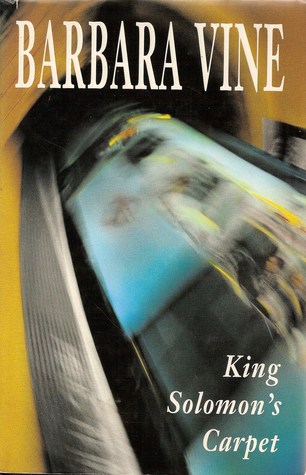
Book Beginnings & The Friday 56: King Solomon’s Carpet by Barbara Vine

Every Friday Book Beginnings on Friday is hosted by Gillion at Rose City Reader where you can share the first sentence (or so) of the book you are reading. You can also share from a book you want to highlight just because it caught your fancy.

I like the title of this Barbara Vine crime novel – King Solomon’s Carpet. It refers to the legend of King Solomon’s magic carpet of green silk which, as it could fly and brought everyone to their destination, is likened to the London Underground. This is one of my TBRs and it’s been sitting on my bookshelves for 12 years! It’s about time I read it …

The Book begins:

A great many things that other people did all the time she had never done. These were the ordinary things from which she had been protected by her money and her ill-health. She had never used an iron nor threaded a needle, been on a bus nor cooked a meal for other people, earned money, got up early because she had to, waited to see the doctor or stood in a queue.

Also every Friday there is The Friday 56, hosted by Freda at Freda’s Voice, where you grab a book and turn to page 56 (or 56% of an eBook), find one or more interesting sentences (no spoilers), and post them.

Page 56:

When the coffee came Tom said she could come and live at Cambridge School if she liked.

‘A school?’

‘It used to be. It’s just a house now where people rent rooms, only the rent’s very low. There’s a room free now Ollie’s going. I asked the man who owns it and he said you could have the Headmaster’s Study’.

Synopsis from Amazon UK:

Jarvis Stringer lives in a crumbling schoolhouse overlooking a tube line, compiling his obsessive, secret history of London’s Underground. His presence and his strange house draw a band of misfits into his orbit: young Alice, who has run away from her husband and baby; Tom, the busker who rescues her; truant Jasper who gets his kicks on the tube; and mysterious Axel, whose dark secret later casts a shadow over all of their lives.

Dispossessed and outcast, those who come to inhabit Jarvis’s schoolhouse are gradually brought closer together in violent and unforeseen ways by London’s forbidding and dangerous Undergound . . .

Barbara Vine: A pseudonym used by Ruth Rendell

Ruth Rendell created a third strand of writing with the publication of A Dark Adapted Eye under her pseudonym Barbara Vine in 1986. Books such as King Solomon’s Carpet, A Fatal Inversion and Anna’s Book (original UK title Asta’s Book) inhabit the same territory as her psychological crime novels while they further develop themes of family misunderstandings and the side effects of secrets kept and crimes done. Rendell is famous for her elegant prose and sharp insights into the human mind, as well as her ability to create cogent plots and characters. Rendell has also injected the social changes of the last 40 years into her work, bringing awareness to such issues as domestic violence and the change in the status of women. (Fantastic Fiction)

The Second Cut by Louise Welsh

Canongate Books| 27 January 2022| 372 pages| e-book| review copy via NetGalley| 3.5*

Synopsis:

Auctioneer Rilke has been trying to stay out of trouble, keeping his life more or less respectable. Business has been slow at Bowery Auctions, so when an old friend, Jojo, gives Rilke a tip-off for a house clearance, life seems to be looking up. The next day Jojo washes up dead.

Jojo liked Grindr hook-ups and recreational drugs – is that the reason the police won’t investigate? And if Rilke doesn’t find out what happened to Jojo, who will?

Thrilling and atmospheric, The Second Cut delves into the dark side of twenty-first century Glasgow. Twenty years on from his appearance in The Cutting Room, Rilke is still walking a moral tightrope between good and bad, saint and sinner.(Amazon UK)

I enjoyed reading Louise Welsh’s debut novel, The Cutting Room back in 2005, even though it was not the usual type of book that I read, and was way out of my comfort zone. I remember that its dark, edgy atmosphere made it compelling reading about Rilke an auctioneer who discovered a collection of violent and highly disturbing photographs. So when I saw that she’d written another novel, about, Rilke, The Second Cut I was keen to read it. I had forgotten most of the detail in The Cutting Room, but that didn’t matter as this book reads well as a standalone.

Twenty years have passed since the first book was published and much has changed in the world, but Rilke at forty seven years old, is now only four years older in this second book, still an auctioneer at Glasgow’s Bowery Auctions and ‘too tall, too thin and too cadaverous to look like anything other than a vampire on the make’. I found this somewhat confusing as The Second Cut is clearly set in the present day, with all the changes that have taken place in the last twenty years regarding the rights of LBGTQ+ people, and the references to Covid.

Just like The Cutting Room, I found this compelling reading, but not always comfortable reading, particularly about the darker side of Glasgow’s violent underworld and gay scene. The characters are vividly drawn and from start to end the pace is fast, and the details about the auction house are fascinating. There are two main threads – the first is Rilke’s determination to find out how and why his old acquaintance Jojo turned up dead on a doorstep.

Aand the second follows his suspicions about the truth behind the house clearance of Ballantyne House, a neglected Georgian house in Galloway, less than two hours from Glasgow. It was crammed with many valuable items along with the dross. It was owned by Mrs Forrest, an old lady who had been a concert pianist but was now suffering from dementia, so her son and nephew were dealing with the sale of the property and its contents. I read a lot of crime fiction, so I soon guessed what had happened to Mrs Forrest, and similarly I was immediately suspicious about what was going on in the polytunnels.

But it’s the gay scene that is the main focus of the book and in her Afterword Louise Welsh explains that she had written The Cutting Room twenty years ago in a white-hot rage about the intensity of the hostile environment against LBGTQ+ people. Although much has changed since then with equal marriages, increased visibility, access to hate laws, improved awareness of queer and trans rights, with a general consensus that violence and prejudice against LBGTQ+ people is wrong, outrages still occur. She writes that the Glasgow she inhabits is largely better, in terms of sexuality, than it was twenty years ago. I have to say that some of the scenes in The Second Cut seem to be stuck in the past – or have I got that wrong?

Many thanks to Canongate Books for a review copy via NetGalley