The Riddle of the Third Mile by Colin Dexter

Rating: 5 out of 5.

Pan| February 2011| 289 pages| e-book| 5*

From the Back Cover

Inspector Morse isn’t sure what to make of the truncated body found dumped in the Oxford Canal, but he suspects it may be all that’s left of an elderly Oxford don last seen boarding the London train several days before. Whatever the truth, the inspector knows it won’t be simple — it never is. As he retraces Professor Browne-Smith’s route through a London netherworld of topless bars and fancy bordellos, his forebodings are fulfilled. The evidence mounts; so do the bodies. So Morse downs another pint, unleashes his pit bull instincts, and solves a mystery that defies all logic. 

My thoughts

The Riddle of the Third Mile is Colin Dexter’s 6th book in his Inspector Morse series, first published in 1983. I remember watching the TV adaptation based on this book, The Last Enemy, but, as with most TV adaptations, it has several changes from the original. Like all of Dexter’s books this is a most complicated mystery, one of the ‘puzzle’ types. Dexter, himself, constructed crossword puzzles and made Morse a crossword aficionado. I agree with Sergeant Lewis when he asks Morse: ‘Aren’t you making it all a bit too complicated?‘ (page 145). I enjoyed trying to follow all the clues that Dexter planted in the mystery, although I had little idea about most of it. But I thoroughly enjoyed it.

The identity of the dismembered and headless corpse could have been that of Morse’s his old classics tutor, Browne-Smith or Browne-Smith’s hated rival, Westerby, or even one of the Gilbert twins who both harboured a grudge against Browne-Smith dating back to the Second World War. Or one of the twins could have been the murderer. Morse eventually works it out, by various means, including considering ‘the most improbable notions, in the sure certainty that by the law of averages some of them stood a more reasonable chance of being near to the truth than others.’ ( page 145) He’s also helped by his intuition, when a passage of scripture springs to his mind about forgiving one’s enemies: ‘ And whosoever shall compel thee to go a mile, go with him twain (Matthew 14.1)’ which he checks in a Gideon Bible, and letting his mind ponder this he remembers a sermon he had heard on the ‘Religion of the Second Mile’:

And it was with the forty-watt bulb shedding its feeble light over the Gideon Bible that Morse smiled to himself in unspeakable joy, like one who has travelled on a longer journey still – that third and final mile …

At last he knew the truth. (page 220)

I can’t say I was also enlightened, and so I just had to read on to find out what Morse had managed to deduce.

Along with the mystery details of Morse’s earlier life when he was a student at St John’s College, Oxford are revealed. He had failed the classics degree, known as ‘Greats’, after his love affair with a postgraduate student at St Hilda’s, Wendy Spencer, came to an end. It had had a disastrous effect on his academic work.

… he departed from Oxford, a withdrawn and silent young man, bitterly belittled, yet not completely broken in spirit. It had been his sadly disappointed old father, a month or so before his death, who suggested that his only son might find a niche somewhere in the police force. (page 61)

I’ve now read 9 of the 13 Morse books:

1. Last Bus to Woodstock (1975) – read in October 2020 not reviewed
2. Last Seen Wearing (1976)
3. The Silent World of Nicholas Quinn (1977)
4. Service of All the Dead (1979)
5. The Dead of Jericho (1981)
6. The Riddle of the Third Mile (1983)
7. The Secret of Annexe 3 (1986)
8. The Wench Is Dead (1989)
9. The Jewel That Was Ours (1991)
10. The Way Through the Woods (1992)
11. The Daughters of Cain (1994)
12. Death Is Now My Neighbour (1996)
13. The Remorseful Day (1999)

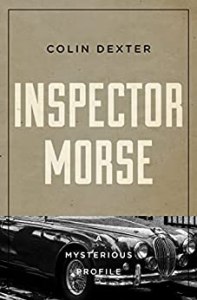
Inspector Morse: A Mysterious Profile by Colin Dexter is also available, published as one of the Mysterious Profiles series of 26 books.

Synopsis:

The international-bestselling author answers readers’ questions and discusses the origins of the Oxford inspector with a penchant for classical music.

In 1975, Inspector Morse debuted, working to solve the case of a murdered hitchhiker in Colin Dexter’s Last Bus to Woodstock. The book led to a multimillion-bestselling mystery series and a television show that spawned a spinoff and a prequel. But how did the beloved DCI from Oxford come to be exactly?

In this quick read, Colin Dexter addresses some of the many questions posed to him by his readers. He reveals what motived him to break into crime writing and which authors and novels influenced him. He discusses Morse’s many traits and inner workings, as well as how he got his first Morse novel published. He also shares how he maintains a discipline with writing, how he deals with critics, and what it’s like to transform a series of novels into a television series.

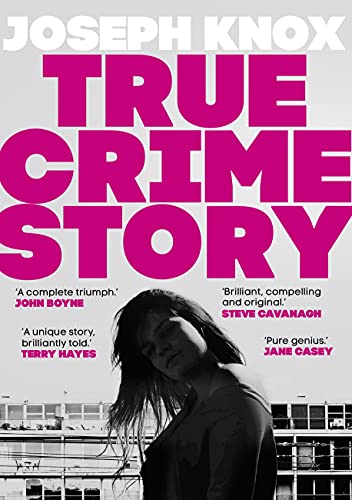
True Crime Story by Joseph Knox

Transworld Digital| 17 Jun. 2021| 433 pages| e-book Review copy| 2.5* rounded up to 3*

Synopsis:

What happens to those girls who go missing? What happens to the Zoe Nolans of the world?’

In the early hours of Saturday 17 December 2011, Zoe Nolan, a nineteen-year-old Manchester University student, walked out of a party taking place in the shared accommodation where she had been living for three months.

She was never seen again.

Seven years after her disappearance, struggling writer Evelyn Mitchell finds herself drawn into the mystery. Through interviews with Zoe’s closest friends and family, she begins piecing together what really happened in 2011. But where some versions of events overlap, aligning perfectly with one another, others stand in stark contrast, giving rise to troubling inconsistencies.

Shaken by revelations of Zoe’s secret life, and stalked by a figure from the shadows, Evelyn turns to crime writer Joseph Knox to help make sense of a case where everyone has something to hide.

Zoe Nolan may be missing presumed dead, but her story is only just beginning

True Crime Story is Joseph Knox’s fourth novel, his first standalone. Previously I’ve read two of his Detective Aidan Waits novels, The Smiling Man and The Sleepwalker, which I loved – they’re both brilliant, dark and violent urban noir novels. They’re also amongst the most complicated books that I’ve ever read. So my expectations for True Crime Story were very high, but, I’m sorry to say, I was disappointed. In fact I almost abandoned it several times, until about the 50% mark when I realised that I had to read on because I wanted to know what had happened to Zoe.

Despite the title this is not a nonfiction true crime story, nor a mix of fact and fiction, it is a novel and it includes the author, Joseph Knox, as one of its characters. It has a story within the story – made up of emails to and from Knox and another writer (fictional) Evelyn Mitchell. Evelyn is writing a book about the disappearance of a student at Manchester University, Zoe Nolan. Her book is a collection of the interviews she carried out with Zoe’s family and friends seven years after Zoe’s disappearance, which she sends to Joseph Knox as she collates them, and asks for his advice.

Initially I found this rather confusing but I gradually worked out their relationships and characters, although it is repetitive and reads as a long session of interviews about the same events as seen through each character’s perspective. For me, this makes it fragmentary and in parts disjointed, slows down the action, and lessens the tension and suspense even as the facts about the mystery emerge, including what happens to Evelyn herself.

However, many other readers love this book, so I am in the minority. It has had rave reviews and was short listed for this year’s Theakston Old Peculiar Crime Fiction Novel of the Year, an award that celebrates excellence, originality, and the very best in crime fiction from UK and Irish authors. You may enjoy it more than I did!

My thanks to the publishers Transworld Digital for a review copy via NetGalley.

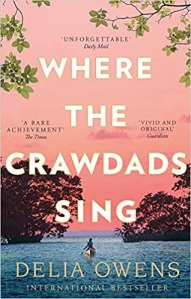
Where the Crawdads Sing by Delia Owens

Synopsis from Amazon:

For years, rumors of the ‘Marsh Girl’ have haunted Barkley Cove, a quiet town on the North Carolina coast. So in late 1969, when handsome Chase Andrews is found dead, the locals immediately suspect Kya Clark, the so-called Marsh Girl. But Kya is not what they say. Sensitive and intelligent, she has survived for years alone in the marsh that she calls home, finding friends in the gulls and lessons in the sand. Then the time comes when she yearns to be touched and loved. When two young men from town become intrigued by her wild beauty, Kya opens herself to a new life – until the unthinkable happens.

Where the Crawdads Sing is the story of how Kya, the youngest child of five, grew up, living in a rundown shack in the marshlands in North Carolina. At the age of seven, her mother left home, then her older brothers and sisters also left, leaving her alone with her father, a violent drunkard. He then also abandoned her. It is also a murder mystery and these two strands interweave throughout the book. I wrote about the opening of this book in this Book Beginnings and The Friday 56 post.

Left alone, Kya survived with help from Jumpin’, the general store owner, who lived in Colored Town and his wife, Mabel, and also from Tate, an older boy who taught her to read and write – she only went to school for one day and after that she managed to hide from the school truant officer. Thinking about it after reading the book I did find the story of Kya’s early years rather unbelievable – the fact that such a young child managed to survive independently and that no one paid more attention to the disappearance of her mother and father bothered me. But, as I was reading it seemed plausible and it certainly did not lessen my enjoyment of the book.

I loved the setting, in an area completely unknown to me, beautifully described by Delia Owens. The details of the marshlands, in the coastal region of North Carolina, its wildlife, flora and fauna brought the setting to life for me. I liked the way that Kya gradually began to trust a few people, letting them into her life – she couldn’t have survived physically or emotionally otherwise. Her interest in her surroundings, encouraged by Tate, led to amazing things for her. So much so that she became an expert on the natural world around her.

But, when Chase Andrews, a handsome sporting hero adored by the other teenage girls, pursues her, she believes him when he promises to marry her, only to discover from the local newspaper that he was engaged to marry someone else. Later when Chase is found dead she is suspected of his murder. The latter part of the book became a courtroom drama that didn’t quite live up to the earlier part of the book for me. And before the end It became increasingly clear to me just who had killed Chase.

This is a story of loneliness and of the effects of rejection – a story of survival and the power of love combined with a murder mystery, and full of fascinating characters that had me racing through its pages. I thoroughly enjoyed it.

And for those like me who didn’t know the meaning of the saying, ‘where the crawdads sing’ this is how Tate explained it to Kya when she asked him:

‘What d’ya mean, where the crawdads sing? Ma used to say that.’ Kya remembered Ma always encouraging her to explore the marsh: ‘Go as far as you can – way out yonder where the crawdads sing.’

‘Just means far in the bush where critters are wild, still behaving like critters.’ (page 111)

  • Publisher: ‎ Corsair, 2019
  • Language: ‎ English
  • Paperback: ‎ 370 pages
  • Source: a library book
  • My rating: 4*

New Additions to BooksPlease June 2022

Yesterday we went Barter Books in Alnwick, my favourite bookshop. This is a secondhand bookshop where you can ‘swap’ books for credit that you can then use to get more books from the Barter Books shelves. It’s back to ‘normal’ now, so there was no queue to get in, although they are still limiting the number of books you can take in.

These are the books I brought home – from top to bottom they are:

Hemingway’s Chair by Michael Palin, a comic novel about Martin, an assistant postmaster who is obsessed with Ernest Hemingway. But when Nick arrives and is appointed postmaster instead of Martin, Martin’s life is turned upside down and he plans the ultimate Hemingwayesque act of revenge.

The Mammoth Book of Historical Detectives edited by Mike Ashley, published in 1995 this anthology includes stories from the earliest locked-room mystery (35,000 BC), through ancient Rome and China to medieval England, the Wild West, the Indian Raj and Victoriam London. It’s arranged chronologically and includes stories by R L Stevenson, Ellis Peters, Peter Tremayne, Steven Saylor and others new to me.

Mr Mac and Me by Esther Freud. I remember seeing this on book blogs a while ago and thought it looked interesting. Set in 1914 on the Suffolk coast just as war with Germany is declared, this is a story of an unlikely friendship between a mysterious artist the locals call Mr Mac (Charles Rennie Macintosh)n and Thomas the crippled son of the village publican.

The Sisters Brothers by Patrick de Witt, another book I’ve spotted on some book blogs. It was shortlisted for the Man Booker Prize 2011. It’s described on the inside cover as ‘an unforgettable comic tour de force. Filled with a remarkable list of characters – losers, cheaters, and ne’er-do-wells’ … ‘it captures the humour, melancholy and grit of the Old West and two brothers bound by blood, violence and love.

All Among the Barley by Melissa Harrison – I enjoyed her book, Rain: Rour Walks in English Weather, so I’m keen to read this one, the winner of the EU Prize for Literature and the ‘Book of the Year’ New Statesman, Observer, Irish Times, BBC History Magazine. Set on a farm in Suffolk just before the Second World War, it introduces a girl on the cusp of adulthood. Glamorous outsider Constance FitzAllen arrives from London, determined to make a record of fading rural traditions and beliefs, and to persuade Edie’s family to return to the old ways rather than embrace modernity. She brings with her new political and social ideas – some far more dangerous than others. (Goodreads)

What do you think? Have you read any of these? Do they tempt you too?

A Tapping At My Door by David Jackson

Zaffre/ 2016/ e-book/ Print length: 315 pages/ My own copy/ 4*

It’s that time of year ago when I’ve been reading and not reviewing – spending more time gardening as the grass grows so quickly and the weeds multiply. And I want to do some more family history . As it’s too hot to do much gardening today I’ve got some time to write a short review.

A Tapping At My Door is a crime thriller, the first in David Jackson’s DS Nathan Cody crime thriller series. I bought it not long after it had been published in 2016, but I’ve only just got round to reading it. I wrote about the opening in this post. Even though this book is more scary and, in parts more gruesome, than I like to read, I did finish it, and enjoyed it for the characters and the plot.

I liked Nathan immediately. He works in the Major Investigation Team in Liverpool, but was previously an undercover officer. It’s obvious that something had gone wrong whilst he was working undercover, which had affected him very badly. He can’t sleep, has a quick temper and flares up very easily, especially with the local reporter and he acts recklessly with little regard for his safety.

The mystery begins as Terri Latham is disturbed late one night by a ‘tapping, scratching, scrabbling noise at her back door’. When she goes outside to investigate she sees a large black bird trapped at her window and she is then struck with something hard and heavy, rammed into her skull. What follows is not a quick death and when the police find her, it is with the dead bird’s wings unfurled and spread across her where her eyes had been, and her cheeks. There is a note attached to the bird’s leg, with the message: ‘Nevermore‘, a reference to Edgar Allan Poe’s poem, The Raven.

There are more bodies, each accompanied by a dead bird and a cyptic note, and it is soon obvious that the murderer is targeting the police. This book is full of tension, it’s very creepy and in places it is utterly gross. Although, I’m giving it 4 stars I am not at all sure I’ll read any more of the books in this series, but if you have a stronger stomach than me you’ll probably love them.

I have a backlog of reviews to write, so this is the first of several short reviews so that I can catch up!

Library Books 18 June 2022

It’s time for another Library Books post – here are my current library loans. From the bottom up they are:

The Women of Troy by Pat Barker – the continuation of the story of Troy following on from The Silence of the Girls (which I have, but have not read yet). It is a retelling of The Iliad from the perspective of the women of Troy who endured it. I hope I’ll be able to read both before I have to return it.

Hag-Seed by Margaret Atwood, a retelling of Shakespeare’s The Tempest, one of my favourites of his plays. I’ve seen it performed on stage twice, once at the Barbican in London and then at the Royal Shakespeare Company Theatre in Stratford-upon-Avon. Margaret Atwood is one of my favourite authors, so I’m expecting this will be good.

Where the Crawdads Sing by Delia Owens. Now, this is a book I’ve wondered about reading ever since I saw other book bloggers’ reviews. It seems to be a book that some people love and others don’t, varying from five to one star ratings. I started to listen to the audiobook, but had to return it unfinished. It’s described as ‘part murder-mystery, part coming-of-age novel’ set in the North Carolina marshlands.

Murder on the Orient Express by Agatha Christie, a Poirot murder mystery. I have read this book, but I fancied reading it again, even though I do know who murdered Mr Ratchett, an American tycoon who was murdered in his compartment, stabbed a dozen times, his door locked from the inside. I really like the cover of this book!

What have you been reading from the library recently?