The Flower Arranger at All Saints by Lis Howell

The Flower Arranger at All Saints by Lis Howell was one of Prime Reader’s free books last year that I downloaded. I loved it! it’s my first 5* read of the year.

Synopsis

In quiet Tarnfield, local rivalries and parish feuds simmer under the genteel surface. It’s the sort of place where everyone knows each other’s business. And a new vicar wants to shake things up in the community. Then Phyllis the church flower arranger is found dead before the big Easter service.
With fingers pointing and tensions rising, the village is in turmoil.

Chaotic mum-of-two, Suzy Spencer, has just arrived in Tarnfield. She needs a fresh start after her husband betrayed her. Now she finds herself entangled in the mystery along with quiet widower, Robert Clark. The killer is set to strike again with another floral flourish. Despite their differences, can Suzy and Robert stop the murderer before anyone else suffers?

My thoughts

There is a lot to like in this book. The setting is Tarnfield, a fictional Cumbrian village. The setting is described so well that I could ‘see’ it all. It’s picturesque, quiet and secluded, where everyone knows everybody’s business. The church plays a huge part in village life, but traditions are being upended by the new vicar and his fondness for playing the guitar during sermons.

And the characters are so ‘real’. I believed in them and even though there are many of them they’re all easily distinguishable and I loved the biblical references and flower clues – they’re intriguing. The plot too kept me keen to carry on reading, wanting to know the identity of the murderer. As Suzy and Robert try to get to the bottom of the mystery many secrets are revealed – and it looks as though a relationship between the two of them is developing.There are more deaths and red herrings with several twists and turns before the culprit is found.

Why haven’t I come across this author before and her Suzy Spencer mysteries? The Flower Arranger at All Saints is the first in the series and luckily there are four more for me to read!

About the author

Lis Howell is from Liverpool, UK. She is the author of the Suzy Spencer cozy mysteries. They are set around the fictional town of Norbridge, Cumbria in the North of England. In her varied life, Lis has spent a short time running a post office in a Cumbrian village; and she lived for several years near Hadrian’s Wall between England and Scotland. Lis is an award-winning TV journalist based in London and is now an academic. Like Suzy, she’s a confused churchgoer, although she married a churchwarden! Anglican traditions feature in her books, along with modern media, family life and village intrigue.

I’m taking part in the  What’s In A Name Challenge? this year and this book fits into the category of a NFL team (New Orleans Saints).

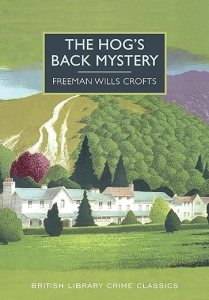
Book Beginnings on Friday & The Friday 56: The Hog’s Back Mystery

Every Friday Book Beginnings on Friday is hosted by Gillion at Rose City Reader where you can share the first sentence (or so) of the book you are reading. You can also share from a book you want to highlight just because it caught your fancy.

I’m featuring The Hog’s Back Mystery by Freeman Wills Crofts one of the books I’m currently reading. I’ve read about half of it and am enjoying it although it is a bit repetitive. It’s a “Golden Age” mystery, first published in 1933.

Book Beginning:

‘Ursula! I am glad to see you!’ Julia Earle moved forward to the carriage door to greet the tall, well dressed woman who stepped down on the platform of the tiny station of Ash in Surrey.

Also every Friday there is The Friday 56, hosted by Freda at Freda’s Voice, but she is taking a break and Anne at My Head if Full of Books has taken on hosting duties in her absence. You grab a book and turn to page 56 (or 56% of an eBook), find one or more interesting sentences (no spoilers), and post them.

Page 56:

‘Well,’ said Sheaf, with a keen glance,what does it look like to you?’ ‘

This was the sort of question which on principle French never answered. He was certainly not to give an opinion until he had had time to think over the facts and come to a reasoned conclusion.

Description from Goodreads:

Dr James Earle and his wife live in comfortable seclusion near the Hog’s Back, a ridge in the North Downs in the beautiful Surrey countryside. When Dr Earle disappears from his cottage, Inspector French is called in to investigate. At first he suspects a simple domestic intrigue – and begins to uncover a web of romantic entanglements beneath the couple’s peaceful rural life.


The case soon takes a more complex turn. Other people vanish mysteriously, one of Dr Earle’s house guests among them. What is the explanation for the disappearances? If the missing people have been murdered, what can be the motive? This fiendishly complicated puzzle is one that only Inspector French can solve.

~~~

What do you think, does it appeal to you? What are you currently reading?

Mini Reviews

I’ve been reading almost non-stop and not pausing long enough to write proper reviews, so it’s time for a brief look at some of the books I’ve read. These notes are not as detailed as I usually write, but when you read quickly this is the result!

Friend of the Devil by Peter Robinson, the 17th DCI Banks book 4*

Inspector Alan Banks and his team, the Western Area Major Crimes Squad, investigate the murder of 19-year-old Hayley Daniels who was found raped and strangled in the Maze, a tangle of narrow alleys behind Eastvale’s market square, after a drunken night on the town with a group of friends. There are plenty of suspects and it’s a matter of looking at who was where and when to find the murderer. It wasn’t who I thought it was.

DI Annie Cabbot, on loan to the Eastern area, is assigned to look into the murder of Karen Drew, a quadriplegic, who was found dead in her wheelchair on a seaside cliff. It’s only when Annie discovers the real identity of Karen Drew, that the question of why anyone would want to murder a quadriplegic, becomes clear. But who could have done it? Annie has to revisit an earlier case to find the culprit.

Although this can be read as a stand-alone novel, part of the enjoyment in reading the series in order is that you see the development of the main characters and their relationships over the years. The books are basically police procedurals but along the way there’s a lot about Alan and Annie as people rather than police officers. I have become fond of the regular characters in these books.

Watching the Dark by Peter Robinson, the 20th DCI Banks book 4.5*

This is the description on Goodreads: DCI Alan Banks reluctantly investigates DI Bill Quinn with Inspector Joanna Passero. Quinn, convalescing at St Peter’s Police Treatment Centre, was killed by a crossbow on the tranquil grounds, and left compromising photos. Quinn may be disreputable, linked to a vicious crime in Yorkshire and to a cold case – English Rachel Hewitt 19 vanished in Estonia six years ago.

Banks is not happy about this investigation, not only at the murder of one of their own officers, but because of the involvement of Joanna Passero who seems to him to be determined to prove that Quinn was a corrupt cop.

The team’s investigations lead them to a group smuggling illegal immigrants from Eastern Europe into the UK, taking Banks and Passero to Tallin in Estonia, whilst Annie heads the investigation in the UK. It’s remarkably complex. It’s also long, with many twists and turns, and it became too repetitive in the middle of the book, which is why I haven’t given it 5 stars. But I did enjoy it more than Friend of the Devil, especially the setting in Estonia. Robinson’s books are all definitely grounded in their settings, whether they’re in Yorkshire, Estonia, or elsewhere.

I have now read 20 of the 28 DCI Banks books.

I think the setting in Estonia means I can add Watching the Dark to the Wanderlust Bingo card in Central/Eastern Europe square.

A Sea of Troubles by Donna Leon

A Sea of Troubles is Donna Leon’s 10th Commissario Guido Brunetti novel. I’ve been reading them out of order of publication on and off for several years now and this book is the earliest one in the series that I’ve read. Her books are crime fiction, but also discuss various social and cultural issues and A Sea of Troubles is no exception. 

Brunetti is one of my favourite detectives. He is happily married with two children. He doesn’t smoke or drink to excess and often goes home for lunch to his beautiful wife Paola, who is a wonderful cook – in this book she treats him to a delicious apple cake made with lemon and apple juice and ‘enough Grand Marnier to permeate the whole thing and linger on the tongue for ever.’ (page 238)

I read it eagerly, keen to get to the bottom of the mystery surrounding the deaths of two clam fishermen, father and son, off the island of Pellestrina, south of the Lido on the Venetian lagoon, when their boat suddenly exploded. As well as the mystery the issues Leon highlights in this book are concerning pollution and the overfishing of clams that is destroying the clam beds.

I was fascinated by the island, never having heard of it before. It’s a long and narrow island (11 km long, and 25 to 210 metres wide) that separates the Venetian Lagoon from the Adriatic Sea. Fishing is the primary source of income and alongside the inner side of the thin peninsular are scores of vongolari, the clam fishing boats.

Pellestrina is a closely knit community, the islanders bound together by a code of loyalty and a suspicion of outsiders. Brunetti is finding it difficult to penetrate their silence, as even though he is a Venetian, he is regarded by the islanders as an outsider, a foreigner. So when his boss’s secretary, the ever-resourceful Signorina Elettra, volunteers to visit her cousin who lives in the village there to see what she can find out, he lets her go. And then is most concerned when she falls for a young man on the island. And Paola begins to question why he is so interested in Elettra, having noticed that he had thought about little else than her for over a week. He then realises his feelings for Elletra are not so straightforward after all.

However, the crime still needs resolving and Brunetti finds himself in a web of political intrigue, corruption and secrets. From a slow start the ending is dramatic and action packed with Brunetti and Elletra in danger of their lives.

  • Publisher ‏ : ‎ Arrow; 1st edition (26 Feb. 2009)
  • Language ‏ : ‎ English
  • Paperback ‏ : ‎ 336 pages
  • Source: I bought it
  • My rating: 5*

Top Ten Tuesday: Books with Water on the Covers

Top Ten Tuesday is a weekly meme created by The Broke and the Bookish and now hosted by Jana at That Artsy Reader Girl. For the rules see her blog. The topic this week is Water (This can be covers with water on them, books with bodies of water in them, titles with bodies of water in them, etc.)

These are all books I’ve read. Some have the word Water in the title and all show scenes with bodies of water on their covers. And they are all crime fiction. It seems fictional murders at least often take place in or near water.

A Dark and Twisted Tide by Sharon Bolton – PC Lacey Flint is a police constable with the Metropolitan Police’s Marine Unit on the River Thames, living on a houseboat in Deptford Creek. Lacey loves swimming and is perfectly at home in water, so much so that she wild-swims in the Thames as often as tide and conditions allow, loving it so much that she feels she has become part of the river. It’s a multi-layered book, told from different characters’ perspectives, complex and chilling as it weaves its way through murders, people trafficking, and a mysterious character called ‘the swimmer’.

A Fear of Dark Water by Craig Russell – the sixth book in the Jan Fabel series, the head of Hamburg’s Murder Commission. A massive storm hits Hamburg, flooding the city, just as a major environmental summit is about to start.  A serial rapist and murderer is still at large in the city and when the flood waters recede a headless torso is found washed up. Initially it’s thought to be another victim of the killer, who had dumped his victims’ bodies in waterways around the city.

The Serpent Pool by Martin Edwards – the main characters are DCI Hannah Scarlet, in charge of the Cumbria’s Cold Case Team, her partner Marc Amos, a rare book dealer and Daniel Kind, a historian and the son of Hannah’s former boss, Ben Kind. Hannah is investigating the apparent suicide of Bethany Friend who had drowned 6 years earlier in the Serpent Pool, a lonely, isolated place below the Serpent Tower, a folly high on a ridge. The book begins with the death of George Saffell, one of Marc’s customers, stabbed and then burnt to death amidst his collection of rare and valuable books.The motive for his killing, the subsequent death of another of Marc’s customers, Stuart Wagg, and the connection with the cold case Hannah is investigating gradually become clear.

Dead Water by Ann Cleeves – the first book in her Shetland Quartet. Rhona Laing, the Fiscal, finds journalist Jerry Markham lying dead, drifting in a yoal, a traditional Shetland boat in Aith marina. Markham, a Shetlander visiting his parents, was apparently working on a story for a national newspaper – maybe about the development of renewable energy proposed for Shetland, or maybe his reason was more personal? Detective Inspector Jimmy Perez is not the man he once was, since the death of his fiancée and at first he takes a back seat in the investigations, led by Detective Inspector Willow Reeves (originally from the Hebrides) who is drafted in from the Inverness team to head up the investigation. But eventually his natural curiosity takes over and he decides to help the inquiry, and his knowledge of the local community is vital in catching the killer.

Murder in the Mill Race by E C R Lorac – Dr Raymond Ferens and his wife move to a practice at Milham in the Moor in North Devon. Everyone says that Sister Monica, warden of a children’s home, is a saint – but is she? A few months after the Ferens’ arrival her body is found drowned in the mill race. Chief Inspector Macdonald faces one of his most difficult cases in a village determined not to betray its dark secrets to a stranger.

Time is a Killer by Michel Bussi – Every summer Clotilde, her brother, Nicolas and her parents, Paul and Palma Idrissi visit Paul’s parents in Corsica. Twenty seven years earlier her parents and brother were killed in a car crash. Her grandparents are still alive but are reluctant to talk about the accident and the locals seem to resent her presence. She’d kept a diary, writing about her holiday, her family and friends, but had left it behind just before they all set off in the car and after the accident it had disappeared. As Clotilde delves into her memories she begins to realise that the past is not quite as she thought it was.

On Beulah Height by Reginald Hill, the 17th Dalziel and Pascoe novel, a complex book, that begins with a transcript written by Betsy Allgood, then aged seven, telling what had happened in the little village of Dendale in Yorkshire before the valley was flooded to provide a reservoir. That summer three little girls had gone missing. No bodies were ever found, and the best suspect, a strange lad named Benny Lightfoot, was held for a time, then released. Fifteen years later another little girl, Lorraine, also aged seven went out for a walk one morning with her dog before her parents got up and didn’t return home, reviving memories of the missing children from fifteen years earlier.

The Malice of Waves by Mark Douglas-Home, Cal McGill is an oceanographer, who works for environmental organisations tracking oil spills using wind speeds and data on ocean currents. Known as the Sea Detective he uses his expertise in tracking human bodies and sea-borne objects. So when the police investigations failed to discover what had happened to Max Wheeler who had disappeared from a remote Scottish island, his family asked Cal for his help. It is a fascinating book, not only an engrossing mystery, but also a study of the sea, of birds’ eggs (I had never heard of erythristic eggs before), of obsessions and of the way people cope, or don’t cope with grief.

The Lake District Murder by John Bude – a police procedural, showing in intricate detail how the detectives investigate a crime. In this case a body is discovered in a car outside a lonely garage on a little used road. At first it appears that Jack Clayton one of the garage owners had committed suicide, but there are a couple of clues pointing to murder and when Inspector Meredith discovers that Clayton was planning to marry and move abroad it turns into a murder investigation. This book really takes you back in time. It was first published in 1935, which means that police methods of investigations particularly in rural areas were very different. Inspector Meredith uses buses or trains or travels the local roads on a motor cycle with a side car and pops into the local post office to use the telephone. It’s a slow process.

Entry Island by Peter May, set in the present day Magdalen Islands, part of the province of Quebec, in the Gulf of St Lawrence, and in the nineteenth century on the Isle of Lewis at the time of the Highland Clearances.  It mixes together two stories and two genres, crime fiction and historical fiction. It has a strong sense of place in both locations and beautiful descriptions of the landscape. Detective Sime Mackenzie, based in Montreal is part of the team sent to Entry Island to investigate the death of the wealthy businessman, James Cowell found stabbed to death. His wife, Kirsty is the obvious suspect. Sime is suffering from insomnia, a situation made worse by the fact that his ex-wife is also on the investigating team. 

Book Beginnings on Friday & The Friday 56: Death is Now My Neighbour by Colin Dexter

Every Friday Book Beginnings on Friday is hosted by Gillion at Rose City Reader where you can share the first sentence (or so) of the book you are reading. You can also share from a book you want to highlight just because it caught your fancy.

I’m featuring Death is Now My Neighbour by Colin Dexter, one of the Inspector Morse novels. I’ve read this recently for my 20 Books of Summer Challenge.

Book Beginning:

From the Prolegomenon

‘What time do you call this, Lewis?’.

‘The missus’s fault. Not like her to be late with the breakfast.’

Chapter 1

It is perhaps unusual to begin a tale of murder with a reminder to the reader of the rules governing conditional sentences in a language that is incontrovertibly dead. In the present case, however, such a course appears not wholly inappropriate.

Also every Friday there is The Friday 56, hosted by Freda at Freda’s Voice, where you grab a book and turn to page 56 (or 56% of an eBook), find one or more interesting sentences (no spoilers), and post them.

Page 56:

In his earlier years Geoffrey Owens had been an owl, preferring to pursue whatever tasks lay before him into the late hours of the night, often through into the still, small hours. But now, in his mid-forties, he had metamorphosed into a lark, his brain seeming perceptibly clearer and fresher in the morning.

Description from Goodreads:

As he drove his chief down to Kidlington, Lewis returned the conversation to where it had begun.
‘You haven’t told me what you think about this fellow Owens – the dead woman’s next-door neighbour.’
‘Death is always the next-door neighbour,’ said Morse sombrely.

The murder of a young woman . . . A cryptic ‘seventeenth-century’ love poem . . . And a photograph of a mystery grey-haired man . . .

More than enough to set Chief Inspector E. Morse on the trail of a killer.

And it’s a trail that leads him to Lonsdale College, where the contest between Julian Storrs and Dr Denis Cornford for the coveted position of Master is hotting up.

But then Morse faces a greater, far more personal crisis . . .

~~~

I thoroughly enjoyed this book, the penultimate book in the series and hope to write more about it in a separate post. Morse is nearing retirement and he is not a well man – his drinking is now causing him problems, enough to make him go to the doctor, who diagnoses diabetes. But does Morse follow his doctor’s advice?

This is the novel in which Morse’s first name is revealed – these days it’s not the revelation for the current readers as it was for its first readers.

What do you think, does it appeal to you? What are you currently reading?