Books Read in May

I can’t quite believe it but despite spending many hours in the garden in May mowing the grass and weeding (there are still too many weeds!) I managed to read ten books, bringing my total for the year so far to 45. They’re a bit of a mixed bag of excellent and not very good, with some good ones in between!

They are, in the order I read them, with links to my reviews (* marks crime fiction novels):

  1. The Big Four* by Agatha Christie – a bit of a let down, not up to her best!
  2. The Lost Army of Cambyses by Paul Sussman – goodish
  3. The Dance of Love by Angela Young – her second book due out at the end of July. I loved it!
  4. The Wicked Day by Mary Stewart – good
  5. The Graveyard Book by Neil Gaiman – very good
  6. Nemesis* by Agatha Christie – disappointing
  7. The Witch’s Brat by Rosemary Sutcliff – good
  8. No Stranger to Death*by Janet O’Kane – very good, her first book
  9. The Little Coffee Shop of Kabul by Deborah Rodriguez -not very good and I don’t intend to write about it
  10. A Whispered Name* by William Broderick – excellent – see my thoughts below.

I’m not taking The Dance of Love into account in considering which book is my favourite book of the month because I’m saving my review for July when the book is published – but I can say now that it is brilliant!

The Graveyard Book and No Stranger to Death are both really good books and as I was reading each one I thought either could be my favourite book for May but then I read A Whispered Name and that decided it – it is my favourite book of the month and also my Crime Fiction Pick of the Month (hosted by Kerrie at Mysteries in Paradise)!
 

A Whispered Name by William Brodrick is the third Father Anselm novel, which won the Crime Writers’ Association Gold Dagger Award in 2009.

I think this is a most remarkable book and it kept me glued to the pages as I read about the First World War and the effects it had on those who took part, those left at home and on future generations. It is, of course, historical fiction.

From the back cover:

During the slaughter of Passchendaele in 1917, an Irish soldier faced a court martial for desertion. On the panel was a young captain, Herbert Moore, charged with a responsibility that would change him for ever.

After the war Herbert became a monk, one of the founders of Larkwood monastery, where Father Anselm came across two visitors, Kate Seymour and an unnamed old man, searching for Father Herbert. But he had died in 1985 and no one could answer their questions about the trial of a deserter, Joseph Flanagan and Father Herbert’s part in it. Father Herbert was revered and loved by all who knew him and Anselm was deeply dismayed at the thought that there was anything in his past that he had lied about and he set out to discover the truth.

I think the whole book is so well thought out with chapters revealing what happened from different characters’ viewpoints during the war and what Anselm discovered as he went through the records and talked to people. Nothing is straight forward, the records are ambiguous and there is confusion about identities. The horror of the war is there:

After the wallop, Herbert found himself prostrate with his face against the dirt, vaguely aware that time had passed, that water was creeping on him; that he would have to move or he’d drown.

… Herbert slid through a sludge of intestines and grit, hauling himself into the open. Staring across the beaten land he tried to gain his bearings … he couldn’t see anyone else from the regiment. (page 35)

And Herbert did indeed serve on a court martial that condemned Joseph Flanagan to death. But there is not just the horror of war in this book, it’s an intricate, evocative novel focussing on the themes of morality, justice, sacrifice and human redemption. It is a book above all that identifies the place of the individual within history, written so lyrically putting the past under a searching spotlight. One of the best books I’ve read for quite some time.

A Whispered Name is a thoroughly researched book with a list of sources at the end of the book, but it never reads like a dry factual account – it comes so vividly to life. Although based on fact, gathered from memoirs, reports, published research, Battalion War diaries and the original transcripts of trials, William Brodrick explains in his Author’s Note:

This novel is not about FGCMs [Field General Court Martial] in general. It does not imply a comprehensive critique of First World War executions from any perspective, be that historical, legal or moral. Rather, one might say, it is a parable of how a man found meaning in death, and how another – on seeing that – found faith in life. And it is about a fictional trial that cannot be compared with any genuine case. (p 344) (my emphasis)

William Brodrick became a barrister, having been an Augustinian monk for six years (the other way round from his fictional character, Father Anselm). After 10 years at the Bar, his interest in writing led him to writing the Father Anselm books.

The Father Anselm books are:

  1. The Sixth Lamentation (2003)
  2. The Gardens of the Dead (2006)
  3. A Whispered Name (2008)
  4. The Day of the Lie (2012)
  5. The Discourtesy of Death (2013)

I’ve now read the first three books and think A Whispered Name is probably the best. I have yet to read the next two – I hope to do so soon.

No Stranger to Death by Janet O'Kane

No Stranger to DeathMy thanks to Janet O’Kane for sending me a copy of her book,  No Stranger to Death, which I really enjoyed reading.  Once I’d started it I just wanted to keep on reading. I was surprised by how intricate and complex the plot is, with several sub-plots and a crowd of characters, all of whom are clearly defined. Set in the Scottish Borders, it also has a strong sense of location and it was refreshing to read a Scottish crime novel that is not set in Edinburgh, Glasgow or even in Shetland. It’s a fast-paced novel that kept me on the edge wanting to find out more.

No Stranger to Death begins with recently widowed Dr Zoe Moreland’s discovery of a body in the remains of a Guy Fawkes bonfire. Westerlea, a fictional village, is a place where everybody knows everyone, but even so it seems everyone has something to hide.  Zoe is new to the village, having moved from there from England to join the Health Centre as a GP and with the help of her new friend, Kate Mackenzie, she soon finds herself in the middle of a murder investigation. This is not a police procedural, although Detective Erskine Mather of Police Scotland is in charge of the investigation.

It’s not only the villagers who have secrets, as there is something in Zoe’s background that she wants to keep to herself and getting involved in a murder investigation is the last thing she wanted:

She had gone back to using her maiden name when she came to Scotland, but would that protect her against people whose job it was to dig up the past of anyone remotely connected with a sensational crime? (page 29)

As Zoe and Kate dig deeper quite a few nasty secrets come to light with almost disastrous consequences and Zoe is in fear of her own life. No Stranger to Death touches on some quite dark themes with an ending that took me by surprise.

Janet O’Kane lives in the Scottish Borders and she is currently writing a follow up to No Stranger to Death, again featuring Zoe Moreland. For more information see her blog – Janet O’Kane: Crime Fiction with a Heart and her Facebook page.

As well as being a really good book in its own right, No Stranger to Death meets the criteria for both the Read Scotland 2014 challenge and the My Kind of Mystery challenge.

Nemesis by Agatha Christie

Nemesis first published in 1971, is one of Agatha Christie’s later books written in her eighties. It is the last book she wrote about Miss Marple. There are two more books that were published later, but those were written earlier. It’s not among the best of her books, it’s slow moving, lots of dialogue, lots of recapping of events and clues, lots of moralising and social commentary. It follows on, although it is not a sequel to, A Caribbean Mystery in which Miss Marple met Mr Rafiel.

It’s slow moving because for quite a while Miss Marple doesn’t know what the crime is that she has been asked to investigate. Mr Rafiel, who she met in the West Indies, has left her £20,000 in his will on condition she investigates a certain crime, but doesn’t give her any details. He wrote that she had a natural flair for justice leading to a natural flair for crime and reminded her that the code word is Nemesis. Then she is invited to join a tour of Famous Houses and Gardens of Great Britain at Mr Rafiel’s expense. And off she goes.

As Miss Marple remarks:

Murders as reported in the press have never claimed my attention. I have never read books on criminology as a subject or really been interested in such a thing. No, it has just happened that I have found myself in the vicinity of murder rather more often than would seem normal. (page 90)

What an understatement!

Miss Marple has to first of all work out who she can trust.Very gradually through meeting people and talking to them in her usual rather scatty old-lady manner Miss Marple begins to uncover a crime committed years earlier, working largely on intuition. During this process Miss Marple ponders on a number of subjects from wondering how the three witches in Macbeth should be portrayed, during the visit Mr Rafiel had arranged for her with the three sisters at the Old Manor House, to her disapproval of the clothes young women wore. I suspect this was Agatha Christie using Miss Marple as a mouthpiece for her own views – just as this view of rape expressed by  another character, Professor Wanstead, a friend of Mr Rafiel may be her own thoughts too:

Girls you must remember, are far more ready to be raped nowadays than they used to be. Their mothers insist, very often, that they should call it rape. (page 182)

But I wondered about the whole premise of the book – would someone really ask a person to investigate a crime and not give them any details?  It seems highly improbable to me even if Mr Rafiel had wanted Miss Marple to approach the crime with an open mind. And surely if Mr Rafiel really wanted to discover the true facts about the crime he could easily have done so before he died.

I think Nemesis lacks tension and suspense. The characters are rather hard to differentiate, mainly because there are too many, and too many who have no part in the mystery. There are few red herrings to deflect the reader, just unexplained facts that Miss Marple clears up in the last chapters. But I think it is an unusual book and I quite enjoyed it.

Adding to the TBR Shelves

A few days ago I rearranged my bookshelves – and now I’ve got to make space for a few more books, because I went to Barter Books in Alnwick on Tuesday and came home with more books to add to the TBR shelves.

Dead Scared pile I really enjoy going to Barter Books, wandering around the shelves and browsing. But I also take with me lists of books I want to look at including a list of the Agatha Christie books I haven’t read and don’t already own. There is always a good selection of books, the stock regularly changes, so there are always ‘new’ books to look at. (Barter Books is, as its name indicates, a sort of exchange of used books; you take some in and choose others in exchange. You can, of course, just buy the books if you haven’t any credit.)

I’m very pleased with this little pile of books because I’ve been on the look out for some of them for quite a while, although one of them is a book (Talking to the Dead) that I only read about on Tuesday morning on Alex’s blog Thinking in Fragments. They are (from top to bottom):

  • The Floating Admiral – this wasn’t on my list of books to look for, but it was filed with the Agatha Christie books (I always look there first) and I thought it looks good. It’s a collaboration by Agatha Christie, Dorothy L Sayers and ten other crime writers from the Detection Club, with a prologue by G K Chesterton. It was originally published in 1931 and this new edition published in 1911 has an introduction by Simon Brett.
  • The Mysterious Mr Quin by Agatha Christie, featuring Mr Satterthwaite and Mr Quin, the man ‘who appears from nowhere‘ and ‘unravels mysteries that seem incapable of solution’. It is one of the early Christie books, first published in 1930. This edition is one of the Penguin Crime fiction books in green and white reprinted in 1961 for 2/6. This fills a gap in my reading of her earliest books.
  • The Mousetrap and Selected Plays by Agatha Christie. There are three other plays in this collection – And Then There Were None, Appointment with Death and The Hollow, adapted by Agatha Christie from her novels, which, with the exception of Appointment with Death, I have read, so it’ll be interesting to see how they differ from the originals.
  • The Queen of the Tambourine by Jane Gardam. This is the only non crime fiction book in the pile, by the author of Old Filth, which I loved. It’s described on the front cover as ‘Brilliant, wickedly comic … masterly and hugely enjoyable‘. It’s about a do-gooder and promises to be a refreshing change from the crime fiction.
  • Talking to the Dead by Harry Bingham – the book recommended by Alex. It’s the first in the Fiona Griffiths series, a crime thriller in which police woman Fiona Griffiths investigates the death of a woman and her six-year old daughter. It is described on the back cover as ‘a stunner with precision plotting, an unusual setting, and a deeply complex protagonist … breathtaking.’
  • Dead Scared by S J Bolton. I like S J Bolton’s books and I’ve been looking out for this one, the second in her Lacey Flint series ever since I read the first book, Now You See Me. This is another crime thriller featuring a police woman, this one investigating a spate of suicides – all female university students.

The Big Four by Agatha Christie

I’ve read a lot of Agatha Christie’s books, most of which I’ve really enjoyed, but I’m not too keen on her books that involve spies and gangs of international criminals who are seeking world domination. And The Big Four, first published in 1927, is one of those books.
Basically it’s a collection of short stories (derived from a series of stories that first appeared in The Sketch, a weekly magazine) in which Hercule Poirot and Captain Hastings lock forces with a vast organisation of crime led by four individuals, in the course of which they uncover the identity of the ‘Big Four’. The aim of the Four is ‘to destroy the existing social order, and to replace it with an anarchy in which they would reign as dictators.’  They are a Chinese man, Li Chang Yen, an American multi-millionaire, a French woman and ‘the Destroyer’, an Englishman. Poirot is convinced that they are behind everything:

The world-wide unrest, the labour troubles that beset every nation, and the revolutions that break out in some. There are people, not scaremongers, who know what they are talking about, and they say that there is a force behind the scenes which aims at nothing less than the destruction of civilisation. (page 25)

In the course of their investigations Poirot and Hastings find themselves in many dangerous  situations, all melodramatic and a little far-fetched, from which they miraculously escape certain death. The Big Four is action packed, with Poirot uncharacteristically chasing off after the criminals, still using his ‘little grey cells’ of course, whilst Hastings is knocked out and kidnapped, and Li Chang Yen threatens to abduct and torture Hasting’s wife, whom he had left behind in their ranch in the Argentine.

This is not one of my favourite Agatha Christie books. But perhaps it is not so surprising that The Big Four is far from her best. It was in  December 1926 that Agatha Christie disappeared after her husband, Archie Christie had told her he wanted a divorce and in 1927 she was still recovering from this. It was her brother-in-law’s suggestion that the last Poirot short stories she had published could be re-written to ‘have the appearance of a book‘ as a ‘stop-gap‘ – and the result was The Big Four, which, I think, suffers from being a loosely connected collection of episodes. Agatha explained in her Autobiography that Campbell Christie had helped her with linking the short stories as she was ‘unable to tackle anything of the kind.‘ (Autobiography page 365)

Knavesborough Stories by Dorte Hummelshoj Jakobsen

Recently Dorte Hummelshoj Jakobsen kindly made two of her short stories available to me (e-books) for review. They are both about the Gershwin family in Knavesborough, a fictional village in Yorkshire, namely Ding Dong Bell, the Kitten in the Well and Green Acres. I often find short stories lack the necessary depth to be convincing – either weak plots and/or characterisation, but these short stories are both convincing and satisfying. Maybe it helps that they are continuations of other stories, or in the case of Ding Dong Bell, the Kitten in the Well, a prequel.

Ding Dong Bell, the Kitten in the Well goes back in time to Rhapsody Gershwin’s childhood in the early 1990s. Rhapsody is the vicar’s daughter first featured in The Cosy Knave. In this short story Rhapsody and her sisters are worried about the disappearance of the black kitten they have called Black Pete. The last time they had seen him was when they had played in old Ursula Abbot’s garden and they wondered if he had he got locked in her cottage. Ursula had died but as she was nearly ninety it wasn’t entirely an unexpected death … but she had been in good health. Is Ursula’s death connected to Black Pete’s disappearance?Rhapsody helps to solve the mystery.
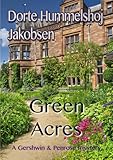
Green Acres* takes us to the latest in the Gershwin and Penrose Mysteries series. Green Acres, once a country mansion, has been converted into a home for the elderly. Rhapsody visits Rowan Dougal, a farmer who has broken his hip and is currently living at Green Acres. Lavinia Banbury staying in the room next to Rowan dies in her sleep. Nothing unusual in an old people’s home, but is her death really a natural one?

Green Acres* was originally published in the anthology The Red Shoes. This is a new and longer version.

I like these stories. They’re humorous crime fiction, with colourful characters all with quirky names. There’s no blood and gore and each story has an unexpected twist at the end. In other words, they are cosy crimes (if any crime could really be considered as ‘cosy’, that is).

Dorte Hummelshoj Jakobsen is Danish. After many years as a teacher she is now concentrating on a writing career, publishing in both Danish and English. As well as writing her cosy mysteries she has also written a full length psychological murder mystery novel, Anna Marklin’s Family Chronicles, which I thoroughly enjoyed too – see my post here.