First Chapter First Paragraph: The Zig Zag Girl

Every Tuesday Diane at Bibliophile by the Sea hosts First Chapter First Paragraph Tuesday Intros, where you can share the first paragraph, or a few, of a book you are reading or thinking about reading soon.

My choice this week is: The Zig Zag Girl by Elly Griffiths, a book I have just finished reading.
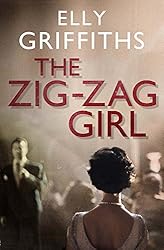
It begins:

 ‘Looks as if someone’s sliced her into three,’ said Solomon Carter, the police surgeon chattily. ‘We’re just missing the middle bit.’

I must not be sick, thought Edgar Stephens. That’s what he wants. Stay calm and professional at all times. You’re the policeman, after all.

What do you think? Would you read on?

I did. I’m a squeamish reader and don’t like anything too graphically gory and you might think this opening would put me off. But it didn’t – for one thing, it doesn’t go into detail about how the body got cut into three. Well, yes later down the page there’s mention of ‘clotted blood and smell of decaying flesh‘, but that’s it, it’s all secondhand, no scenes where the murderer is described doing the terrible act, no dwelling on what he/she was doing to the other person.

Blurb from the inside flap:

Brighton, 1950 – a post-war world of rationing, austerity, pea-souper fogs and seedy seaside resorts. When the body of a girl is found, cut into three, DI Edgar Stephens recalls a magic trick that he saw as a boy. The illusion is called the Zig Zag Girl and its inventor, Max Mephisto, is an old friend of his. They served together in the war as part of a shadowy unit called the Magic Men, formed to use stage trickery to confuse the enemy.

Edgar tracks down Max and asks for his help. Max is still on the circuit, touring seaside towns in the company of ventriloquists, sword-swallowers and dancing girls. Max is reluctant to get involved but the changes his mind when the dead girl turns out to be his former stage assistant. Another death follows, again gruesomely staged to resemble a magic trick, the Sword Cabinet.

Edgar and Max become convinced that the answer to the murders lies back in their army days and the antics of the Magic Men.

When Edgar receives a letter warning of another ‘trick’, he knows that they are all in danger. The Wolf Trap is the deadliest illusion of all, but who will be the next victim?

I’ve read some of Elly Griffiths’ Ruth Galloway, forensic archaeologist, crime novels, which I have enjoyed despite wishing they weren’t written in the present tense. So it was with relief that I came to The Zig Zag Girl and found it’s written in the past tense.

I enjoyed it in several ways – for its characters, particularly Edgar Stephens and its setting, recalling the atmosphere of the 1950s and how times were changing. The theatrical elements are fascinating – life on the variety circuit was not all glitz and glamour; and the activities of the  Magic Men unit during the war had of course an immense effect on all their lives. I worked out quite early on who the murderer was – but not why, which only dawned on me at the end of the book.

I don’t know if this is going to be the start of a new series – I’d read more if it is.

New-To-Me Books

I took a bagful of books back to Barter Books yesterday and came home with these books:

Christie encyclopedia 01 P1010423From top to bottom

  • Sad Cypress by Agatha Christie – this is one of the few of her books that I have yet to read. I’ve been looking out for this one, first published in 1940. It’s a Poirot mystery in which there are two victims murdered by poison.

As I hope to finish reading Agatha Christie’s books this year I’ve decided to attempt reading as many of Ruth Rendell’s books and those she has written as Barbara Vine:

  • End in Tears by Ruth Rendell – an Inspector Wexford murder mystery in which the victim’s father discovers her body near the family house.
  • The Chimney Sweeper’s Boy by Barbara Vine – in this case a daughter discovers that her perfect father was not all he appeared to be.

Then I browsed the shelves and found the next two books:

  • The Winter Garden by Jane Thynne is set in Berlin in 1937, where Clara Vine, an actress is an undercover agent for British Intelligence.  I thought the author’s name was familiar but couldn’t remember reading any of her books – until I got home and found that I already have Black Roses, the first Clara Vine book (set in 1933),  unread on the black hole that is my Kindle. I’d better read Black Roses first.

and finally:

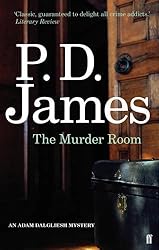
The Murder Room by P D James

The Murder Room by P D James is one of the last of the Adam Dalgleish books, first published in 2003 . Although I’ve not read many of the books I’ve watched most (if not all) of the TV adaptations, but I don’t remember watching this one.

The Murder Room itself is in the Dupayne Museum, displaying the most notorious murder cases of the 1920s and 30s, with contemporary newspaper reports of the crimes and trials, photographs and actual exhibits from the scenes of the murders. These were actual crimes and not fictional cases made up by P D James.

The novel  begins, as Commander Adam Dalgleish visits the Dupayne in the company of his friend Conrad Ackroyd who is writing a series of articles on murder as a symbol of its age. A week later the first body is discovered at the Museum and Adam and his colleagues in Scotland Yard’s Special Investigation Squad are called in to investigate the killing, which appears to be a copycat murder of one of the 1930s’ crimes.

The Murder Room is not a quick read. It begins slowly with a detailed description of the main characters and it is only after 150 or so pages that the first murder occurs, so by that time I had a good idea of who might be killed but not of the culprit as many of the characters could all have had the motive and opportunity. There are two more killings before Dalgleish reveals the culprit.

More used to fast paced murder mysteries initially I was impatient with this slow start but soon settled into P D James’ approach and appreciated the depth of the intricate plot. The setting is fascinating and the characters are convincing, so much so that I was hoping the second victim wouldn’t be one of my favourite characters.

The lease on the Museum is up for renewal and not everyone wants it to continue – as one of the characters says:

It’s the past … it’s about dead people and dead years … we’re too obsessed with our past, with hoarding and collecting for the sake of it.

There is the Dupayne family – Marcus and Caroline both actively involved in running the Museum, and their brother Nigel, who is a psychiatrist, and his daughter Sarah; the Museum staff – Muriel Godby in charge of the Museum’s day to day running, Tally Clutton the housekeeper, James Calder-Hale, the curator who used to work for MI5; Marie Strickland, a volunteer calligraphist; and Ryan Archer, the handyman and gardener.

I liked the interaction between Dalgleish and D I Kate Miskin, and between Dalgleish and Emma Lavenham who is finding their relationship increasingly frustrating. I enjoyed the book and found it absorbing and testing of both my powers of deduction and vocabulary.

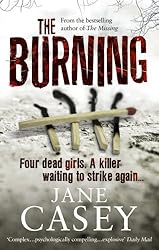
The Burning by Jane Casey

The Burning by Jane Casey is one of the books I selected for the TBR Pile Challenge 2015. It’s a book that I read about on other book blogs and thought I would like.  I was right – I really enjoyed it.

It’s the first the DC Maeve Kerrigan series. Maeve is on the murder task force investigating the case of the serial killer the media call The Burning Man. Four young women have been brutally murdered, beaten to death and their bodies burnt in secluded areas of London’s parks. When a fifth body is discovered that of Rebecca Haworth, it appears to be the work of The Burning Man – but is it, there are slight differences? The more that Maeve and her colleague Rob Langton check out the facts it appears it could be a copy-cat killing.

The pace of the book is quite slow at first as the characters are introduced and the story unfolds mainly through Maeve’s eyes  with some  chapters narrated by Rebecca’s friend Louise, and briefly by Rob. Because the pace is slow to begin with the main characters are fully rounded – Maeve in particular is a likeable character, intelligent and empathetic, working to impress her male colleagues and determined to catch the murderer. She’s new to the job, which both her boyfriend and her family criticises. Rebecca’s character is revealed through Louise’s eyes,  fleshed out as other friends give their versions of her past to Maeve and Rob. As the pace picks up, a complex  plot develops providing several suspects which kept me turning the pages right to the end.

I have the third Maeve Kerrigan book, The Last Girl, but I think I’ll postpone reading it until I’ve read the second book, The Reckoning. There are now six books in the series and Maeve has her own website!

As well as the TBR Pile Challenge The Burning completes one of the categories in the What’s In a Name challenge, that of a book title containg a word ending in ‘ing’, the My Kind of Mystery challenge and also the Mount TBR Reading Challenge (a book I’ve owned prior to 1 January 2015).

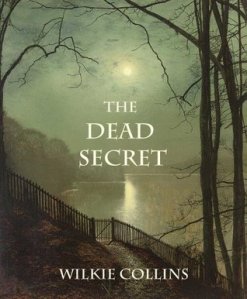
The Dead Secret by Wilkie Collins

I can imagine how intriguing Wilkie Collins’ novel The Dead Secret must have been when it was first serialised in weekly episodes in Household Words in 1857, every episode ending leaving the reader eager to know what happens next. It’s a sensation novel* (see my note below) , with many twists and turns, giving hints to the secret (which I did guess fairly early in the book) gradually and surely building up the suspense and with a final twist at the end (which I hadn’t forseen).  I’m reading Anthony Trollope’s Autobiography and this is what he had to say about his friend, Wilkie Collins:

 When I sit down to write a novel I do not all know, and I do not very much care, how it is to end. Wilkie Collins seems so to construct his that he not only, before writing, plans everything on, down to the minutest detail, from the beginning to the end; but then plots it all back again, to see that there is no piece of necessary dove-tailing, which does not dove-tail with absolutely accuracy. The construction is most minute and most wonderful.

And the plotting is like this in The Dead Secret – detailed and dove-tailed right from the powerful beginning at Porthgenna Tower in Cornwall in the 1820s, at the bedside of a dying woman, Mrs Treverton as she commands her maid, Sarah Leeson, to give her husband a letter confessing a great secret, to its end when all is revealed.

I think that to the modern reader the impact of this book is not the revelation of the secret but the manner of its style of delivery – the initial questions about the secret, what is in the letter, why has Sarah’s hair turned prematurely white, why she visits an an old grave set apart from others in the graveyard, why she talks to herself and why she disappears from Cornwall soon afterwards, having hidden the letter.

Fifteen years later, Rosamund, Mrs Treverton’s daughter returns to Porthgenna Tower to live in her old home. By an accident of circumstances, before Rosamund and her husband reach Cornwall, she gives birth a month earlier than expected and Sarah under an assumed name, is appointed to nurse Rosamund and the baby. Overcome by emotion Sarah cannot stop herself from warning Rosamund not to go into the Myrtle Room, which of course arouses Rosamund’s curiosity.

Trollope, however, says he ‘can never lose the taste of the construction’, feeling that Collins ‘books are ‘all plot’. I think this is a harsh judgement. In The Dead Secret, I think that on the whole the characters do come across as real people – I particularly like Rosamund and Sarah’s Uncle Joseph, both are sympathetically drawn – and there are other characters that add colour and interest. The settings and details of Victorian life are clearly described.  It also examines several social and moral issues of period, such as the role of women and respectability.

I don’t think The Dead Secret is in quite the same league as The Moonstone or The Woman in White, but it has all the elements of a good mystery story, drawing out the secret in tense anticipation of its revelation and making me as eager as Rosamund to know the secret and then almost as paranoid as Sarah that it should remain a secret!

*Sensation Novels*

I wrote about sensation novels,  in an earlier post and have reproduced the information here for ease of reference. It is a novel  with Gothic elements  ‘“ murder, mystery, horror and suspense ‘“ within a domestic setting. They have complicated plots, are set in modern times, and are reliant on coincidences, with plots hinging on murder, madness and bigamy. They exploited the fear that respectable Victorian families had of hidden, dark secrets and explored the woman’s role in the family. There is a pre-occupation with the law ‘“ wills, inheritance, divorce and women’s rights over property and child custody. They are emotional dramas about obsessive and disturbed mental states, with villains hiding behind respectable fronts, and bold assertive women, as well as passive, powerless and compliant women.

Reading Challenges: Mount TBR Challenge 2015, My Kind of Mystery Challenge, Victorian Bingo Challenge 2015 

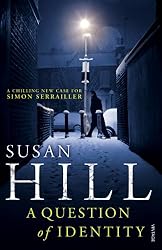
A Question of Identity by Susan Hill

I began reading A Question of Identity, the 7th Simon Serrailler book by Susan Hill immediately after I’d finished reading the 6th book, The Betrayal of Trust (see my previous post), which had left some issues unresolved. I was hoping to find out more in this book and I wasn’t disappointed – which is one reason for reading these books in order. Another reason is to follow the continuing story of Simon and his family. And a third reason is that Susan Hill always focusses on one or more psychological/moral/ ethical issues.

Summary (back cover):

How do you catch a killer who doesn’t exist?

One snowy night in the cathedral city of Lafferton, an old woman is dragged from her bed and strangled with a length of flex.

DCS Simon Serrailler and his team search desperately for clues to her murderer. All they know is that the killer will strike again, and will once more leave the same tell-tale signature.

Then they track down a name: Alan Keyes. But Alan Keyes has no birth certificate, no address, no job, no family, no passport, no dental records. Nothing.

Their killer does not exist.

I much preferred this book to the previous one. It is more balanced between the crime and the continuing story of the main characters. I suspect it may be incorrect in describing police procedures – I don’t know and really it doesn’t bother me, this is fiction after all and I have no difficulty in believing in the world of Serrailler and Lafferton that Susan Hill has created.

The main theme in this book, as the title indicates is ‘identity’ and its importance, how it is concealed, whether a personality can be changed convincingly and completely, or whether eventually the façade will crack and the real character reassert itself.

Susan Hill is also very good at creating tension and suspense. You know there are going to be murders (just as in Casualty you know there’s going to be a terrible accident etc), but that just increases the suspense. She builds up the setting and the characters and I was hoping against hope that one of the characters would not be a victim – and of course she was. I suspected the identity of the killer quite early on and hoped I was wrong about that too – but I wasn’t.  I began to feel very uncomfortable about the fate of the elderly, living on their own, frail and vulnerable …

It’s the psychological/social elements of A Question of Identity that appealed to me more than the crime, although these elements are inevitably so closely connected.