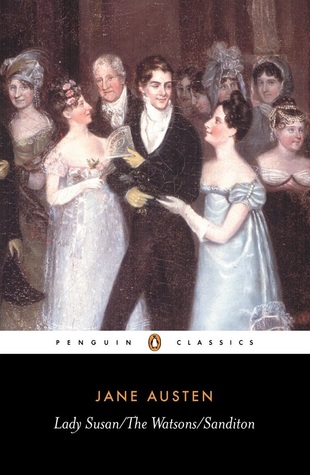
Lady Susan, The Watsons and Sanditon by Jane Austen

Adam at Roof Beam Reader’s Austen in August event reminded me to read Lady Susan, The Watsons and Sanditon.

Jane Austen has long been one of my favourite authors, ever since I read my mother’s copy of Pride and Prejudice and since then I have re-read it several times and her other full length novels too. But I’ve never read Lady Susan, The Watsons and Sanditon before. In fact it was only reading Carol Shields’ biography of Jane Austen quite some years ago now that I discovered that she had written these books, none of which were published in her lifetime. Lady Susan is a finished novella, whereas The Watsons and Sanditon are two unfinished fragments. Lady Susan and The Watsons were first published in 1871 by her nephew, James Edward Austen-Leigh in his Memoir of Jane Austen, including an account of  Sanditon . The full text of Sanditon wasn’t published until 1925.

Lady Susan

According to Margaret Drabble’s introduction to my Penguin Classics edition there is some evidence that Lady Susan was probably written between 1793-4, when Jane Austen was about 20 years old. Drabble thinks this is the least satisfactory of the three stories, but I can’t agree with her view. I was completely taken with it.

Told in a series of letters, Lady Susan is the  story of an unscrupulous widow who plans to force her daughter into a marriage against her wishes. Lady Susan is an attractive and entertaining and totally wicked character, who nevertheless almost manages to fool people for some of the time at least. She is also trying to captivate her sister-in-law’s brother, whilst still holding on to the affections of a previous lover.

As I was reading Lady Susan it reminded of Laclos’s Les Liaisons Dangereuses, not just because both are epistolary but also the content – manipulative and evil characters without any moral scruples, who delight in their power to seduce others. I wondered if it was possible that Jane Austen had known of this book. It was published in 1782, so it is possible that she knew of it, even if she had not actually read it.

To my mind Lady Susan is unique in Jane Austen’s works and I was delighted to read it. It’s written with style, confidence and humour convincingly illustrating 18th century morals and manners.

The Watsons

Jane Austen began writing this in 1804, her father died in 1805 and she never finished it. Its main character is Emma Watson who after fourteen years of absence returns to her father’s house after being brought up by a wealthy aunt. She had grown up in an affluent household and until her aunt had remarried she’d had expectations of an inheritance. She joins her three unmarried sisters, living with their invalid father  and looking for husbands whilst struggling for money. Mr Watson is a clergyman, so on his death they will lose their home. Maybe it was the parallel with Jane and Cassandra Austen’s own situation that caused Jane to abandon the novel when her own father died.

In some ways it is a little like Pride and Prejudice with its account of a ball and Emma Watson has a spirited nature similar to Elizabeth Bennet’s.  Women without money were often obliged to marry for money, but Emma doesn’t want to. Her sister Elizabeth points out that it is ‘very bad to grow old and be poor and laughed at‘, whereas Emma thinks she would ‘rather be a teacher at a school (and I can think of nothing worse) than marry a man I did not like.’

I liked The Watsons but with just this fragment to go off it is a bit basic and does seem rather similar to Pride and Prejudice. I wished she had finished it.

Sanditon

I thoroughly enjoyed Sanditon, even in its unfinished state. It’s the last fiction that Jane Austen wrote, beginning it in January 1817, the year she died. She was ill and the subject of health is one of its themes, but not in a serious or gloomy way. It has a lively, bright and humorous tone, with three of the characters being hypochondriacs, wonderfully satirised by Jane Austen.

The other theme is change in the form of the development of a seaside resort at Sanditon. It conveys the spirit of change of the times as  Sanditon is developed by two of the landowners, Mr Parker and Lady Denham from ‘a quiet village of no pretensions‘ into ‘a fashionable bathing place‘. The two of them, realising its potential of becoming profitable ‘had engaged in it, and planned and built, and praised and puffed, and raised it to a something of young renown – and Mr Parker could think of nothing else.‘

It extols the benefits of sea air and sea bathing, Lady Denham decries the need for a doctor saying it would only encourage the servants and the poor to imagine they were ill – and pronouncing that  if her husband had never seen a doctor he would still have been alive, ‘Ten fees, one after the other, did the man take who sent him out of the world. – I beseech you Mr Parker, no doctors here.‘

Sanditon contrasts the old world with the new upcoming world. Mr Parker has moved from his old comfortable family house set in a sheltered dip two miles from the sea to a new elegant house, which he has named Trafalgar House, not far from a cliff  from which there is a descent to the sea and the bathing machines. Granted it has all the ‘grandeur of storms’, which rocked their bed whilst the wind rages around the house.

…

There is so much more in these stories than I can write about here (this post is far too long anyway).  I shall enjoy re-reading them in the future. They are so different from each other, probably reflecting the different periods of her life when they were written. And I can’t decide between Lady Susan and Sanditon which one I like best.

THE CLASSICS SPIN RESULT ‘¦

‘¦ it’s NUMBER 5

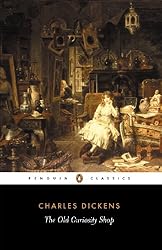
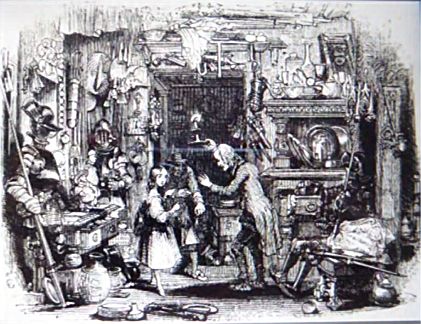
which on my list is The Old Curiosity Shop by Charles Dickens.

I have until October 23, 2015 to read it  – but it could easily take me much longer than that as in the mean time I have George Eliot’s Adam Bede to read for my local book group for our next meeting at the end of September. I can see that my reading is going to be a lot slower than normal.

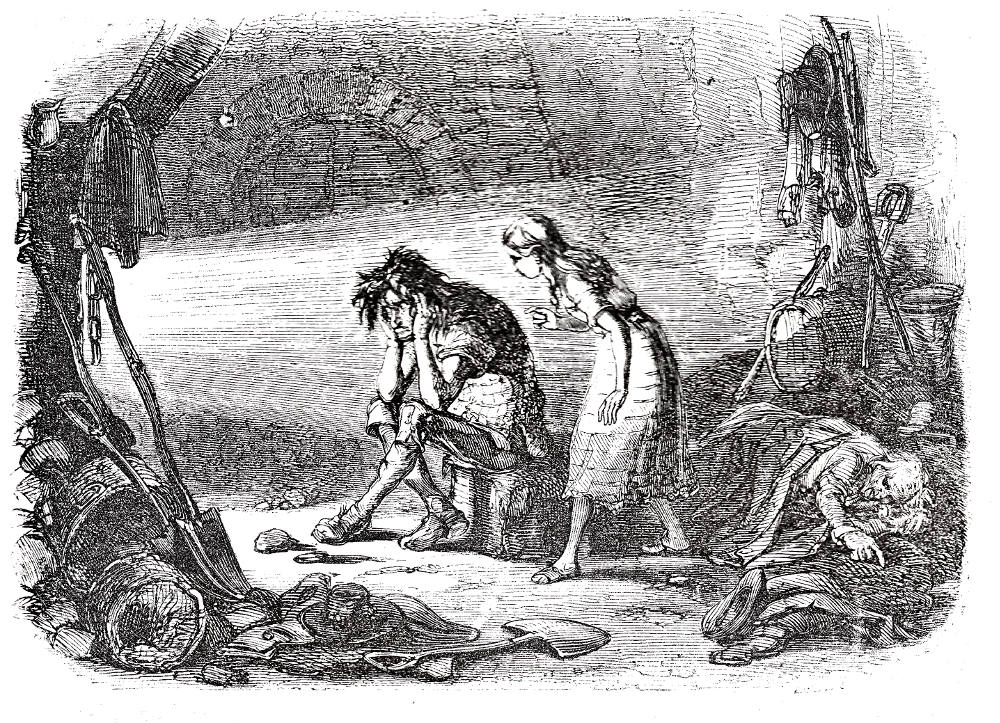
I have started reading Adam Bede, but each time I’ve picked it up I’ve nodded off to sleep (and it wasn’t even bedtime!) I just hope The Old Curiosity Shop won’t have the same effect on me. I have a feeling that I might find it a bit too sentimental for my liking – this is the book in which Little Nell suffers a melodramatic death. And that’s as much as I know about it.

If you’re in the Spin too which book did you get?

The Classics Spin: My List

The Classics ClubThe Classics Club has been so quiet for a while now that I was beginning to think it had folded – but no!

It’s time for another Classics Spin for any who are interested. By next Monday, August 24, list your choice of any twenty books you’ve left to read from your Classics Club list ‘” in a separate post. Next Monday morning, The Classics Club will announce a number and that is the book for you to read by October 23.

This is my list:

  1. Moll Flanders by Daniel Defoe
  2. Nicholas Nickleby by Charles Dickens
  3. Little Dorrit by Charles Dickens
  4. Martin Chuzzlewit by Charles Dickens
  5. The Old Curiosity Shop by Charles Dickens
  6. Oliver Twist by Charles Dickens
  7. The Mill on the Floss by George Eliot
  8. Romola by George Eliot
  9. Parade’s End by Ford Maddox Ford
  10. Mary Barton by Elizabeth Gaskell
  11. North and South by Elizabeth Gaskell
  12. Wives and Daughters by Elizabeth Gaskell
  13. Far from the Madding Crowd by Thomas Hardy
  14. The Return of the Native by Thomas Hardy
  15. Love in the Time of Cholera by Gabriel Garcia Marquez
  16. One Hundred Years of Solitude by Gabriel Garcia Marquez
  17. Doctor Thorne  (Barsetshire Chronicles, #3) by Anthony Trollope
  18. The Color Purple by Alice Walker
  19. The Age of Innocence by Edith Wharton
  20. The Voyage Out by Virginia Woolf

I don’t mind which one of these comes up in the Spin, but I’m half hoping it will be one of the Hardy books and I’m not sure about reading The Voyage Out as I’ve started this in the past and put it back on the shelf unfinished.

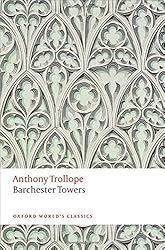
Barchester Towers by Anthony Trollope

First published in 1857 Barchester Towers, is the second book in Anthony Trollope’s Chronicles of  Barchester series, following on from The Warden.

As I began reading this book I was thinking it’s really slow, very much set in its period detailing the religious and ecclesiastical controversies of its time, but then the story of who was going to succeed the old dean, who was going to be the warden, Mr Harding or Mr Quiverful (with his 14 children) and above all who was going to marry Eleanor, Mr Harding’s widowed daughter took hold of me. Not to mention the odious Mr Slope, chaplain to the new Bishop, the ambitious, but hen-pecked Dr. Proudie and his overbearing wife who would dearly like to be the Bishop herself; the Archdeacon Dr Grantly and his wife, Susan Mr Harding’s elder daughter; the Stanhope family including the entrancing cripple, Madeline, ‘a basilisk from whom an ardent lover of beauty could make no escape‘; and the Thornes of Ullathorne.

Barchester Towers provides a view of the class structure of society, in Victorian Britain. Miss Thorne and her brother, the local squire  hold a party, a gala day, inviting all the main characters and the local labourers, their wives and children. The guests are divided according to their place in society – the upper classes and the non-quality were to eat in separate marquees. The question arose as to who should go where amongst the lower class of yokels, with the Lookalofts and the Greenacres. The Lookalofts won’t sit among the bumpkins, nor will Mrs Lookaloft think Mrs Greenacres should sit next to her and talk about cream and ducklings. But neither is she a fit companion to the Thornes and Grantlys – what a dilemma for Miss Thorne! It’s scenes like these that make Barchester Towers such an entertaining novel.

This is a novel strong on character, less strong on plot, with strong female characters, power-hungry men, humour and pathos as the various battles for supremacy are played out. And throughout the book the narrator frequently expresses his opinion on the characters and on the novel itself. Here he describes Obadiah Slope:

I never could endure to shake hands with Mr Slope. A cold, clammy perspiration always exudes from him, the small drops are ever to be seen standing on his brow and his friendly grasp is unpleasant. (page 31)

The characters, however, are not portrayed as wholly good or wholly bad. Here Trollope indicates Mr Slope’s better (if you can call it that) side:

And here the author must beg it to be remembered that Mr Slope was not in all things a bad man. His motives, like those of most men were mixed, and though his conduct was generally different from that which we would wish to praise, it was actuated perhaps as often as that of the majority of the world by a desire to do his duty. (page 146)

He also comments on how he has made his characters withhold the truth from each other, causing such misunderstandings between them:

Everything would have been explained … had she but heard the whole truth … But then where would have been my novel? (page 337)

In his Autobiography Anthony Trollope wrote that he had taken great delight in writing Barchester Towers, the characters of the Bishop and Mrs Proudie were very real to him, as were the troubles of Dr Grantly, the archdeacon and the loves of Mr Slope. As they are to me too.

I thought this statement of his was very interesting:

It [Barchester Towers] achieved no great reputation, but it was one of those novels which novel readers were called upon to read. Perhaps I may be assuming more to myself than I have a right to do in saying now that Barchester Towers has become one of those novels which do not die quite at once, which live and are read for perhaps a quarter of a century; but if that be so, its life has been so far prolonged by the vitality of some of its younger brothers. Barchester Towers would hardly be so well known as it is had there been no Framley Parsonage and no Last Chronicle of Barset. (page 104)

and here we are over 150 years later still reading Barchester Towers.

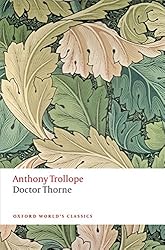
The next book in the series is Doctor Thorne, which Trollope thought had a good plot and was, he believed, the most popular book he had written. I’m looking forward to reading it.

The Dead Secret by Wilkie Collins

I can imagine how intriguing Wilkie Collins’ novel The Dead Secret must have been when it was first serialised in weekly episodes in Household Words in 1857, every episode ending leaving the reader eager to know what happens next. It’s a sensation novel* (see my note below) , with many twists and turns, giving hints to the secret (which I did guess fairly early in the book) gradually and surely building up the suspense and with a final twist at the end (which I hadn’t forseen).  I’m reading Anthony Trollope’s Autobiography and this is what he had to say about his friend, Wilkie Collins:

 When I sit down to write a novel I do not all know, and I do not very much care, how it is to end. Wilkie Collins seems so to construct his that he not only, before writing, plans everything on, down to the minutest detail, from the beginning to the end; but then plots it all back again, to see that there is no piece of necessary dove-tailing, which does not dove-tail with absolutely accuracy. The construction is most minute and most wonderful.

And the plotting is like this in The Dead Secret – detailed and dove-tailed right from the powerful beginning at Porthgenna Tower in Cornwall in the 1820s, at the bedside of a dying woman, Mrs Treverton as she commands her maid, Sarah Leeson, to give her husband a letter confessing a great secret, to its end when all is revealed.

I think that to the modern reader the impact of this book is not the revelation of the secret but the manner of its style of delivery – the initial questions about the secret, what is in the letter, why has Sarah’s hair turned prematurely white, why she visits an an old grave set apart from others in the graveyard, why she talks to herself and why she disappears from Cornwall soon afterwards, having hidden the letter.

Fifteen years later, Rosamund, Mrs Treverton’s daughter returns to Porthgenna Tower to live in her old home. By an accident of circumstances, before Rosamund and her husband reach Cornwall, she gives birth a month earlier than expected and Sarah under an assumed name, is appointed to nurse Rosamund and the baby. Overcome by emotion Sarah cannot stop herself from warning Rosamund not to go into the Myrtle Room, which of course arouses Rosamund’s curiosity.

Trollope, however, says he ‘can never lose the taste of the construction’, feeling that Collins ‘books are ‘all plot’. I think this is a harsh judgement. In The Dead Secret, I think that on the whole the characters do come across as real people – I particularly like Rosamund and Sarah’s Uncle Joseph, both are sympathetically drawn – and there are other characters that add colour and interest. The settings and details of Victorian life are clearly described.  It also examines several social and moral issues of period, such as the role of women and respectability.

I don’t think The Dead Secret is in quite the same league as The Moonstone or The Woman in White, but it has all the elements of a good mystery story, drawing out the secret in tense anticipation of its revelation and making me as eager as Rosamund to know the secret and then almost as paranoid as Sarah that it should remain a secret!

*Sensation Novels*

I wrote about sensation novels,  in an earlier post and have reproduced the information here for ease of reference. It is a novel  with Gothic elements  ‘“ murder, mystery, horror and suspense ‘“ within a domestic setting. They have complicated plots, are set in modern times, and are reliant on coincidences, with plots hinging on murder, madness and bigamy. They exploited the fear that respectable Victorian families had of hidden, dark secrets and explored the woman’s role in the family. There is a pre-occupation with the law ‘“ wills, inheritance, divorce and women’s rights over property and child custody. They are emotional dramas about obsessive and disturbed mental states, with villains hiding behind respectable fronts, and bold assertive women, as well as passive, powerless and compliant women.

Reading Challenges: Mount TBR Challenge 2015, My Kind of Mystery Challenge, Victorian Bingo Challenge 2015 

The Call of the Wild by Jack London

The Call of the Wild and White Fang by Jack London are books that I’ve known about as long as I can remember – they were books my parents owned – but I’ve never read them, until now.  So, I was pleased when The Call of the Wild, Jack London’s first book came out as my Classics Club Spin book.  I would have read it one day anyway but the Spin gave me the nudge to read it now. I wasn’t expecting to find it such a beautiful, moving and poignant book, but it is. And it has so much packed into its 106 pages in my little hardback copy.

It begins in 1897 when Buck, a cross between a St Bernard and a Scotch Shepherd (Collie) was stolen from his home in the Santa Clara Valley in California and taken to the Yukon where strong sled dogs were needed during the Klondike Gold Rush. It’s a shock to Buck (what an understatement) as he moves from his pampered life on a California ranch where he had free rein, swimming, hunting and playing to the harsh realities and cruelty of the life of a working dog in the wastes of Alaska, where the ‘law of club and fang‘ predominated. The book is told from Buck’s point of view, but this is no cutesy, sentimental animal story. Buck has to fight for existence and as he learnt by experience, instincts that were long dead came alive in him:

The domesticated generations fell from him. In vague ways he remembered back to the youth of the breed, to the time the wild dogs ranged in packs through the primeval forest and killed their meet as they tracked it down. It was no task for him to learn to fight with cut and slash and the quick wolf snap.

…  And when, on the still cold nights, he pointed his nose at a star and howled long and wolflike, it was his ancestors, dead and dust, pointing nose at star and howling down through the centuries and through him. … the ancient song surged through him and he came into his own again (page 24)

After changing owners several times, each worse than the one before he is eventually saved from death by John Thornton who nurses him back to health and for a while it is the love between man and dog that keeps Buck with him. Eventually however, the call of the wild is too strong!

Apart from the story which kept me turning the pages to find out what happened next it’s the quality of London’s writing, the vivid descriptions and the haunting mystical sense of the wild that captivated me – this passage for example:

There is an ecstasy that marks the summit of life, and beyond which life cannot rise. And such is the paradox of living, this ecstasy comes when one is most alive, and it comes as a complete forgetfulness that one is alive. This ecstasy, this forgetfulness of living, comes to the artist, caught up and out of himself in a sheet of flame; it comes to the soldier, war-mad in a stricken field and refusing quarter; and it came to Buck, leading the pack, sounding the old wolf-cry, straining after the food that was alive and that fled swiftly before him through the moonlight. (pages 37-38)

I’ll be reading White Fang soon.