Wild Fire by Ann Cleeves

Wild Fire

Macmillan|6 September 2018|417 pages| paperback|4*

Wild Fire is the 8th and last book in Ann Cleeves’ Shetland series. I have loved this series ever since I read the first book, Raven Black, back in 2010. And because I began reading the books before they were televised my picture of Inspector Jimmy Perez is drawn from them rather than from the dramatisations. There are some significant changes  between the TV dramatisations and the books – notably in the characters of Cassie, Fran’s daughter who is still a child in the books is older in the TV stories, and the relationship between her father, Duncan Hunter and Perez is different. And Douglas Henshall, who plays the part of Perez, is not physically like Jimmy Perez – Perez has long dark hair with Spanish ancestry in his blood, whereas Douglas Henshall is a redheaded Scot.

It’s not necessary to have read the earlier books in the series as each one works well on their own, but I think it helps enormously if you have as the personal stories of the main characters form a continuous thread.

Wild Fire is set in Deltaness, an invented village in Northmavine where the Fleming family, Helen, a knitwear designer, her architect husband, Daniel, and their children, autistic Christopher, and Ellie,  have recently relocated from London. They are finding it hard to settle and matters were only made worse when the previous owner of their house is founding hanging in their barn. But they have made friends with the Moncrieff family, Belle, her husband Robert the local doctor and their four children – the eldest two,Martha and Charlie are teenagers, with a younger brother and sister. 

Things go from bad to worse for the Flemings when Christopher discovers the hanged body of the Moncrieff’s nanny, Emma Shearer in the barn. Suspicion immediately falls on Daniel and Helena as the rumours spread like wild fire that Emma and Daniel had been having an affair. Chief Inspector Willow Reeves, Jimmy’s boss returns to Shetland to lead the investigation and it is immediately obvious that they have personal issues to resolve as well as finding the murderer.

But of course it is not that straight forward. Emma comes from a dysfunctional family and has issues of her own to work through, and the Moncrieffs are also suspects. In fact there are plenty of people who bear grudges against the incomers and they become a focus of resentment and jealousy. Emma’s boyfriend Magnie Riddell and his mother Margaret are two more people whose motives and movements come under suspicion.

The main interest for me is the relationship between Jimmy and Willow and how Jimmy reacts to her news. It causes him to question what he really feels and what form his life will take for the future. I don’t think it is giving away any spoilers, as this is the last book in the series, to say that things are about to change for them both. As in all the Shetland books it is Ann Cleeves’ beautiful descriptions of the islands that stand out – that and the characters themselves who have become like real people to me and I shall miss reading about them. But then, I can always re-read the series!

Reading Challenges – Calendar of Crime (the main action takes place in May), and Mount TBR 2019 (a book I’ve owned for 2 years)

As it is the last day of the year, this is my last post in 2019 (you may have noticed that I’ve written three posts today to complete my entries in the two Reading Challenges above).

And now I’m looking forward to the start of a new decade and lots of books to read.
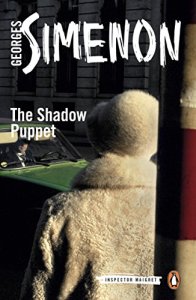
 

The Shadow Puppet by Georges Simenon

The Shadow Puppet

Penguin Classics|2 October 2014|160 pages|Paperback|4*

Georges Simenon wrote his 13th Maigret book, The Shadow Puppet in December 1931 at the villa Les Roches Grises at Antibes (Alpes-Maritimes) on the French Riviera. It was first published in 1932 under the title L’Ombre chinoise. 

It’s the second Maigret book I’ve read in the last two days and I think this is better than the other one I read, The Saint-Fiacre Affair. It is a more typical murder mystery – a man is shot dead in his office in the Place des Vosges in Paris and Maigret uncovers a tragedy involving desperate lives, unhappy people, addiction and an all-consuming greed. He gets to the truth through careful examination of the facts, questioning those involved and applying his knowledge and understanding of human nature.

One evening Raymond Couchet, the owner of a serum company in the Place des Vosges, was shot dead, seated at his desk, and the safe behind him was empty, the 3600 francs that should have been there have gone. The building contains Couchet’s medical laboratory  as well as residential apartments, set around a central courtyard. Called to the scene Maigret notices the shadowy figures in the lighted windows of the building and suspects that the murderer could be one of the residents of the apartments where Couchet’s first wife, Juliette Martin and her husband live. Then there is his son, Roger, a drug addict living in the Hôtel Pigalle, and in the next room to him, Couchet’s girlfriend, Nine Moinard, a dancer at the Moulin Bleu.

It is an entertaining mystery and Maigret finds himself getting to really like Couchet as the details of his life emerge – and equally disliking both his son and his bitter ex-wife. What I like about these Maigret books are that they are concise and tightly structured yet convey such convincing characters and depths of perception. In this particular book Maigret comes across feelings of enmity, greed, class distinction, hatred and paranoia in the course of his investigations.

Reading Challenges – Calendar of Crime (the setting is a place of employment), and Mount TBR 2019 (a book I’ve owned for 2 years)

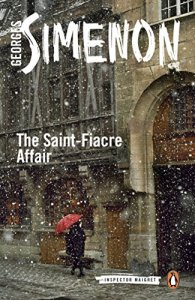
The Saint-Fiacre Affair by Georges Simenon

The Saint-Fiacre Affair

Penguin Classics|6 November 2014|160 pages|Paperback|3*

The Saint-Fiacre Affair by Georges Simenon was first published in January 1932, under the title Maigret Goes Home. My copy is one of the Penguin Classics publications in new translations.

Saint-Fiacre is where Maigret was born and grew up. His father had been the steward of the château there for thirty years. So when an anonymous note predicting a crime during All Souls’ Day mass at the church is handed in to the Moulins police office, Maigret went back there for the first time since his father had died. It is a melancholy visit for as well as a death to investigate, Maigret finds so much had changed and the atmosphere was oppressing him – he had never imagined that he would find the village in such a sorry state.

The predicted death took place in the church whilst Maigret was attending the the first Mass on All Soul’s Day – the old Countess of Saint-Fiacre died during the mass, of heart failure.  But Maigret soon discovers that the heart attack had been brought on when the Countess read a fake newspaper story of her son’s suicide that had been planted in her missal. Maigret suspects a number of people could have been responsible – her son, Maurice, her secretary/lover, Jean, the steward, Ernest and his son, Emile.

I enjoyed this book, although I found it rather disjointed and at times couldn’t follow very easily who was speaking, so it was a bit difficult keeping track of what was going on – maybe that was my problem, I’m not sure. But I thought the melancholy atmosphere and the descriptions of the chateau and Maigret himself were well done and it is packed with drama and tension. The denouement in which Maigret reveals the truth reminded me of the way Poirot rounds up all the people involved and explains who had done the deed and why, and why it was a crime that was not punishable by the law. 

 Reading ChallengesCalendar of Crime (winter scene on the cover), and Mount TBR 2019(a book I’ve owned for 2 years)

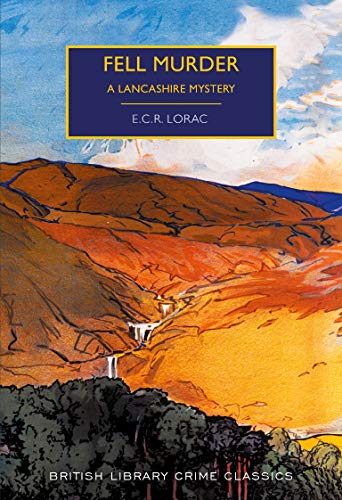
Fell Murder: a Lancashire Mystery by E C R Lorac (British Library Crime Classics)

‘…this crime is conditioned by the place. To understand the one you’ve got to study the other.’

Fell Murder

Poisoned Pen Press|6 January 2020|223 pages|e-book |Review copy|4.5*

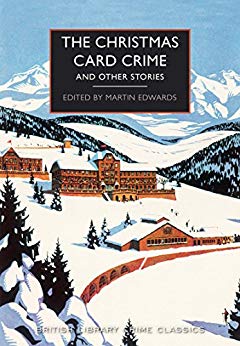
The Christmas Card Crime and Other Stories edited by Martin Edwards (British Library Crime Classics)

Here is another collection of short stories from the Golden Age of Murder edited by Martin Edwards: The Christmas Card Crime and Other Stories.

Christmas Card Crime

Poisoned Pen Press, in association with the British Library|1 October 2019|Print length 240 pages|e-book |Review copy|4*

There are eleven stories all set during the Christmas season in this collection and an introduction by Martin Edwards. In it he points out the differences between a short story and a novel. It’s not just the length, but it is also the fact that in a short story there is little space to develop the characters in depth or for lengthy descriptions, so ‘every word must be made to earn its keep‘. He has also prefaced each story with a biographical note, which I found useful as some of the authors were new to me.

The mysteries range in date of publication from 1909 up to 1965. I’ve read stories by some of the authors before, such as Baroness Orczy, John Dixon Carr, Ronald Knox, E C R Lorac, John Bude and Julian Symons, but others were new to me. The ones I enjoyed the most are:

The Motive  Ronald Knox. This story first appeared in The London Illustrated News in November 1937 and is about an attempted murder in a smart hotel on the English Riviera, by a character named ‘Westmacott’ (a pen name used by Agatha Christie).. On Christmas Day after a party the guests decided to play a version of ‘blind man’s buff’ in the swimming pool, which didn’t go as planned.

Another version of ‘blind man’s buff‘, this time called ‘blind man’s bluff‘, is played in the next story also with disastrous consequences.

Blind Man’s Hood by John Dickson Carr writing as Carter Dickson. This first appeared in the Christmas edition of The Sketch in 1937 and is a story inspired by the unsolved Peasonhall murder case of 1902. It is a strange tale about a young couple arriving to spend Christmas with friends, only to find the house empty – except that is for a young woman carrying a white bag, who tells them about a game of ‘Blind Man’s Bluff’ that went very wrong, years ago. It’s a variation on a locked room mystery, with a touch of the supernatural.

Crime at Lark Cottage by John Bingham – this first appeared in the 1954 Christmas Number of The London Illustrated News. Bingham was the 7th Earl of Clanmorris, a journalist who was recruited into MI5, where he worked with David Cornwell, who later wrote spy novels under the name of John Le Carré. This story and the next are my two favourites in the book. It is the story of an escaped convict and an isolated country cottage occupied by a young woman and her little daughter one snowy Christmas. Very atmospheric and tense with an unexpected ending. I’d like to read more of John Bingham’s work.

‘Twixt the Cup and the Lip by Julian Symons – this first appeared in Ellery Queen’s Mystery Magazine in January 1965). Longer than the other stories in this collection it is the tale of Mr Rossiter Payne, a meticulous bookseller who plans a perfect robbery – to steal the jewels, that had once belonged to the Russian royal family, on display in a London department store at Christmas. But Mr Payne had made an uncharacteristic error …

Overall, I enjoyed reading this collection, with a mix of excellent short stories and some that I thought  were too short and had disappointing or predictable endings.

My thanks to the publishers for my review copy via NetGalley.

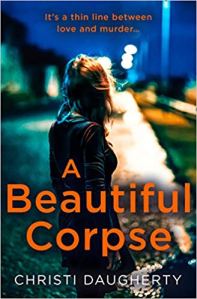
A Beautiful Corpse by Christi Daugherty

a beautiful corpse

Harper Collins|March 2019|384 pages|e-book via NetGalley|Review copy|5*

I saw A Beautiful Corpse by Christi Daugherty on NetGalley and thought I would like it from the description, but not expecting to enjoy it as much as I did. I didn’t realise that it’s the 2nd in the Harper McClain series but I think it works very well as a standalone.

I liked a lot about it – it is well written, has a fast-paced plot, but not at the expense of the characters, and it’s set in Savannah, with its historic buildings, parks and ancient oak trees covered in Spanish moss.

Harper McLain is a crime reporter with the Savannah Daily News. The book begins late one evening as she is playing pool in the Library Bar with her friend and bartender, Bonnie. The crime photographer rings her, telling her about a murder on downtown River Street, a narrow cobblestoned lane between the old wharves and warehouses and the Savannah River. And she is shocked to discover that the young woman sprawled on the uneven cobbles is Naomi, a law student, who had worked with Bonnie at the Library Bar. She had been shot dead.

There are three men who are all suspects, but her current boyfriend Wilson Shepherd is the prime suspect. The Library Bar owner, Fitz, is also a suspect especially as no one has seen him after the shooting. And then there is her ex-boyfriend Peyton Anderson, the powerful DA’s son. The police are convinced that Wilson is the killer, but after Harper talked to him, she just can’t believe that it was him. There were no witnesses to the shooting and when Harper talks to Jerrod, Naomi’s father, she realises that Peyton’s alibi may not be as solid as the police maintain it to be. 

This a story of obsession and jealousy and the tension rises as the killer’s focus shifts on to Harper herself. She is a strong determined character, determined to find out the truth. But as well as the murder investigation Harper has her own personal problems to contend with. Her job as a reporter is under threat, someone is breaking into her apartment and her personal relationship with Detective Luke Walker seems about to be revived, but she is wary where it will end. On top of all that she is desperate to find out who had killed her mother twelve years earlier. 

I loved it and it has made me eager to read the first book, The Echo Killing, to find out more about Harper and her background and also to read the next book in the series – Revolver Road due to be published in March next year – to find out what happens next.